I’m up early every weekday morning pulling together all the news and information you need to start your day. I find the stories unique to Juneau or Southeast Alaska that may linger or become food-for-thought at the end of your day. What information do you need from me to give your day some context?
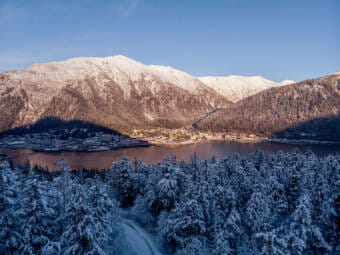
Downtown Juneau in December 2018 (Photo by David Purdy/KTOO)
The entire Southeast Alaska panhandle will experience very cold temperatures this week, with wind chill warnings issued for upper Lynn Canal.
“The last time Juneau hit zero was back in 2014,” said Cody Moore, a meteorologist with the National Weather Service in Juneau. “However, the last time we actually got below zero was back in winter of 2009.”
Moore said temperatures will range from zero to five degrees below zero in Haines, Skagway, Gustavus, and Juneau.
The coldest areas in Juneau will be in the Mendenhall Valley near Mendenhall Glacier.
“Cold air likes to pool in valleys during the nighttime, then having the glacier just exacerbates that,” Moore said. “So, that’s why we get 10 to 15 degrees colder than the airport, which is only a few miles away.”
Temperatures at the Juneau airport are also moderated by water in Gastineau Channel.
All other communities in the Southeast, from Yakutat to Metlakatla and everywhere else in between, will experience temperatures down to the low teens and single digits.
“It’s going to last through the week,” Moore said. “Tuesday and Wednesday are going to be the coldest days, then we have a slight moderating trend through the weekend. However, temperatures are still expected to remain below freezing.”
Winds will be gusting in White Pass north of Skagway, prompting wind chills as low as 60 below. Wind chills in downtown Juneau will be as low as 40 below.
“Bundle up, dress well, and then if you have to be outside, just make sure you’re taking the necessary precautions for dealing with this cold weather,” Moore said. “Just know that in as little as 30 minutes that frostbite can occur, especially when wind chills are as low as negative 25.”
Moore said a high-pressure system over northwest Canada is forcing cold air to flow toward a low-pressure system in the Gulf of Alaska. He also said the colder and drier conditions may be helped by a cool La Niña ocean pattern now underway in the Pacific Ocean.
View of the jury box in one of the courtrooms in the Dimond Courthouse in Juneau. (Photo by Matt Miller/KTOO)
A limited number of criminal jury trials may resume in state courts starting March 17.
Alaska Supreme Court Chief Justice Joel Bolger issued an order Feb. 4 allowing jury trials under certain circumstances.
After a request by a party in each case, the presiding judge in each judicial district will make a decision based on public health considerations such as COVID-19 case counts and risk levels in the area.
They will also consider other issues such as the age and severity of the case, whether the defendant is still in jail, the number of witnesses and other people required to attend the trial, and whether courthouse facilities can safely handle a trial.
The judge will also consider any agreements made between the prosecution and defense that are intended to protect the safety of a large number of prospective jurors who may be called for a trial.
Otherwise, criminal jury trials remain suspended until at least April 19.
In his order, Bolger notes that COVID-19 case counts have declined in many areas and Alaska leads the nation in per capita vaccinations. But he says the situation is still uncertain with some areas in high alert status and a more contagious variant of coronavirus appearing in Alaska.
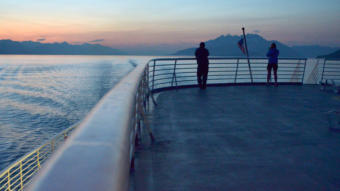
Alaska Marine Highway System ferry Malaspina plies the waters of Lynn Canal in 2012. (Kelli Berkinshaw/KTOO)
More people are leaving Juneau than arriving. Not by the dozens, but by the hundreds each year because of state budget cuts and dwindling state jobs. And there doesn’t appear to be an end in sight.
Sol Neely was an associate professor at the University of Alaska Southeast, teaching English, Indigenous studies and other humanities. Neely was also responsible for the Flying University, a program that introduced college coursework to inmates and inspired them to attend college after they got out of prison.
“It was building and it was working. And we were connecting across the state,” Neely said. “We were on track to do some really incredible stuff that was backed by data from across different states across different programs. The higher the education, the lower the recidivism.”
Neely’s 10-year-old daughter was an active and engaged student in Juneau, from Juneau Jumpers and ice skating to testifying before the Legislature on education funding and oil tax credits. His wife worked as a professional baker and then at Yaaḵoosgé Daakahídi High School.
But then as the pandemic spread last June, Neely says they decided to leave Juneau.
For example, Juneau lost 172 residents from July 2018 to July 2019, while there was a loss of 286 people in the following year up to July 2020.
All totaled, Juneau’s population declined by 1389 people since that high point.
The state also lost population. But Juneau’s loss is especially pronounced.
Sara Teel, an economist with the state Department of Labor and Workforce Development says the percentage of Juneau’s lost population is almost double the state overall. One big reason is the loss of state jobs in the Capital city.
“Most likely it has to do with state budget cuts and then attrition, not filling jobs that somebody left,” Teel said.
Teel said they expect the trend to continue well into 2021.
Neely said they left Juneau last summer after the governor’s budget cuts — what he calls “Dunleavy’s Death Budget.” Neely said everything, including the Flying University, was dismantled and destroyed.
The state’s recently renovated offices in Douglas. (Photo by Elizabeth Jenkins/KTOO)
Even though he had tenure, Neely still worried about losing his job under a proposed consolidation of the University of Alaska system.
“So, I called it escape routes, just looking for escape routes,” Neely said.
He accepted a position at Heritage University, a private college in Washington state.
Neely said he really misses Juneau. But he now has something he did not have before.
“I do have a sense of job security right now,” Neely said. “And we do have family here. So that’s nice.”
“What we’re seeing now is as tough as it’s been in the 23 (or) 24 years I’ve lived in Juneau,” said Senator Jesse Kiehl of Juneau.
With the possible exception of the Department of Corrections, he said no state department in Juneau has been immune from job losses because of budget cuts and attrition.
“When you see the economy losing payroll, losing jobs, that’s tough for kids in schools and strong cultural institutions,” Kiehl said. “That’s tough for contributions to our nonprofits, and volunteers and our social service organizations.”
There are also questions about whether another sector, cruise tourism, will resume this year.
“We have three or four legs to this stool or this table that Juneau’s economy sits on,” Kiehl said. “And some of them are awfully wobbly, and you don’t want any of them shrinking in terms of jobs and people’s ability to raise a family and provide for their loved ones.”
Kiehl said it’s worrying, but he doesn’t believe Juneau is in a downward spiral just yet.
He believes there will be an effort this legislative session to stabilize state government funding. Kiehl also wants more local hire for seasonal tourism jobs and make sure that prospective public service employees know Juneau is still an attractive place to work and live.
The Alaska Legal Services Corporation, Alaska Court System and Alaska Bar Association will have a free legal clinic on Monday, Jan. 18. (Photo by Skip Gray/360 North)
Because of COVID-19, this year’s free legal clinic for Alaskans will be done differently and it will likely tackle issues related to the pandemic.
The MLK Free Legal Help Day event on Monday is organized by the Alaska Legal Services Corporation, Alaska Court System and Alaska Bar Association. The event is for low- or moderate-income Alaskans who cannot afford to hire lawyers.
“Volunteer service, while it’s important year-round, as a nation we come together on MLK Day as a day on, not a day off. And the (Alaska Bar Association) feels that it’s important for us to participate,” said Krista Scully, pro bono director with the Alaska Bar Association.
In the last 11 years, lawyers might answer questions in person at the local courthouse. Not this year.
Scully says this time, they are using a statewide call center. Volunteer lawyers will answer calls about civil issues like family law, public assistance, employment law, probate, estate planning and landlord-tenant issues. They may also refer people to another agency that can better help them with their problems.
“What tends to be one of the most difficult issues are for people to just navigate a system that they’re not familiar with. And lawyers are so well suited for listening, and then untangling what it looks like to move forward on something that feels incredibly overwhelming to a person,” Scully said.
Ben Hofmeister, president of the Alaska Bar Association, expects to hear from Alaskans who can’t pay their rent because they lost their job during the pandemic.
“I would imagine this year, there’s going to be a lot of questions about housing. That’ll probably be a big issue, given what’s been going on with evictions and eviction moratoriums over the last year,” Hofmeister said.
The MLK Free Legal Help Day runs from noon to 4 p.m. on Monday. The call center number is 844-263-1849.
Scully says they’ll have a limited number of volunteer lawyers standing by and she asks Alaskans to be patient when dialing in. Volunteers won’t be able to answer any questions about criminal cases.
In addition to Monday’s clinic, there is a virtual legal clinic in which any Alaskan can log in and ask volunteer lawyers questions about civil issues. Scully says the website will stay up all year round.
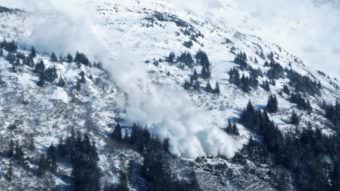
An avalanche triggered by a state crew slides down the slopes of Mount Roberts above Thane Road on March 3, 2017. The cloud of snow crossed the channel to Douglas. (Photo by Ed Schoenfeld, CoastAlaska News)
Between the wind and rain in town and snow in the mountains, the avalanche risk in and around Juneau is increasing, especially along Thane Road.
Thursday’s high winds along with heavy snowfall at higher elevations will increase the possibility of an avalanche reaching Thane Road in the next 24 hours, according to the Department of Transportation.
Thane residents or other travelers should not stop or park in the avalanche danger zone that is marked by road signs.
City officials say Thane residents should prepare in case the road is blocked by an avalanche. State officials may not be able to use heavy equipment to clear the road of any avalanche debris until the risk of hazard diminishes.
In a daily urban avalanche advisory posted Thursday, Juneau’s emergency programs manager Tom Mattice says the current avalanche danger in the Juneau area is “considerable.” He says natural avalanches are likely overnight and into Friday as an incoming storm brings over 2- nches of precipitation and gale-force winds.
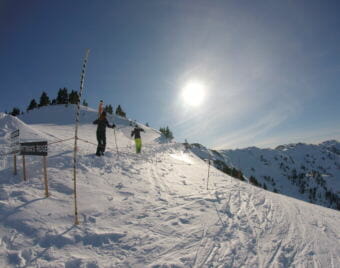
A pair of skiers hike out to Pittman’s Ridge, the far western boundary of Eaglecrest Ski Area. (Photo by Matt Miller/KTOO)
January is the peak month for avalanches. It’s also the deadliest time for people who venture out into the backcountry.
But according to recent research, it’s not those who are brand new to the backcountry who’ve been getting caught in avalanches during the pandemic. More often, it’s experienced skiers getting themselves into trouble. But the new Coastal Alaska Avalanche Center is trying to help.
According to the Colorado Avalanche Information Center, 23 people died in avalanches in the U.S. last year. That includes three people killed in Alaska. Over the last seventy years, Alaska is second only to Colorado for total number of deaths.
The City and Borough of Juneau routinely issues urban avalanche advisories. But those only apply to the nearby mountains that tower over downtown.
Usually, anyone who goes outside Eaglecrest Ski Area boundaries or heads into the backcountry wouldn’t know about conditions unless they’re trained to recognize avalanche hazards.
Mike Janes, a Juneau-based avalanche forecaster and educator, said the new Coastal Alaska Avalanche Center compiles observations from the general public as well as professionals and puts them up on a website for people to check before they head out.
Ski guide Ed Shanely pauses while digging a snowpit just outside the boundaries at Eaglecrest Ski Area on Jan. 20, 2020. (Photo by Matt Miller/KTOO)
“We really encourage anybody to post. It’s kind of a crowdsourcing approach, right?” Janes said. “If somebody sees an avalanche, or triggers one, or sees some sign of instability, it’s great to be able to share that. And it doesn’t take a professional to share a lot of this information.”
The website also includes a map of alpine weather conditions around Juneau.
Janes said the goal is providing actual avalanche forecasts for some of the more popular backcountry recreation areas around Juneau like Mt. Troy, Mt. Ben Stewart, Mt. McGinnis, Dan Moller Trail, northern Douglas Island, and the backside of Mt. Roberts and the Perseverance Basin.
Eventually, other areas in Southeast Alaska like Ketchikan and Sitka might be included.
With the pandemic prompting more people to get outside and away from others, Janes is concerned about people heading into the backcountry without avalanche experience.
“From what I saw in Eaglecrest last spring, for example, just looking from not just inside the ski area boundary, but outside of the ski area boundary, you do have people traveling out in these places that don’t have rescue training or as much knowledge,” Janes said.
But it turns out that Janes may need to worry more about Juneau’s advanced and expert skiers and snowboarders than those who are new to the sport.
Eaglecrest Ski Area Snow Safety Director Brian Davies marked up this photo of Showboat to show the approximate paths of the rider and avalanche on March 4, 2017. The blue line is where the person slid and walked out of the gulley. The green star is where ski patrollers made first contact with the patient and escorted him to the base area and ambulance.
Ethan Greene, director of the Colorado Avalanche Information Center, said it’s already been a rough season in the Colorado backcountry.
“We have had four fatal accidents in Colorado so far this year, all in December,” Greene said.
Greene is also co-author of research looking at the training and experience of those caught in avalanches immediately before and after the pandemic closed Colorado ski areas in mid-March.
Greene says there were worries then — just like there are now in Juneau — about new users like beginning and intermediate skiers and snowboarders venturing outside those closed areas.
“And that was going to continue into this current winter where the ski industry was going to have more regulations,” Greene explained. “And so, more people were going go into the backcountry and that these new users, these inexperienced users, we’re going to cause a bunch of accidents.”
But Greene said that wasn’t the case. They discovered that advanced and expert users — those who already had specialized training and skills to identify hazards and do rescues — were more likely to get caught or killed in an avalanche.
“We did see some accidents where people said that they were trying to go into new places because of abuse patterns, changes and use patterns,” Greene said. “So, you know, we certainly can’t say like, you know, everybody was doing that. But we can point to, again, anecdotally, a couple specific events and say, you know, ‘Hey, that did happen.’”
In other words, there were a few people who admitted using their training and experience to venture further into potentially risky areas in an effort to get away from others.
An avalanche down this ridge outside the Eaglecrest Ski Area boundary facing the parking lot caught one skier on Saturday, March 4, 2017. The skier was injured. (Photo courtesy Mikko Wilson)
Close
Update notification options
Subscribe to notifications
Subscribe
Get notifications about news related to the topics you care about. You can unsubscribe anytime.