Matt Miller

Morning Host & Local News Reporter

I’m up early every weekday morning pulling together all the news and information you need to start your day. I find the stories unique to Juneau or Southeast Alaska that may linger or become food-for-thought at the end of your day. What information do you need from me to give your day some context?
Avalanches still likely in Juneau area, even while ski area is closed

Devon Calvin 032821
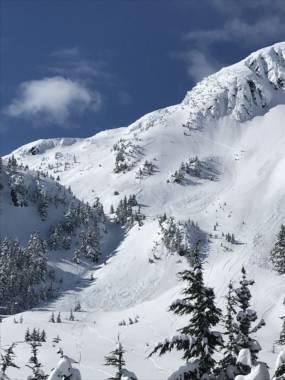
This picture taken by Devon Calvin and included in his avalanche report to the Coastal Alaska Avalanche Center shows his path down Mt. Ben Stewart on March 28, 2021. It was taken approximately an hour before another skier triggered an avalanche in the same area. (Photo by Devon Calvin via Coastal Alaska Avalanche Center)

Avalanches blocked a highway on the Kenai Peninsula and killed a skier near Matanuska Glacier within the last week. There were also several avalanches reported around Juneau, including a very close call just outside the boundaries of the Eaglecrest Ski Area.

But it still may be risky with high potential for human-triggered avalanches over the next few weeks, even inside the ski area.

Skier Devon Calvin said he watched another skier trigger an avalanche on Mt. Ben Stewart on Douglas Island last Sunday. He recounted his experience on the Coastal Alaska Avalanche Center website and included a video that was also posted to YouTube.

Calvin skied down that same path earlier on that sunny day. An hour later, he was watching three other skiers come down when one triggered an avalanche that was estimated at 150 feet wide. It ran for at least 500 feet.

Calvin watched the third skier appeared to hold his own and not get carried down the slope. But in what is probably an understatement, Calvin ended his report by writing: “I’m a little rattled.”

The Coastal Alaska Avalanche Center said they saw evidence of at least four different avalanches off Mt. Ben Stewart on Sunday morning.

SEADOGS March 28, 2021
Dogs and handlers with SEADOGS meet with the Eaglecrest Ski Area ski patrol on Sunday, March 28, 2021. (Photo courtesy of SEADOGS)

SEADOGS, or Southeast Alaska Dogs Organized for Ground Search, said they planned on doing training exercises at Eaglecrest Ski Area on Sunday. But because of what happened, they paused their training and stood by in case they had to quickly get to an avalanche scene and do a real rescue.

Tom Mattice, CBJ’s urban avalanche forecaster and emergency programs manager, said there was “considerable” avalanche danger on that day and it had been that way for several days.

“And people get kind of complacent, and then the sun comes out and it’s, ‘Today’s my day. I’m going to go up there!’ said Mattice. “Considerable danger is not low danger, and it’s not no danger. It just means that natural avalanches are less likely.”

Human-triggered avalanches are still very likely, and Mattice said most fatalities actually occur at the ‘considerable’ danger level.

In other reports posted to the Coastal Alaska Avalanche Center website the day before on Saturday, one person reported a fellow skier got caught in a small slide at nearby Fish Creek Knob. Another reported turning around and going back after digging a snow pit and finding an unstable snowpack in the same area.

Dave Scanlan, Eaglecrest Ski Area general manager, said their ski patrol does avalanche mitigation every morning before they open to the public, ranging from doing ski cuts to release thin snow layers to dropping explosive charges. But that is only within the ski area.

Scanlan said they can’t control what anyone does outside their boundaries.

“A lot of the backcountry ski enthusiasts will come up to the parking lot and they’ll leave the parking lot and hike up towards Mt. Ben Stewart or Mt. Troy, both on neighboring state lands,” Scanlan said.

Scanlan also worries about people coming up when the ski area is closed and the ski patrol hasn’t had a chance to go out after a big snowfall.

“It’s easy to get complacent and not realize the hazards that exist just within the average ski area boundaries,” Scanlan said. “So, when people are hiking up the slopes on our closed days, the risk for avalanches is still very much present.”

Last weekend, Mattice said avalanche control measures on Gastineau Peak brought down enough to cover Thane Road with snow fifteen feet deep and hundred feet wide.

There were also small slides at the bottom of the Behrends Avenue avalanche path, but no activity higher up on Mt. Juneau.

“This is the warmest period we’ve had in quite some time with the temperatures as well as having more than an inch of rain each day or right at an inch of rain each day,” Mattice said. “So, we’re seeing a lot of loading during a warm period with significant wind and we’re back to high danger.”

The urban avalanche danger was lowered back down to “considerable” level on Thursday. But Mattice said the snow layer featuring the deep persistent slab from last month likely still exists throughout the region.

Editor’s note: The headline for this story has been updated.

Capital Transit gets new equipment to clear snow from Juneau bus shelters

Bus shelter
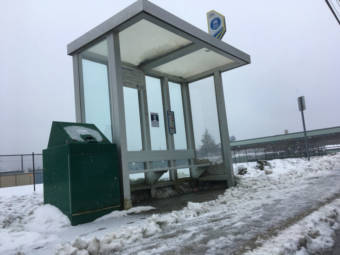
Capital Transit bus shelter in front of the Marie Drake school. A picture circulating on social media shows another bus shelter with a large berm and chunks of ice and snow in front of it. (Photo by Matt Miller/KTOO)

This month’s heavy snowfall has complicated travel and access for Juneau drivers and pedestrians. For people who use Juneau’s public transit, they’ve also had to deal with bus stops blocked by snow berms. But the city has purchased new equipment to clear out bus shelters and nearby sidewalks.

A recent social media post highlighted the difficulty of the elderly and disabled accessing a Juneau bus shelter with big chunks of snow and ice piled in front of it.

“That was a twist. I’ve never seen that before. Not that the snow was plowed into the bus stops. That was a new trick,” said Cheryl Putnam, a Juneau disability advocate.

A bus stop in the Mendenhall Valley blocked completely by snow in mid-March. Juneau resident Patrick Williams said shelters would be blocked like this for days at a time. (Courtesy Patrick Williams)

Putnam says she has used a heavy electric wheelchair for the last 12 years. She remembers getting unstuck from snow at bus stops and on sidewalks many times thanks to the kindness and help of strangers and drivers for Capital Transit and Juneau AKcess, formerly Care-A-Van.

Katie Koester, director of the CBJ’s Engineering and Public Works Department which oversees Capital Transit, said they have 49 bus shelters around town.

“It’s absolutely essential that people of all ages and ability can access the bus stops,” Koester said. “However, we — sometimes on heavy snow days — do have challenges keeping up.”

Koester said they clear bus shelters of snow first thing in the morning. But most of them, about 95%, are located on state thoroughfares which are usually cleared by state Department of Transportation snow plows.

“We don’t always know when that snowplow is going to come by. So we could have just cleared out a shelter, and the plow would come by and rebury it,” she said.

A state Department of Transportation official for Southeast Alaska said it is the city’s responsibility to keep bus stops and shelters cleared of snow.

Koester said they have one employee dedicated to snow removal, but they call up other Capital Transit employees to help out on heavy snow days.

Koester said Capital Transit just ordered two specialized vehicles that are built for clearing snow from sidewalks and bus shelters. But she said they may not arrive for a few weeks, which could be after the snowy season ends.

Putnam said those vehicles were on their wish list when she served on a local ADA commission.

“It’s great. They couldn’t get it at the time. But that’s good to hear,” Putnam said. “If they do it right, they can cover a lot of ground.”

Koester said the $395,000 cost of the two vehicles was paid by federal and state grants and a small local match.

In addition, the CBJ Assembly on Monday approved spending $92,000 in federal and local funds for two trailers and a new truck to pull the vehicles, plow snow and wash down bus shelters.

Koester encourages anyone to report a blocked bus shelter at 789-6901.

Editor’s note: This story has been updated. 

Update: Thane Road in Juneau closed for avalanche control

Thane Road and Snowslide Creek
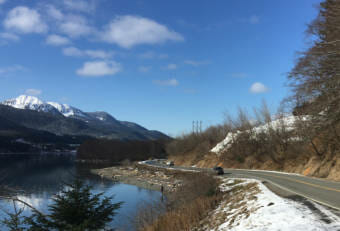
View of the Thane Road and Snowslide Creek avalanche chute on March 14, 2021. (Photo by Matt Miller/KTOO)

Updated post — Thursday, March 18, 10:00 a.m.

Thane Road will be closed from noon to 2 p.m. on Thursday for controlled avalanche mitigation activity.

The avalanche danger for the Juneau region was downgraded to “considerable,” or level 3, on Thursday morning. In the urban avalanche advisory, Tom Mattice wrote that “things have calmed down a great deal overnight.”

There was natural avalanche activity above Thane Road on Thursday, as well as above the Flume Trail and the Behrends Avenue path. The risk for larger slides in urban areas remains after high winds yesterday piled up new snow into a layer called a storm slab. These can trigger larger avalanches from the weak layer of snow underneath from earlier in the winter.

Original post — Wednesday, March 17, 12:40 p.m.

Thane Road will be closed Wednesday afternoon from 2 p.m. to 7 p.m. because of high natural avalanche danger.
State Department of Transportation officials say strong winds and warming temperatures will increase the likelihood of potential avalanches off Gastineau Peak.

If the avalanche danger remains high through Wednesday night, then the road closure may be extended. That could also delay any safe cleanup of the roadway if any avalanches reach Thane Road.

Tom Mattice, Juneau’s emergency programs manager, says there was evidence of two slides along Thane Road since this storm system started Monday night. One of the slides appeared to be several hundred yards wide. Snow from the slides did not reach the road.

In his urban avalanche advisory for Wednesday, Mattice says the avalanche danger remains ‘high,’ with over 21 inches of snow falling over the last two days in the region. He says he’s seen evidence of several avalanches since Monday night, including some slides off the north side of Mount Juneau that didn’t come all the way down.

The Coastal Alaska Avalanche Center reported a small cloud of snow from a slide in the Behrends Avenue avalanche chute around 11:30 a.m. Wednesday morning, but no snow was observed reaching the road.

Mattice is asking for people to avoid the Flume Trail and the area beyond the gate in the avalanche chute behind the Behrends neighborhood near downtown.

Juneau still on hydropower, even after controlled avalanche took out transmission line

Thane pole structure
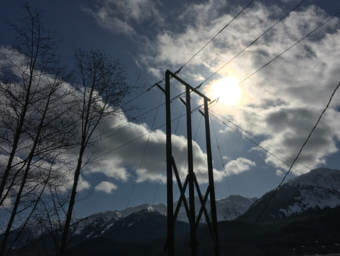
Pole structure holds up a set of electrical transmission lines along Thane Road in Juneau. (Photo by Matt Miller/KTOO)

Earlier this month, a controlled avalanche damaged a power transmission line along Thane Road. It’s the main power line that runs from two major hydroelectric facilities at Lake Dorothy and Snettisham, southeast of Juneau.

But Juneau is still running off that hydropower because there’s a second, parallel transmission line that runs underground beneath an active avalanche path.

“Both these lines are typically in service during normal operations,” said Debbie Driscoll with Alaska Electric Light and Power, Juneau’s electric utility. “They offer some redundancy, which is great in the event that one line needs to be taken out of service for maintenance or repairs.”

Driscoll said damage to the overhead line during the controlled avalanche was limited because the transmission lines are connected to pole structures with what are called breakaway links.

“We use breakaway links on that section of lines so that the line will just break free from the poles,” Driscoll said. “That minimizes the chance that the poles themselves would break or be damaged.

Driscoll said it makes their repairs easier whenever there is an avalanche.

“And then we only have to rehang the line as opposed to having to replace the pole structures as well,” she said.

So the lines aren’t broken. They’re just disconnected from the poles.

Driscoll said their crews cannot safely return and rehang the lines until the state Department of Transportation resumes avalanche control operations above Thane Road. She said that will happen after the current cycle of storms.

In 2008 and 2009, avalanches destroyed up to three towers near Snettisham for the above-ground transmission line providing hydropower for Juneau. The city ran on backup diesel generators for several weeks or months in both cases, and residents paid dramatically higher electric bills.

After 1-year suspension during pandemic, misdemeanor jury trials resume next month

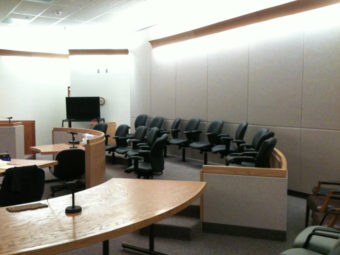
View of the jury box in one of the courtrooms in the Dimond Courthouse in Juneau.
View of the jury box in one of the courtrooms in the Dimond Courthouse in Juneau. (Photo by Matt Miller/KTOO)

Misdemeanor jury trials will resume in Alaska’s state courts starting April 19. That’s after being suspended for more than a year due to the pandemic.

Alaska Supreme Court Chief Justice Joel Bolger issued an order on March 1 allowing those trials to resume.

The presiding judge in each judicial district can suspend misdemeanor trials based on public health considerations, such as if there are high COVID-19 case counts and high-risk levels in the area.

Bolger wrote that case counts have continued a moderate decline since February, and many more Alaskans have received vaccinations. He also notes that judges and court staff have developed procedures designed to reduce the risk of exposure for grand jury proceedings and other hearings.

Last month, Bolger issued an order allowing a limited number of criminal jury trials to resume March 17 after the district’s presiding judge hears a request from both sides in a case. But the general suspension of felony trials has been extended until June 1.

Eagle euthanized after being found hanging upside down like a bat near Juneau’s airport

J.D. McComas, Kathy Benner, and the eagle
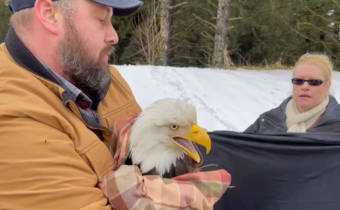
J.D. McComas, a USDA wildlife biologist, hands off a stranded eagle over to Kathy Benner of the Juneau Raptor Center during a rescue at the Juneau International Airport on March 1, 2021. (From video courtesy Scott Rinkenberger)

Hikers and dog walkers along a Juneau trail on Monday spotted something unusual, an eagle hanging upside down in the trees. Although the eagle ultimately did not survive, its rescue led to a compassionate and painless end of life.

Stranded eagle
Stranded eagle in the trees at the Juneau International Airport on March 1, 2021. (Photo courtesy Scott Rinkenberger)

J.D. McComas says they were tipped off by Juneau resident Laurie Craig who was walking the Emergency Vehicle Access Road, commonly known as the airport dike trail. In the trees near the south end of the floatplane pond was what appeared to be an eagle hanging upside down like a bat.

At first, the eagle appeared dead. But then it moved and screeched a little.

“We don’t believe it had been in there for more than a day. But it had been there for quite a few hours, it seemed,” McComas said. “It was fairly distressed.”

McComas is a federal wildlife biologist. His job includes bird hazard mitigation at the Juneau International Airport, because if a seagull, raven or eagle hits a plane or gets sucked into a jet engine, then it could be a bad day for everyone.

Capital City Fire/Rescue arrives with a ladder truck to help with rescue of an eagle at Juneau International Airport March 1, 2021. (Photo courtesy Scott Rinkenberger)

The fire department sent a ladder truck to the airport for the eagle in the tree.

Kathy Benner of the Juneau Raptor Center also arrived with some sheets and tips on handling a large raptor.

“He was amazing,” Benner said. “I mean, that bird was at least 70 feet up. So, it was a long walk for him.”

“It was precarious to say the least,” McComas recalled. “I’m slightly afraid of heights”.

J.D. McComas
J.D. McComas climbs a ladder to rescue a stranded eagle in the trees at the Juneau International Airport on March 1, 2021. (Photo courtesy Scott Rinkenberger)

McComas was clipped to the ladder. But he said it was still tricky to maintain balance, wrap the eagle with a sheet, and free the eagle’s leg from the fork of a branch.

“I’m guessing the way it looked, it had went to leave his perch, and got its body weight out in front of it,” McComas said. “And that kept his leg pinned in between that fork and hanging upside down.”

And then there was McComas’ difficult climb back down the long ladder.

“You’re holding the bird tucked under one arm sort of like a football, and keeping three points of contact on the way down,” McComas remembers. “It was a slow, slow descent.”

Back at the Juneau Raptor Center, Benner said they put the eagle in a dog kennel with shredded paper and a towel as a pillow for its head. They gave it some fluids and pain medication.

“The bird was in pain,” Benner said. “He was crying out.”

https://www.facebook.com/1427365594/videos/pcb.10218250606003048/10218250528121101

Benner said the male eagle showed signs that it had spent most of its time recently on the ground, but also it had difficulty standing. For the right leg that was caught in the branches, X-rays showed signs of another older injury like a previous break that didn’t heal properly. The left leg was swollen, too.

“The bird’s range of motion was impaired,” Benner said. “It was contributing to this bird not being able to hunt and catch food.”

Benner said even before it found itself stuck in a tree, it was starving. So, they euthanized the eagle or put it to sleep.

“So if he hadn’t been rescued, he could still be up there, for all we know, dying a very slow painful death,” Benner said.

She said the eagle will be sent down to a federal facility for permanent cold storage, which is routine for a protected species.

Eagle talons and feathers
Eagle’s talons and feathers after a rescue in the trees at the Juneau International Airport on March 1, 2021. (Photo courtesy Scott Rinkenberger)
Site notifications
Update notification options
Subscribe to notifications