
Matt Miller

Morning Host & Local News Reporter

I’m up early every weekday morning pulling together all the news and information you need to start your day. I find the stories unique to Juneau or Southeast Alaska that may linger or become food-for-thought at the end of your day. What information do you need from me to give your day some context?
Gardentalk – How to plant and hill potatoes this season

Certified seed potatoes on sale at a Juneau grocery store in April 2019.
Certified seed potatoes on sale at a Juneau grocery store in April 2019. (Photo by Matt Miller/KTOO)

In what is now Peru, the Inca people discovered how to domesticate a local root vegetable as early as 10,000 years ago. During what was called The Columbian Exchange, the potato eventually made its way to Europe, transported there by colonizers returning home.

The potato became a relatively easy-to-grow food staple ending the routine famines of the Middle Ages and prompting the rise of European empires. The potato’s increasing popularity was later traced to touching off the modern agriculture and pesticide industries.

In the very first edition of Gardentalk for the 2021 season, Master Gardener Ed Buyarski explains that gardeners should only buy Alaska-certified seed potatoes, which already have been inspected for potential disease and pests before they are sold by retailers.

Buyarski said potatoes sold in grocery stores for eating are not inspected for such diseases because they don’t normally affect appearance or taste. But they can affect long-term growth.

“The issue there is contaminating your soil with diseases that might come in,” Buyarski said.

But if you have a cooking potato that has been sprouting because it was forgotten and left in the pantry, Buyarski said you might be able to avoid any contamination by snapping off and planting just the sprout.

You can grow potatoes in large containers or grow bags with good drainage. Start by putting in a few inches of soil and then some fertilizer. The potato seed pieces should be cut up so they have at least one or two eyes for each piece. Plant the seed piece and then just barely cover with soil. Cover the planting container with clear plastic to warm up the soil.

For in-ground garden boxes or plots with good drainage, Buyarski recommends digging a trench about 6-8 inches deep, sprinkle in some fertilizer, and then plant the seeds about a foot apart. Barely cover the seeds with soil and then cover with clear plastic.

As the potato seedling grows every 2-3 inches, gently hill it or add more soil around it so that the seedling is just barely covered.

“I’ll usually try to leave just the little green tips showing,” Buyarski said. “But they just want to keep growing up.”

Also, here’s a reminder to avoid planting potatoes in the same container or garden plot that you planted them during the previous season. Rotating your crops every two to three years helps prevent disease build-up and depletion of the same nutrients.

Close up view of potato seedlings growing in a North Douglas garden.
Close-up view of potato seedlings growing in a North Douglas garden. (Photo by Matt Miller/KTOO)

Family, volunteers, search and rescue teams still looking for missing 78-year-old Juneau woman

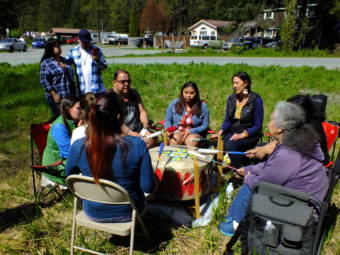
Spirit Lodge Singers use a healing drum to offer songs and prayer for the safety of Geraldine Nelson as the search for her continues around Lemon Creek on Wednesday, May 19, 2021, in Juneau, Alaska. (Photo by Matt Miller/KTOO).
The Spirit Lodge Singers use a healing drum to offer songs and prayer for the safety of Geraldine Nelson as the search for her continues around Lemon Creek on Wednesday in Juneau. (Photo by Matt Miller/KTOO).

After five days, there’s been no let-up in the search for Geraldine “Gerry” Nelson. The 78-year-old Juneau woman was last seen at her home in the Lemon Creek area on Sunday.

On Wednesday afternoon, Geraldine’s grandson Preston Nelson was searching the grass, brush and standing water just off Glacier Highway as traffic whizzed by.

“Some nights, we stay up all night. Other nights, we’re up until 1:30, 3 o’clock in the morning,” he said. “At this point, I’m searching every nook and cranny that I could find, and going through everything twice, three, four times and trying to get as much evidence or some sort of sign that she’s still around here somewhere.”

Preston Nelson said he has taken off work this week to search for her.

A Coast Guard helicopter hovers over Switzer Creek where the search continues for Geraldine Nelson on Wednesday, May 19, 2021 in Juneau, Alaska. (Photo by Matt Miller/KTOO)

Volunteer searchers and family have been working with the Central Council of Tlingit & Haida Indian Tribes of Alaska to coordinate a search. The tribe has been providing meals, equipment like flashlights and safety vests, and a staging area.

Juneau Police, Alaska State Troopers, Juneau Mountain Rescue and a Coast Guard helicopter have concentrated their search in and around Lemon Creek’s nearby woods and trails. Multiple teams with Southeast Alaska Dogs Organized for Ground Search (SEADOGS) also started searching early in the morning and continued well into the evening.

Geraldine Nelson
Geraldine Nelson (Photo courtesy of family)

Trooper Josh Bentz says they are assuming that Nelson is still walking around.

“We believe that she is mobile, which means that she could wander into an area that we just finished searching, right after we searched it. So, we’re researching some areas and we’re searching new areas that haven’t been touched yet,” Bentz said.

Geraldine Nelson, who also goes by Gerry, is an Alaska Native elder who is approximately 5′ 1″ and 125 pounds. She has shoulder-length hair and wears glasses. 

Juneau Police Department asks anyone who sees her to call them at 586-0600.

Search for missing Juneau woman centers on Lemon Creek area

Geraldine Nelson
Geraldine Nelson (Photo courtesy of family)

Friends, family, law enforcement and search and rescue teams are still looking for an elderly Juneau woman who disappeared Sunday in the Lemon Creek area.

Geraldine Nelson, 78, was last seen at her home on Churchill Way late Sunday afternoon. She may have been wearing black pants and a black or light blue coat or sweater.
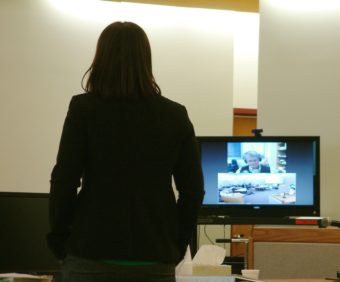
Juneau Police describe Nelson as an Alaska Native woman who is approximately 5′ 1″ and 125 pounds. She has shoulder length hair and wears glasses.

Community members who have been searching for her posted a flier saying that she goes by “Gerry” and is hard of hearing.

Granddaughter Heather Olsen said Nelson usually walks the streets in the Lemon Creek area. But she’s gone miles before.

Olsen said this isn’t the first time she has disappeared.

“It was about a month ago, we also reached out to Facebook to keep an eye out for her. She got lost in the woods near her place over in Lemon Creek,” Olsen said. “Someone had found her later that same night.”

Lt. Krag Campbell of the Juneau Police Department said it’s common for Nelson to be gone a long time.

“But it’s uncommon for her to be gone overnight,” Campbell said. “That’s the scary part.”

Juneau Police, Alaska State Troopers, SEADOGS, and a Coast Guard helicopter have searched the Lemon Creek area, including nearby woods and trails, over the last several days. Juneau Mountain Rescue was called in to help on Tuesday.

Olsen said about 25 people joined in the search Tuesday morning.

Campbell said Troopers currently have enough volunteers to help with an organized search. But he urges everybody else to be vigilant and keep an eye out for Nelson.

And, if others want to look for Nelson on their own, Campbell encourages them to stay safe and let others know where they’ll be going before they head out.

Alaska Court System services slowly coming back online after cyberattack

Amanda Beebe-Bay covers the front desk at the clerk's office in the Dimond Courthouse in Juneau on April 22, 2019.
Amanda Beebe-Bay covers the front desk at the clerk’s office in the Dimond Courthouse in Juneau on April 22, 2019. ( Jeremy Hsieh/KTOO)

After nearly two weeks, the Alaska Court System’s email came back online on Tuesday.

But other services are still down after a cyberattack last month. The disruption has limited public access and further complicated court operations already backlogged by the pandemic.
Court staff, judges and attorneys are finding ways to adapt, while also reverting to a few old routines in place before development of the internet.

“We’ve walked back a lot of the strides that we made to adapt to COVID going back to the more traditional way of doing things,” said Angie Kemp, the District Attorney for Juneau and Sitka.

Some of those traditional ways include physically carrying documents down to the clerk’s office in the bottom of the Dimond Courthouse in Juneau.

Or dusting the cobwebs off of a fax machine to send documents to other attorneys and judges in the region.

“One of the interesting aspects about this is fax became or becoming kind of antiquated technology. And so I think the court system was sort of cycling those out, fax machines out,” Kemp recalled. “I know from speaking to some of their IT folks that they’ve had to scramble a bit to get those things back in place.”

The state’s relatively new electronic filing system is shut down, which has caused problems with attorneys and local police departments statewide.

The cyberattack, which was discovered on April 29, effectively disabled that and other Alaska Court System functions accessible through the internet. The connection has been severed, so a cybersecurity contractor can eliminate any malware and prevent further breaches.

In addition to electronic filing, the CourtView case tracking system used to check someone’s history in state courts is also disconnected.

Online payments for bail and fees has also been disabled.

The disruption also shut down communication with clerks, judges or their staff by court system email. Court staff were communicating with alternative messaging services or gmail accounts.

Dimond Courthouse
The Dimond Courthouse in Juneau on Feb. 27, 2017. (Photo by Jeremy Hsieh/KTOO)

Court calendars initially were inaccessible, though some courthouses posted calendars on dedicated Facebook pages. Now, they are going to a new, separate web page.

Kemp said they’ve returned to physically transporting defendants from jail to the courthouse.

And, to keep many cases moving, judges are holding more teleconferenced hearings.

During the pandemic, the court shifted from in-person to videoconferenced court hearings. That’s not possible right now. Live streaming hearings through YouTube is also impossible at the moment.

“One of the things that I think the court system is doing relatively well is it started to shift and using technology well to accommodate the pandemic,” said Robert Henderson, Assistant Professor of Legal Studies at the University of Alaska Anchorage’s Justice Center. “With this cyberattack, that’s really impacted their ability to do that.”

For example, someone’s credibility is easier to determine during videoconferenced testimony.

“We humans, we routinely communicate through nonverbal cues both in emphasis, and manner and delivery, and the like,” Henderson said. “And video conferencing allows the trier of fact, meaning the judge, allows the judge to assess credibility in a way that he or she can’t do that on a telephone, at least not as well.”

Angie Kemp and Richard Harruff
Then-Assistant District Attorney Angie Kemp listens as a medical expert answers a question by videoconference during testimony in a 2013 homicide trial in Juneau. (Matt Miller/KTOO)

Alaska Supreme Court Chief Justice Joel Bolger said malware infected about half-a-dozen computers. Some of those computers operated essential online services during the pandemic, like email filing and videoconferencing.

“Not being able to do those things for a few days, I’m sure has disrupted our operations a little bit, and has been an inconvenience to our customers,” Bolger said.

The court system’s email came back on line on Tuesday. Bolger said other online services will be restored individually over the next several days.

“Right now, we’re just trying to assess the extent of the damage and see if we can reopen safely,” Bolger said.

Bolger said they did not receive a message or ransom demand from someone claiming to launch the attack. And, they don’t know the motive. But state and federal law enforcement authorities have been notified.

Downtown Juneau sinkhole causes suspension of some bus service

Sinkole042821c
Regular traffic can drive around, but Capital Transit bus service has been suspended along Franklin Street in downtown Juneau after a sinkhole developed at the intersection of Third and N. Franklin streets. (Matt Miller/KTOO)

A sinkhole has appeared in a downtown Juneau street, but city officials say it’s unlikely to develop into anything that would swallow vehicles or buildings.

“There is a hole in the pavement about the size of a small salad plate,” said Katie Koester, head of the city’s Engineering and Public Works Department. “But the sinkhole underneath is a little bit larger.”

Sinkhole042821b
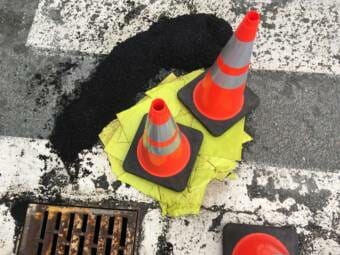
Close up of a sinkhole at Third and N. Franklin streets in downtown Juneau that has been temporarily patched until permanent repairs can be made. (Matt Miller/KTOO)

Koester said the sinkhole at the intersection of Third and North Franklin streets probably goes down about nine feet. It may have developed when an underground culvert corroded and collapsed, but she said they won’t know for sure until they dig up the area sometime next week.

“The reason is because we’re expecting a lot of rain over the next three days,” Koester said. “And we really want to wait for a sunny window before we disturb that storm drain system, since it handles all the drainage off of Mount Juneau and a significant amount of drainage off of Starr Hill.”

For now, the sinkhole is covered with temporary pavement patches and blocked off with cones and barriers.

Koester said there are no major restrictions to pedestrian or vehicle traffic in the area, but Capital Transit has suspended bus service from the downtown library and along North Franklin to Front and Fourth streets until the sinkhole is fixed. Downtown bus passengers should catch the bus at the Downtown Transit Center.

The headline for this story has been updated to include that the sinkhole is in Juneau.

‘Don’t answer the call’: Federal agency warns of phone scam sweeping Alaska

U.S. Marshals
(Creative Commons Photo by Sam Teigen)

Alaskans all over the state are reporting getting calls from the U.S. Marshals Service threatening to charge or arrest people unless they hand over money.

The U.S. Marshals office said it’s a scam that has been circulating in the rest of the country for several years.

“So now in order to connect to U.S. Marshals office, please press ‘one’ and your call will connect it to your case concern officer,” said a voicemail left on Alaskans’ phones.

“I didn’t call them back,” said Laurel Andrews of Fairbanks. “I considered it, but I don’t want them to have my number on their list or however it works.”

Alaskans may be getting flooded with these calls. But they’re actually not new. They’re part of a scam that’s swept nationwide for the last several years.

Usually, the person being called is threatened with criminal charges or arrest if they don’t hand over checking account or credit card numbers or personal information like a social security number to the U.S. Marshals Service.

“We wouldn’t call you and warn you that we’d be coming, “said Deputy U.S. Marshal Rochelle Liedike. “We would be knocking on your door.”

Liedike said they’ve received hundreds of reports from Alaskans about the fraud. The phone calls sometimes appear ‘spoofed’ which is when they look like they’re from a local phone number.

“First of all, if you don’t recognize the number coming in to you, don’t answer the call, let it go to voicemail. Do not respond to that voicemail,” Liedike said.

“Again, this is not [an] actual U.S. Marshals office contacting you. Please do not push any buttons. Do not provide any information to them,” she said. “Just hang up on the call.”

Liedike said their office in Anchorage has been jammed with calls from Alaskans asking or notifying them about the scam. But she said the U.S. Marshals Service cannot investigate the calls. Neither can any local police department.

The scammy calls may come and go in waves. So, Liedike urges Alaskans to go to the FBI’s Internet Crime Complaint Center or report fraud at the Federal Trade Commission website, especially if someone suspects they may have become a victim.

Site notifications
Update notification options
Subscribe to notifications