Matt Miller

Morning Host & Local News Reporter

I’m up early every weekday morning pulling together all the news and information you need to start your day. I find the stories unique to Juneau or Southeast Alaska that may linger or become food-for-thought at the end of your day. What information do you need from me to give your day some context?
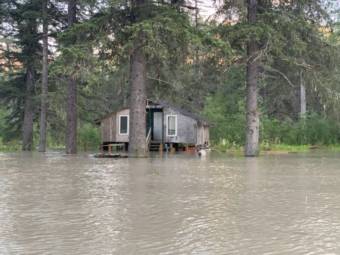
Major flooding underway on Taku River near Juneau

The Taku River surpassed its major flood stage level overnight on June 29, 2021, threatening structures along its banks. (Photo courtesy of Suzanne Bavaard).

The Taku  River near Juneau has exceeded its major flood stage and its record high water level.

Major flooding is underway after a glacial dam release dumped even more water into an already swollen river.

Increased snow melt from recent heavy rains and warm temperatures pushed the river above minor flood stage on Sunday morning.

On Tuesday, the water from Lake No Lake that frequently gets dammed by the Tulsequah Glacier, entered the river from the Taku’s headwaters high in the Juneau Icefield.

There have been other glacial dam releases around the region, including into the Mendenhall River in Juneau and the Salmon River near Hyder.

Aaron Jacobs with the National Weather Service in Juneau says most transboundary rivers in the region are already swollen with melting of the snowpack, which is as much as twice the average. After the glacial dam release ends, he says the Taku River may continue running at about minor flood levels until most snow has melted.

He also says this kind of melt is ahead of schedule.

“It seems like this year the glacial dam releases are happening a little bit earlier than we’ve seen in the past,” he said.

On Wednesday morning, a river gauge at the U.S.-Canada border registered 45.13 feet, above major flood stage.

The National Weather Service expects flooding on the Taku River to continue and exceed 2004’s record-setting event. The river crested at  45.07 feet that year. The latest projections call for the river to crest at over 46 feet late Wednesday or early Thursday. The flood warning is in effect until Sunday.

They are warning that cabins and other structures along the river may be damaged. Boaters should watch for debris. The colder water will increase the threat of hypothermia.

A problem with a sensor at the river gauge produced an incorrect number this morning. The correct number is 45.13 feet, not 46.13 feet. The story has been corrected.

‘Night and day’: What Juneau learned when an avalanche turned out the city’s lights

Snettisham crown
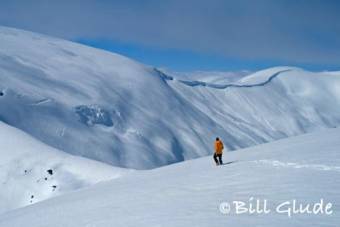
Signs of an avalanche above the transmission line from the Snettisham Hydroelectric Project. (Photo copyright Bill Glude, used with permission)

In the spring of 2008, Juneau residents were affected by a huge set of avalanches that wiped out towers for a power transmission line, severing the capital city’s connection to its biggest source of hydroelectricity, the Snettisham Hydroelectric Project.

When the city switched to diesel generators, Juneau residents quickly had to find ways to conserve electricity. Others faced financial hardship with electricity costs that were suddenly 500% higher.

Juneau-based avalanche forecaster Bill Glude says the avalanches on April 16, 2008, were the biggest he’s ever seen — at the absolute top of the scale for size and destruction.

“They did, in fact, gouge the landscape,” he said. “Not only did they remove forests, but they took a lot of the area right down to bedrock, just ripped all the soil out as well. It was pretty impressive. There was a lot of yellow cedar floating out in the arm, big chunks of snow and lots of trees.”

The slides damaged at least two towers and destroyed three others for the main transmission line that runs more than 40 miles to town. Juneau got cut off from its main source of cheap hydroelectric power.

Snettisham transmission line tower and helicopter
A helicopter lands at the site of one of the destroyed towers for the transmission line from the Snettisham Hydroelectric Project. (Photo copyright Bill Glude, used with permission)

Alaska Electric Light & Power, Juneau’s electric utility, ran diesel generators to meet demand. Back then, the high price of diesel fuel meant the typical household suddenly faced electricity bills that jumped to five times what they were before.

Edward Thomas had just finished a term as president of the Central Council of Tlingit and Haida Indian Tribes of Alaska. He still remembers what tribal citizens were experiencing then, like a friend of his who was afraid of turning up the electric heat in his home.

“He had turned everything down too much. And pipes all froze under his kitchen, then flooded out his whole kitchen,” Thomas said. “And he’s handicapped. So, he had a real traumatic experience with all that stuff.”

People who relied on public assistance programs had to wait before their assistance actually matched their increased electricity costs.

“You’re basically behind by two months by the time the family can make up the difference for what they’re paying and the higher costs,” Thomas said.

He also remembers higher grocery costs and cuts in bus service. Thomas says his family focused on conserving electricity. They turned off unneeded lights, dialed down the electric heat and closed off unoccupied rooms. He says they also disconnected everything that still drew power when it was turned off.

Bruce Botelho was mayor of the City and Borough of Juneau at the time. He was focused on conserving energy in those weeks after the avalanche, too. He stopped using his clothes dryer.

“We got in the habit of draping laundry over banisters to dry out,” he said. “A practice that my wife still does on particularly larger items, sheets and the like.”

Botelho says repairs to the transmission line were expected to take several months, but the city wanted to provide fast relief for residents.

The city took a few quick steps, like suspending sales taxes on the extra surcharge for electricity bills. There were also loan programs for businesses and other relief grants for individuals and organizations.

Electricity powers the city’s wastewater treatment plants and the pumps that deliver freshwater around town. So Botelho says they tried encouraging water conservation, too.

“We estimated that the crisis was going to cost an additional $15,000 a day to maintain Juneau’s water system, with literally 140 miles of pipe,” he said.

As well as the damaged and destroyed towers, over a mile of cable from the transmission line itself was carried down the slope and buried in the snow. Bill Glude says that threatened to pull down even more towers.

“They came up with the thoroughly ingenious method of using a deer hunting rifle from the helicopter to shoot out the glass insulator bells to drop the cables,” he said. “They were able to drop all the cables, take the tension off the towers and save quite a few towers.”

Repairs were finished by June 1, 2008, which was nearly two months after the slides but much earlier than expected.

Transmission tower and avalanche diversion structure on the Snettisham transmission line. (Photo courtesy AEL&P)

Glude made several recommendations to the electric utility in the aftermath. Since then, 40-foot tall steel structures were built around some towers to divert snow away from them. And now there’s a state-of-the-art avalanche forecasting and control program.

Glude says the utility is much better equipped now to deal with any potential avalanche hazards along the transmission line.

“Yes, it’s pretty much a night and day difference,” he said.

As part of the avalanche mitigation plan, helicopters hovering over the slopes above the power lines are a common winter sight. Since 2010, the utility has been using a device called a daisy bell that hangs down under the choppers and produces a controlled, targeted blast on the snow.

Avalanche control above Thane Road on March 18, 2021 in Juneau, Alaska. (Photo by Rashah McChesney/KTOO)

The city will never be completely safe. Just this winter, a controlled avalanche wiped out a section of those same transmission lines, close to downtown Juneau. Fortunately, the utility had already switched to a set of redundant back-up lines buried in the 1990s under that particular avalanche chute. So this time, residents didn’t even notice.

Alaska’s Avalanche Capital

This story is part of a KTOO series about Juneau’s urban avalanche risk.

Gardentalk — Harvesting and using wild celery and devil’s club

Wild celery
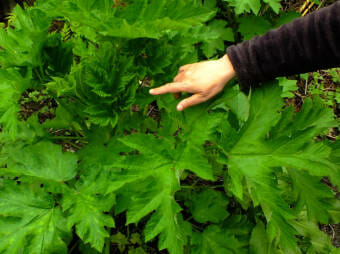
Yéilk’ Vivian Mork points to a wild celery plant’s new leaves, which along with the stalks, are edible. She says the plant usually tastes best when new, young growth develops in the early spring. She recommends picking wild celery – sometimes known as cow parsnip – during cloudy, cool days to avoid an allergic skin reaction to the photosensitive chemical furanocoumarins that are part of the plant’s sap or found on the hairs. (Photo by Matt Miller/KTOO)

You may not realize it, but there may be plenty of edible plants already growing in your yard or off the trail. Just be sure that you already know what it is that you’re picking.

“Don’t harvest what you don’t know so you don’t die,” said Yéilk’ Vivian Mork, a traditional foods and medicine educator.

In this week’s edition of Gardentalk, Mork explains that a good starting place for new harvesters is going after edible invasive species like the dandelion.

Broadleaf avens
Roots of broadleaf avens can be used as a flavoring for wild game or as a tea. Yéilk’ Vivian Mork does not recommend eating plants growing in parking lots or near roads, and even suggests washing plants found off a trail. (Photo by Matt Miller/KTOO)

“Of course, take it home and wash it off if you’re harvesting next to a trail,” Mork said.

She does not recommend eating plants growing in a parking lot or near a road.

Other common edible plants in the Juneau area include broadleaf plantain, broadleaf avens, chickweed, sourdock, tips of fireweed, salmonberry stalks, and wild celery.

“You actually have a pretty great salad in a very short amount of space,” Mork said.

Mork said you can eat wild celery’s stalks, leaves, flower buds, and even use the seeds as a seasoning. She says older plants are usually pretty fiberous and not quite as tasty.

“All spring greens taste better in the early spring,” Mork said.

Edible weeds
Broadleaf plantain, broadleaf avens, and chickweed are fairly common edible plants that are usually dismissed as weeds. (Photo by Matt Miller/KTOO)

If someone wants to learn more about identifying edible plants, Mork suggests seeking out knowledgeable, local experts.

She tells people to avoid online blogs that may contain misinformation.

Instead, she recommends publications from author Janice Schofield Eaton or from any reputable institution like the University of Alaska Fairbanks’ Cooperative Extension Service or the U.S. Forest Service, especially if they cite their sources.

When it comes to devil’s club tips or buds, Mork said they have enormously more medicinal value than any nutritional value as a food item.

“I’m hoping that this foodie trend for harvesting devil’s club tips and sautéing them and pickling them and harvests (of) large quantities starts to fade a little bit and it gets respected for the medicinal plant that it is,” Mork said.

Mork said each tip or bud can produce as many as ten leaves, and picking the tip actually deprives the plant of the ability to photosynthesize and survive.


Devil's club plant
The devil’s club stalk in front has at least seven leaves at the top. Yéilk’ Vivian Mork says each devil’s club tip can produce as many as ten leaves, and picking the tip actually deprives the plant of the ability to photosynthesize. She says it is more suitable as a medicinal plant rather than as a food item. (Photo by Matt Miller/KTOO)

Young Juneau bears are now getting kicked out of their dens

Black bear
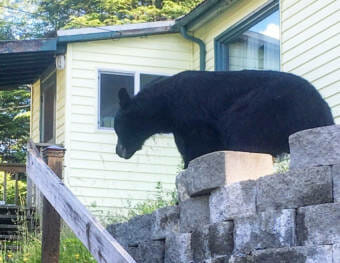
A young black bear lingers in the front yard of a KTOO employee’s house in July 2018, effectively blocking entrance to the house. (Matt Miller/KTOO)

There have been scattered reports and a few pictures of Juneau black bears recently popping up on social media. But so far, there have not been many conflicts related to the bears’ food sources.

Roy Churchwell, an area biologist with the Alaska Department of Fish and Game, said that’s because bears coming out of hibernation in this spring’s wet weather have been munching on the grasses, sedges and dandelions. Soon, they’ll shift to salmonberries and blueberries.

Churchwell expects bear sightings to increase in the next few weeks as yearlings or one-year-old bears get kicked out of the den by mom.

“Basically if you see a bear that’s kind of about the size of a German Shepherd, that’s probably a yearling bear,” Churchwell said. “And it’s supposed to be on its own.”

“They do tend to be more curious and, and we do get more calls about those bears, compared to when they’re with mom, and she’s kind of taking care of them,” he said.

City and Borough of Juneau’s garbage ordinance specifies that garbage should be kept in a secure location until 4 a.m. on pickup day.

“Basically, folks can’t have their garbage out before the morning of garbage pickup,” Churchwell said. “You should be keeping your garbage inside a locked garage or some fairly secure methods so that bears can’t get into it.”

Already this season, Churchwell said they believe they spotted what they are calling the “Car Bear” because of its behavior last year. He said the bear learned how to open car door handles in order to get at food left inside vehicles.

“A lot of folks would come out in the morning, and all the cars along the sidewalk would all have their doors open as the bear had gone through and checked them all out,” Churchwell said.

Some vehicles were even damaged by the bear.

Churchwell said they recently put out a bear trap in the Mountainside Estates area, but Car Bear already seems to have moved on.

Gardentalk – How to recycle kitchen scraps, yard debris to make your own garden compost

Greens for compost
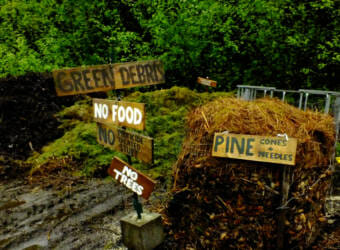
In a commercial operation like Juneau Composts in Lemon Creek, items are sorted out before they are mixed into a compost pile. (Photo by Matt Miller/KTOO)

Adding compost to your garden adds nutrients back into the soil while improving its physical properties. With a little patience, gardeners can make their own compost by recycling ingredients found in the kitchen and in the yard. Making compost also helps cut down on the waste stream to the local landfill.

“You just want to make sure that you’re setting yourself up for a good time rather than a bad time. Bears are the big thing to think about (for) a bad time,” said Lisa Daugherty who runs Juneau Composts, a commercial composting operation in Lemon Creek.

“If you’re composting food scraps, you want to make sure you have plenty of carbon (like cardboard) on hand at all times so that no food scraps are ever exposed to the air,” Daugherty said. “If you can see them, if you can smell them, then you’re just kind of asking for trouble.”

Those exposed food scraps can attract flies, squirrels, ravens and bears.

For home composting, she said she creates a pallet bin with four wooden pallets standing up on end and tied together at the corners. A cover is placed over the top of the bin so the compost is not saturated by rain.

The front pallet is split in half so she can open up the bin and use a pitchfork or shovel to turn the compost or aerate the pile. Turning the pile on a regular basis provides oxygen for the microbes which will help them break everything down faster.

“People tend to think about greens and browns or carbons versus nitrogens,” Daugherty said. “But basically, you’re just trying to have a diversity of material. So, food scraps, yard debris, leaves, shredded paper, cardboard, sawdust, (and) moss.”

“I think the more diverse your inputs are, the better your compost is going to be.”

Compost
A sample handful of compost ready to be added to a garden. (Photo by Matt Miller/KTOO)

Daughtery admits that she’s not a big fan of the composting drum turners that are sold by retailers because they are hard to crank and attract a lot of flies.

“Flies are going to fly out at you from the opening and to me, that’s not a very pleasant experience,” Daugherty said. “I think of composting as you should feel like you’re working in your garden. You shouldn’t feel like you’re working at the dump.”

Daugherty said things like spent grains from home brewing are great for the compost pile.

But she doesn’t recommend that novice composters put in weeds, seafood, meat, or dog poop, especially if they’re not sure if their compost pile is getting hot enough.

Utah man sentenced to 30 years in prison for Alaska cruise ship homicide

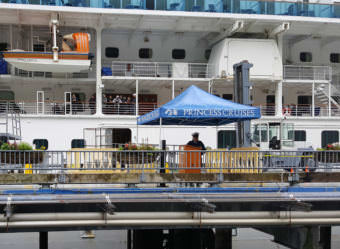
Passengers wait aboard the Emerald Princess moored on the South Franklin Street Dock in Juneau on Wednesday, July 27, 2017. The FBI investigated an alleged murder after a Utah woman died the day before on the ship.
Passengers wait aboard the Emerald Princess moored on the South Franklin Street Dock in Juneau on Wednesday, July 27, 2017 as the FBI investigated an alleged murder on board. (Photo by Tripp J Crouse/KTOO)

A Utah man was sentenced to 30 years in federal prison for killing his wife while on an Alaska cruise.

Kenneth Manzanares, 43, on Thursday was also sentenced to five years of supervised release if he finishes serving out his federal prison term.

Manzanares, his 39-year-old wife Kristy, their three daughters and other relatives were on board the Emerald Princess as it cruised up through Southeast Alaska waters in July 2017.

During a plea agreement hearing in February 2020, Manzanares admitted that he and his wife got into an argument in their cabin. Kristy said she wanted a divorce, and she also wanted Kenneth to get off the ship in Juneau and go home to Utah.

Prosecutors say two of the daughters were then told to leave the room during the argument, but they were prevented from reentering when they later heard Kristy scream. Through an adjoining room’s balcony, the daughters witnessed Kenneth assaulting and beating Kristy.

Manzanares admitted during the plea agreement hearing that he struck his wife with two closed fists.

Prosecutors say she died from blunt force trauma to her head and face.

Manzanares originally pled not guilty in U.S. District Court in Juneau to a first-degree murder charge. But during that February 2020 plea agreement hearing, he pled guilty to second-degree murder.

Site notifications
Update notification options
Subscribe to notifications