I’m up early every weekday morning pulling together all the news and information you need to start your day. I find the stories unique to Juneau or Southeast Alaska that may linger or become food-for-thought at the end of your day. What information do you need from me to give your day some context?
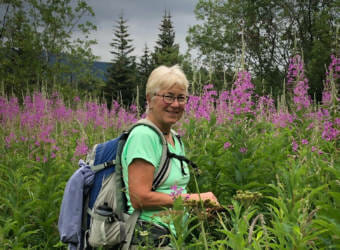
Deb Rudis among the fireweed at Pt. Bridget State Park. (Photo courtesy Deb Rudis)
Wildflowers are in full bloom around Juneau and Southeast Alaska this month. In the latest edition of Gardentalk, wildflower enthusiast Deb Rudis tells us her favorite spots for viewing them.
“I think my very best favorite is the Cowee Meadows, which is accessed through Point Bridget State Park,” Rudis said. “That’s about 38 miles off on the Glacier Highway.”
She also likes the Eagle Beach area and up the Eaglecrest road, where she said she can find some really nice pockets of flowers.
“And then the Brotherhood Bridge meadow, and that’s such an accessible place for anyone,” she said.
River Beauty or Dwarf Fireweed (Photo courtesy Deb Rudis)
Lupine (Photo courtesy Deb Rudis)
Wild Iris or Blue Flag (Photo courtesy Deb Rudis)
Avens (Photo courtesy Deb Rudis)
Board Petaled Gentian (Photo courtesy Deb Rudis)
Swertia (Photo courtesy Deb Rudis)
Wild Geranium (Photo courtesy Deb Rudis)
White Bog Orchid (Photo courtesy Deb Rudis)
Chocolate Lily (Photo courtesy Deb Rudis)
Marsh Marigold (Photo courtesy Deb Rudis)
Cow Parsnip (Photo courtesy Deb Rudis)
Western Columbine (Photo courtesy Deb Rudis)
Dwarf Dogwood (Photo courtesy Deb Rudis)
High elevation Shooting Star (Photo courtesy Deb Rudis)
For homeowners who may want the same wildflowers in their own yard, Rudis says gathering seeds is best. But it can be hard to get wildflower seeds to germinate.
Rudis said you can gather whole plants for transplantation, but she suggests first considering their original habitat.
“You have to make sure you have appropriate habitat,” she said. “Because you don’t want to put something that requires a wet spot into a dry spot. It just won’t thrive.”
Rudis says new housing developments just off the side of the road — or other wildflower patches that are not on state refuge or state park land — are perfect places to gather whole wildflowers.
“There’s lots of places out around Eagle Beach. There’s lots of places in Cowee Meadows where you could take some plants or (that are) up on the Eaglecrest road,” Rudis said. “I don’t think you could put much of a dent in the population of plants in those places.”
River beauty/dwarf fireweed in Granite Basin (Photo courtesy Deb Rudis)
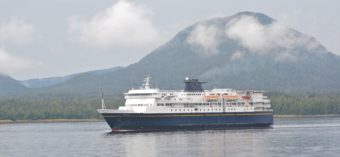
The M/V Kennicott leaving Wrangell on Jan. 8, 2021 (Sage Smiley / KSTK)
The state ferry Kennicott will resume sailing Thursday after being sidelined in Juneau’s Auke Bay since last week because of a mechanical breakdown.
State Department of Transportation spokesperson Andy Mills said part of the vessel’s cooling system malfunctioned on Wednesday, and the U.S. Coast Guard would not allow the vessel to sail again until it was repaired or replaced.
“It was an unexpected mechanical issue that arose,” Mills said. “That’s why they didn’t have a spare part for it. It had been operating for quite a while without an issue.”
Mills said they had a replacement part — plus a few spares — sent into Juneau. Repairs were made over the weekend, and the ship has been cleared to resume its schedule. It’s headed to Ketchikan next.
Meanwhile, he said as many as 135 passengers and their vehicles were booked on the ferry for last week’s trip across the Gulf of Alaska.
Mills said the state asked the Canadian government for an exemption to allow Kennicott’s passengers and their vehicles to enter Canada without a passport or COVID-19 test.
“This Kennicott trip was a cross-gulf trip,” Mills said. “And, so we did work that out, and graciously the Canadian customs worked with us on allowing those passengers to transit up to Interior Alaska.”
Mills said those passengers took the ferries LeConte and Matanuska up to Haines before crossing through Canada.
He said some Kennicott passengers went with other options, such as getting a partial refund of their fares and flying on to their destinations.
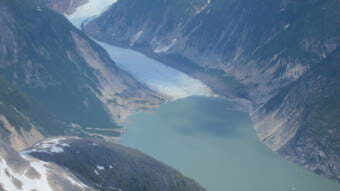
Jason Amundson took this picture of Speel Glacier, located approximately 6 miles south of Wright Glacier and Mt. Ogden, while investigating the source of ice quakes in 2020. (Photo courtesy of Jason Amundson/UAS)
Within a set of glaciers and mountains near Juneau, there’s seismic activity almost every day in the summer. They’re called ice quakes. They’re not as widely understood as earthquakes, but researchers are monitoring them closely.
It’s called an ice quake. It’s one of many types, and it’s probably quite similar to what has been happening almost every day for the last few weeks in the mountains and glaciers near Mount Ogden, about 40 miles directly east of Juneau.
Southeast Alaska made headlines in some blogs and online news sites recently, with people connecting them to the area’s recent heat wave. But they aren’t anything new — scientists have been studying them for a long time.
Photo taken 1905 of Wright Glacier, looking southeast. The start of the glacier and Mt. Ogden on the U.S.-Canada border are likely out of view on the left side of the picture. (Nelles, D.H.. 1905. Wright Glacier: From the Glacier Photograph Collection. Boulder, Colorado USA: National Snow and Ice Data)
Seismologist Natalia Ruppert of the Alaska Earthquake Center said there were 360 ice quakes in the area last year, including some significant shakers.
“They were up to magnitude three. And magnitude three is a quite significant signal, that some of those ice quakes were reported to be felt in Juneau,” Ruppert said. “So those were quite large.”
This year the ice quakes started in May, with a big spike in activity starting four days before late June’s heatwave in Southeast Alaska. Ruppert said there have already been a hundred ice quakes recorded so far in 2021.
Last year, glaciologist Jason Amundson of the University of Alaska Southeast actually flew out to investigate one of the bigger ice quakes near Wright Glacier and Mount Ogden on the United States-Canada border.
“The glaciers in that area are pretty small,” Amundson said. “To produce an earthquake like that, that could be detected regionally, you would need to have a pretty big event.”
Dots show location of ice quakes, largely of magnitude 2.9 or lower, that were detected in two weeks preceding July 8, 2021. Far right cluster of yellow dots are located at the start of Wright Glacier. Mt. Ogden is on the northeast side of the glacier just north of the blue dot. (Screen capture from Alaska Earthquake Center website)
For those of you who might be new to ice quakes or glaciology, let’s get a few things out of the way first.
Scientists can’t see or feel the quakes themselves, so they use seismometers. That’s the same instrument they use to measure and locate earthquakes.
“Ice is always moving. Ice is always deforming and cracking. And every time it moves, deforms or cracks, it creates some energy that propagates in the form of seismic waves,” Ruppert said. “And our seismic sensors are able to record that energy.”
Ice quakes actually may be caused by many different things, like a glacier scraping against the bedrock or a crevasse opening up.
In Greenland and Antarctica, giant icebergs slowly breaking away from tidewater glaciers create vibrations that can be detected around the world.
In Antarctica, scientists detected seismic activity which revealed how a giant river of ice called the Whillans Ice Stream lurches ahead into the ocean every 12 hours, as the tide rises and falls.
So how do scientists know the difference between an earthquake and an ice quake when they’re looking at the data? It turns out, that data looks and even sounds different.
When a big event occurred last year east of Juneau, Ruppert noticed that it didn’t resemble a typical earthquake.
You know those squiggly and jumpy lines on a seismogram?
Ice quakes, like this calving iceberg in Greenland observed by Amundson and sped up 25 times, don’t have a lot of high-frequencies. And they start more gradually.
Glacial seismologist Rick Aster of Colorado State University said they’ve actually known about ice quakes around Juneau, Wright Glacier and Mount Ogden for decades.
As the glacial ice flows down the valleys, Aster said friction and obstructions can slow it down. But then temperatures rise every spring and summer, and snowmelt and rainfall increases.
“The seasonal influx of water into the glacier can make it more likely to slip,” Aster said. “And in this case, the annual cycle of melting water and water getting under the glacier drives the seasonality to the occurrence of these ice quakes as the glacier slips at its base.”
Aster said there are even practical applications for seismometers to detect ice quakes created by glacial outburst floods.
“This is happening in Iceland now, for example, where they have enormous glacier floods and the seismometers can detect when the water is coming out of the ice cap before it appears on the surface,” Aster said.
That was actually done very close to Juneau’s Mendenhall Glacier a few years ago. A temporary seismometer was able to detect the ground shaking during a jökulhlaup — a glacial outburst flood — because of the force of all that water gushing through cracks in the glacier.
Sam Bertoni checks the garlic at Orsi Organic Produce for any scapes that are beginning to loop on themselves. He will eventually pick the scape in the foreground that is already bending over. (Photo by Matt Miller/KTOO)
If you’re a Juneau area gardener who is growing garlic, you may have noticed that the plant’s scapes are bending over. Pick them now.
In the latest edition of Gardentalk, Joe Orsi explains that softneck garlic usually sold in stores is missing a central scape or seed stalk when it grows, while hardneck garlic has a round, bulbous central stem or scape that curls into a loop in the early summer.
“They will keep growing and form a flower stock, and they’ll twist up and then untwist and form a flower,” Orsi said. “And if you don’t pull the scapes off the hard neck, it pulls all the energy away from the bulb and you end up with a very small bulb.”
He said that you have go through your garlic crop and physically snap off the scapes when they start to bend over.
Orsi is a former master gardener and owner of Orsi Organic Produce, a small commercial operation in Juneau that grows garlic, rhubarb, squash and other vegetables.
He said he likes using diced up garlic scapes in omelettes or soups any other dish where he wants to add a garlic flavor.
Orsi also makes pesto with minced garlic scapes, pine nuts, a little olive oil, basil, salt and parmesan cheese.
“And they keep a long time too,” Orsi said. “You can keep scapes for months in the refrigerator. They just hold really well.”
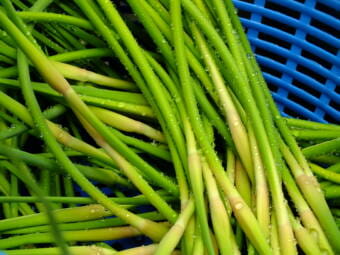
Freshly picked garlic scapes get a light washing. (Matt Miller/KTOO)
Slow developing raspberries in a Douglas Island yard in early July 2021. (Matt Miller/KTOO)
Juneau area berrypickers and gardeners may be wondering, “Where are the berries this year?”
In this week’s edition of Gardentalk, Master Gardener Ed Buyarski explains they’ve been slow — even compared to last year’s cold and wet season.
Buyarski said blueberries are late, even the early April bloomers. Raspberry plants are behind at least 10 days or more.
“So, definitely late,” Buyarski said. “Apples and cherries, likewise, late two to three weeks or more.”
He said there is really nothing that can be done other than crossing your fingers for more sunshine and warm weather.
But for cherry and apple trees, Buyarski suggests doing some thinning.
“I think because of last year’s poor cold wet weather, that there may not be a lot of energy stored in the roots of the plants to ripen all those fruits,” Buyarski said. “So, thinning may be especially important this year.”
Buyarski said fertilization of trees and woody shrubs with seaweed and compost should be wrapping up right now.
He recommends watching out for bursting and cracking cherries if the weather suddenly goes from wet to dry. Also, it might be worthwhile to lightly cover or shelter developing raspberries to prevent the rapid onset of mold.
“Blackberries seem to be resistant to a lot of the molds,” he said. “Currants and gooseberries are great in that way, too, and are much less affected by them.”
Slowly developing blueberries in a Douglas Island yard in early July 2021. (Matt Miller/KTOO)
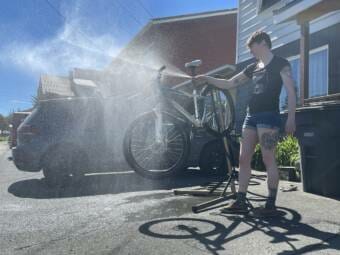
Ariel Svetlik washes dirt of her mountain bike after a sunny ride in Juneau on June 19, 2021. (Photo by Rashah McChesney/KTOO)
Warm temperatures in Southeast Alaska earlier this week were actually part of the stifling heat wave that has oppressively gripped the Pacific Northwest.
Aaron Jacobs with the National Weather Service in Juneau says they call it a “blocking pattern” because it was blocking other incoming weather systems that could bring cooler temperatures and precipitation.
“We have a big high pressure sitting over a certain area and then all the different other disturbances are kind of getting lifted up and around it or kind of stable patterns which can’t really move,” he said. “All this warm air is building up and building up, and that warm air has moved this way up into Southeast Alaska and British Columbia.”
On Sunday, Juneau hit 80 degrees for the first time this year. On Monday, it was 83 degrees.
Other communities set new records for the day like Ketchikan at 82 degrees and Sitka at 75 degrees.
The forecast for the rest of the week calls for more clouds, cooler temperatures and even a little rain for Southeast Alaska.
Close
Update notification options
Subscribe to notifications
Subscribe
Get notifications about news related to the topics you care about. You can unsubscribe anytime.