Matt Miller

Morning Host & Local News Reporter

I’m up early every weekday morning pulling together all the news and information you need to start your day. I find the stories unique to Juneau or Southeast Alaska that may linger or become food-for-thought at the end of your day. What information do you need from me to give your day some context?
Did you hear it?: Avalanche control booms over Juneau and Douglas

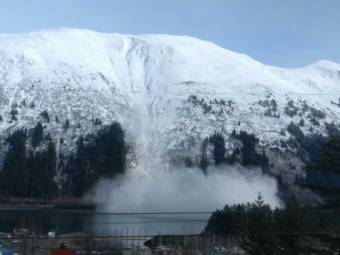
An avalanche cascading down a steep mountain into water
An avalanche triggered by explosives from a state-contracted helicopter crew cascades down Mount Roberts over Thane Road on Thursday morning, March 4, 2021 in Juneau, Alaska. (Jacob Resneck/CoastAlaska)

Updated post — Friday, March 5, 3:25 p.m.

From 9 to 11 a.m. Saturday morning, Thane Road will be closed for avalanche control activities.

According to a Department of Transportation spokesperson, utility crews noticed small slides coming down off Gastineau Peak and Mount Roberts on Friday.

The crews were repairing the main electric transmission line that was damaged on Thursday when a helicopter crew was setting off avalanches intentionally above the road where unstable snow had piled up in recent storms.

Original post — Thursday, March 4, 2:12 p.m.

Residents of downtown Juneau and parts of Douglas Island heard loud booms as at least one helicopter performed avalanche control measures above Thane Road on Thursday morning.

The state Department of Transportation closed the road to all traffic as they tried to set loose the unstable snowpack on the mountainside above the road.

Sam Dapcevich with the Alaska Department of Transportation said the snow was so deep that any natural avalanches would likely be very large. At the same time, they expected that their Daisy Bell device, which uses explosive gases directed at the snow, probably would not penetrate to a weak snow layer.

Instead, explosives were dropped from a helicopter to trigger several slides, including a big one that dumped wet snow at the foot of the mountain and created a giant powder cloud.

“[The] powder cloud dropped about two feet of snow on Thane Road and it also knocked down some trees. It even knocked down some power lines,” he said.

Dapcevich said late Thursday afternoon that the road was cleared quickly and Alaska Electric Light & Power crews were fixing the power lines.

Video posted on social media showed an avalanche sliding all the way down to the road with a dust cloud billowing out almost midway across Gastineau Channel. 

https://www.facebook.com/ktoopublicmedia/videos/275914947307106

This story has been updated with information from the Alaska Department of Transportation.

Protections added to Juneau’s power lines after 2008 avalanches, but risk remains

Ground level view of an avalanche diversion structure on the Snettisham transmission line. (Photo courtesy AEL&P)

The avalanche danger has gone down, from extreme to considerable, in downtown Juneau this week. But that still leaves a risk of avalanches, especially along the transmission line that supplies a large portion of Juneau’s hydroelectric power.

Mike Janes is an avalanche forecaster for Juneau’s electric utility, Alaska Electric Light and Power. He said — when the weather allows — they routinely fly over the transmission line to the Snettisham Hydroelectric Project about 28 miles southeast of Juneau.

“One of the main differences with Snettisham is that we get two to four times the precipitation down there that we get in town,” Janes said. “So, things stack up a lot quicker. The storms are more intense and more potent, and all that.”

Because the transmission line’s towers are located in avalanche terrain, Janes said they look for recent avalanches and clues of potential slides yet to come.

The utility’s avalanche mitigation work and modifications started after an avalanche destroyed three towers in April 2008. Another avalanche in January 2009 hit one of the same towers that was destroyed the year before.

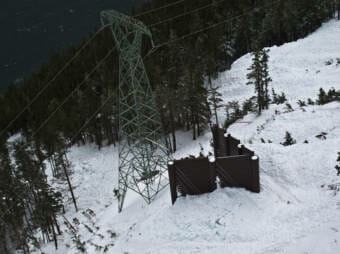
Three of the towers located in an avalanche path now have diversion wedges constructed around them. They are basically giant steel structures intended to deflect most of an avalanche away from the base of a tower.

“They’re bolted to the mountain with long rock bolts and rods. And yeah, they’re pretty beefy,” Janes said. “These columns are four feet in diameter, 40 feet tall, and everything had to be lifted in with a heavy lift helicopter.”

Transmission tower and avalanche diversion structure on the Snettisham transmission line. (Photo courtesy AEL&P)

In addition, a tower near an avalanche path was strengthened while another was simply removed. Parts of the transmission line along nearly a two-mile stretch have been modified to break away in the event of an avalanche. That’s so a falling tower doesn’t pull down other nearby towers.

Part of an avalanche forecaster’s work is avalanche control or triggering small avalanches before they became much bigger ones. Janes said they used to drop explosives from a helicopter. But now they sling a device called a Daisy Bell, which makes a small explosion by mixing oxygen and hydrogen. It’s inexpensive to use, safer, and much more accurate.

“And it just blasts down onto the snow, which will collapse the weak layer that you’re trying to get at and then causes avalanche releases when that happens,” Janes said.

Even though the current avalanche danger is not as high as last weekend, Janes said Juneau is not out of the woods yet. Freezing rain that fell on cold snow last month created instability in the snowpack throughout the region.

And, he said, the biggest avalanche cycles in the Juneau area typically happen in March and April.

Update: Juneau officials recommend residential evacuations, warning of dangerous ‘historic avalanches’

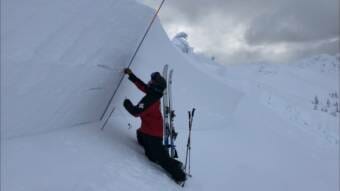
Eaglecrest Ski Area ski patroller Tucker Cooper examines snow layers during avalanche mitigation activities Feb. 21, 2021. (Photo courtesy Coastal Alaska Avalanche Center)

Updated Post — Saturday, Feb. 27, 10:25 a.m.

Juneau’s urban avalanche forecast is for “extreme” danger Saturday evening with the potential for “historic avalanches” in residential areas.

City officials recommend that residents in the avalanche zone of the Behrends neighborhood in downtown Juneau evacuate their homes.
The city and the Red Cross are opening Centennial Hall as an emergency shelter for anyone who chooses to leave their home. The doors will open at 8:00 p.m. on Saturday and COVID-19 mitigation measures will be in place.

In the advisory, Emergency Manager Tom Mattice also recommends that all residents avoid avalanche paths including the Flume Trail.

“People need to make their own safety decisions,” he wrote. “But we feel that with the forecast for the next 24 – 48 hours natural avalanches are likely and of great size.”

The City and Borough of Juneau describes the Behrends Avenue avalanche path as the neighborhood directly above the Breakwater Inn, a horseshoe area of houses between Glacier Highway, Behrends Avenue and Ross Way; adjacent to Highland Drive. 

Original Post — Friday, Feb. 26, 2:38 p.m.

Avalanche forecasters are warning of increasing danger in downtown Juneau and the surrounding backcountry, especially if more snow and rain falls on an already unstable snowpack. If conditions worsen, the city would recommend evacuation of downtown neighborhoods.

Juneau city officials said in a release Friday that there is potential for “historic avalanches” in the downtown area through Monday. Depending on temperatures and how much snow falls, the city’s Urban Avalanche Advisory could be raised to “extreme” danger, which is the highest level on the scale.

“I have never forecasted an extreme avalanche condition,” said Tom Mattice, the city’s emergency programs manager.

He is advising downtown residents to be cautious, especially if they live near the Behrends Avenue avalanche path. If residents end up evacuating their homes on the city’s recommendation, a shelter would be set up at Centennial Hall.

Mattice says they’ve recently seen avalanches of snow four to six feet deep throughout the region.

“In the urban environment, if we have a four foot deep avalanche that’s wide enough across the face of the Behrends path, (then) that’s more than enough to hit houses,” he said.

An avalanche from Mt. Juneau on Jan. 4, 2021. Juneau’s avalanche danger is considerable, and conditions are forecast to get worse. (Screenshot of social media video)

The Alaska Department of Transportation & Public Facilities is warning of increased avalanche hazard along Thane Road. Residents along the road should be prepared for an extended road closure if crews are unable to safely remove any avalanche debris.

Kanaan Bausler of the Coastal Alaska Avalanche Center says they’ve already seen widespread avalanche activity all around Juneau, from Douglas Island down to Snettisham Inlet. And they expect more avalanches over the weekend.

A freezing rain crust has formed on top of recent snow that fell on a weak snow layer. Bausler says the snow’s weakness can be triggered from even a flat spot on the terrain.

“And then, it’ll travel through that freezing rain crust and collapse the looser snow below and the denser snow above,” he said. “So, it can travel great distances and we’ve already seen avalanches that have traveled over a quarter mile just from propagating through the snowpack.”

He says they’re warning people heading out to the backcountry to use extreme caution, even in terrain that is generally considered safe from any avalanches.

He says the unstable snowpack conditions could potentially last through the rest of the season.

‘Pretty foolhardy’ to try crossing Mendenhall Lake’s slushy ice now

Hikers crossing frozen Mendenhall Lake
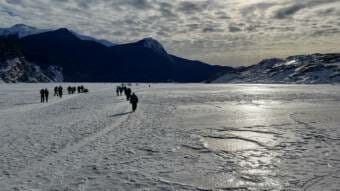
Hundreds of hikers cross a frozen Mendenhall Lake to reach glacier ice caves on Feb. 14, 2021. The Mendenhall Glacier Visitor Center is visible on the far end of the lake. (Photo by Jeremy Hsieh/KTOO)

If you want to cross the lake to visit the ice caves in the Mendenhall Glacier, do so at your own risk, says Barb Miranda, director of the Mendenhall Glacier Recreation Area.

“The temperatures have warmed considerably in Juneau since last weekend, and the lake is looking pretty slushy outside my office window,” Miranda said. “And, I think people would be pretty foolhardy to try to get across it at this time.”

She said Friday morning that the ice is thin in areas, and there are icebergs in the middle of the lake.

“And the ice is always thin around those icebergs as well. And they can flip over at any time,” Miranda said. “So, we never will say that the ice is safe. We don’t monitor the ice for safety. And we definitely tell people that they go on to the ice at their own risk.”

It’s at least a mile and a half from the visitor center to the other side of the lake where the ice caves are located. If someone falls through the lake ice, then it could take a long time for rescuers to arrive on the scene.

Miranda says a safer route to the ice caves is along the West Glacier Trail. It’s a challenging hike that can last all day, and she suggests hikers use microspikes on their boots.

“The ice caves are very dynamic,” Miranda said. “They could collapse at any time. They are beautiful.”

A hiker makes their way out of one of the ice caves at Mendenhall Glacier on Feb. 14, 2021.
A hiker makes their way out of one of the ice caves at Mendenhall Glacier on Feb. 14, 2021. (Photo by Jeremy Hsieh/KTOO)

Miranda said there are plenty of other things to do around the lake that don’t involve getting on the lake ice. They just plowed the Nugget Falls and Photopoint Trails for hikers and cross country skiers. And the Juneau Nordic Ski Club has been grooming ski trails at the Mendenhall Campground.

Eaglecrest chairlift back in operation after Juneau windstorm

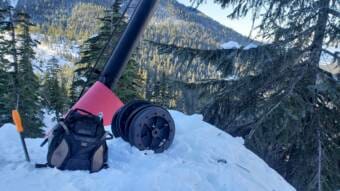
Backpack wheels by damaged Ptarmigan chairlift pole on Insane
A backpack and wheels sit near the base of the damaged Ptarmigan chairlift pole at Eaglecrest Ski Area on Douglas Island on Feb. 13, 2021. (Photo by Jeremy Hsieh/KTOO)

A chairlift providing access to the upper portion of the city-owned Eaglecrest Ski Area has been repaired after last week’s high winds. And, it’s back in operation.

General Manager Dave Scanlan said it was a freak of nature event that has not happened at Eaglecrest Ski Area in almost 40 years. Early last Thursday, chairs on the 4,700-foot long Ptarmigan Chairlift were swinging back and forth, pushed by high winds.
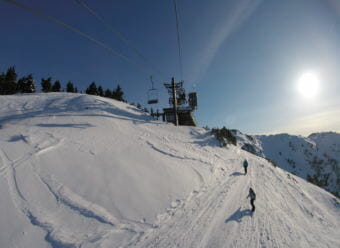
“As the wind gusts picked up about a third of the way up the mountain between our lift tower seven and eight is our longest span where the chairs are the highest off the ground,” Scanlan said. “And, it swung the chairs to the point that we had two chairs flip over the wrong side of the haul rope. So, they were dangling down and the clip that keeps the chair on the lift was sitting on the wrong side.”

National Weather Service meteorologist Jake Ruckman said a high-pressure system over Canada created the 67 to 72 mile per hour winds at Eaglecrest that morning.

“And this was causing a very, very strong pressure gradient over not just Juneau, but much of the northern panhandle of Alaska,” Ruckman said. “The winds were not by any means just localized to downtown Juneau or Eaglecrest. They were all over.”

Damaged Ptarmigan chairlift pole on Insane
High winds led to damage to this chairlift pole at Eaglecrest Ski Area on Douglas Island, pictured here on Feb.13, 2021. (Photo by Jeremy Hsieh/KTOO)

When the chairlift was started up later that morning, the two flipped chairs got caught in a lift tower’s pulley system. One chair fell, while the other was partially dislodged. The pulley system on the top of the tower appeared damaged, while the haul rope, or the thick metal cable that the chairs hang from, had derailed.

Ptarmigan Chairlift takes skiers and snowboarders to the top of the ski area and provides access to both the west and east bowls.

“It’s the most popular chairlift. Everybody loves the Ptarmigan chair,” Scanlan said.

Initially, Scanlan said he couldn’t predict when it would be repaired because they didn’t know the amount of damage and whether they would need any replacement parts. He also expected to bring people to Juneau to inspect repairs.

The ski area’s other upper mountain chairlift, Black Bear on the east side, as well as Hooter and Porcupine on the lower mountain were still operating. Still, even those skiers who said they didn’t ride Ptarmigan much were disappointed.

“Well, that was pretty surprising because everybody was going on Ptarmigan. And, I didn’t expect the winds to be that crazy. At least nobody was on it,” said Cerys Hudson.

Eaglecrest figured it out and fixed it quickly.

“We had a really productive weekend. We just went through a really methodical process to go through all of the various steps of the repair.” Scanlan said. “And thankfully, everything went about as good as it could have gone.”

Scanlan said they replaced the two damaged chairs, inspected and tested the haul rope, and readjusted and realigned the tower and the haul rope pulley set. The haul rope and ski lift inspectors did their inspections remotely.

And, just in time for Wednesday morning’s fresh snow, the Ptarmigan Chairlift resumed hauling skiers and snowboarders to the top of the mountain.

High winds damage Eaglecrest Ski Area chairlift

Snowboarders head down upper Hillary‘s run after getting off the Ptarmigan chairlift at Eaglecrest Ski Area in March 2018.
Snowboarders head down upper Hillary‘s run after getting off the Ptarmigan chairlift at Eaglecrest Ski Area in March 2018. This photo was taken just above the location where the chairlift was damaged by high winds on Feb. 11, 2021. (Photo by Matt Miller/KTOO)

A chairlift providing access to the upper portion of the Eaglecrest Ski Area has been damaged by this week’s high winds in Juneau. It will be out of operation at least for this weekend, and likely longer.

Ski area general manager Dave Scanlan says the winds flipped two chairs up and over the haul rope for the Ptarmigan Chairlift. It happened near a chairlift tower located above the ski run called Insane.

The two chairs then got caught in the tower when the chairlift was started up Thursday morning. One chair was partially dislodged while the other chair disconnected completely and fell, and the haul rope derailed from the damaged pulleys on the tower.

Wind speeds of between 67 and 72 miles per hour were recorded at Eaglecrest after 2 o’clock Thursday morning.

No one was injured, and no one was on the chairlift when it happened.

Scanlan says they plan on assessing the damage and making repairs to the chairlift starting Saturday. But he doesn’t know how long it will take.

The other upper mountain chairlift — Black Bear on the east side — as well as Hooter and Porcupine on the lower mountain are still in operation.

Site notifications
Update notification options
Subscribe to notifications