Matt Miller

Morning Host & Local News Reporter

I’m up early every weekday morning pulling together all the news and information you need to start your day. I find the stories unique to Juneau or Southeast Alaska that may linger or become food-for-thought at the end of your day. What information do you need from me to give your day some context?
Coast Guard newbies stepped up when mission was threatened by quarantine

USCGC Munro at RIMPAC 2020
An MH-60S Seahawk Helicopter assigned to Helicopter Sea Combat Squadron 21 conducts “touch and go” drills aboard U.S. Coast Guard cutter Munro during the 2020 Rim of the Pacific exercise. Ten nations, 22 ships, one submarine, and more than 5,300 personnel participated in the exercise from August 17 to 31, 2020 at sea around the Hawaiian Islands. (U.S. Navy photo by Mass Communication Specialist 3rd Class Madysson Anne Ritter)

This summer, the COVID-19 pandemic threatened to scuttle the Alaska patrol of a U.S. Coast Guard cutter when over 10% of the crew was put in quarantine. But the ship’s mission was saved when a large group of cadets — the youngest, newest and most-inexperienced members of the Coast Guard — was called on to help.

To use a very old nautical phrase, Captain Blake Novak was caught between the devil and the deep blue sea.

Captain Blake Novak
Captain Blake Novak, commanding officer of the U.S. Coast Guard cutter Munro, wears some of his favorite off-duty attire as he explains the training provided for cadets who served aboard his ship in summer 2020. He’s explaining how they briefed cadets on some of the dangers, including what happens when a 4-inch diameter mooring line for a 4,000 ton ship suddenly parts while under tension. (Photo by Matt Miller/KTOO)

Novak is commanding officer of the cutter Munro, one of the biggest vessels in the Coast Guard fleet at 418 feet.

The Munro was in Dutch Harbor this summer when Novak got word of a big storm heading their way. The weather forecast was so bad that Novak was advised to stay in port for the next four days. It would’ve been dangerous to get underway as the storm passed through the area.

“We were going to encounter 18-plus-foot seas off the beam,” Novak said.

If they stayed in port as advised, they would miss a planned military exercise off Hawaii. As Novak saw it, they had to leave.

But many of his crew were ashore for a barbecue celebration that included having a few beers.

“We call it the bottle-to-throttle policy, which says that you need to stop drinking 12 hours prior to getting the ship underway,” Novak said.

The Munro normally has 150 crew members. But many couldn’t help prepare the ship for departure because they had been drinking. So Novak turned to 16 cadets fresh from the U.S. Coast Guard Academy.

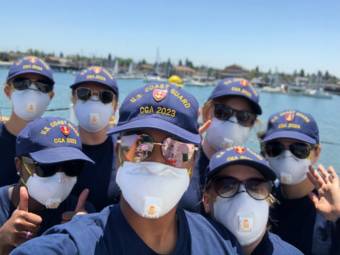
First Class cadet group
First Class Cadet Jordan Park (far right) with four other First Class cadets aboard USCGC Munro. (Photo courtesy Jordan Park)

“The majority of our cadets were underage,” Novak said. “So, right away they were filling shoes and able to step in immediately to assist and assume those roles to help out with the crew.”

Novak says the cadets handled the ship’s lines so they could leave Dutch Harbor as soon as possible.

First Class Cadet Jordan Park says that turned out to be a long day.

“It was really great to be relied on in that way,” Park said. “I think it was a little bit tough because we had been up since pretty early that morning pulling in, and we expected to stay overnight. And then, not staying overnight and getting underway that night was a little bit challenging. But that’s how the Coast Guard is and it was cool to experience that.”

Novak says they then steamed at high speed for 48 hours to beat the weather and eventually get to Hawaii on time.

So many cadets serving aboard a Coast Guard ship is very unusual. But it’s an unusual year.

Munro's Third Class cadets
Third Class Cadet Branyelle Carillo (center) with other Third Class cadets. (Photo courtesy Branyelle Carillo)

The Munro’s mission in the Bering Sea this summer included fisheries enforcement, search and rescue and patrolling the maritime boundary with Russia. But just before the ship left, Novak says they had an asymptomatic crewmember who tested positive for COVID-19. The crewmember and their close contacts, 18 people total, had to stay in quarantine.

So, Novak asked the Coast Guard Academy in New London, Connecticut for help. Many cadets were just returning from a summer break.

“In the military, we would say they were ‘voluntold,’” Novak said.

Novak says the arriving cadets were excited but understandably very nervous.

These cadets are essentially officers in training. And for two months, they filled roles normally held by enlisted service members just out of boot camp. Senior enlisted personnel trained the cadets to handle the lines for the ship, work in the mess, serve as lookouts and steer the ship.

3/c Branyelle Carillo
Third Class Cadet Branyelle Carillo aboard USCGC Munro. (Photo courtesy Branyelle Carillo)

Third Class Cadet Branyelle Carillo says she expected to be working hard.

“But we knew that it was going to be a great learning environment for the future and understanding what the fleet is actually about compared to us being here at school,” Carillo said.

And Carillo says they learned the importance of working as a team.

“You have to use other people that are around you in order to get what needs to be done,” Carillo said.

“So, that was like a biggest lesson of a lot of things that we did on (the) Munro.”

Novak, who considers his ship as a floating schoolhouse, says their experiences are important for any future leader, whether in the Coast Guard or elsewhere.

“These young men and women, in the future, are going to be put in positions where they’re managing our enlisted personnel,” Novak said. “So, for them to get a true feeling of what it’s like to walk and spend a day — in this case to spend two months — in the same shoes as our enlisted personnel, it’s very important from a leadership development standpoint.”

Not only did all the cadets have a unique experience, they also received a Meritorious Team Commendation that is usually only awarded to regular Coast Guard personnel. The Coast Guard Academy says it’s rare for these cadets, some a little over a year out of high school, to wear such a red ribbon on their uniform before they even graduate from the Academy.

None hurt as pickup truck explodes, catches fire in downtown Juneau

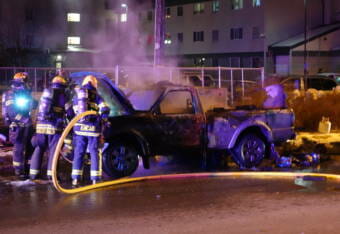
Truck on fire
A firefighter aims a hose at a burning pickup truck Monday night on F Street in downtown Juneau. (Photo courtesy Noah Williams)

A pickup truck exploded in downtown Juneau Monday night, but the Juneau Police Department does not believe the fire was suspicious or a crime.

A witness says it sounded like a fireworks factory exploding.

“They make this kind of shish-shish-shish-shish-shish sound that sounds just like rockets shooting up into the air repeatedly,” says Noah Williams. “And then, I just saw this big fire away from my house.”

Williams says he called 911 from his home near Cope Park and then grabbed his camera and ran to F Street, across from the laundromat and the old Bill Ray Center.

“I was a little scared running into that general area. But they seemed to have it mostly under control by the time I got there,” Williams says. “So, props to CCF/R! You guys rock!”

Wrecked truck
Firefighters check out a pickup truck that exploded and caught fire Monday night on F Street in downtown Juneau. One of the propane tanks can be seen at the far right. (Photo courtesy Noah Williams)

Firefighters were already putting out the fire.

There were also filled propane tanks in the back in the pickup truck that firefighters were trying to keep from exploding.

“It looks like maybe one of the propane tanks had blown or two of them had blown,” Williams said. “And then, the safety valves had kicked in for the rest of them. I’m pretty sure they have like an overpressure valve and it appears the one (tank) that was on fire when I got there was just venting.”

Tuesday morning after the fire, a woman who did not give her name grabbed a blanket and a few clothes from the burned out truck that was still parked on the street. She said she was in the pickup’s cab when the fire started and escaped uninjured.

The Fire Marshal’s office says a propane-fueled heater tipped over and ignited other items in the truck. They ask people to call them if they witnessed the start of the fire Monday night. If witnesses have pictures or video, they would like to see them as well.
Jury trial suspension extended because of escalating COVID-19 cases

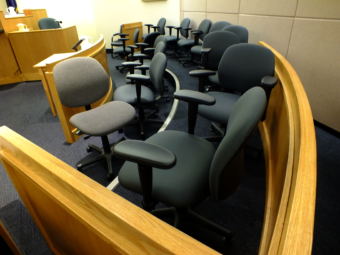
View of the jury box on Oct. 5, 2017 in the Christopher Strawn trial. (Photo by Matt Miller/KTOO)
View of the jury box during a break in a recent homicide trial in Juneau. (Photo by Matt Miller/KTOO)

There will be no jury trials in Alaska’s courthouses until at least Jan. 4.

Earlier this summer, Alaska Supreme Court Chief Justice Joel Bolger said he planned for jury trials for misdemeanor cases only to resume Nov. 2.

But in an order signed Friday, Bolger wrote that the suspension would continue due to escalating case counts of COVID-19. He also noted that Gov. Mike Dunleavy’s video address on Thursday encouraged state employees to work from home.

There was never a plan to resume trials for felonies or more serious cases because they require more people to gather at the courthouse for the jury selection process.

In-person grand jury proceedings are also suspended until Jan. 4. But Bolger said other court hearings or proceedings can still be held remotely through videoconference or teleconference.

Shouldn’t all of Juneau’s bears be hibernating by now?

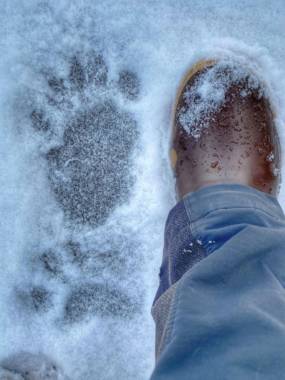
Bear claw and Xtra Tuff
Bear print in the fresh snow on Nov. 3, 2020, just after the first big snowstorm of the month. (Photo courtesy of Rebecca Albert)

It’s almost mid-November, and there are a few bears still active in the Juneau area. That may seem unusual, but it’s not.

Gloria Soto Llauger checked out her security camera footage just after this month’s first big snow storm. There they were, after 1 o’clock in the morning, slowly ambling across the front of her house and parking area. A big mama black bear trailed by two new cubs of the year.

“The other day they come and they are big bears,” Soto Llauger said. “Mama was super big. The cubs are so cute. And they are very small.”

https://www.facebook.com/100037416232096/videos/356319912291880/

Soto Llauger is not the only one. Other Juneau residents recently posted on social media videos of roaming bears or pictures of prints in the fresh snow.

The Alaska Department of Fish and Game is still getting reports of bears roaming through Juneau neighborhoods looking for food.

Bear tracks
Fresh bear tracks discovered during a hike on Nov. 3, 2020, just after the first big snowstorm of the month. (Photo courtesy of Rebecca Albert)

Anthony Crupi says it’s not that unusual to still see bears out right now.

“Most bears are probably encouraged to head to the den once resources really become limited and covered in the snow that we received in the last week,” Crupi said.

Crupi is a biologist with Fish and Game, but he focuses on research. He captures bears, puts radio collars on them, collects samples and tracks their movements with trail cameras. The information he collects is crucial for understanding bear biology, behavior and abundance.

Around Halloween or so, Crupi says black bears usually start denning up for winter hibernation.

He says black bears will find a hollow tree or excavate part of the tree’s roots as their den for as much as 3 to 8 months. Their core body temperature, heart rate and metabolism will all drop dramatically. They won’t eat, poop or pee. Crupi says they’re essentially living off of their fat reserves.

And here’s a little known fun fact you may not know about hibernating bears. A fertilized egg in a female bear will delay implantation until she starts hibernation. Whether a mama bear later has a cub or has as many as three cubs can hinge on how healthy she is and much fat she has built up during the summer.

“A bear that doesn’t have enough fat, you could see that those animals wouldn’t survive, their cubs may not be produced or they come out in the spring with really poor body condition,” Crupi said.

This has been a bad year for bears in Juneau. There was less natural food because of lackluster salmon runs and a poor berry crop.

Crupi says that means bears were also looking for food elsewhere, like human garbage. They became conditioned to associate food as a reward for their encounters with humans, knocking over garbage cans and breaking into homes and vehicles.

ADF&G’s Roy Churchwell says they responded to a record total of 19 bears this year. Of those, five bears were physically moved out of town. They put down or killed 11 bears that became a danger to life or property.

Dog and bear claw
A dog sniffs out a bear print during a hike on Nov. 3, 2020, just after the first big snowstorm of the month. (Photo courtesy of Rebecca Albert)

“Once they break into cars are something like that, then we really don’t have any other choice than to euthanize them,” Churchwell says.

Meanwhile, Gloria Soto Llauger says she’s seen bears make a mess by going through garbage in her Churchill Park neighborhood in Lemon Creek.

“And this year has been the worst,” Soto Llauger said. “A lot more bears lately.”

But she takes steps like freezing her discarded food until garbage pick-up day. Only then does she put out her garbage can, minutes before the garbage truck arrives.

Her big pro tip, though, is spraying down her garbage can with a eucalyptus-based odor and germ killer called OdoBan which she finds at a big box home improvement store near her neighborhood.

She describes the last time a bear checked out her garbage can after she sprayed it.

“She or he put the can down on the ground, and smelled, got up and left,” Soto Llauger said.

Besides an occasional stroll in front of her house, she says she hasn’t had a single problem with bears since then.

Arctic cold air mass brings Juneau snow, freezing rain and rain mixed with ice pellets

Niko Sanguinetti and Terry Hoskinson shovel snow while Roux plays in it on Monday, Nov. 2, 2020, in Juneau, Alaska. (Photo by Rashah McChesney/KTOO)

The winter storm warning for Juneau expired at 9 a.m. on Monday morning, but the National Weather Service still expects two to five inches of more snow through Tuesday.

Meteorologist Pete Boyd said the weather service expected a powerful winter storm to dump a lot of precipitation on the panhandle Sunday night and Monday morning, but forecasters had a hard time figuring out where exactly in the region that rain would turn into snow.

“Tricky is not the word for it,” Boyd says.

A boundary of cold Arctic air moved farther south than expected, dramatically dropping temperatures in Haines, Skagway and Juneau. For example, at Boyd’s office in the Mendenhall Valley, it was 27 degrees at 8 a.m. Monday while it was 51 degrees in Petersburg. At the same time, a low-pressure system with warm air and lots of precipitation moved directly east into the central panhandle instead of heading further north.

“Rain, snow, rain mixed with snow, rain mixed with ice pellets, freezing rain in addition to some breezy conditions,” Boyd says.

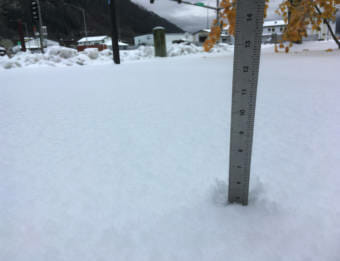
Unofficial snow depth measurement at the KTOO studios in downtown Juneau on Nov. 2, 2020. (Photo by Matt Miller/KTOO)

About 7.6 inches of snow fell at the Juneau airport by 8 a.m. Monday morning and 11.5 inches fell at Lena Point.

Blizzard conditions were reported in Haines and Skagway while heavy rain and flooding was reported in the southern part of the panhandle. Sixty-mile-per-hour winds were also reported throughout the panhandle.

Boyd says drivers should take extra caution. Road conditions are “horrendous” with the combination of rain, freezing rain and snow falling Sunday night and Monday.

Bonnie Walters shovels snow off of her Nordic Tug “Madeline“ at Statter Harbor on Monday, Nov. 2, 2020, in Juneau, Alaska. (Photo by Rashah McChesney/KTOO)

“This would be the day [or] the morning to say inside if you can,” Boyd advises.

The Juneau Police Department reported at least eighteen vehicles went into the ditch because of slippery driving conditions Monday morning. Lt. Krag Campbell says there were no major crashes or any injuries.

Campbell says they also had reports of debris, like trees and powerlines, in the roadway.

How Alaska decides if a judge can stay on the bench

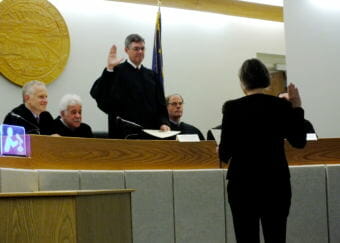
Alaska Supreme Court Chief Justice Joel Bolger administers the oath of office to Superior Court Judge Amy Gurton Mead. Watching, seated from far left, is Juneau Superior Court Judge Philip Pallenberg, Senior Judge Louis Menendez, and Ketchikan Superior Court Judge William Carey.
Alaska Supreme Court Chief Justice Joel Bolger administers the oath of office to Superior Court Judge Amy Gurton Mead. Watching, seated from far left, is Juneau Superior Court Judge Philip Pallenberg, Senior Judge Louis Menendez, and Ketchikan Superior Court Judge William Carey. (Photo by Matt Miller/KTOO)

Nearly two dozen judges will be on the Nov. 3 state election ballot. Alaskans won’t be voting on all of them, just those judges in their particular area. 

But Alaska’s system of keeping or removing judges from the bench sidesteps much of the politics that dominate the judicial process in some other states.

Trial judges, supreme court justices and their opposition run television campaign ads outside of Alaska. 

Elaine Andrews, a retired state District and Superior Court judge, said she’s glad she didn’t have to raise money, make campaign speeches and run ads to stay on the bench. 

“I can assure [that] I would not have the job if it wasn’t in Alaska because I would not do what’s required to be done to have the job in other states. I wouldn’t do it,” Andrews said.

Campaigning, she said, would set up many ethical compromises and conflicts of interest.

“It’s hard for the public to believe that a judge is impartial when they show up to court and the person on the other side just contributed $5,000 to the judge’s reelection campaign. It just doesn’t make sense,” she said.

Here’s how the retention election in Alaska works.

Instead of a partisan campaign and election, sitting Alaska judges are simply listed on the ballot. If 50% or more of voters vote “yes,” then the judge would continue serving on the bench. Or, voters would vote “no” if they think a judge should be removed.

Susanne DiPietro is executive director of the Alaska Judicial Council, a citizens panel devoted to vetting potential new judges and investigating sitting judges before they come up for retention.

“It is an extremely thorough and nonpartisan evaluation,” DiPietro said, recently explaining the process to the Alaska Federation of Natives.

Louis Menendez served on the Superior Court in Juneau for seven years. He appeared on the ballot for retention almost midway through his term.

“The process we have in Alaska is quite remarkable. I think the process the council goes through is so time-consuming and so difficult,” Menendez said. “They put an awful lot of themselves into that.”

Menendez said the council surveyed all attorneys, public safety officers, social service workers, jurors, and court employees who worked with him. Call it a public report card. It included numeric ratings and written feedback about his performance and ability.

Menendez said he took those ratings and comments to heart. 

“I learned an awful lot about that process. They congratulate you and they criticize you in the same situation,” he said. “I think it is all helpful to what we do as judges and how we learn, and how that learning process is continuous from the day you’re appointed to the day you leave the bench.”

DiPietro said the council also investigates judges for any ethical complaints and getting their work done on time. It also helps if they work on judicial reform efforts.

“And, actually this year [the Alaska Judicial Council] has recommended that all the judges be retained in office for the reason that the judges have met the performance standards,” DiPietro said.“The judges have done a good job in office.”

Voters can see those ratings and the Alaska Judicial Council’s recommendations on their website or in the voters election pamphlet that comes in the mail.

Author and legal researcher Albert Klumpp said Alaska was the first state to incorporate this kind of non-partisan, merit-based process, called the Missouri Plan, to install and keep fair and impartial judges in every state court. 

For one, it virtually eliminates campaign fundraising. Also, Klump said that there was the idea that the process would reduce the influence of political parties.

“And, of course, back then in the Progressive Era, that was the big concern,” Klumpp said. “And then, you also had the point that it was going to give voters some assistance in sorting through all these candidates that they were probably weren’t very familiar with and try to pick out the most likely candidates to become good judges.”

At least 36 states have a version of the Missouri Plan in place for some or most of their state courts.

That’s not to say, though, that politics is completely absent in Alaska’s process.

For reasons still undetermined, Klumpp said large blocks of Alaska voters will routinely vote “no” or against keeping judges on the bench. Judges are also targeted for removal by special interest groups. 

For example, Alaska Supreme Court Justice Susan Carney is opposed by the group Alaskans for Judicial Reform, though their reasons don’t appear to target her personally. Rather, they take issue with the court’s decisions on Alaska’s sex offender registry, abortion funding, and the Permanent Fund Dividend. Carney just happens to be the justice who is up for a retention vote this year. 

Former Alaska attorneys general and the group Vote Yes – Retain Justice Susan Carney have come to her defense to keep her on the bench. And that is allowed. 

Sitting judges in Alaska can’t campaign for retention unless it’s in response to an opposition group. Otherwise, all they can do is put out basic biographical information about themselves. 

That’s the idea behind AnchorageJudges.com

Anchorage Superior Court Judge Yvonne Lamoureux set up the website featuring herself and four other judges.

“I think that people don’t realize that there’s a lot of judges up for retention and it’s not always easy to access all the information,” Lamoureaux said. “So, we tried to make it accessible for those who wanted to learn more.” 

Klumpp said Alaska voters have approved over 99% of all judges on the ballot since statehood. It’s rare for a judge to be removed. But voter percentages for approval have declined over the years.

You can learn more about the judges on this year’s ballot on the Alaska Judicial Council website.

Site notifications
Update notification options
Subscribe to notifications