Matt Miller

Morning Host & Local News Reporter

I’m up early every weekday morning pulling together all the news and information you need to start your day. I find the stories unique to Juneau or Southeast Alaska that may linger or become food-for-thought at the end of your day. What information do you need from me to give your day some context?
Misdemeanor trials to resume in November after 8-month suspension due to COVID-19

Dimond Courthouse
A woman leaves the Dimond Courthouse in Juneau on Feb. 27, 2017. (Photo by Jeremy Hsieh/KTOO)(Photo by Jeremy Hsieh/KTOO)

After an eight month hiatus, jury trials will resume in Alaska courtrooms in November. But not all of them. And the long delay in justice is hard on some Alaskans.

George Benson says he’s been jailed at Lemon Creek Correctional Center in Juneau for the last three months.

“I feel like I’m being held in here unfairly and unjust,” Benson said.

The Juneau resident was arrested for felony assault back in February. He posted bail and was out for several months on electronic monitoring. But he says the ankle monitor’s battery died, he got arrested again, and his bail was reset so high that he can’t afford to get out again.

Meanwhile, Benson says his trial date has been pushed back four times already. He says his family can’t visit him, and he’s lost his job and housing.

“During the COVID thing, I feel like I’m just … I shouldn’t be stuck in here and my girlfriend is like, you know, feeling the same way I am and my family,” Benson said.

James Christie, a criminal defense attorney in Anchorage, says it’s not just those accused of crimes who are living under a huge cloud of uncertainty. He had a homicide trial scheduled for last spring that was indefinitely postponed by the pandemic.

“People who are victims of crimes, who are desiring closure and resolution of their cases, all the family members,” Christie said. “These are all people whose suffering has been protracted for who knows how long.”

Most criminal cases are resolved in other ways, such as through negotiations between the prosecution and defense. Only a fraction are heard by a jury. But Alaska Supreme Court Chief Justice Joel Bolger says there are still a lot of cases backed up.

“I’m sure hundreds. And I think I would be safe to say thousands,” Bolger said. “I mean, we have thousands of filings across the state every year. Jury trials have been suspended since the middle part of March.”

Bolger issued an order Thursday allowing jury trials for misdemeanors or lesser crimes to resume in November with special conditions. Everyone in the courtroom must get a daily health screening and — with few exceptions — wear a masks at all times. Plexiglas screens will go up, and social distancing rules will apply.

That means the old picture of six jurors sitting side-by-side in a jury box will not be seen again anytime soon.

“We expect that in all of our courtrooms the jury will have to be spread out throughout the entire courtroom to allow for adequate social distancing,” Bolger said.

Observers will have to watch the trial remotely from another room.

Instead of dozens or even hundreds of people physically arriving at the courthouse all at once for the jury selection process, prospective jurors will be prescreened with questionnaires and video or teleconferences. Even the usually crowded courtroom routine of attorneys questioning prospective jurors’ backgrounds could be replaced by Zoom.

Courtrooms in some smaller communities simply aren’t big enough for a socially-distanced jury trial. So they’ll be moved to larger communities nearby.

Bolger calls it a cautious approach focusing on everyone’s safety. He acknowledges trials could be postponed again at a particular courthouse, or even statewide, if people get sick.

“One thing that I’ve learned from this crisis is that it’s very difficult to predict the future or predict what action will be appropriate in a pandemic,” he said.

As for more serious felony trials, which take a lot longer and require a minimum of 12 jurors, Bolger says those might resume in January. But a lot could happen in the next few months.


Gardentalk – Preparing your ornamentals for winter hibernation, safe from Juneau’s cold

Dahlias
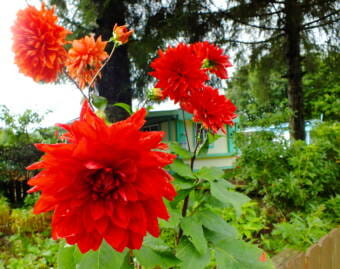
Dahlias bloom in a Lemon Creek yard in September 2020. (Photo by Matt Miller/KTOO)

Ornamental plants like petunias, begonias, dahlias and fuchsias won’t survive even a mild Southeast Alaska winter outside. We need to bring sub-tropical plants into a space that won’t freeze, says Master Gardener Ed Buyarski.

“If they hit 32 degrees, they’re probably toast,” Buyarski says. “I guess frozen, not toast.”

Once a hard frost knocks back the foliage of dahlias and begonias, Buyarski recommends removing the tubers. Wash off the dahlia tubers while allowing the begonia tubers to dry out before putting them in a labeled paper bag and storing it in a place that does not freeze.

Dahlia tubers can also be stored in dry sawdust, dry shredded paper or dry straw in a paper grocery bag. They can be divided now or in the spring.

Fuschias should be trimmed back to 4-to-8 inch stems and can overwinter in a place colder than 40 degrees, like a root cellar. But Buyarski says check on them regularly to make sure they don’t dry out over the winter.

Gardentalk – How to stop a fungus invasion and why your veggies might be turning yellow

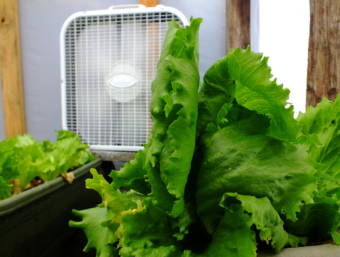
Lettuce fan
A fan keeps the air moving in a North Douglas greenhouse. The lower leaves of the lettuce in the background are turning yellow. (Photo by Matt Miller/KTOO)

Are your veggies turning yellow this late in the season?

Master Gardener Ed Buyarski says it’s likely because most of the soil nutrients have been been washed away by this summer’s rains.

It may be too late this season for an application of weed juice or fertilizer. So Buyarski recommends trimming leaves from vegetables as soon as they begin turning yellow. Otherwise, they will be susceptible to slugs and fungus.

With all the rain and moisture we’ve had this summer, Buyarski also recommends harvesting squash, zucchini and cucumbers as soon as possible — before they succumb to a fungus, which can spread fast in an environment where there is little air circulation.

Yellowing lettuce
The lower leaves of this lettuce are turning yellow and will soon fall victim to slugs and fungus if they are not removed. (Photo by Matt Miller/KTOO)

Gardentalk – Pick those apples and turn them into pie, jelly and applesauce

Homemade Apple Pie“Homemade Apple Pie” by WinstonWong* is licensed under CC BY-NC-SA 2.0

There may be a few hundred apple trees of several different varieties in Juneau. The exact number is unknown.

For many of those trees, it’s harvest time.

But Master Gardener Ed Buyarski says tree owners should look carefully at the interiors of their trees. If the leaves and branches get too thick, then future apples on the north side of the tree won’t get enough sunlight to ripen. He recommends thinning out any interior growth while you’re already up there picking apples.

Yellow Transparents are usually the earliest apple variety. They should be picked at the end of August, when the fruit is still a little green. They will get mealy and turn pale yellow if you leave them on the tree too long.

Other varieties, like Pristine and William’s Pride, usually are picked later in the season as their flavor improves.

For anyone wanting to plant a new apple tree, Buyarski says now is the perfect time to order. He suggests picking out an early ripening, scab resistant variety for next spring’s planting — and getting together with others for ordering multiple trees

This woolly bear caterpillar was spotted roaming an apple tree in Juneau in August 2016.
This woolly bear caterpillar was spotted roaming an apple tree in Juneau in August 2016. (Photo courtesy Ed Buyarski)

.

Juneau’s unsecured garbage and ‘bumper crop of yearling bears’ are a deadly combination

Renato Olangco's shed
Renato Olangco pauses from cleaning up a mess to contemplate what a bear did to the locked shed where he stored his garbage can. (Photo by Matt Miller/KTOO)

This summer is shaping up to be one of the worst ever in recent memory for bears in Juneau. Alaska Department of Fish and Game officials say a bunch of young bears and a dwindling natural food supply are forcing the bruins to search human garbage for food before they hibernate for the winter.

It’s trash day in Renato Olangco’s neighborhood. He’s out this morning cleaning up the mess and looking over the damage to what used to be a locked tool shed in his driveway. A bear clawed open the shed’s plastic doors overnight, got into the smelly garbage stored inside and scattered it all over the place.

Olangco pointed to places where the bear damaged the doors and said, “I will try to fix it.”

Bears are now desperate to fatten up before hibernating. But this year’s poor berry crop and lackluster salmon runs means more bears are looking for food in other places, like human garbage.

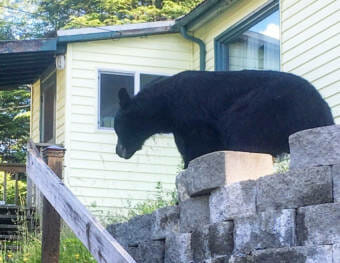
Black bear
A young black bear lingers in the front yard of a KTOO employee’s house in July 2018 , effectively blocking entrance to the home. (Photo courtesy Matt Miller)

Abby McAllister, a wildlife education and outreach specialist with the Alaska Department of Fish and Game, explains that more bears are competing for what little food is available.

A better berry crop and decent fish runs last year meant more new cubs survived the winter. McAllister said those bears, which she calls a bumper crop of yearlings, have just been kicked out by mom. But they’re still inexperienced about a lot of things.

“Whether or not they should avoid humans, whether or not they should venture into the person’s backyard and you know, get into their trash,” said McAllister, who explained that the yearling bears are still testing and are learning.

“They may appear bolder, if for that reason. But mostly they just don’t know any better,” McAllister said. “They’re kind of like a teenager on their own for the first time just trying to figure out things. They make a lot of mistakes along the way.”

The number of bear-related calls into ADF&G and the Juneau Police Department already totals at least 687. That’s double last year at this time.

They’ve responded to thirteen different bears so far. That’s on track as most ever for the year. Of those thirteen bears, four were moved far away from town. Nine were killed because they were a threat to life or property.
Olangco lives in Creekside Park, a neighborhood of manufactured and mobile homes in Lemon Creek. Garages pretty much don’t exist here. Many yards aren’t big enough for a shed. Only a fraction of the garbage cans put out are actually bear resistant.

Bear resistant can
Kristen Romanoff of the Alaska Department of Fish and Game with a bear resistant garbage can that was put out on trash day in a Lemon Creek neighborhood. (Photo by Matt Miller/KTOO)

Loren Brown, Juneau site manager for garbage utility Alaska Waste, told Juneau assembly members recently that about 1,500 out of 8,000 total residential customers have bear resistant cans, which automatically unload when turned upside down by a garbage truck lift.

“None of them are bear proof,” Brown said, gently correcting an assembly member who posed a question about existing garbage cans. “That will get us in trouble if I say they’re bear proof, for sure. They’re bear resistant.”

Brown said there’s a waiting list of a hundred customers for the newest, bear resistant cans.

“It really depends on bear issues,” Brown told assembly members. “This year is the worst it’s been in years. It’s just hard to say what number is enough.”

Brown said 350 more cans are on order. But they’re more expensive to use and only come in one size so far, the biggest that is currently produced for residential customers. They won’t arrive for another month or two, too late for this season.

For now, there’s the Juneau Bear Committee. Members recently walked through many of Juneau’s neighborhoods on their respective trash days.

JBC sticker
Kristen Romanoff of the Alaska Department of Fish and Game applies a Juneau Bear Committee sticker to a garbage can. (Photo by Matt Miller/KTOO)

Laurie Craig and Kristen Romanoff walked through Creekside Park on a recent Friday morning, talking with residents and putting yellow and black stickers on garbage cans that are not bear resistant.

The stickers also lay out Juneau’s garbage ordinance. Specifically, it points to the rule that says garbage must be kept inside an enclosed structure until 4 a.m. on pick up day.

One resident tells them she’s already had a bear tear into her enclosed entryway where she keeps her garbage.

“My day off is Friday,” she said. “So, like when I hear the garbage truck come, I bring it out. My coming out right now is to bring (the can) back in.”

Romanoff and Craig respond with a “Perfect!” and “That’s great!”

From residents Craig has talked to, she believes everyone wants to do the right thing. But some are not sure how.

Craig said that’s where community education is key for preventing Juneau’s bears from becoming habituated to garbage — and getting killed.

Gardentalk – How to top tomatoes and get the most out of hardy, cold-tolerant greens

Cherry tomato flowers
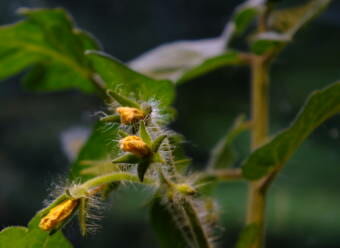
Close up view of tiny heirloom cherry tomato flowers that are preparing to bloom in an indoor aeroponic garden in September 2020. For tomato plants growing outside or in a greenhouse, such flowers should trimmed off now so the plant can devote its remaining energy for ripening of existing tomato fruit. (Photo by Matt Miller/KTOO)

If you have tomato plants flowering in your greenhouse right now, now is the time to top them off.

Master Gardener Ed Buyarski says tomato plants need to devote any remaining energy to ripening fruit that has already emerged instead of wasting it on flowers that are unlikely to mature or produce any fruit later this fall.

Just use nail clippers or your fingers to trim or pinch off any new flowers.

Buyarski also says it’s the last call for harvesting cucumbers and zucchini. This summer’s prolonged rains have set up perfect conditions for a severe spreading of fungus.

“To the point that removal (of those plants and vegetables) is the best option,” Buyarski says.

Also, the gardening season is not over.

You can plant lettuce, mustard greens, spinach, kale, and radishes in your greenhouse right now. They will either be ready for a fall harvest or will tolerate the winter’s cooler conditions and have a head start next spring.

Buyarski says he has nine-month-old lettuce in his greenhouse that is just now beginning to bolt.

Site notifications
Update notification options
Subscribe to notifications