Matt Miller

Morning Host & Local News Reporter

I’m up early every weekday morning pulling together all the news and information you need to start your day. I find the stories unique to Juneau or Southeast Alaska that may linger or become food-for-thought at the end of your day. What information do you need from me to give your day some context?
Mother of all jökulhlaups reported in Southeast Alaska

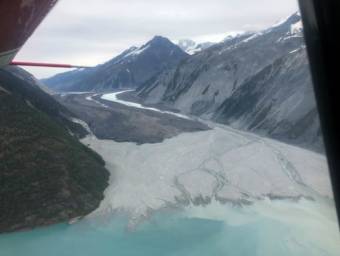
Lituya Glacier terminus
The terminus of Lituya Glacier on September 17, 2020, after the delta (foreground gravels) was completely resurfaced by the Aug. 15 outburst flood. The source of the flood, “Desolation Lake,” is just visible under the aircraft’s red pitot tube, while the main body of Lituya Glacier emerges from the mountains to the right. (Photo courtesy of J. Capra/NPS)

Scientists believe a massive glacial dam release recently occurred in Southeast Alaska.

But they probably would not have known about it if they had not been tipped off by an observant commercial fisherman.

Jim Moore says Lituya Bay on the outer coast of Southeast Alaska has always been a special place for his family. During the first day of the August chinook season, the Sitka commercial fisherman was out in his boat with his two grandsons preparing to ride the flood tide into the bay to anchor up for the night.

Instead, the current was flowing out, the other way.

“This event was pretty spooky,” says Moore.

The water was muddy, full of trees and other debris. And, something that Moore hasn’t seen since the 1970s — icebergs, as far he could see into the bay. They were mostly refrigerator-sized and smaller.

“We picked up a couple and put this ice, this thousands of years old ice into our cooler to keep our food on the trip,“ recalls Moore.

Moore says it was too dangerous to fight the current to get into the bay.

“The prudent thing to do was just leave the area,” Moore says.

So, what happened?

Lituya Bay is a place where Mother Nature has always had the upper hand.

In 1786, for example, French explorer Jean-François de Galaup La Pérouse lost two boats and 21 men trying to chart the entrance to the bay.

Longtime Southeast Alaska residents may remember the 1958 earthquake that killed five people. It triggered a rockfall in the bay that generated one of the world’s tallest tsunamis of at least 1700 feet.

But what caused this latest mystery?

Desolation Valley
False-color satellite images of Lituya Bay, Lituya Glacier, and “Desolation Lake” (thin dark blue streak in the middle of picture) showing the lake level and delta before (left) and after (right) the August 15, 2020 flood. Sentinel 2 image via USGS. Lituya Bay is located near the bottom of the picture and the Pacific Ocean is to the left.

Michael Loso, a geologist with the National Park Service, says satellite images taken just before and after the August event were key to solving it. First, he looked at the braided river delta between Lituya Glacier and Lituya Bay.

“The active channels that normally carry meltwater from the glacier down to the ocean had been completely revamped. Preexisting channels were gone and new channels have formed in other places.”

Loso says they suspected Moore saw the aftermath of a glacial dam release. It’s got a cool Icelandic name, jökulhlaup.

Here’s how it happened: Just above Lituya Glacier is Desolation Valley. In it, a 4 square mile lake is collecting meltwater from other nearby Desolation and Fairweather glaciers.

Lituya Glacier normally acts as a dam, holding the lake’s water in place.

Loso says a colleague noticed Desolation Lake’s water levels had dropped by as much as 200 feet.

“What that meant is now we essentially had sort of the smoking gun of where did that water come from,” Loso says.

It likely found a path under Lituya Glacier. And, it’s a lot of water.

“Roughly the average hourly discharge of the Amazon River, the biggest river in the world,” Loso says.

The amount of water is roughly 20 times the volume released by Mendenhall Glacier from Suicide Basin near Juneau in a similar event every summer.

Loso says anyone camping on the delta would’ve witnessed a big violent torrent of water pouring down on them over a day or so.

“You would’ve had a little bit of time if you were paying attention to get out of the way,” Loso says. “But if you didn’t pick up on the signs of the rising river levels as the flood sort of began, that would be a deadly place to be.”

He also believes water levels throughout Lituya Bay would’ve risen several feet above the high tide line because of the jökulhlaup.

“The biggest or one of the biggest to come out of this particular basin, and it’s one of the biggest that has happened in the state that we know of,” Loso says.

Lituya Glacier river delta
True-color satellite images of the Lituya Glacier terminus and delta, showing proglacial lakes and stream channels prior to the August 15, 2020 flood (left) and burial and resurfacing of proglacial lakes and stream channels by the Aug. 15, 2020 flood (right). July 15 Sentinel 2 image via USGS and September 11 true-color satellite image Worldview2 image via https://evwhs.digitalglobe.com.

Loso says archived satellite images and previously reported observations suggest this wasn’t the first time it’s happened. Because of climate change, Loso says it’s possible it’s occurring at least once, perhaps more each year now.

Meanwhile, Jim Moore continues helping scientists by compiling the bathymetry or underwater data he’s collected over the last five decades.

“It would be interesting going back this coming year and seeing if there was any noticeable changes in that because that’s a lot of water that ran out carrying a big load of silt or mud or something,” Moore says.

Loso hopes Moore’s data will help them discover areas prone to underwater landslides, mini tsunamis, or any other secrets in Lituya Bay.

Active aurora likely to be seen in Juneau this week

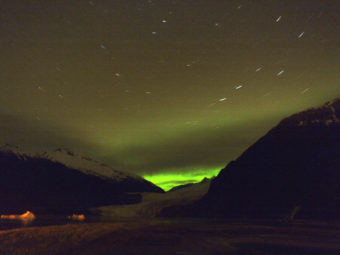
Six-minute combined night exposure of Mendenhall Glacier and Mendenhall Lake on Nov. 9, 2013. (Photo by Matt Miller/KTOO)

Juneau residents may be in for a visual treat this week. Expect to see displays of the aurora borealis — or northern lights — because of the sun’s activity and a rare Southeast Alaska weather forecast for clear skies overnight.

How is the aurora created? Think of a neon light. When you plug it in, the electricity excites the gases inside the tube.

“They really are the same processes that happen in the neon sign are happening in the aurora. Aurora is just bigger,” says Donald Hampton, a research associate professor at the University of Alaska Fairbanks’ Geophysical Institute.

Charged particles from the sun collide with the earth’s atmosphere and create the green — and sometimes red and white — patterns that dance across the sky.

“What we have right now is what’s called a coronal hole. And what comes out of that is usually a stream of sort of faster particles,” Hampton explains. “It’s called a high-speed stream fairly often. That’s usually fairly stationary on the sun.”

“And, of course, the sun rotates every 27 days. So, we’re kind of expecting the same thing to happen here at the end of October,” says Hampton. “And that’s why the forecast is showing some pretty good signs for aurora.”

Hampton says it’s difficult to predict how long the display will last, how intense it will be, or where it will be visible. But he says it’ll likely last several days and be visible overhead to Anchorage residents.

Juneau residents should look to the northern horizon after 10 o’clock at night.


Related resources and web links:

UAF Geophysical Institute’s aurora forecast
Poker Flat Allsky Aurora Camera
Aurorasaurus – Reporting Auroras from the Ground Up
NOAA Space Weather Prediction Center

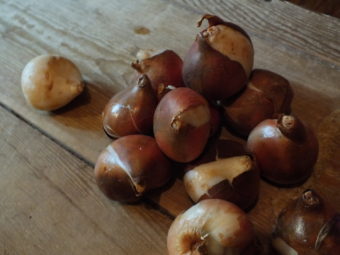
Gardentalk – How to plant flower and garlic bulbs this fall

Bulbs ready for planting.
Bulbs ready for planting. (Photo by Matt Miller/KTOO)

As temperatures slide below freezing this month, now is a good time to plant flower and garlic bulbs.

“Obviously, the ground should not be frozen,” says Master Gardner Ed Buyarski. “That makes it a lot easier.

He suggests working compost and other organic fertilizer into the soil before digging holes for the bulbs. Garlic, especially, is a heavy feeder over the winter.

Planting guide attached to bag of bulbs (Photo by Matt Miller/KTOO)

Garlic bulbs should be planted pointy end up, about two or three inches deep, with uniform spacing about six inches apart. Rake soil over the holes and cover with seaweed or compost. Then cover the whole planter with clear plastic or tarps so the bulbs don’t get moldy and the fertilizer doesn’t leach away in the rain.

Flower bulbs should be planted differently, according to the variety. Check the bag or box for specific instructions on planting depth and spacing.

Buyarski says he usually digs a small trench for planting a large number of bulbs all at once. Sprinkle in some bulb fertilizer just before planting the bulbs. Replace the soil over the bulbs in the trench or hole, and then cover it with mulch.

Planting guide attached to bag of bulbs (Photo by Matt Miller/KTOO)

Once bulbs get twelve to sixteen weeks of temperatures below 40 degrees, that will trigger green sprout formation.

Just cross your fingers that Juneau doesn’t experience another mild spell later this winter.

If there’s another hard freeze after the bulbs sprout early, then both the bulb and eventual blossom could be damaged.

Census Bureau claims nearly all Alaska households have been counted

2020 Census materials including envelope and plastic bags for leaving census forms
2020 Census materials distributed by this year’s enumerators. (Davis Hovey, KNOM)

Unless there is further action by the courts, the counting in the U.S. Census is expected to end on Oct. 31.

Meanwhile, the Census Bureau reports that almost all Alaska households have been counted already. But the accuracy of that number is in question.

Andrew Smith spent the summer as a census taker in Palmer, Wasilla and near Glenallen.

“Sometimes it would surprise people,” he said, about approaching people on their property. “But I would always make it a good experience and say ‘Hi, I’m the census guy!’ Make myself known in a very polite and respectful way.”

Smith says he always kept a few things in mind. Wearing a safety vest, standing in the light, being aware and quickly reading the situation.

“If someone curses at you, you should just turn around,” Smith said. “There were a couple rough characters that were just not interested. And you just say ‘OK. Have a good day! Thank you! Bye bye!’”

Smith says he would also do quality control follow-up by phone for Alaskans who had already called, mailed in or filled out an online census form.

An aspiring musher from Oregon, Smith says he had lost his dog handling job during the pandemic. He later helped the Salvation Army with their relief efforts and struggled for a while this summer to find a place to stay.

“I still needed to make really some good income, and I thought this would be a good opportunity with my initial plan,” Smith says. “This was actually perfect timing.”

The 2020 Census efforts began in January as enumerators and trainers began work in Toksook Bay, Alaska. (Photo courtesy U.S. Census Bureau)

The nationwide census started in January in Toksook Bay, Alaska with what the Census Bureau calls their remote operation. Census takers went door-to-door in rural Alaska communities while the ice and snow made travel easier — and before residents got busy in the spring with subsistence and construction.

Then there was the self-response phase, when residents in larger Alaska communities and cities were encouraged to go online, call or mail in their own census form.

“The best response is the self-response because we want to make sure that the information comes from the person,” says Donald Bendz, spokesman for the Census Bureau.

Bendz says census takers went door-to-door again in Alaska to get data missing from the self-response phase, sometimes making multiple household visits.

“If we can’t get a hold of someone at a household, we talk to a neighbor,” Bendz says. “It’s called using a proxy, and that’s a standard operating procedure.”

According to the Census Bureau, just over 54 percent of Alaska households participated in the self-response phase, while just over 45 percent were counted by census takers.

“We are committed to getting 100-percent of the state counted,” Bendz says. “Right now [Sept. 29] being at 99.8 percent, we still have .2 percent to be done. So, we want to continue to encourage everyone who hasn’t responded to the census to do so.”

But some people are questioning those figures.

“The total response rate of well over 99 percent, I think, is misleading,” says Terri Ann Lowenthal, former staff director of the U.S House census oversight subcommittee.

Lowenthal says the percentage of completed housing units doesn’t say anything about the accuracy, quality, and completeness of the census.
“There are people who live in group facilities such as college dorms, nursing homes and so forth,” Lowenthal says. “There are people experiencing homelessness or living in shelters or an outdoor location. And then people in transitory locations such as RV parks, single room occupancy motels, and so forth.”

Lowenthal says those counts were delayed and disrupted by the pandemic.

She also says there are problems using a proxy.

“Your neighbors or landlord don’t always know everything about your household, even everybody who lives there who is not supposed to be living there, let’s say, and certainly may not know much about the demographic characteristics of the household members,” Lowenthal says.

In the 2010 census, Lowenthal says a proxy was used while counting almost a quarter of all households.

Census data is used to divide up the seats in the U.S. House of Representatives. It’s used in state redistricting. And it also determines where about $1.5 trillion in federal funding will be spent.

Jacqueline Pata, CEO of Tlingit Haida Regional Housing Authority, says that data is crucial for funding for things like tribal housing and transportation.

“In fact, it has been calculated that about $41,000 will come to your community if a typical household fills out their census form. And that’s critical money,” Pata says.

For now, the count goes on.

The Trump Administration has put an end-of-year deadline on reporting the data. Pata doesn’t think that’s enough time for the necessary quality control and double-checking, and she worries some Alaskans won’t be counted properly.

Gardentalk — How to stretch your harvest well into fall

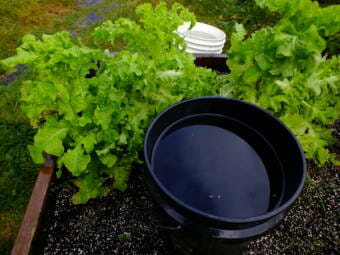
Cold sink buckets
These buckets of water, particularly when placed inside a greenhouse, can delay or even prevent the effects of a frost or sharp freeze. (Photo by Matt Miller/KTOO)

Temperatures are dropping, and the amount of daylight is diminishing rapidly each day. But it’s hardly the time to give up entirely on gardening.

Master Gardener Ed Buyarski says he’s stopped watering his greenhouse tomatoes as a way to force them to ripen.

“Peppers, eggplants, zucchini, squash — all of those are pretty tender. They, too, are kind of semi-tropical,” Buyarski says. “We can wrap them up in fleece blankets (or) put buckets of water in around them, that helps slow the freezing process.”

The fleece blankets will provide as much as five degrees of insulation. The buckets of water will act as cold sinks, delaying or even preventing freezing in some cases.

For potatoes, cut off the plant above the soil and put a tarp over the mound. That will keep the potatoes dry and help the skins toughen up before digging them up for indoor curing.

“Our carrots, cabbages, kale, parsnips, turnips, rutabagas — I guess all those cabbage family plants particularly — will get better with colder weather,” Buyarski explains.

“Their sugar content increases,” he says. “So, we can leave them out there and just harvest them as we need them until a really hard frost threatens, that might actually freeze the soil.”

Buyarski says he’s even harvested brussel sprouts, carrots and parsnips late into the fall and early winter.

Weekend storm brings wind, rain and even lightning to Southeast Alaska

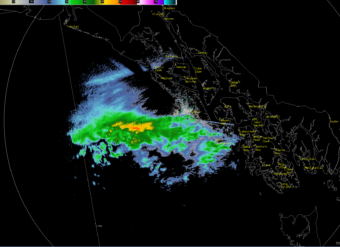
Radar image of a warm front moving into Southeast Alaska the afternoon of Sep. 29, 2020 (Courtesy of National Weather Service Juneau office)

Southeast Alaska just had its first big fall storm of the year.

“This is more normal than what last year was,” said Kimberly Vaughan with the National Weather Service in Juneau. “Last year definitely had more of a lamb-type fall and where this one is coming in with a lion.”

Vaughan says windy conditions were recorded all around Southeast Alaska over the weekend.

Wind gusts topped 68 miles per hour in Sitka and 62 in Hydaburg. In Craig, the wind blew over a shed.

Winds only gusted to 34 miles per hour at the largely sheltered downtown Juneau harbors Sunday afternoon. But they topped out at 57 mph at nearby Scull Island, 37 at Portland Island and 48 at Little Island.

Rainfall was significant but not unusual. Only 2.08 inches were recorded falling Saturday and Sunday at the Juneau airport.

And there was a light show to go along with the rain Monday morning.

“One of the residual things, though, that is happening as the storm is exiting the area is some lightning activity again (Monday) morning,” Vaughan said. “So we’ve had actually indications of a lightning strike down near Taku Inlet and also a big cluster up by just north of Berners Bay.”

Lightning was also reported along the outer coast of Southeast Alaska and up near Yakutat.

Vaughan says the high winds, rainfall and lightning occurred as a low pressure system moved through the area. That happened as cold air from Russia and the Bering Strait pressed down on warmer air rising from Gulf of Alaska waters.

Site notifications
Update notification options
Subscribe to notifications