I’m up early every weekday morning pulling together all the news and information you need to start your day. I find the stories unique to Juneau or Southeast Alaska that may linger or become food-for-thought at the end of your day. What information do you need from me to give your day some context?
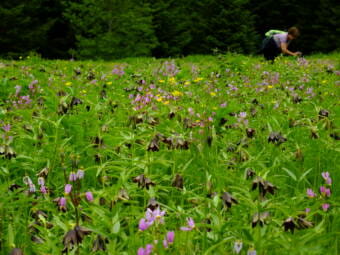
A kaleidoscope of Alaskan wildflowers in a meadow off Sawmill Creek, near Berners Bay. (Photo by Matt Miller/KTOO)
If you’ve ever coveted your neighbor’s prize cucumbers or wanted to duplicate an Alaskan wildflower meadow in your backyard, there’s a way you can do that. Just collect the seeds and plant them yourself.
Master Gardener Ed Buyarski says he collects seeds from kale, radish, parsnips and spinach in his garden. He’s also tried growing shooting stars, wild columbine and chocolate lily flowers from collected seeds. But timing is key.
“Those can all be collected once the seed pods, the stems finish blooming, turn brown — and then some of those seed pods will start to open up,” Buyarski says. “If you wait too long, they will seed themselves out across your garden. Kind of like in my garden, I’ve got kale growing everywhere where it has gone to flower over many years.”
Purple or mountain shooting star near Juneau. (Photo by Matt Miller/KTOO)
Buyarski says he’s now growing primrose seedlings from seeds that he collected in April from the plant’s tall stem.
Lupines and geraniums have seed pods that explode to spread their seeds out further away from the plant. Buyarski recommends picking the pods before they burst, while they’re still a little bit green. Put them into a cardboard box and store them in a dry place, like a garage.
Seeds can be dried over the winter or planted immediately. In the latter case, they will become dormant with this winter’s cold weather before naturally sprouting in the spring.
Kale, columbine and mustard seed pods selected by Ed Buyarski from KTOO’s Agricultural Test Station and Garden of Science. (Photo by Matt Miller/KTOO)
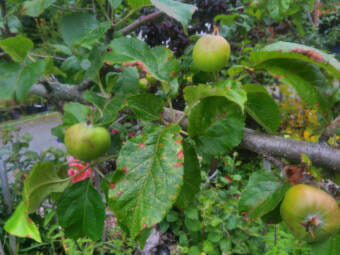
This locally grown apple tree has already been thinned of extra fruit. (Photo courtesy Ed Buyarski)
It may seem a little counter-intuitive at first. But you have to get rid of some apples now to get bigger and better tasting ones at the end of the season.
Master Gardener Ed Buyarski says gardeners should thin out clusters of four or five apples to a reasonable leaf-to-apple ratio.
“Somebody who’s being really obsessive, they say forty leaves to one fruit,’ Buyarski said.
He prefers leaving one per cluster so that the remaining apples are spaced out along a branch.
Thinning apples will allow more color and sugars to develop in the remaining fruit. It will also extend the life of the tree because it removes extra weight that could break limbs and branches.
Any scabby or wormy apples should be thrown in the garbage, not in the compost.
Buyarski is also thinning out beets and carrots to about an inch apart before starting with mid-season planting. It’s also time to start planting lettuce, radish and turnips seeds.
Peony flowers and stems should be picked before they bloom. For proper timing, Buyarski says buds should feel like a marshmallow just before all the flower petals open up. This way, peonies will last much longer than if you waited for the flowers to fully open before picking them.
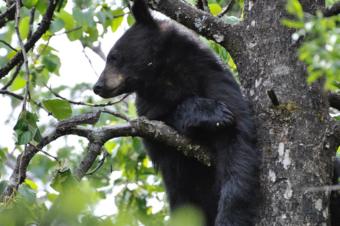
Bear #153, who is not suspected in Friday’s incident. (Courtesy of Laurie Craig, USFS)
A black bear entered a Juneau home late Friday evening. It walked through the arctic entryway and into the living room.
Alaska Department of Fish and Game’s Roy Churchwell said the bear surprised three adults and ten children inside.
“Mom was able to gather up the kids and lock them in and back room with herself while the father and a friend tried to shoo the bear out of the main living area,” Churchwell said. “The bear did jump on the friend at one point as they were trying to shoo it out.”
The Lotts’ friend sustained puncture wounds and scratches. They were minor injuries, but the Juneau Police Department reports he sought medical attention at Bartlett Regional Hospital.
Churchwell believes the man’s injuries were likely caused by the bear’s claws.
The bear then clawed its way out of the entryway, damaging it, before escaping into the woods behind Switzer Village.
A bear trap was placed behind the home on Saturday. It trapped a smaller bear previously observed getting into garbage in the area. That bear was euthanized.
But the home intruder is still at large. Based on descriptions, it is an older, male black bear about 250 to 300 pounds with a faded ear tag. If it’s captured, it will likely be euthanized, too, since it has already threatened life and property.
Churchwell said bears seem to be more prevalent in town this summer because their normal, natural food sources are not readily available.
“There aren’t hardly any fish in the rivers for the bears to eat currently, and the berry crop seems to be pretty minimal and failed, maybe even failed in some areas,” Churchwell said.
This isn’t the first time bears that have sniffed out potential food sources in a residential area recently. Just last month, downtown Juneau residents reported bears getting into their vehicles.
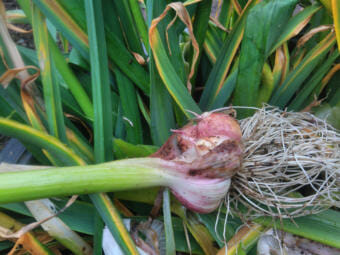
Freshly harvested garlic (Photo courtesy of Ed Buyarski)
After nine months of patiently waiting, this is the moment many Southeast Alaska gardeners have been anticipating. Garlic is probably ready for harvest, right now.
Master Gardener Ed Buyarski with a bunch of freshly harvested garlic in front of a garlic planter. (Photo courtesy of Ed Buyarski)
Master Gardener Ed Buyarski reminds gardeners of the key signals for harvest — the unfurling of bulbous scapes and the yellowing of the lowest leaves of the garlic plant.
Carefully check if the garlic bulbs in the soil are big enough for harvest, with intact skins that are free of mold.
Moldy garlic (see photo below) should be removed immediately so that other garlic is not infected.
Plants with moldy garlic stems or skins should be cleaned and processed separately to avoid transmitting mold spores.
Dispose or throw out the moldy parts in the trash, not in your compost bin, where they will contaminate other organic matter.
For mold-free garlic, you can cut the stems to about 6 inches, remove the roots and use the leaves in soups and salads.
Clean off the dirt and then store and dry the garlic for about two weeks in a warm, dry place — like a furnace room — where temperatures may be 70 to 80 degrees.
But you don’t have to harvest everything right now.
“That is the game I’m playing,” says Buyarski.
He says he’s leaving other a few other garlic plants in the ground so they can get bigger in any warm and dry weather that comes over the next few weeks.
Garlic with white or gray mold (left) and healthy garlic (right). Gardeners should clean and process moldy garlic separately and dispose of the moldy skins and the stems in the trash, not in the compost. (Photo courtesy of Ed Buyarski)
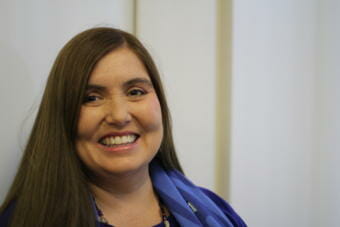
Ingrid Cumberlidge, a former tribal judge and educator, has been named Alaska’s Missing and Murdered Indigenous Persons Coordinator. (Photo by Wesley Early/Alaska Public Media)
On July 27, the U.S. Department of Interior announced it will open its first office dedicated to investigating cold cases in what has been called an epidemic of Murdered and Missing Indigenous People. There will be seven of these offices nationwide. Alaska’s office will be in Anchorage and opens next month.
Cumberlidge was a teacher and principal in the Aleutians East Borough School District and also served as tribal judge who presided over child protection and protective order cases.
Her new job will include helping communities develop response plans for times when someone is murdered or goes missing.
She was appointed to the position by the U.S. Attorney’s office — part of the Justice Department.
U.S. Attorney Bryan Schroder says Cumberlidge will also help investigators sift through the state’s missing persons database.
“It’s challenging, though. That can include things like missing fishermen off of ships or aviation accidents,” Schroder said. “So, trying to comb through all that data and come out with the lists of people who could be missing or murdered because of foul play, you know, that’s a difficult task.”
That work will be important as the new federal office in Anchorage gears up to tackle cold cases involving missing and murdered American Indians and Alaska Natives.
Debra O’Gara is optimistic and says it’s a sign that the issue is being taken seriously.
“Attorney General’s office and the Department of Justice is at least willing to take some steps in helping to remedy the situation that has just devastated so many communities and families,” she said.
O’Gara is with the Fairbanks-based Alaska Native Women’s Resource Center and herself served as a tribal judge and state magistrate judge in Southeast Alaska.
She says there are several factors behind Alaska’s high number of cases, most stem from the racism, sexism, and misogyny ingrained into institutions.
O’Gara says the authorities have routinely shown outright disregard for missing or murdered Indigenous women.
“The other problem is that even when there is law enforcement in a village, in a small village, what’s happened is that some of those law enforcement are perpetrators themselves having been already fired,” she said. “And, some of those stories are coming out.”
O’Gara says another problem unique to Alaska is it may take days for investigators to get to a village by plane or snowmachine. Investigations can slow down or stall as a result.
According to the Seattle-based Urban Indian Health Institute, 52 Indigenous women and girls are listed as missing or murdered in Alaska. That’s the fourth highest of all states.
Anchorage alone has 31 cases. It’s the third highest of all cities nationwide.
Cumberlidge’s position is funded for at least a year. It comes out of $1.5 million set aside by the Justice Department to hire coordinators in 11 states, and partially stems from U.S. Attorney General William Barr’s visit to Alaska last year.
Panoramic view of Suicide Basin looking north. (Photo and illustration by Christian Kienholz, UAS/USGS)
Scientists, emergency managers and Juneau residents are bracing for an event at the Mendenhall Glacier that could flood a nearby lake and river again. The now-yearly phenomenon is caused by climate change.
The important vocabulary word for this story is jökulhlaup — pronounced yo-KOOL-lahp — an Icelandic word for a glacial dam release or flood.
“The famous examples are from Iceland, where they have really massive outburst floods,” said Jason Amundson, who studies and teaches about glaciers as associate professor of geophysics at the University of Alaska Southeast. “Those are geothermally driven.”
“So, you have a glacier sitting on a volcano and you get this sort of subglacial lake sitting there,” said Amundson. “And then, that can drain catastrophically. That’s definitely affected the road system and knocked out two pretty big bridges.”
(Courtesy of National Oceanic and Atmospheric Administration)
Amundson said jökulhlaups in Alaska and off the Mendenhall Glacier happen a little differently.
Ice melt and rainfall accumulate every summer in Suicide Basin, a gigantic bowl-shaped valley adjacent to the glacier and about two miles up. The basin was carved out of the granite by a much smaller glacier, which retreated in the last few decades because of climate change. So much water builds up in the basin that the side of the Mendenhall Glacier starts floating. The water’s immense pressure also creates cracks in the ice called conduits.
“The water starts melting the conduit bigger and bigger,” explained Amundson. “So, as the water flows through, the discharge is low. But as it’s flowing, it melts the channel and the channel gets bigger which makes the discharge get bigger which makes the melt rate higher until you get this rapid growth.”
All that water dumps into Mendenhall Lake and Mendenhall River in a matter of hours.
Amundson said there are other glaciers around Alaska that have similar releases.
That’s why Jamie Pierce of the U.S. Geological Survey attached monitoring equipment to the high-angle rock walls of Suicide Basin in 2012.
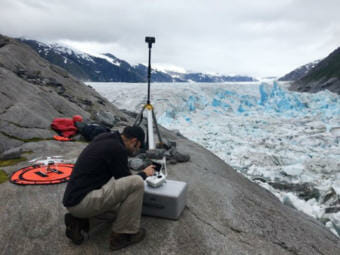
Setting up equipment and preparing for a drone survey of Suicide Basin in Spring 2020. This view from the southern ridge of the basin is looking west with the Mendenhall Glacier in the background. (Photo courtesy Jamie Pierce/USGS)
“(It) worked for a couple of years, but then the ice just sheared the cable,” Pierce laughs. “I didn’t think the ice would cream it, but it did. It kind of showed the power of this stuff. I mean, really!”
New underwater instruments, without the metal cabling, were installed last year.
The UGS shares that data with researchers and other agencies so they can warn the public.
Aaron Jacobs, a hydrologist with the National Weather Service in Juneau, says they’ve documented jökulhlaups on the Mendenhall every year since 2011.
“Typically see one to two a year,” Jacobs said. “But there’ve been years in which we’ve seen multiple glacial dam releases, but on a smaller magnitude or size.”
In the past, all of the water would flow out of Suicide Basin under or through the glacier. But scientists have noticed something new. The side of the glacier, which acts as a giant ice dam, is thinning and getting lower because of climate change. Water spilled over that ice dam for the first time last year.
Then, scientists noticed in mid-July this year that the basin’s rising water caused a portion of that ice dam to calve or break off.
“It pushed a whole bunch more ice into the basin and made for some very huge, monster icebergs,” Jacobs said.
Water is already spilling over the ice dam. And the lake below the glacier is already approaching flood stage from rain water.
The big jökulhlaup could happen anytime.
Scientists say it’s tricky to predict how big the flood will be this time because the basin and the amount of water inside it are constantly changing.
View of Suicide Basin looking south shows some of the instruments and how they are placed there. (Photo and illustration by Christian Kienholz, UAS/USGS)
Close
Update notification options
Subscribe to notifications
Subscribe
Get notifications about news related to the topics you care about. You can unsubscribe anytime.