Matt Miller

Morning Host & Local News Reporter

I’m up early every weekday morning pulling together all the news and information you need to start your day. I find the stories unique to Juneau or Southeast Alaska that may linger or become food-for-thought at the end of your day. What information do you need from me to give your day some context?
Gardentalk – How to reuse your kitchen food waste as nutrients for your garden

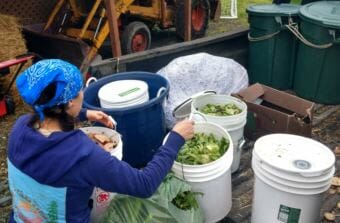
Lisa Daugherty, owner of Juneau Composts!, unloads residential food scraps in 2017. (Photo by Jacob Resneck/KTOO)

Instead of dumping food waste into garbage cans that may be emptied in a landfill with a limited life span, many gardeners reduce their waste stream by composting food scraps and garden debris. The materials decompose or break down into basic nutrients that benefit a flower or vegetable garden.

Master Gardener Ed Buyarski says the bigger you can make your compost bin or pile, the better.

“Size matters,” Buyarski said.

Food scraps and dead leaves will get hotter and break down faster in a big compost bin, especially if you chop the organic matter up into very small pieces.

Adding horse, chicken or other livestock manure will generate the worms and microorganisms that will accelerate the decomposition process.

How do you know how much of a certain material to put into your compost pile? Buyarski says most gardeners follow a green-to-brown ratio of 30 to 1.

Greens are usually green leaves and grass that may be higher in nitrogen and moisture.

Browns are typically materials that are drier and higher in carbon like sawdust, paper, and dead leaves.

Buyarski cautions against using materials that may contaminate a compost bin. They include colored paper, wood or sawdust from treated lumber, and grass clippings from a lawn that has had weed-and-feed applied to it.

Also, do not compost any diseased or infested plants or invasive weeds. Just throw those out into the garbage.

At least two Juneau bears seen rifling through unlocked vehicles in search of food

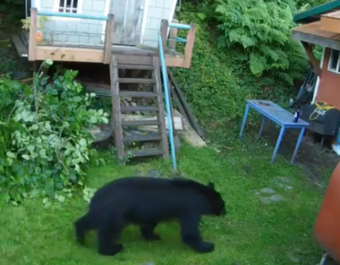
A black bear on Douglas Island (Photo by Elizabeth Jenkins/Alaska’s Energy Desk)

Berries are ripening at lower elevations around Juneau, but the salmon runs have been sparse so far. And so, Juneau’s bear population has been getting creative.

At least two different bears in the area have been opening car doors in search of food, and they have a preferred style of door handle.

“It’s mostly the flat ones that are kind of long and wide,” said Alaska Department of Fish and Game’s Roy Churchwell. “It looks [like] it usually starts, at least, by trying to open the door with its mouth. So, maybe a door handle that you push in the button might be a little more difficult for this bear.”

Churchwell said one vehicle with locked doors was damaged when a bear climbed onto the hood and smashed the windshield trying to get in.

Screenshot of a Facebook post featuring photos of a broken car windshield.
Michelle Murinko posted these photos of her car windshield on Facebook on July 13, 2020, saying it was broken by a bear throwing a trashcan at it (Screenshot taken on July 17, 2020).

He said bears have a sense of smell seven times greater than a bloodhound.

“We’ve heard of the bear getting in there for just a small can of peanuts,” Churchwell said. “So, any food or food residue, or food smell that you can keep out of your car, we’re asking people to try and keep their vehicles as clean as they can.”

In addition to removing other attractants like birdseed and pet food, Churchwell recommends locking vehicle doors.

One bear has been getting into vehicles in the Mendenhall Peninsula area along Engineers Cutoff. The other is closer to downtown, starting with vehicles in the Mountainside neighborhood above Twin Lakes. It was recently spotted near Highland Drive and Behrends Avenue.
Churchwell said they put out a trap for that bear. But it moved away from the area before it could be trapped and relocated.

Gardentalk – Pick your garlic scapes when they curl

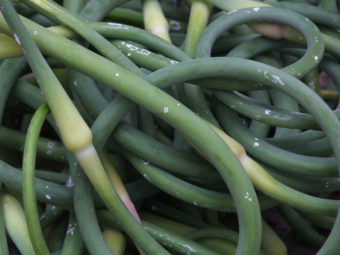
Recently harvested garlic scapes.
Recently harvested garlic scapes. (Photo by Matt Miller/KTOO)

It’s a key moment for gardeners who have been patiently waiting since they planted garlic as much as nine months ago. The garlic scapes — the round, bulbous, center stem-like part of the plant — are now curling into loops.

That’s a big sign for gardeners that their garlic bulbs will soon be ready for harvesting, perhaps within a few weeks.

Garlic scape is all curled up in a North Douglas garden.
Garlic scape is all curled up in a North Douglas garden. (Photo by Matt Miller/KTOO)

Master Gardener Ed Buyarski suggests gardeners snap off the scapes and use them like green onions or make a garlic scape pesto. The garlic plant will then devote the remainder of its energy into the bulb’s growth instead.

Buyarski says he harvests most of the scapes, but leaves just a few remaining in his garlic patch to provide another clue about harvesting the bulbs.

“Timing is important,” he says.

When the scapes fully uncurl and the plant’s lower leaves turn yellow, then that’s the signal to carefully dig into the soil to see if any of the bulbs are big enough to harvest.

It’s also a good idea to check the bulb’s skins to make sure they have not peeled off or gotten moldy.

Hundreds of garlic plants waiting to be harvested.
Hundreds of garlic plants waiting to be harvested. (Photo courtesy of Ed Buyarski)

Buyarski also answered a question from a listener.

Patte writes, “Is there any reason I shouldn’t mulch with tree needles, cones, and other natural materials? We get a lot of it. I layer cardboard first.”

“Certainly. Go for it,” Buyarski says.

Buyarski urges caution because the needles and cones will make the soil more acidic.

That may be ideal for rhododendrons, azaleas, and evergreens.

But not for peonies and lilacs, for example, which prefer sweeter soil. Buyarski says adding lime or wood ash will keep the acidity down.

Taku River turns cold, runs fast after glacial dam release in the Juneau Icefield

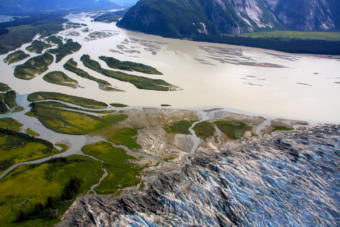
Aerial view of the Taku River basin.
Aerial view of the Taku River basin. (Creative Commons photo by Lee LeFever)

A glacial dam release in the Juneau Icefield caused the Taku River to swell over the holiday weekend.

The National Weather Service issued a flood advisory on July 4 when a river gauge at the Canadian border showed water levels rapidly rising.
The river peaked at about 2 o’clock the next morning.

Senior hydrologist Aaron Jacobs said water temperatures dropped and river flow doubled from 40,000 to 80,000 cubic feet per second.

“There’s a lot of debris coming down the river, a lot of logs. There can be some icebergs that come down,” Jacobs said. “So, it can be treacherous during these events along the Taku River. People who do live around there are definitely aware of these events and I think they take their precautions when events are ongoing.”

Jacobs said there were no reports of damage or injuries from cabin owners or anyone recreating along the Taku River.

There have been glacial dam releases — called jökulhlaups — into the Taku River in previous years. Jacobs says they’re usually caused by the frequent damming of Lake No Lake by the Tulsequah Glacier.

Jacobs said this release was a little smaller than previous ones and a second release this summer is still likely.

Update: California hiker dies after apparent fall near Juneau’s Perseverance Trail

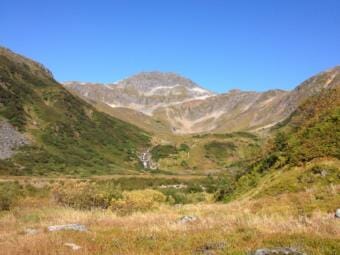
Granite Creek Basin on a sunny September day
Granite Creek Basin in September 2019. The area is accessed via the Granite Creek Trail, which starts 2 miles up Juneau’s popular Perseverance Trail. (Jennifer Pemberton / KTOO)

A man is dead after an apparent hiking accident near Juneau’s Perseverance Trail on Friday, July 3.

Juneau police have identified the man who died as 36-year-old California resident Anthony Michael Medina.

Lieutenant Krag Campbell said in an email that Medina and a Juneau resident were hiking in the area and slid down a snow chute. Medina slipped off about an eight-foot drop and hit his head on a rock. Capital City Fire/Rescue Chief Rich Etheridge says the man suffered a massive head injury.
Etheridge says some members of Juneau Mountain Rescue were already in the area and responded to the scene. The Alaska State Troopers also responded.

“We sent two of our paramedics up to Basin Road on a helicopter,” said Etheridge. “They were able to load the patient up and start doing an assessment. [They] took him straight to Bartlett [Regional] Hospital.”

Medina was declared dead at the hospital.

Campbell said Medina’s family have been notified.

Note: This story has been updated.

Gardentalk – Your best tools for this summer’s slugs

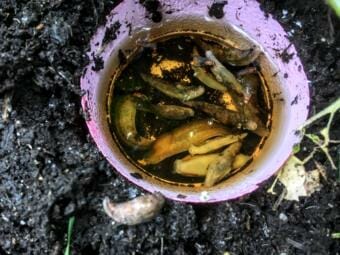
Beer trap
Beer trap improvised from a discarded plastic cup attracts a whole bunch of slugs in a North Douglas garden. (Photo by Matt Miller/KTOO)

Where there’s rain, there are also slugs.

June 2020 just tied with June 1949 for 25 days of measurable rain, the most ever for the month of June in Juneau. June 2020 is also the second-wettest June ever with 7.3 inches of rain at the Juneau International Airport.

With so much moisture, Master Gardener Ed Buyarski knows that gardeners may feel that their battle with slugs is never ending. Slugs like to hide under vegetation and prefer feeding on beets, lettuce, cabbage and other leafy greens.

But Buyarski says gardeners can use several techniques to make their garden nearly slug-free.

  • Use two fingers or pair of bricks to squish them
  • Spray a solution of half ammonia and half water on the slugs
  • Set out slug and snail bait like Sluggo
  • Make beer traps that will attract slugs and drown them in a drunken stupor

Of all the methods, the squish and spray methods probably take the most effort.

Slug!
Intruder Alert! – Invader spotted in a raised bed of bolting spinach in a North Douglas garden. (Photo by Matt Miller/KTOO)

Slug bait and beer traps usually require minimal maintenance other than cleaning out dead slugs and refreshing the bait. Ideally, the traps should have some sort of cover or be placed under plants to protect them from the rain.

Beer bottles with about an inch of beer inside work great as traps with the bottle laying on it’s side. The bottle’s closed end should be slightly buried while the mouth should be level with the soil.

Other slug mitigation techniques include mini-hoop houses over plants to keep them relatively dry during constant rains.

Cleaning up old leaves and other yard debris can also eliminate much of the slugs’ hiding places and egg-laying spots.

Listener Debby also asked about another pest: “How do I get rid of fungus gnat infestation on indoor plants?”

Buyarski says the gnats feed on the organic matter in the potting soil.

He recommends keeping the surface of the potting soil as dry as possible or covering it with a half-inch layer of play sand.

Buyarski also says the biological larvicide Gnatrol will work. It should be diluted before pouring it on the soil and plants.

Slugs on radish leaves
Holes in these radish leaves are the tell-tale bite marks of slugs. (Photo by Matt Miller/KTOO)
Site notifications
Update notification options
Subscribe to notifications