I’m up early every weekday morning pulling together all the news and information you need to start your day. I find the stories unique to Juneau or Southeast Alaska that may linger or become food-for-thought at the end of your day. What information do you need from me to give your day some context?

View from near jury box of the courtroom that is part of the Robert Boochever U.S. Courthouse located on the ninth floor of the Hurff Ackerman Saunders Federal Building in Juneau. (Photo by Matt Miller/KTOO)
There won’t be any jury trials in Alaska until at least September because of concerns over potentially spreading COVID-19 inside Alaska’s courtrooms.
Alaska Supreme Court Chief Justice Joel Bolger issued the order on Monday, saying the number of coronavirus cases remains high and it’s not possible to maintain social distancing in courthouses around the state.
In a typical jury trial, dozens or even hundreds of people at a time might be called to a courthouse for jury selection. Then, during the trial, the courtroom is packed with jurors, court staff, attorneys and clients, witnesses and even spectators.
“We’re not going to see that at this time,” said Bolger. “I don’t know when it will be safe to do that. We won’t see that until it is safe to do that.”
In Monday’s order, Bolger says most courtrooms do not have adequate space for social distancing and they need more time to come up with new procedures to safely hold jury trials.
Most non-emergency civil and criminal court proceedings were suspended in late March when the coronavirus began to spread.
Those started back up again June 1st, and included allowances for witnesses to testify before grand juries by telephone or videoconference.
Celebration grand processional June 6, 2018, in Juneau. (Photo by Adelyn Baxter/KTOO)
One of Southeast Alaska’s biggest cultural events was supposed to kick off in Juneau on June 10. But Celebration 2020 has been postponed at least a year because of the coronavirus pandemic.
Harvey Shields is a leader with the Cape Fox Dancers in Saxman and he remembers the months, even years it sometimes takes to plan and prepare for Celebration in Juneau.
Of course, there’s practicing song and dance.
Then, there’s all the fundraising to pay for transportation and lodging for as many as a hundred people in the dance group.
“We all go by ferry as far as being the least amount (of money) for the dance group,” Sheilds said. “It’s real hard to take that many on a plane.”
And, there’s creating new regalia, especially for kids who are just learning the songs, dances and stories themselves.
“I really enjoy watching and seeing the younger kids being a big part of it because there are the ones that’s going to take over of what we’ve been doing for a lot of years,” he said.
Celebration 2018 grand processional June 6, 2018, in Juneau. (Photo by Adelyn Baxter/KTOO)
Celebration started in 1982 when only a few hundred Tlingit, Haida and Tsimshian people met in Juneau. Now held every two years, it has since grown to be one of the largest cultural gatherings in Alaska.
Celebration is not happening this year because of the coronavirus pandemic. But Shields says, he understands.
“Our elders have to be taken care of very special because that’s who we look up to,” Shields said.
In downtown Juneau this week, it’s relatively quiet as a handful of vehicles and buses drive through during morning rush hour.
Missing are the parades of several thousand people dressed in their colorful regalia, drumming and singing through downtown Juneau. The convention center where nearly fifty dance groups would perform continuously for days is silent.
Instead, Celebration has gone virtual this year with popular events like the juried art show and a fashion show held on line.
“I think there’s a lot of people right now that are heartbroken in the Yukon that want to be at Celebration,” said Teslin resident Juanita Kremer.
She counts about 450 other Tlingit around her community.
Kremer said it’s always a powerful experience to meet up with so many Tlingit from Southeast Alaska and beyond.
“And a lot more language speakers, a lot more knowledge carriers than we realize,” Kremer said. “So, it really just reinvigorates my soul to go to Celebration and see Tlingit dancers and language, and culture, our foods brought to the forefront.”
Kremer said a lot of people have developed relationships and created bonds up and down the coast because of Celebration.
For Shields, it’s also about rediscovering forgotten family connections. He said it’s not uncommon to meet a family member at Celebration and not even know it at first. But then everyone names their parents and grandparents and where they’re from, siblings,and aunties and uncles.
“That gets them to thinking: ‘Well, that’s my aunt as well and that’s my uncle. And, that’s my aunt and uncle as well,’” Sheilds remembers. “From there, that’s where it comes out.”
Celebration 2020 has been rescheduled for June 2021.
In the meantime, Kremer said they’ve been filling the void by watching previous Celebration events on social media.
Editor’s note: KTOO is under contract with Sealaska Heritage Institute to produce television and online video coverage of this year’s virtual Celebration.
A low tide leaves shellfish exposed on a beach near Juneau, Nov. 17, 2018. (Photo by Ryan Cunningham/KTOO)
Researchers say they have found elevated levels of toxins in Juneau area shellfish that can cause paralytic shellfish poisoning.
The toxins come from harmful algal blooms.
Sitka-based Southeast Alaska Tribal Ocean Research, or SEATOR, reports the toxins were found in blue mussels collected from the Point Louisa/Auke Recreation Area.
They were at 92 micrograms, over the Food and Drug Administration regulatory limit of 80 micrograms for every 100 grams of shellfish.
Lindsay Pierce, an environmental technician with the Central Council of Tlingit and Haida Indian Tribes of Alaska, said blue mussels are a leading indicator for shellfish poisoning, or PSP.
“Blue mussels filter faster than cockles and cockles filter faster than butterclams,” Pierce said. “So, like the butterclams, I think, have been over the federal limit for over a year.”
Pierce said that toxin levels can vary widely over time or from beach to beach.
Paralytic shellfish poisoning can be fatal. Pierce said the toxins cannot be removed by cooking or freezing. Some of the symptoms include nausea, difficulty breathing, and tingling in the lips and the body.
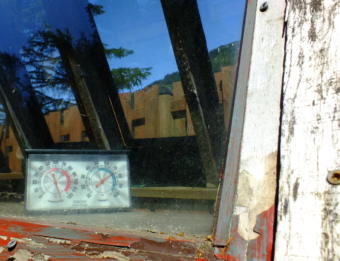
Air inside this North Douglas greenhouse made from upcycled double-paned windows already has exceeded 120 degrees and 70 percent humidity before noon in late May 2020. (Photo by Matt Miller/KTOO)
It is certainly possible for your greenhouse to start overheating, even in Southeast Alaska’s usually cool and damp climate. Not only will some plants and vegetables be unable to tolerate such extremely hot conditions, it would also be uncomfortable for a gardener to work inside.
Master Gardener Ed Buyarski recommends keeping greenhouse air from exceeding 100 degrees. That can be done by using fans and opening doors, windows, and vents to pull in cool air and push out hot air.
“They actually talk about moving a greenhouse full of air every minute or every two minutes,” Buyarski said.
High humidity, along with poor air circulation, can kick off rapid fungus growth.
Instead of spraying water on plants in the greenhouse, Buyarski advises using a drip watering system or soaker hoses in planters.
Don’t space your plants too close together. Otherwise, air cannot flow through them.
And, covering planter soil with plastic mulch will keep most of the moisture in the soil and prevent it from quickly evaporating into the greenhouse air.
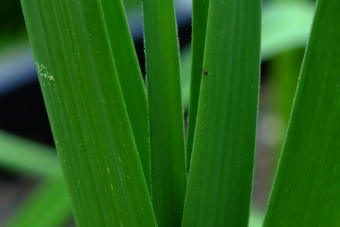
Super close-up view of pollen and a very small, winged visitor which have landed on garlic planted in a North Douglas garden. (Photo by Matt Miller/KTOO)
Master Gardener Ed Buyarski answered another batch of listener questions in this week’s segment.
Sheryll writes: “The bark on my well established (10-20 yrs old) Kiwi tree is peeling. Is that okay? Should I do something different?”
“That (peeling bark) is very normal,” Buyarski said. “Mine is, too. And, mine is 20 years plus in the ground, climbing on everything in sight or it can reach.”
Brooke writes: “We have a rising sun red bud (about) 1 year old and top seems dead. Only lower branch flowering. Sandy soil. Should we prune off the dead part?”
“Yes,” Buyarski answered. “And, that’s probably the easiest thing in pruning in general. If you see dead parts on a plant, prune them to back to live wood where then it will, hopefully, heal over most quickly.”
Alexander writes: “I have a community plot downtown planted with garlic by the person before me. Never had it before. When to harvest/let go to seed?”
Buyarski said most garlic should be thriving and well over a foot tall by now.
The garlic scape, or the bulbous, curling stem (see picture below), can be snipped off in a few weeks and used in recipes like green onions.
The rest of the plant, including the bulbs still in the soil, can be harvested starting in mid-July through August.
Garlic scape is all curled up in a North Douglas garden. (Photo by Matt Miller/KTOO)
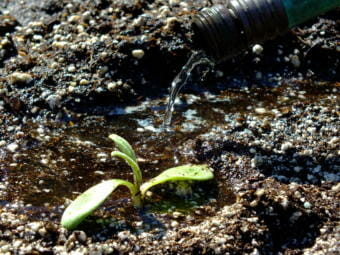
An artichoke seedling gets some water in a North Douglas garden in May 2020. (Photo by Matt Miller/KTOO)
Living in Southeast Alaska’s rainforest, it’s sometimes easy to forget when rainfall levels may be low. But even with the recent rainfall, this season could still shape up as similar to last summer’s dry conditions.
Master Gardener Ed Buyarski suggests gardeners continue checking the moisture levels of their trees, plants, and vegetables to make sure they get the water they need. He’s noticing that his primroses are wilting at the end of each day.
“If Mother Nature doesn’t provide, I guess we need to,” Buyarski said. “Or, we let the weaker ones get weeded out from the herd.”
How do you know if your plants need more water? Buyarski said it’s as simple as poking your finger down into the soil.
In pots or other containers, for example, dry soil may also pull away from the edges and start to crumble. Buyarski recommends spreading it out before watering or watering again to thoroughly moisturize the soil.
Constantly thirsty plants, like tomatoes, will noticeably wilt when they are not getting enough water.
You can water just about anytime of day, even during the height of the sun. But be careful about watering too late in the evening when little evaporation and cool temperatures can prompt fungus growth.
Buyarski also suggests looping soaker hoses around the drip line of trees and large bushes so their roots get adequate moisture.
Close
Update notification options
Subscribe to notifications
Subscribe
Get notifications about news related to the topics you care about. You can unsubscribe anytime.