Northwest News Network

Washington man travels from Puget Sound to Alaska alone on a standup paddleboard

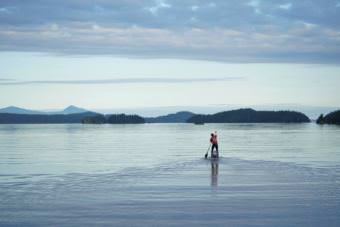
Karl Kruger arrived at Thomas Basin Boat Harbor in Ketchikan Sunday evening, becoming the first SUP finisher of the Race to Alaska. (Photo by Leila Kheiry/KRBD)

An Orcas Island, Washington, man has become the first person to complete the Race to Alaska on a standup paddleboard.

Karl Kruger stroked 750 miles solo from Port Townsend up the Inside Passage, crossing the finish line Sunday evening in Ketchikan.

A crowd came down to the harbor in Ketchikan to see Kruger accomplish an athletic feat that quite a few people had called crazy, nutty or foolhardy.

The exhausted and soft-spoken 45-year-old glided to the dock, stepped off his 17-foot standup paddleboard and rung the finisher’s bell.

Kruger embraced his waiting wife and daughter and expressed amazement at what he had done over the past two weeks.

“There were days where every single stroke was a barrier and I just wanted to stop,” Kruger said. “Everything was screaming at me to stop. So it was absolutely mental, absolutely.”

Kruger maintained an incredible pace on his journey north. He averaged about 50 miles per day on his standup paddleboard.

Two other paddleboarders from northwest Washington state, Luke Burritt and Erdogan Kirac, dropped out of the Race to Alaska after one week near Campbell River, midway up Vancouver Island.

The timed portion of the Race to Alaska covers the 710 miles from Victoria, British Columbia, to Ketchikan.

Kruger clocked in at 14 days, six hours and 17 minutes. The paddleboarder posted a faster time than some sailboats, kayaks and two-person rowboats that are still on the watery, mostly wilderness race course.

This was Kruger’s second attempt at the Race to Alaska on a paddleboard.

Last year, he was forced to quit after about 100 miles because  stress fractures in his board.

Karl Kruger paddles north through the Canadian Gulf Islands on June 12. (Photo courtesy Race to Alaska)
Karl Kruger paddles north through the Canadian Gulf Islands on June 12. (Photo by Liv von Oelreich/Race to Alaska)

The zany adventure race has two basic rules: no motors and no support crews. A race co-founder once compared the event to the Iditarod sled dog race, “but with a chance of drowning or being eaten by a bear or run over by a freighter.”

This year’s race was won by three Massachusetts brothers racing in a 28-foot trimaran dubbed Team Pure and Wild/Freeburd.

They reached Ketchikan after sailing nonstop for four days and three hours through erratic winds, storm and calm.

The 2017 edition of the Race to Alaska had 41 non-motorized entries in many designs, sizes and human or sail-powered propulsion methods.

Kruger had a race plan that called for paddling for two eight-hour shifts per day alternated with rest on shore.

He strapped about 50 pounds of food and gear onto the bow and stern of his board, which looks like a stretched surf board with a pointed prow.

To save weight, Kruger sustained himself mainly on high calorie food wafers along with some protein shakes and energy bars and gels.

At the finish line, the wet suit-clad Kruger happily accepted the first of what are bound to be many free beers as he answered questions.

“The last few days have been really tough,” Kruger said. “One day it’s one thing, the next day it’s something else.

He described paddling into squalls as “a boxing match.” At other times he had a tailwind with following seas, which he compared to “a sled ride.”

“I enjoyed every minute, even the hard stuff,” concluded the racer who entered the maritime marathon as “Team Heart of Gold.”

Kruger trained for months to prepare for the race with long distance paddles on a new, custom-built expedition board as well as practicing off the water on a balance board and working on core strength with a personal trainer.

Kruger and his wife run a sailing charter business based in Washington’s San Juan Islands.

Kruger credited his wife, Jessica, for originally planting the seed to try the Race to Alaska on a standup paddleboard.

He had been really loving the standup paddling at that point and been doing it for a couple of years,” Jessica Kruger recalled Sunday dockside in Ketchikan. “It just made sense to me that if you want to do this race and if you wanted to do it solo, why not paddle it.”

NPR member station KRBD in Ketchikan contributed on-scene reporting to this story.

Washington state lawmakers could be close to agreement on spending, taxes

After weeks of deadlock, Washington lawmakers could be close to reaching an agreement in principle on a state budget, House and Senate budget writers said Friday.

“Yeah, I think we can get it sorted out by the end of the day,” Democrat Timm Ormby, House budget chair, said of an agreement being negotiated on how much the state budget will spend over the next two years and where the money will come from — though the details are still to be worked out.

Republican John Braun, Senate budget chair, was more restrained.

The two sides are “definitely getting closer,” he said, adding there was a reasonable chance a framework deal could come together within 24 hours.

If that happens, the two sides would still need to work out lots of details. The clock is running out.

Washington state government will go into a partial shutdown if there’s no budget by July 1.

Washington governor calls third special session as government shutdown looms

Washington Gov. Jay Inslee declared a third special session on Wednesday and said it was time to ''crack the whip'' on lawmakers to get a budget deal and avoid a July 1 government shutdown. (Photo by Austin Jenkins/Northwest News Network)
Washington Gov. Jay Inslee declared a third special session on Wednesday and said it was time to ”crack the whip” on lawmakers to get a budget deal and avoid a July 1 government shutdown. (Photo by Austin Jenkins/Northwest News Network)

Unless lawmakers can agree on a budget, the state of Washington is just days away from a first-ever government shutdown.

Gov. Jay Inslee called a third special session Wednesday and demanded that House Democrats and Senate Republicans get to the table and get a deal.

Inslee announced the immediate start of a third special session, which puts 30 days back on the clock, but the governor made clear that lawmakers don’t have nearly that much time.

“There are nine days remaining in the current fiscal year,” Inslee said.

If there’s no budget by June 30, state government will partially shut down.

Inslee listed off just some of the impacts: state parks will close, prisons won’t accept new inmates and hatchery fish could die.

He said it’s time to “crack the whip” on lawmakers.

“They’ve been punting for too many months and I’ve got to just lay down the law and make it clear they’ve got a job to do and I expect them to do it,” Inslee said.

Inslee also made clear that he will veto any attempt by lawmakers to pass a temporary budget to buy themselves more time.

Earlier, outside his office, Inslee met briefly with education and human services advocates.

Among them, Alise Hegle who helps families navigate the child welfare system, said in a government shutdown kids and parents wouldn’t get their weekly visits.

“Many of our visitation providers are contracted out,” Hegle said. “If they’re receiving notices that there’s going to be a potential government shutdown then they’re not going to be able to ensure that this child is being transported to go see their parent and vice versa.”

How real is the prospect of a government shutdown?

Inslee said he’s “a lot more concerned” now than he was.

Senate Majority Leader Mark Schoesler said he remains optimistic. He noted there are multiple negotiating teams working on different parts of the budget.

“They’re all getting close, they’re all getting closer,” Schoesler said. “Of course, I would prefer we were farther along.”

Schoesler also said this is no ordinary budget.

Lawmakers are under court order to fund a constitutional public school system.

“This is a generational issue and it doesn’t come together as easy as addressing the crime of the year did in the ’90s,” he said.

House Democrats and Senate Republicans have been hung up for months over how to end the reliance on local school levies to fund basic education.

Republicans voted to eliminate the levies and impose a new state property tax levy—contingent on voter approval in November.

Democrats proposed, but never voted on, a multi-billion dollar tax package.

Finding a compromise between those vastly different approaches is what’s remained elusive.

Government shutdown looms as Washington state lawmakers head for third special session

House budget chair Timm Ormsby, second from left, and Senate budget chair John Braun, on right, say they are working to get a budget deal by June 30 to avoid a government shutdown. (Photo by Austin Jenkins/Northwest News Network)

The state of Washington is 10 days from a government shutdown as lawmakers head into a third overtime session with still no budget deal.

This is the point when even veteran Olympia insiders start to get nervous.
Time is nearly out for House Democrats and Senate Republicans to bust through their months-old impasse over the budget and school funding.

The question to both sides now: do you have a backup plan?

“Of course we have a back-up plan,” Senate budget chair John Braun said. “We always have a backup plan, but that’s not what we should be focused on. We should be focused on getting the job done on June 30th.”

House budget chair Timm Ormbsy stuck with that theme.

“Our sole focus is to get the biennial budget done by the end of the fiscal year,” he said.

If they don’t, then Ormbsy said all options should be on the table to avoid a government shutdown.

Gov. Jay Inslee has indicated he will not sign a 30-day stop-gap budget.

More than 30,000 state employees will be sent home in the event of a government shutdown, state parks will close and many other state functions will be suspended.

Budget writers did get a bit of help Tuesday.

The latest state revenue forecast shows Washington is projected to take in an additional $80 million over the next two years.

“It doesn’t solve all our challenges, but it doesn’t hurt them either,” Braun said.

This is the third time since 2013 that Washington lawmakers have been unable to agree on a budget forcing a third special session.

Quake prone cities on West Coast aim to improve countermeasures

Vulnerability assessments by utilities and emergency planners along the U.S. West Coast suggest it could be weeks or a month or more before water service gets restored after a major earthquake — not to mention electricity, sewage treatment and fuel supply too.

The social and economic disruption does not have to be that bad though, given adequate preparedness and investments in critical infrastructure as demonstrated in Japan.

Contractor at work preparing to brace the walls and ceiling joints to earthquake-proof the operations building at Everett's drinking water filtration plant. (Photo by Tom Banse/Northwest News Network)
Contractor at work preparing to brace the walls and ceiling joints to earthquake-proof the operations building at Everett’s drinking water filtration plant. (Photo by Tom Banse/Northwest News Network)

In 1995, a major earthquake struck Seattle’s sister city in Japan.

The magnitude 6.9 quake knocked out water, electricity, collapsed a main highway and railway and killed more than 6,000 people in and around Kobe.

Fires consumed entire neighborhood blocks because there was no water for firefighters.

Kobe is now in the process of replacing nearly 3,000 miles of cast iron water distribution lines with flexible pipe to make its system earthquake resistant.

“The damage we have received in the earthquake kind of determined that we will do that, replace the pipes,” said Hitoshi Araike, an assistant manager at the Kobe City Waterworks Bureau.

Araike and an interpreter led foreign journalists deep underground to see a new large transmission main that can double as emergency water storage. It cost a fortune — $326.4 million.

He described automatic shutoff valves installed at reservoirs to keep water from draining away through broken mains after a quake. And he showed the flexible pipes and new-style connectors with reinforced sleeves that resist breakage. They are being deployed at both the waterworks and a rebuilt sewage treatment plant.

So how long might water service be out in Kobe after the next great earthquake?

“Once the new technology is in place, I expect zero disruption,” Araike said.

Balancing upgrades and rate hikes

How does this compare with the Pacific Northwest?

“We’d like to get back up and be operating within three to four days. That’s our goal from a level of service standpoint” said Jim Miller, engineering superintendent for Everett Public Works.

This month, contractors are at work reinforcing walls and ceilings to earthquake-proof the operations building at Everett’s drinking water treatment plant. It serves 600,000 people across Snohomish County, Washington.

Miller said his utility assessed its earthquake vulnerability and has prioritized a list of improvements.

Next, the Public Works Department wants to install flexible joints at some pipeline water crossings. Everett’s full list of seismic upgrades could take 20 years to complete.

The cost would be folded into multiple rate increases.

Rate hikes above the pace of inflation inevitably draw pushback, Miller said.

“If we did nothing, that’s more business as usual and you could keep rates lower,” he said. “But we’ve found people for the most part expect a reliable system. Once they understand what it’s for, they seem—in fact our wholesale customers have actually encouraged us to make our system more resilient.”

Some of the City of Everett's water pipelines have flexible sleeves as an earthquake countermeasure. (Photo by Tom Banse/Northwest News Network)Some of the City of Everett's water pipelines have flexible sleeves as an earthquake countermeasure. (Photo by Tom Banse/Northwest News Network)Some of the City of Everett's water pipelines have flexible sleeves as an earthquake countermeasure. (Photo by Tom Banse/Northwest News Network)
Some of the City of Everett’s water pipelines have flexible sleeves as an earthquake countermeasure.
(Photo by Tom Banse/Northwest News Network)

Everett is one of the big three drinking water suppliers in the central Puget Sound Water Supply Forum — alongside Seattle and Tacoma.

The forum recently estimated outage times for a big offshore earthquake and close-by shallow ones.

Their analysis found it currently could take up to 60 days to restore service to most customers.

Seattle Public Utilities aims to finish a comprehensive vulnerability assessment of its own by the end of this year.

“SPU is planning to survey several hundred residents that represent Seattle’s demographics to provide their opinions about different seismic resiliency levels and cost,” the agency said in an emailed summary. “The goal of this survey is to learn what people are prepared to spend on seismic upgrades. Once SPU determines the desired balance between seismic resiliency and system improvement costs, SPU will develop a detailed seismic improvement plan and program.”

SPU said it has invested $60 million in seismic upgrades to existing water infrastructure to date — such as switching from above-ground to buried reservoirs — and that’s only a start.

Meanwhile, Miller anticipates having a discussion with the Everett City Council soon about the cost-benefit trade-offs of various degrees of investment to prepare for a rare, but potentially catastrophic event.

In Oregon, a state resilience plan set a goal for water supply systems to be mostly operational within two weeks after a Cascadia megaquake.

“We’re nowhere close to that,” said Theresa Elliott, Portland Water Bureau chief engineer at a conference earlier this spring.

Readiness suggested, not required.

Kobe got massive disaster recovery aid from the national government to get to the position of being one of the most earthquake resilient cities in the world now.

Pacific Northwest states and utilities can’t count on the same largesse.

“There’s awareness as to the catastrophic damage a subduction zone earthquake could cause (in the Pacific Northwest), but these events don’t occur with the same frequency as in Japan. The last one here was more than 300 years ago,” observed University of British Columbia Professor David Edgington. He researches the Japanese response to natural disasters and authored “Reconstructing Kobe.”

Earthquake resilience experts in both Oregon and Washington state delivered nearly identical recommendations a few years ago.

They said the states should require utilities to do vulnerability assessments and make plans to mitigate the deficiencies. That remains largely a suggestion, not a requirement.

Washington Utilities and Transportation Commission Director Steve King made that point to Gov. Jay Inslee at a subcabinet meeting earlier May.

“One of the things that is a gap is explicit statutory authority is needed if you want to pursue an effort to increase resiliency over a 50 year timespan,” King said.

The Resilient Washington State Subcabinet brings together a range of state agency leaders who are working on fresh recommendations to the governor for how to improve earthquake and tsunami readiness.

The current projections for long outages of vital services mean you need to prepare to survive on your own.

State and federal emergency managers used to recommend that families stockpile enough food, water and medicines to last three days.

Now Oregon and Washington suggest people in earthquake country prepare a kit with two weeks’ worth of supplies.

From drugs to prison to law school, woman faces one extra hurdle to become a lawyer

Tarra Simmons is about to graduate magna cum laude from Seattle University School of Law. But she faces another hurdle before she can practice law. (Photo courtesy Seattle University School of Law)

A former Washington state prison inmate will graduate Saturday magna cum laude from Seattle University School of Law.

But her criminal record may prevent her from practicing law as a licensed attorney.

Tarra Simmons’ story could be a movie. She was a nurse, a mom and a wife. Then in 2010 her father, whom she was caring for, died suddenly.

After his death, she said, she started using meth and abusing prescription drugs.

“Within 10 months of using, I was arrested three times and eventually sent to prison,” Simmons said in an interview about prison reentry on TVW’s “Inside Olympia” program.

Her final arrest was for delivery of Oxycodone, possession of marijuana with intent to deliver and unlawful possession of a firearm.

Simmons spent 20 months behind bars and went through a drug treatment program.

She was released in 2013 and her life was in tatters.

“Nobody would hire me because of my criminal record,” Simmons recounted.

Her home was in foreclosure and she had to declare bankruptcy.

“I had a lot of barriers,” she said.

Eventually she did get a job at Burger King.

Through it all Simmons got help — a lot of help — from lawyers. They helped with her foreclosure, with the debt that had piled up while she was in prison, and with family law issues relating to her children.

But these attorneys did more than help. They also saw potential in Simmons and encouraged her to apply to law school, which she did.

“I decided that if I was having all of these problems and I have some education in my background, and I have some other privilege, that there’s a lot of people that are suffering,” Simmons explained.

She figured that, as a lawyer, she could help others navigate the hurdles to re-entering society after serving time in prison.

In 2014, Simmons was accepted to Seattle University Law School. Awards and recognition followed.

She was named a King County Bar Foundation Scholar and a King County Washington Women Lawyers Scholar. In 2015 she received a Public Interest Law Foundation Grant. And in 2016 she became a Legal Foundation of Washington Goldmark Fellow.

Also in 2016, Gov. Jay Inslee appointed her to the state’s new 15-member Statewide Reentry Council, which she now co-chairs with King County Prosecutor Dan Satterberg.

This year Simmons became only the second student from a Washington state law school to receive a prestigious national Skadden Fellowship.

Described as “a legal Peace Corps,” the 29-year-old fellowship program, sponsored by the Skadden law firm in New York, allows recent law school graduates or those finishing judicial clerkships to devote two years to providing civil legal services to the poor.

Simmons was awarded the fellowship to work with recently released prisoners.

When Simmons graduates from law school on Saturday, she will be awarded the Dean’s Medal for the graduating student “who has the greatest potential to achieve the legal profession’s most noble aspirations for justice and ethics.”

But despite all the accolades, all the honors, and all the successes Simmons has achieved, she’s just been dealt a major setback: Simmons may not get to join the legal profession — at least not right away.

This wasn’t something Simmons was going to talk about publicly yet. But the story came out as she spoke on “Inside Olympia” about her role on the governor’s re-entry council and the challenges people like her face after prison.

Here’s what happened.

The Washington State Bar Association’s Character and Fitness Board, on a vote of 6-3, recommended against Simmons’ admission to the bar about a month ago.

All applicants to take the Washington Bar Exam must pass a character and fitness review before they can take the test.

For the vast majority it’s a formality.

But some applicants get flagged and must make their case to the board.

That Simmons was one of them, given her background, wasn’t a surprise. The recommendation not to admit her, though, was.

“It’s very hard, personally for myself and for my children,” Simmons said. “(It sends) a strong message to the community that second chances are really, really hard to get.”

Right now, she can’t even sit for the exam as she had planned to in July.

The Bar Association’s character and fitness review is guided by court rules and takes into account many factors including past unlawful conduct, neglect of financial responsibilities and disciplinary action by any professional licensing agency.

On paper, Simmons has several red flags: felony convictions, bankruptcies and enforcement action against her by the state’s nursing board.

The Washington State Bar Association doesn’t comment on specific cases.

But Jean McElroy, the association’s general counsel, said when deciding on character and fitness, the board considers how recent and serious the misconduct was, and its cumulative nature.

“The board wants to treat everybody fairly and equally,” McElroy said. “There are people who come in and have great records … but within what the board is looking at, the board just isn’t comfortable that they’re there.”

McElroy added the board must consider not just the fitness of the applicant, but also the protection of the public.

“There’s all sorts of trust that’s put into lawyers,” she said, noting that some states won’t allow anyone with a felony record to become an attorney.

Washington is not one of those states.

But still, the recommendation not to admit her is confounding to Simmons and her supporters. She delivered to the board more than 100 letters of recommendation, including one from a judge on the Washington Court of Appeals.

“It’s disappointing,” said Elizabeth Hendren, an attorney at the Northwest Justice Project who first met Simmons when she was in prison and was among those who encouraged her to go to law school.

“She’s already had more accolades and success than many attorneys have throughout their careers,” Hendren said.

Prosecutor Dan Satterberg, Simmons’ co-chair on the re-entry council, added, “I have never met any law student more prepared to be a contributing member of the Bar than Tarra.”

But the door to her legal career hasn’t slammed completely shut.

Simmons will request a review of the board’s recommendation by the Washington Supreme Court, which has the final say on admission to the bar.

“I think the Supreme Court should take a look at this matter and reverse the Board’s decision,” Satterberg said in an email.

If that’s not successful, Simmons would be able to reapply for admission in one year.

In the meantime she would be able to conduct a limited law practice under the supervision of a licensed attorney.

The logistics, though, would be difficult because her sponsoring law firm is in Seattle and the work she planned to do is in Kitsap County.

Simmons said without a license to practice, she might focus on advocacy work instead of legal representation.

One thing she doesn’t have to worry about: losing her Skadden Fellowship. She’s been told she can keep it.

“We deeply believe in her and we believe that this will be resolved amicably,” said Susan Plum, director of the Skadden Foundation. “She just projects resilience and what could be better for the clients?”

Amid the bad news about the Bar Association, Simmons recently received another gubernatorial appointment—this one to the state’s Public Defense Advisory Committee.

Site notifications
Update notification options
Subscribe to notifications