
Northwest News Network

Washington law bans Native-themed school mascots — unless nearby tribe approves

A new state law will further prod the Spokane school district to find a new mascot for North Central High School, now the home of the Indians. (Rebecca White/Spokane Public Radio)

Washington public schools with Native American-themed team names or mascots have a decision to make now that Gov. Jay Inslee has signed into law a ban on such symbols. The schools have until year’s end to find a new mascot or try to win the blessing of a nearby tribe for continued use under an exception.

Inslee on Monday wasted little time signing legislation sent to him last week by the Washington Legislature to phase out “inappropriate” tribal mascots.

“This bill will end the disrespectful use of Native American imagery in our public schools,” Inslee said at a private signing ceremony streamed from in his office.

The new law includes an option that could allow some schools to keep using team names like Chiefs, Braves, Indians or Tomahawks. School administrators would need to consult with a nearby tribe and win permission for respectful use beyond January 1, 2022. Several school districts in central and eastern Washington have already begun those conversations with tribal leaders.

The office of the state schools superintendent estimated approximately 32 Washington schools have Native-themed mascots or team names. The affected schools span the state from Colville to La Conner to South Bend.

When Oregon adopted a similar phase-out policy five years ago, most of the affected school districts moved away from Native American imagery and team names. The high schools that secured permission to retain an Indians or Braves moniker agreed to tribal requests to beef up curriculum about Oregon tribes and their governments.

Some districts will try to keep their Native-themed mascots

The Kennewick School District said Monday that it would sound out the Yakama Nation about keeping Kamiakin High School as the “Home of the Braves.”

“The Kamiakin High School name and mascot, the Braves, were selected to honor Chief Kamiakin,” said district spokesperson Robyn Chastain via email. “The district’s intent is to consult with the Yakama Nation Tribal Council and seek their authorization.”

The Colville School District superintendent and Moses Lake School District superintendent separately met with Colville Confederated Tribes leadership last week to initiate talks. No decisions were reached, but the superintendents came away hopeful about building a partnership. Colville High School is home to the Indians. Moses Lake has three affected schools: the Moses Lake High School Chiefs, Frontier Middle School Warriors and Chief Moses Middle School Braves.

“It might be rather than just getting rid of the mascot altogether that it is rebranded or reimaged in a way that is culturally appropriate,” said Moses Lake Superintendent Josh Meek in an interview. “We know regardless we have some cleanup to do of certain elements of the imagery or how stereotypes are played out.”

“I also don’t want in any way, shape or form for this to be another place of divisiveness between our local community perhaps and leadership of the Colville Confederated Tribes,” Meek continued. “I want just the opposite. I want this to be an opportunity for us to really come together and grapple with these complex issues. I am hopeful that we will be able to do that.”

Other districts yielding to change

Spokane Public Schools has scheduled a public forum Tuesday evening to to take comments about changing North Central High School’s team name, the Indians.

“There is a misunderstanding that the use of Native American-related or Indian mascots is honoring the Spokane tribe and indigenous people, and I can tell you this is not true,” said Ivy Pete, a Native student at the school, in a SPS statement. “This is not an attempt to erase North Central’s history. Now is the time to move forward with our students’ well-being at the forefront.”

A research review published last year in the journal Race Ethnicity and Education said negative stereotyping that followed Native American mascots was psychologically detrimental to Native students.

The Bethel School Board recently requested a mascot replacement committee be put to work for the Bethel High School Braves in east Pierce County.

The experience of Roseburg High School in southern Oregon provides a cautionary tale for schools hoping to thread the needle between alumni and community loyalties and modern sensibilities. In 2017, the Cow Creek Band of Umpqua Tribe of Indians signed off on the high school’s request to keep Indians as its moniker. The agreement contained a provision to revisit the name every three years. The first review, now wrapping up, reignited old controversy, including spurring protests outside the high school and a flood of sometimes-heated comments to the school board. The Roseburg Public Schools board is scheduled to meet on Wednesday to consider retiring the Indians mascot once and for all.

State to offer assistance

The Washington Legislature moved to incentivize prompt action by schools in the Evergreen State by creating a $1.6 million fund to help cover some costs of replacement or redesign of school signage, uniforms or logos. Schools could qualify for a grant if they select a new mascot by September 1.

“It is well past time to phase out Native-themed mascots and logos. It is degrading that we are being portrayed as no different than a token,” said the measure’s prime sponsor, Democratic Rep. Debra Lekanoff, early in the 2021 session.

Lekanoff is the only Native American currently serving in the Washington House of Representatives. Her proposal passed with wide bipartisan votes in both chambers.

“This bill is a small change that will bring about healing and show respect for our Native American neighbors and friends,” Lekanoff said.

Layoffs and shop closures hit Seattle and Portland airports, terminal expansions continue

Departing passengers at Sea-Tac International Airport have lots of check-in kiosks to choose from with air traffic still way down from last year. (Photo courtesy Tom Banse/ NW News Network) TOM BANSE / NW NEWS NETWORK
Departing passengers at Sea-Tac International Airport have lots of check-in kiosks to choose from with air traffic still way down from last year. (Photo courtesy Tom Banse/ NW News Network)

The recovery in airline travel seems to have hit a plateau in recent weeks, according to Transportation Security Administration checkpoint screening numbers. With the end of coronavirus pandemic seemingly beyond the horizon, the near future is turning grim for workers in the airline and airports sector.

Multiple airport tenants in Seattle and Portland issued layoff notices in the past week. But in a possible sign of optimism over the long term, the Pacific Northwest’s major airport operators, the ports of Seattle and Portland, are continuing with big budget construction projects.
Seattle-Tacoma International Airport has $1.5 billion worth of terminal expansions and upgrades underway that are proceeding apace. Portland International Airport (PDX) just opened a new concourse with six new gates, which Southwest Airlines moved into last month. Inside the extended E Concourse, six of the ten new retail spaces remain shuttered because of the travel slowdown.

The Port of Portland is pushing ahead with additional construction plans amid the pandemic. A $2 billion plan of airport improvements, dubbed “PDX Next,” includes a rebuild of the main terminal, expanded security checkpoint, a dedicated center for rideshare pickups and more close-in spots for parking and car rentals. The construction timeline stretches to 2025.

“We started the PDX Next program to upgrade outdated facilities, make PDX more seismically resilient and prepare for growth in our region,” the port says on its project website. “Those needs have not changed.”

What has changed is the outlook for travel in the near term as long as pandemic fears keep air passengers at home. The steep drop in passenger counts is spurring layoff warnings by airlines and immediate reductions by airport concessionaires.

Airport newsstand and gift shop operator Hudson Group announced layoffs on Friday, including 91 workers at Sea-Tac and a smaller number in Portland. Hudson said passenger volumes in July were running around 75% below the same weeks last summer.

“The COVID-19 pandemic has had an unprecedented impact on world travel, and a corresponding impact on our travel retail business,” said Hudson CEO Roger Fordyce in a news release announcing the nationwide layoffs and a sharp swing from profit to loss in the second quarter. “While we took proactive and targeted actions beginning in March to significantly reduce expenses across the Company, we determined that more structural and wide-ranging actions were necessary.”

A beloved Portland institution, Powell’s Books, announced last week that it was permanently closing its airport location and kiosk, effective immediately. Its landmark downtown Portland book paradise is not affected by this decision.

“Closing the airport store is a sad necessity as we face the months ahead,” said Powell’s owner and CEO Emily Powell in a statement. “We hope to return one day.”

During the height of the global pandemic, two-thirds of the dining and retail tenants at Sea-Tac Airport temporarily closed due to the decline in air travel. Currently, 72% of shops and cafes are back open as passenger volumes rebound, said Sea-Tac Airport spokesman Perry Cooper.

The Port of Seattle gave airport dining and retail tenants a break on rent and fees for the rest of 2020 to help them stay afloat. Now, major airlines are asking for relief too.

At Portland International, the airport’s COVID-19 web page lists 36 shops and restaurants as open and 19 temporarily still closed. The Port of Portland extended rent relief to airport food and retail tenants through June 30.

Alaska, Delta, United, American and Hawaiian airlines all signaled hard times lie ahead when their federal pandemic payroll support expires on September 30.

Seattle-based Alaska Airlines sent layoff warnings to about 20% of its Pacific Northwest workforce last week. Nearly 1,600 positions are slated for elimination in the Seattle area according to a required notice filed with the Washington State Employment Security Department. Alaska Airlines said it sent layoff notices to 277 workers at PDX, mostly customer service agents, flight attendants and maintenance technicians.

Alaska Airlines spokesperson Cailee Olsen predicted in an email Tuesday that not every employee who received a warning notice will ultimately be laid off in the fall because of voluntary leave incentives that remain on offer and further operational adjustments.

“We were able to prevent involuntary pilot furloughs through a combination of voluntary leaves and early outs, which allow us to keep all of our pilots employed beyond Sept. 30, either as an active pilot or on a leave at a reduced rate of pay and with full health-care benefits,” Olson said.

United Airlines notified the state of Oregon last Thursday that it expects to make 122 job cuts at Portland International Airport in October.

“Based on current demand, while we are hopeful the reductions for our frontline team members will be temporary, we presently anticipate that they will last six months or longer,” said Kate Gebo, United’s executive vice president for human resources and labor relations, in a notification letter.

Sea-Tac Airport took advantage of the downturn in travel to accelerate several construction projects. It was able to complete an airport ramp paving project faster this spring because there were fewer plane movements to accommodate. Spokesman Cooper said some sequences in the big budget expansion and modernization of the North Satellite gates and the build out of a new International Arrivals Facility were also accelerated.

Separately, a state commission tasked with finding a location for a second major airport to serve the Puget Sound region after Sea-Tac reaches capacity continues to meet. The Commercial Aviation Coordinating Commission aims to come up with a short list of six potential locations by late this year. It will winnow the list next year before submitting a final recommendation to the 2022 Washington Legislature. The commission members are looking far beyond the current pandemic, toward air travel demand 15 to 20 years from now.

COVID-19 hasn’t interrupted Alaska’s resupply lifeline from Pacific NW, and woe if it does

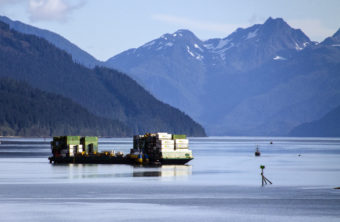
A barge departs from the Alaska Marine Lines dock in downtown Juneau.
A barge departs from the Alaska Marine Lines dock in downtown Juneau. (Photo by Heather Bryant/KTOO)

The coronavirus pandemic has served to remind many of us how much we count on strangers staying healthy so we can restock our cupboards and go about daily life. That’s especially true for Alaskans who depend on a marine cargo lifeline from the Pacific Northwest for the majority of their goods.

Most days of the week, at least one ocean-going tugboat heads out from Puget Sound going north to Alaska with a heavily laden barge in tow. The tug crews fit into a category of essential workers the general public rarely sees — even less so now that shore leave by mariners and visitors boarding the vessels are almost completely forbidden.

“It’s good to be a part of the system that keeps the area where you grew up and raised your family supplied,” said Captain Pete Erickson, who helms the Western Titan, a tug in the Western Towboat Company fleet. “It’s really personal for me.”

Erickson shared the cozy confines of the tug with a crew of five as they set out from Seattle bound for Ketchikan, Juneau and other Southeast Alaska ports. The barge they had in tow was stacked 40 feet high with containers full of all the things sold in grocery and hardware stores, plus construction equipment, vehicles, and last but not least, alcohol.

When barges come back, they carry Alaska fish to market, along with empty shipping containers, containerized municipal garbage destined for the large regional landfills near the east end of the Columbia River Gorge and a bit more alcohol sometimes — beer for the Lower 48 from Alaskan Brewing Company in Juneau.

Erickson said dealing with the coronavirus has made the roundtrips to Alaska a lot different this summer compared to years past. The state of Alaska required tug companies to file plans for how they’d keep their crews healthy, as well as how to avoid spreading the virus into small towns with limited medical care.

One big operational change is that tug and barge crews now have to stay onboard throughout their voyage. Western Towboat Vice President Russell Shrewsbury explained that contact with people on shore must be minimized. Previously, crews would go to the store when they got to Alaska and resupply on produce and other kinds of stuff.

“We can’t do that now,” Shrewsbury said in an interview. “If they have friends there, they used to be able to come visit. We haven’t been able to do that.”

Interactions with customers and port staff are basically done over a telephone now.

The caution extends to the downtime between voyages. Shrewsbury said he advises his crews to avoid contacts with people besides family members when they’re home. Western Towboat does temperature screenings before reboarding, but the company is not enforcing a strict pre-departure quarantine or ordering COVID testing like some Northwest seafood companies did with seasonal workers they sent to Alaska this year.

“We’re not going to chain anybody to their homes,” Shrewsbury said. “We just want people to be really smart about who they interact with because the implications it could have on the supply chain for Southeast Alaska could be devastating if we started having the virus run through the tugboats and people were getting sick.”

So far, so good, said Shrewsbury. Other marine cargo companies on the Alaska circuit such as Cook Inlet Tug & Barge, Foss Maritime and Centerline Logistics said they too have not had crew members get sick with the virus at sea.

Tote Maritime and Matson transport containers and vehicles from Tacoma to Anchorage and southwest Alaska on large cargo vessels. Tote said it is maintaining its regular schedule but limiting interactions between ship crews and people on shore to avoid COVID exposures, like the tug and barge companies do.

“The barges never stopped coming and we don’t want them to stop coming,” said Mila Cosgrove, deputy city manager in Juneau and the local COVID-19 incident commander.

Cosgrove said it would be very bad if there were an interruption in the marine supply links. In an interview, she noted that a lot of Alaska towns, including hers, are geographically isolated by virtue of not having a road connection to the outside world. Resupply comes either by airplane, which is very expensive, or by sea.

“It’s not an option to say we’re going to get it from someplace else,” Cosgrove said.

The relative isolation helped keep COVID away for a good while. But now the West Coast’s interconnected economies and the relentless nature of the virus are converging. The COVID case count in Alaska soared recently. Partly, that’s due to outbreaks in seafood processing plants and on board a factory fishing trawler based out of Seattle.

On a per capita basis, Alaska diagnosed 113 new cases per 100,000 people over the past seven days, which means Alaska surpassed Washington state (68 cases per 100,000) and Oregon (51 per 100,000).

Alaska breaks down its COVID statistics between residents and non-residents, with the latter category including seasonal workers and travelers who test positive in the state.

Where things get extra complicated is when crew changes happen and relief crews fly in from the Lower 48. The marine cargo vessel crews are considered “critical workforce,” so the workers get some latitude for how to observe the otherwise mandatory 14-day self-quarantine for all travelers who arrive in Alaska. The state allows critical workers to go straight to their vessel and start working. COVID testing is not required for vessel crewmembers, but the state highly recommends it.

The president of Anchorage-based Cook Inlet Tug & Barge said his company has increased the duration of on-duty shifts to decrease the number of crew changes and travel.

“The 14-day quarantine comes kind of natural to our guys,” Johnson said in an interview Tuesday. “They work in pretty remote areas.”

In the wheelhouse of the Western Titan with the chatter of marine radios softly crackling in the background, Captain Erickson mentioned one silver lining of the pandemic. He noted the absence of big cruise ships on the water, which can create bottlenecks and tight squeezes in the narrow channels and ports along the Inside Passage. The Canadian and American governments shut down the 2020 Alaska cruise season to reduce the risk of virus spread.

“My stress level has gone down a lot as I navigate between Seattle and Alaska,” Erickson said. “I know a lot of people depend on that tourism money. For my own selfish reasons, I don’t miss them one bit.”

Erickson himself was forced off the water for six weeks this spring when he contracted COVID-19 at a Seattle hospital while attending to his dying father. Relatives organized surprise welcome back greetings in Petersburg and Skagway on Erickson’s first work trip north after his recovery to show he was missed as well as show appreciation for everyone maintaining the marine supply line. Erickson was raised in Southeast Alaska, but now lives on Camano Island, Washington.

“We had no clue what was going on,” Erickson said, remembering his first thoughts upon noticing unusual crowds lining the shore as his tug and freight barge motored by in late April.

“What the heck are all the firetrucks doing down here? Why are all those people at the dock?” Erickson asked as the tug pulled in to Skagway. Then he saw the flags and signs, heard the honking and figured it out.

“That was pretty cool.”

Erickson’s status as a recovered COVID patient with immunity makes him a rare exception under Alaska’s COVID mitigation rules, allowing him to leave his vessel while in Alaska to visit friends and family on shore.

It flew! All-electric seaplane completes milestone first flight near Vancouver.

A de Havilland Beaver floatplane converted to electric battery-powered propulsion prepares to land on the Fraser River in Richmond, British Columbia, on Dec. 10, 2019.
A de Havilland Beaver floatplane converted to electric battery-powered propulsion prepares to land on the Fraser River in Richmond, British Columbia, on Tuesday. It was the seaplane’s first flight since its conversion. (Photo by Tom Banse/Northwest News Network)

A fully electric seaplane has made its first flight over the mouth of the Fraser River near Vancouver, British Columbia. The maiden flight represents a milestone in the long process of reducing the aviation industry’s emissions, noise and costs by electrifying short-to-medium distance commercial flying.

Several hundred people crowded the riverbank on Tuesday morning to witness what they hoped would be a historic moment. They were not disappointed.

Amid cheers and oohs and aahs, a Harbour Air floatplane converted to battery-powered propulsion lifted off into the day’s only sunbreak. The plane flew a short out-and-back leg downriver before landing five minutes later.

“It was much more quiet than I expected it to be,” said onlooker Nicki Malcom of Auburn, Washington. “It was great. It was magical.”

“It’s definitely the future,” offered Chip Jamison, who came from Portland to see the electric plane he machined parts for. “You can see it with automobiles. Planes are next. It’s right in front of us.”

The test pilot was the only person on board the six-passenger DHC-2 de Havilland Beaver. He was none other than the CEO and founder of Harbour Air, Greg McDougall.

“This thing is a prototype for sure, but it is an amazing airplane,” said McDougall at a post-flight press conference. “In every way, it’s a high tech piece of equipment, which is kind of ironic considering the airframe the motor is attached to is actually one year younger than me — so, 62 years old.”

Harbour Air's e-Plane flies over the Fraser River near Vancouver, British Columbia, on Dec. 10, 2019.
Harbour Air’s ePlane flies over the Fraser River near Vancouver, British Columbia, on Tuesday. The electric plane’s first flight was a short loop that lasted about 5 minutes. (Photo courtesy of Harbour Air)

McDougall’s seaplane airline teamed up with a Redmond, Washington-based electric motor maker named MagniX to convert the classic de Havilland Beaver. MagniX CEO Roei Ganzarski cast the refashioned plane’s first flight as a milestone akin to the first jet takeoff.

“Today you witnessed the first shot of the electric aviation revolution,” Ganzarski told a hangar full of the two companies’ staffs, contractors, media and other celebrants. “Let’s start the revolution.”

Ganzarski laid out a case for how battery-powered flight offers lower noise, zero pollution and could reduce fuel and maintenance costs.

“Lower operating costs for airlines like Harbour Air, which in turn will mean lower ticket prices for all of you,” he said. “Lower operating costs means they can now fly to more destinations that we couldn’t fly to before.”

It will be awhile before regular folks can book a ticket on a clean, electric seaplane. Aviation regulators first need to evaluate and certify the new propulsion system. McDougall estimated that could take about two years.

Representatives of safety regulator Transport Canada observed the maiden flight and the U.S. Federal Aviation Administration has been looped in as well.

Media follow an electric seaplane's first landing on Dec. 10, 2019, at the company's seaplane base on the south side of Vancouver International Airport.
Media follow an electric seaplane’s first landing on Tuesday at the company’s seaplane base on the south side of Vancouver International Airport. (Photo by Tom Banse/Northwest News Network)

Moses Lake, Washington, may be the scene for the next milestones in electric flight. MagniX is working with two other companies to achieve maiden flights next year on two larger airplanes. One is a Cessna Caravan commuter plane converted to battery power in partnership with Seattle-based engineering and flight testing company AeroTEC. MagniX and AeroTEC anticipate a first flight of the electric-powered Caravan in the first half of 2020.

The other plane to watch for is a brand new design named Alice from startup Eviation. The unusual-looking, three-motor airliner with pusher propellers is slated to carry nine passengers. A privately-held, Singapore-based conglomerate named Clermont Group owns both MagniX and Eviation.

Harbour Air CEO and test pilot Greg McDougall stands in a company hangar near Vancouver, British Columbia, on Dec. 10, 2019.
Harbour Air CEO and test pilot Greg McDougall stands in a company hangar near Vancouver, British Columbia, on Tuesday. MagniX CEO Roei Ganzarski is over his left shoulder. (Photo by Tom Banse/Northwest News Network)

McDougall and Ganzarski acknowledged Tuesday that batteries need to improve for this technology to replace jet fuel widely. McDougall said a full charge on the nearly one ton of batteries tucked in the belly of the Harbour Air prototype was good for about 30 minutes of flight or about 100 miles.

The power-to-weight ratio of batteries is one of the biggest hurdles to overcome for electrifying aviation. Ganzarski said Harbour Air is a good match to start the process because its routes from Vancouver to Vancouver Island, the Canadian Gulf Islands, Sunshine Coast and Seattle are short and it mostly flies small, single-engine planes. The airline aspires to become the world’s first fossil fuel-free airline.

Meanwhile, the plight of Bothell, Washington-based Zunum Aero shows the path to emissions-free aviation is not easy or cheap. The erstwhile designer of hybrid-electric regional jets laid off nearly all its staff earlier this year when it ran low on money. Airframe and propulsion system development appears to be on pause while the remaining company leadership seeks new investors.

“Like startups often have to do, we have been navigating a challenging period,” said Zunum CEO Ashish Kumar in an emailed statement. “However, our team remains committed to a future with electric flight everywhere. We are a group of persistent problem-solvers and are continuing to make progress toward our goal.”

Daylight saving movement gets another nudge, this time from Canada

"Le temps nous est compté"
(Creative Commons photo by Andoniaina Nambinintsoa RAZAFINDRADOARA)

The movement to “ditch the switch” — the twice-yearly ritual of changing our clocks between daylight and standard time — just got a push from British Columbia, where residents signaled they are keen to join Washington state and Oregon on permanent daylight saving time.

More than 223,000 British Columbians responded to a government survey on whether to adopt daylight saving time all year-round. The voluntary online survey broke provincial records for the most responses. In a tally of the results released earlier this month, 93 percent said they want to quit the biannual practice of springing forward and falling back.

“The people of British Columbia have spoken and their collective voice has come through loudly and clearly,” B.C. Premier John Horgan said in a statement.

As he has before, Horgan indicated he wants the observance of time on Canada’s west coast to stay in alignment with the U.S. West Coast states. Earlier this year, the Oregon and Washington legislatures both voted by wide margins to adopt permanent daylight saving time. Oregon lawmakers also declared their intention to move only in concert with their neighbors.

There’s a hiccup in California though, where the state legislature punted the issue to next year’s session. Californians wound this watch up last November when 60 percent of voters backed Proposition 7. That paved the way for the California Assembly to vote unanimously in May to make daylight time permanent.

But the implementing measure stalled in the California Senate this summer. Assemblymember Kansen Chu, the prime sponsor, pulled the legislation back this week.

“I want to clarify that (the bill) is not dead and will be moving forward in January,” Chu tweeted. “I want to take the next few months to ask my constituents their thoughts on permanent daylight saving time versus permanent standard time.”

Another potentially bigger snag for the West-wide movement comes from the U.S. Congress, which can’t seem to find the time to deal with requests from states for permission to go to year-round daylight saving time. Congress needs to get involved because while states can adopt year-round standard time, the federal Uniform Time Act does not currently allow for year-round daylight saving time.

Oregon Sen. Ron Wyden and Washington’s Patty Murray have signed on as co-sponsors to a Florida senator’s bill to make daylight saving time permanent nationwide in one fell swoop in every state that observes it.

A separate U.S. House measure introduced in March by Utah Congressman Rob Bishop would simply give states the option to observe daylight saving time year-round. Neither measure has been scheduled for a committee hearing at this time.

Sticking with daylight saving time year-round would give people an extra hour of daylight on winter evenings. The sun would rise later during winter mornings than under the current observance of standard time between November and mid-March.

In British Columbia, people who participated in the government consultation frequently expressed the opinion that the biannual time change no longer makes sense and is a hassle. Another rationale expressed in the survey frequently was that eliminating the time switch and thus extending sunlight hours on winter afternoons would contribute to better health and wellness.

The desire to move to permanent DST was consistently high across the province and across occupations and demographic groups. However, a handful of industry groups sent formal letters pleading to maintain the status quo. The ski resort and golf sectors told Horgan they would be negatively impacted by later sunrises in winter if daylight saving time were observed year-round.

“As a rule, most skiers desire to get out on the mountain first thing in the morning and a move to Daylight Saving Time in the winter would shift this ski culture,” said Christopher Nicolson, CEO of the Canada West Ski Areas Association. “Retail and food and beverage revenues may also be impacted as activities are squeezed into a smaller window at the end of the day.”

Two states — Arizona and Hawaii — and the territory of Puerto Rico long ago dispensed with the time change ritual by sticking to standard time year-round.

The twice-yearly time change is losing traction overseas too. Earlier this year, the European Parliament voted to discontinue time switching in 2021, but left it up to each member state to decide whether to stick with standard time or daylight saving time.

Some of Alaska’s lawmakers have tried to tinker with time, too. But none successfully since Alaska Standard Time was adopted in 1983. For Juneau specifically, time zones and time changes have been a particularly sore subject.

Two former Jesuit officials resign from Gonzaga University after revelations about abusive priests

Situated on Gonzaga’s campus, between the university’s business school and the St. Aloysius Rectory, Cardinal Bea House played host to at least 20 Jesuit priests accused of sexual abuse.
Situated on Gonzaga’s campus, between the university’s business school and the St. Aloysius Rectory, Cardinal Bea House played host to at least 20 Jesuit priests accused of sexual abuse. (Photo by Emily Schwing for Reveal)

This story was produced in partnership with Reveal from the Center for Investigative Reporting and PRX.

Two priests in high-level positions at Gonzaga University resigned Friday. Both previously held leadership roles in the Jesuits’ Oregon Province while it sent Jesuits accused of sexual abuse to live in a home on campus.

President Thayne McCulloh announced the resignations of Father Frank Case, university vice president and men’s basketball chaplain, and Father Pat Lee, vice president for mission and ministry, in a brief statement emailed to the Gonzaga community. Both men served on the University President’s cabinet.

Case was named in an investigation by the Northwest News Network and Reveal from The Center for Investigative Reporting about sexually abusive Jesuits whose victims were predominantly Native girls, boys and women in Alaska and the Northwest. A Jesuit home on Gonzaga’s campus, Cardinal Bea House, became a retirement repository for at least 20 Jesuit priests accused of such sexual misconduct dating back as far as 1986.

In 1989, while serving as head of the Jesuit order’s Oregon Province, Case wrote a letter to the Catholic chaplains association backing Father James Poole’s application to become a chaplain at St. Joseph Medical Center in Tacoma, Washington.

“(Poole) is a Jesuit priest in very good standing, and it is my strong expectation that he will serve in such a ministry in a manner that is both generous and effective,” Case wrote. Poole got the job, working at the hospital until 2003 when he was removed from ministry and sent to live at Gonzaga.

Poole was a serial sexual predator. The Catholic Diocese of Fairbanks has received at least 19 reports of abuse by Poole. In 1988, Poole had been removed from his position at a radio station in Alaska after young women who had volunteered at the station wrote letters to the bishop in which they accused Poole of sexual misconduct.

In a 2008 deposition, Case said he did not review Poole’s personnel file before writing the letter because he had no indication of misconduct. In a statement through Gonzaga University’s public relations office last week, Case said he did not have access to Poole’s personnel file.

Father Patrick Lee led the former Oregon Province through bankruptcy proceedings brought on by abuse claims between 2009 and 2011. The Oregon Province merged with the Jesuits’ California Province to become Jesuits West in 2017.

“It is the only way we believe that all claimants can be offered a fair financial settlement within the limited resources of the province,” Lee reportedly said in statement at the time.

Cardinal Bea House is located in the middle of Gonzaga’s campus, but is owned by the Jesuit order and Gonzaga does not make decisions about who was assigned there. Priests living in the house who had been accused of abuse were given “safety plans” to restrict their interactions with students. Our investigation found they were not rigorously enforced.

Priests accused of sexual abuse were assigned to the house as far back as the 1980s. The last known Jesuit on a safety plan was moved off of Gonzaga’s campus in 2016.

Earlier this week, McCulloh issued a written statement to faculty, staff and students saying that he knew Jesuit priests accused of sexual abuse were living in a Jesuit residence on campus, but he had not been aware that any of them might be a threat to students.

McCulloh said he relied on Jesuit leadership “to inform us of any Jesuit whose history might pose a threat to our students or campus community. I deeply regret that I was not informed of the presence of (Father James) Poole, nor any other Jesuits who might pose such a danger.”

It’s unclear exactly when McCulloh learned about the accused priests living on campus. His statement provides what appears to be contradictory information.

“It is important for me to share with you, that in the years following the 2011 Oregon Province bankruptcy, I learned that there had been priests under supervised ‘safety plans’ living at the Jesuit retirement community (Bea House),” he wrote.

But in the next sentence, he says, “It was not until 2016, when the Province chose to begin relocating a number of retired men to the Sacred Heart Community in Los Gatos, that I learned that among them were Jesuits who had been on safety plans (and were moved).”

News organizations also reported on some of the accusations against Poole and his presence at Gonzaga as far back as 2005. McCulloh has worked at Gonzaga since 1990 and was appointed as interim president in 2009.

McCulloh would not make himself available to clarify his statement. He also had declined to be interviewed for the original investigation. McCulloch, Case and Lee could not immediately be reached for comment.

The revelations from the investigation are expected to be mentioned during Mass this weekend at St. Aloysius Church, a Jesuit-owned parish on Gonzaga’s campus. The church’s parish priest, Father Tom Lamanna, also a Jesuit, told us we should not attend the service and are not allowed to record the proceedings.

Site notifications
Update notification options
Subscribe to notifications