Have you ever wondered what birds see when they fly over Seattle? Well, now you can see for yourself.
The Space Needle’s rotating glass floor is officially open to the public.
Five hundred feet above the city, patrons can look down and see the top of MoPOP, Chihuly Garden and Glass, and the tiny figures of people milling about on the streets below.
The 12 motors and dozens of rollers that keep the floor gliding along are also visible along the edges of the floor, reminiscent of the inside of a watch.
The idea of standing hundreds of feet above the city with nothing but glass between you and open space may not appeal to everyone.
But Karen Olson with the Space Needle said it’s perfectly safe.
“This glass floor is ten layers of reinforced structural glass. It’s stronger than concrete, you can just see right through it,” Olson said.
According to Olson, this is the first and only floor of its kind in the world.
Known as “The Loupe,” the floor can rotate at varying speeds and in both directions.
It’s part of a $100 million renovation of the Space Needle that’s nearing completion.
Construction hasn’t been an easy task. Olson said everything that couldn’t fit in the elevator was hoisted up by a crane that was situated on top of the Space Needle.
Overall, the renovations have added 200 percent more glass to the iconic structure, which now has a full time glass cleaning team.
Olson said they hope the renovations will mean the Space Needle is as exciting 50 years from now as it was when it was first built for the 1962 World’s Fair.
Seattle’s Space Needle at sunset on April 22, 2012. (Creative Commons photo by Richard Ha)
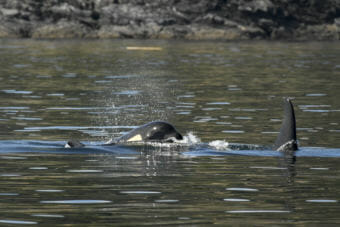
This picture from July 21 shows shrinkage around ailing orca J50’s head from weight loss, aka “peanut head syndrome.” (Photo by Katy Foster/NOAA Fisheries)
Whale scientists and a federal agency are weighing the risks and benefits of giving food and medicine to an emaciated endangered orca. The orca has been under observation in the border waters between Washington and British Columbia in recent weeks.
The 4-year-old female is a younger member of the same killer whale family that’s been in the news because of a mother orca who persists in tending to her dead calf. The 4-year-old orca is showing signs of starvation and infection. NOAA Fisheries spokesman Michael Milstein said options on the table include feeding live Chinook salmon to the orca, possibly laced with medication.
“We want to do this very carefully and deliberately because we don’t want to go into a situation where we’re creating an animal that becomes dependent on human handouts for food,” Milstein said. “That’s certainly not a recipe for survival in the wild, so we have to be very careful not to go down that road.”
Before a decision to intervene is taken, researchers in boats are trying to get a better handle on what’s wrong with the young orca, known as J50. They’ve got a drone ready to capture full body shots from above and also want to collect fecal and breath samples for analysis.
An earlier attempt in late July to collect droplets of breath using a long boom held over J50’s blowhole yielded too small of a sample to provide a definitive diagnosis.
Researchers use a boom to collect exhalations from ailing orca J50 on July 21, 2018. Unfortunately, the samples were too small to be of diagnostic value. (Photo by Katy Foster/NOAA Fisheries)
“We’ve been watching J50 now for a few weeks and watching her condition seem to deteriorate, so there’s been increasing concern about that,” Milstein said in an interview Friday.
Milstein said J-pod was making the urgent data collection task difficult on Friday by disappearing from sight. He said the family group was last seen headed out the Strait of Juan de Fuca toward the west coast of Vancouver Island.
Whale scientists also want to collect the dead calf of the seemingly grieving mother, J35, to do a necropsy if possible. That could reveal why the newborn died about a half-hour after birth.
The critically endangered population of Southern Resident killer whales is down to 75 individuals. As a young female, J50 holds particularly high value because of her “reproductive capacity to the population,” Milstein said.
Against this backdrop, a Southern Resident Killer Whale Recovery Task Force convened by Washington Gov. Jay Inslee in March meets in Wenatchee on Tuesday to formulate short and long term recommendations. The task force wants to address the major factors affecting orca survival of lack of prey, environmental contaminants and disturbance by vessels. Possible recommendations could include further restrictions on salmon fishing, speed limits for ferries to reduce underwater noise and increased hatchery production of Chinook salmon. The recommendations will be finalized in the fall.
Filmmaker Dirk Wierenga introduces the new documentary “D.B. Cooper: The Real Story” at its premiere in Cle Elum on Saturday. The roughly 200 available tickets sold out. (Photo by Tom Banse/Northwest News Network)
The legend and theorizing about Northwest skyjacker D.B. Cooper just won’t die.
A new documentary about the unsolved 1971 hijacking introduces a new twist to the tale. It suggests we might have been looking for D.B. Cooper and his loot in the wrong place for all these years.
The makers of the four-part video literally rolled out a red carpet for the sold-out premiere of “D.B. Cooper: The Real Story.” It happened at a community center in Cle Elum, Washington on Saturday.
The town in the eastern foothills of the Cascades was chosen deliberately because Cle Elum is the closest town to where former Army paratrooper Walter Reca said he landed after he jumped out of a hijacked Boeing 727 with a $200,000 ransom tied to his chest.
Decades later, Reca confessed to a close friend and to a niece that he committed the hijacking under the pseudonym Cooper and made a clean getaway.
He allowed himself to be recorded by the friend, Carl Laurin, with the understanding that the secret not be revealed until after Reca’s death, which came in 2014.
The written and recorded confessions are at the heart of the new documentary and a book released in May that covers the same ground, both from Michigan-based publisher Principia Media.
If you remember your D.B. Cooper lore, you’ll know the jump zone has always been assumed to be over southwest Washington, close to Portland.
The airline, the FBI and amateur sleuths have analyzed the flight path many times. No one else has placed the jump over central Washington.
The 84-year-old Laurin asserts the FBI “bungled” this high profile case or purposely misdirected searchers away from the correct jump zone.
“Do I believe that there was a cover up here?” Laurin asked rhetorically in an interview. “Let me put it this way, it’s the only honest answer I can come up with. D.B. Cooper jumped over Cle Elum.”
The FBI reconstruction of the flight path of the hijacked airliner places the jump zone over Southwest Washington, not near Cle Elum. (Map courtesy FBI archives)
On the afternoon of November 24, 1971, Cooper boarded a Northwest Orient Airlines plane in Portland with a one-way ticket to Seattle. He passed a note to a stewardess indicating he had a bomb in his briefcase.
He subsequently negotiated to exchange the passengers in Seattle for $200,000 in ransom and four parachutes. He also got the authorities to refuel the plane and said he wanted to be flown to Mexico.
Shortly after takeoff from Seattle, the remaining flight crew—which had retreated to the cockpit —noticed a warning light indicating deployment of the jet’s aft stairs.
Cooper is believed to have jumped from the stairs a few minutes later at an altitude of 10,000 feet into a frigid Thanksgiving Eve storm.
He was never seen again. The plane landed safely in Reno, Nevada, for a planned refueling stop a few hours later.
The FBI effectively closed the D.B. Cooper case in 2016. The bureau said it won’t re-open the cold case unless someone comes up with relevant physical evidence such as the parachutes the hijacker used or ransom money.
The makers of the new documentary found neither of these things. There are some other discrepancies in their story including Reca’s age at the time of the hijacking, 38 years old, which is on the young side of the estimates from passengers and airline employees interviewed by the FBI. They figured the skyjacker was in his mid-40s.
“Although the FBI appreciates the immense number of tips provided by members of the public, none to date have resulted in a definitive identification of the hijacker. The tips have conveyed plausible theories, descriptive information about individuals potentially matching the hijacker, and anecdotes—to include accounts of sudden, unexplained wealth,” FBI-Seattle Division spokesperson Jillian Voigt wrote in an email Monday. “In order to solve a case, the FBI must prove culpability beyond a reasonable doubt, and, unfortunately, none of the well-meaning tips or applications of new investigative technology have yielded the necessary proof.”
Voigt’s email on Monday in response to questions about the Principia Media documentary used the exact same words as a statement from two years ago explaining the FBI’s redirection of its resources to other investigative priorities.
Various FBI agents over the years have reportedly concluded that D.B. Cooper probably did not survive the jump from the plane.
Principia Media’s investigators faced a challenge in reconciling the getaway story they accepted with one of the undisputed facts of the D.B. Cooper case, namely how did a cache of the ransom money get buried in a sandbank along the Columbia River north of Portland.
In 1980, a boy digging a campfire pit at Tena Bar uncovered three bundles of decomposing $20 bills, whose serial numbers traced back to the D.B. Cooper ransom money.
In 1980, a boy uncovered three bundles of decomposing $20 bills, whose serial numbers traced back to the D.B. Cooper ransom money. (Photo FBI archives)
Laurin and the documentary makers posit that an appreciative Reca gave his getaway driver a bundle of bills and that the accomplice later buried the loot at Tena Bar to dispose of evidence that connected the driver to the hijacking.
Reca is the latest in a line of at least a dozen previous suspects publicly accused by friends and relatives or self-confessed to be D.B. Cooper.
The new documentary presents other details that make Reca a plausible suspect. He had nighttime parachuting experience, survival training, a criminal background (he previously committed armed robbery) and a motive (tired of being poor).
Self-appointed investigator Laurin managed to locate an eyewitness who, with some prompting, corroborated Reca’s getaway. That eyewitness is a Cle Elum musician and former logging company truck driver.
Jeff Osiadacz now believes he unwittingly helped D.B. Cooper summon a getaway driver to the roadside café where they were the only customers on Thanksgiving Eve 1971.
“He come in and the first thing he said is, ‘Hey kid, where am I?’” Osiadacz recalled. “I said, ‘You’re about four miles east of Cle Elum.’ And he says, ‘If I make a phone call, can you give a friend directions how to pick me up?’ I says, ‘Sure, no problem.'”
At the time, the musician didn’t suspect the soaking wet, odd, limping man was anything more than “a French fry short of a happy meal.”
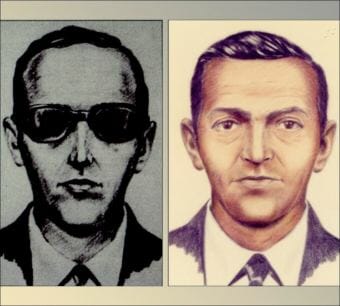
“Never saw him again, never know nothing,” Osiadacz told public radio. “The next day, they’re advertising this guy that jumped out an airplane, all this on the news media. They’re showing these composite sketches and everything. Didn’t look nothing like the man I was sitting with.
Reca told Laurin he removed and bundled up his parachute after he landed outside Cle Elum and covered it up with branches.
There are no accounts of anyone finding a parachute in that area, which might have been newsworthy at the time given the intense coverage of the hijacking.
Reca said he limped for about a half-hour in the direction of the closest lights he saw during his descent, which Laurin deduced to be the Teanaway Junction Café.
At the café, Reca recalled meeting a musician in a cowboy outfit, now believed to be Osiadacz. The cafe no longer exists.
After spending two-and-a-half years investigating the D.B. Cooper case and making his documentary, filmmaker Dirk Wierenga said he is confident they fingered the right guy.
“I’m a 100 percent (confident),” Wierenga said in an interview Saturday. “I gotta tell you every other story that is out there is voodoo. They’re all voodoo.”
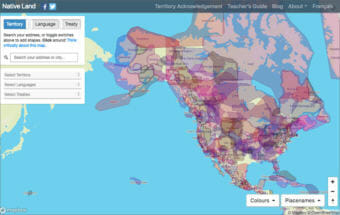
The Native Land app aims to help educate people about Native peoples and their historical lands. (Graphic courtesy Victor Temprano/native-land.ca)
Regardless of where you live in the Northwest, someone was there before you … but who?
Three years ago, Victor Temprano of Vancouver, British Columbia, wanted to find out.
“Once I had encountered the history of residential schools, it kind of shocked me because I hadn’t heard about it,” Temprano said. “Then I learned about it and that took me into realizing that a lot of other settlers, or non-Indigenous people, are kind of lacking in their education around a lot of this — lacking in their consciousness.”
Since then, Temprano, a web developer, has created a web-based app that can help educate people about Native peoples and their historical lands.
He wanted to do his part to right what he considers wrongs and injustices experienced by Indigenous tribes.
“The easiest short little way to tell somebody (about it) without getting into anything too political, or contentious is to just say ‘oh it’s an app that attempts to map out Indigenous territories, languages and treaties across North America and increasingly beyond,” Temprano said.
When you sign on to native-land.ca, you can plug in a ZIP code, and the map will zoom into that region.
What you see is a patchwork of colors, with labels for the area tribes, any treaties they may have signed with other governments and a list of languages that Indigenous people might have spoken there. The information in the App comes from at least 65 different sources, available online.
Because of that mash-up, Temprano calls the map “inadequate, to some degree.”
“It may be misrepresenting people,” he said. “It may have inaccurate information that kind of continues some of the old colonial narratives and that’s a major concern of mine that I take really seriously.”
Temprano said he wants more tribal members to get involved.
Leena Minifie, a member of the Kitkatla Nation with territory along the coast of northern British Columbia, is a member of the board of directors guiding Temprano through development of the native land app.
“I think entering somebody’s house is like entering their territory,” she said.
“This is an entry point to realize, ‘oh, there is a protocol, there is a way that people acknowledge when they go onto other territories and I can actually replicate or imitate that, so I’m not being rude when I go into somebody’s territory or house,’” Minifie said.
She said the app can also help people “be good neighbors,” because it provides better understanding of how land is valued in Indigenous culture.
“Our concepts of what the land is and how we treat it and what it means to us and how we are responsible for it is not from a Protestant view of staking a claim, cutting out a square and saying this acre is mine,” she said.
The app has also expanded to include information about Indigenous people in Australia, New Zealand, Greenland and areas throughout Central and South America.
Temprano said he’d like to see the app expand to include Indigenous place names, and to show how people have moved and migrated across landscapes.
This week is the deadline for initiative backers in Washington and Oregon to submit their petitions to the Secretary of State’s office.
In Washington, backers of a carbon fee initiative have already turned in their petitions. Two years ago, Washington voters rejected a different carbon tax measure. But that proposal didn’t garner the support of a broad coalition.
What makes this different is that this carbon fee proposal is backed by a very powerful coalition of labor, environmental and tribal groups. There is a lot of power, a lot of money and a lot of unanimity behind this particular proposal whereas in the past we’ve seen split views on whether it was the right approach.
Financial supporters of the carbon fee include The Nature Conservancy, the Washington Environmental Council and the Washington State Labor Council.
Oil companies are poised to fund an opposition campaign.
Other initiatives likely to qualify for the Washington ballot include a ban on Seattle-style soda taxes and a gun control measure that would — among other things — raise the age to buy a semi-automatic rifle to 21.
Attorneys and tribal members called it a landmark case for tribal sovereignty, and now the U.S. Supreme Court has agreed to review it.
In 2013, Washington’s Department of Licensing demanded $3.6 million in taxes and fees from a Yakama Nation fuel company, so the two parties went to court.
A Yakama Nation member transported fuel across the Oregon-Washington border for sale at the Cougar Den — a gas station on the tribe’s reservation.