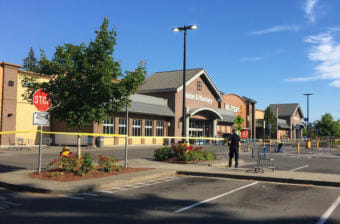
Police block the scene outside a Walmart in Tumwater where a gunman shot a driver, then was himself shot to death on Sunday afternoon. (Photo by Austin Jenkins/Northwest News Network)
A shooting spree in Tumwater, Washington, ended in a sun-drenched Walmart parking lot when a civilian shot the suspected gunman to death, police said Sunday evening.
At least two people were wounded: a teenage girl with a minor injuries and a man who was airlifted to Harborview Medical Center in Seattle, where he is in critical condition.
Tumwater police spokeswoman Laura Wohl said officers first responded to reports of a vehicle being driven erratically. Then came reports of shots fired near Tumwater High School, where the girl was wounded. She said the gunman carjacked a vehicle and drove to the Walmart.
The gunman reportedly fired multiple shots both inside and outside the store, sending shoppers fleeing.
Megan Chadwick from Eugene, Oregon, was with her husband and four children.
“We were at the checkout and there is a flood of people running shouting, ‘Shooter! Get out, get out!'” she said.
The gunman then attempted to carjack a vehicle and shot the driver.
Wohl said at least two armed civilians followed the suspect out of the store and confronted him.
Brian Adams of Olympia said he was picking up pool supplies when he heard the shots and people started running.
He said the civilian with a gun confronted the gunman as he came toward the civilian’s family.
“He is a true hero because there would have been more victims,” Adams said. “This guy was just shooting randomly in the parking lot.
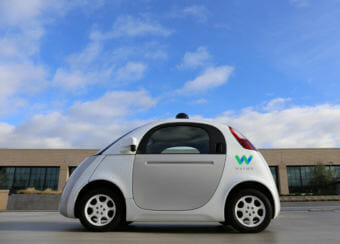
Google spin-off company Waymo’s Firefly 1 reference vehicle. Waymo is one of seven companies that has notified Washington’s Department of Licensing that they plan to test self-driving vehicles. (Photo courtesy Waymo)
Seven different companies have notified Washington’s Department of Licensing that they plan to test self-driving vehicles on roads in the state. Oregon transportation officials have gotten notifications from two other companies.
A mixture of big tech companies and startups are expanding their test programs to the Northwest. The list includes Waymo, NVIDIA, Intel and TORC Robotics. Washington has minimal requirements and allows self-driving car testing either with a safety back-up driver or with no human on board.
“The industry, the private sector is pulling government along, whether we’re ready or not,” said Washington Transportation Commission Executive Director Reema Griffith at the Bloomberg Sustainable Business Summit in Seattle on Thursday. “We’re trying to play catch up, but we do need a public policy framework.”
“The delicate balance is the challenge that we have to hit where we’re not suppressing innovation. We’re enabling it. We’re encouraging it and incentivizing it,” Griffith continued. “But at the same time we’ve got to look out for public safety and getting the public ready and comfortable with this notion. And helping human drivers as we think about a blended fleet that will probably be in existence for quite a while.”
At that same event, Lyft Self-Driving Product Lead Jody Kelman said “the autonomous future” is closer than people realize.
“If you were in Vegas today instead of hanging out with us here, you could actually open up your Lyft app at the Bellagio and request a self-driving Lyft ride today,” Kelman said.
Oregon has a voluntary notification process and no specific rules yet for autonomous vehicle testing. The Oregon and Washington legislatures have both authorized task forces to look into the safety, regulatory, liability, infrastructure and economic development dimensions of autonomous vehicles.
An Oregon Department of Transportation spokeswoman said truck maker Daimler and chipmaker Intel submitted voluntary notification forms for autonomous vehicle testing. ODOT’s Sarah Kelber said Daimler’s project involved a technology for truck platooning — electronically-connected semis closely following each other — which could increase the efficiency of highway transport. Intel is involved in multiple autonomous vehicle projects, but did not immediately respond to a message asking which it was bringing to Oregon.
The seven companies that have “self-certified” to Washington’s Department of Licensing that they can safely test autonomous vehicle technology on public roads are:
May Mobility – Michigan-based startup focused on self-driving shuttle fleets
Navya Inc – French robotaxi developer
NVIDIA Corporation – Established chipmaker that has branched into artificial intelligence and vehicle software and sensors
TORC Robotics – Blacksburg, Virginia-based, with significant defense contracting revenues
Waymo LLC – Self-driving car subsidiary of Alphabet, Inc.
Dooblai LLC – software company in Bellevue, Washington
Simple Solutions – California-based computer networking company
Google spin-off company Waymo has been testing on the roads of Kirkland, Washington, since 2016, starting with a single modified Lexus SUV. Google has a large office in Kirkland.
In total, Waymo reports it has logged more than 5 million self-driving miles across all its test locations, with the majority of those miles happening near its headquarters in California’s Bay Area.
May Mobility, based in Michigan, makes a self-driving mini-shuttle bus. It recently submitted a bid to the city of Bellevue, Washington, in response to a request for proposals for an autonomous downtown shuttle. May Mobility awaits word whether it was selected to provide a single transporter, which would circulate on a 1-2 mile loop through downtown Bellevue’s office and restaurant districts and pass the transit center.
The director of development for Navya North America, Chris Pauly, said the self-driving shuttle and robotaxi company does not have any vehicles operating in Washington yet, but anticipates having them before the end of the year or early 2019.
“Washington is an ideal state to test and operate shuttles in due to a variety of factors including varying environmental (weather) conditions, mix-use traffic patterns and a known regulatory environment which allows for autonomous vehicles to be deployed,” Pauly said in an email.
Virginia-based TORC Robotics posted pictures on its website from a cross-country road trip using a Lexus SUV equipped with its software and multi-sensor self-driving system. The car encountered rain in the Seattle area, a potential challenge to self-driving vehicles’ perception abilities. TORC proudly reported its system conquered the challenge.
The list of companies that have notified Oregon and Washington that they are testing in the Northwest does not include any that were involved in recent serious incidents involving cars operating in autonomous mode. A test sedan owned by the ride-hailing service Uber hit and killed a woman crossing a street in Arizona in March. Several Tesla drivers have been killed or injured when their cars with “Autopilot” software engaged slammed into stopped vehicles. The most recent such crash happened in Utah on May 11.
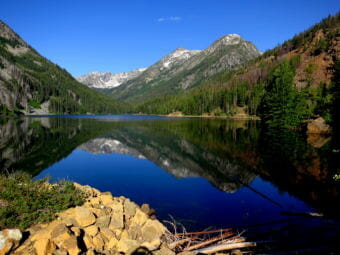
Eightmile Lake in the Alpine Lakes Wilderness. A century-old dam there is now under threat from floodwaters. (Creative Commons photo by Steve Cyr)
A nearly 100 year-old dam near Leavenworth, Washington, is under heavy pressure from melting snow this week and officials are warning downstream residents to be prepared to evacuate if the dam breaks.
The Eightmile Lake Dam, which was built in the 1920’s out of earth, rock and mortar, is on Eightmile Lake in the Alpine Lakes Wilderness. Water from the lake flows into Icicle Creek through Leavenworth and then dumps into the Wenatchee River.
In recent days, snow melt from the mountains in Canada have inundated waterways in Central and Northeast Washington and caused flooding in many areas. A major forest fire burned much of the watershed around the Eightmile Lake Dam last year, so soils there are less absorbent.
The high water has already peeled off a four-foot section of the earthen portion of the dam. Officials are worried as temperatures rise this week, the pressure on the dam could worsen.
Emergency officials just flew in an excavator to the remote site using a helicopter. They plan to siphon water from behind the dam with large hoses. A release pipe that could help is clogged with old boards and debris. Officials say that at this high water stage, they can’t safely remove the blockage.
Emergency managers have called a public information meeting on the situation at the dam for Monday, May 14 in Leavenworth at the Leavenworth Fire District #3 at 7pm.
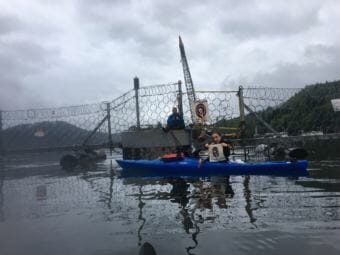
Protesters blocked a marine gate at Kinder Morgan’s Westridge Terminal in Burnaby, B.C., on Wednesday.
Demonstrators took to land and sea in British Columbia Wednesday as energy giant Kinder Morgan hosted shareholders at an annual meeting in Texas.
In Houston, tribal leaders voiced their opposition to the company’s proposed expansion of the Trans-Mountain Pipeline — a project that could increase the amount of crude oil shipped to Washington state.
Oil from that pipeline is shipped from tar sands in Alberta to Washington state refineries in Tacoma, Ferndale and Anacortes.
An expansion would create a second, twin pipeline and add more oil tankers.
“We do not believe the risks of the project have been accurately evaluated nor fully disclosed,” Neskonlith Band Chief Judy Wilson said.
She and other tribal leaders from British Columbia made an emergency trip to Texas.
Wilson also spoke on behalf of the Union of British Columbia Indian Chiefs during Kinder Morgan’s annual shareholders meeting.
Expanding the pipeline has also garnered opposition from Washington Gov. Jay Inslee, as well as British Columbia Premier John Horgan and Vancouver, B.C., Mayor Gregor Robertson.
“It threatens our culture, our spirituality and our identity and our way of life and that means fundamentally more to us than anything that they could offer us,” Wilson said.
She added that some shareholders accepted an invitation to visit indigenous territory in Canada.
In April, Kinder Morgan halted all non-essential spending on the Trans-Mountain Pipeline in response to widespread opposition of the expansion proposal.
The company has self-imposed a May 31 deadline to make a final decision on whether the project is viable.
During their annual meeting, shareholders voted in favor of two resolutions: One to produce annual sustainability reports; another calls for a report by 2019 that outlines the company’s financial risk from climate change.
Chairman Rich Kinder said the board “will carefully consider the proposals,” He noted both resolutions are non-binding.
The Secwepemc Nation is awaiting a verdict from Canada’s Federal Court of Appeals that challenges federal approval of Kinder Morgans proposal to expand Trans-Mountain.
First Nations in Canada argue that the proposal lacks tribal consultation.
As the shareholders meeting took place in Texas, demonstrators in British Columbia blocked the gates to a Kinder Morgan Terminal outside of Vancouver.
So-called kayaktivists also paddled to a marine gate at the terminal. According to the Royal Canadian Mounted Police, at least one was arrested.
One of the diciest points in an airline merger is consolidating computer systems. That moment arrives Tuesday night for Alaska Airlines and its former West Coast rival Virgin America.
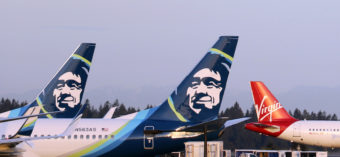
Seattle-based Alaska Airlines bought San Francisco-based Virgin America a year and a half ago. The process of merging the two carriers under the Alaska brand reaches “a crescendo” this week, in the words of Alaska Air Group CEO Brad Tilden.
Beginning Wednesday, Virgin’s ticket counters, kiosks and signage will disappear. Travelers will deal with one reservation system, one call center, one website and one smartphone app — all Alaska’s.
Tilden told Wall Street analysts Monday that the company is now set to realize the benefits of its $2.6 billion acquisition.
“As of this moment we think we are 65 or 70 percent of the way through the merger. By the end of this quarter, by June 30, we think we’ll be 85 percent of our way through the merger,” he said. “I think we are in a really good position today.”
The rebranding won’t be over right away.
Repainting all of Virgin America’s Airbus planes in Alaska colors and changing out the interiors will take until next year. That will eliminate the seat-back TV screens Virgin had. Alaska Airlines delivers in-flight entertainment by streaming content to passengers’ own devices.
As the Virgin America brand and its scrappy, hip culture flies into the sunset, the sting is somewhat salved for Virgin’s pilots and flight attendants by the significant pay raises they receive on Alaska’s more generous union contracts.
Tilden said Monday that the successful negotiation of unified contracts was another reason he is optimistic about the merger of different work cultures.
“We’ve got more work to do, but we do have 80 percent of our collectively-bargained payroll that has got new, market-based agreements,” he said. “That is a great accomplishment. It sets us up to get integrated seniority lists, which sets us up to get the cultural stuff settled and moving forward.”
Alaska Joins “Basic Economy” Trend
During Monday’s quarterly earnings teleconference, Alaska’s management also announced that the company would follow the nation’s biggest three airlines in offering stripped-down, basic economy fares. Alaska said the new option, dubbed “Saver Fares,” would debut in late fall.
“This low-priced product will be limited to seats assigned at the rear of the aircraft, and guests will board last,” said Chief Commercial Officer Andrew Harrison. “Upgrades for elites will not be permitted and the tickets will not be changeable or cancellable.”
Unlike the legacy carriers’ versions of basic economy, Alaska’s offering will still include advance seat assignment for free.
Delta, United and American all introduced basic economy fares in the past year to better compete with low-cost carriers such as Allegiant, Spirit and Frontier. Those airlines each offer super-low fares while imposing a myriad of fees, many for things that air travelers used to consider standard, such as use of the overhead bin, seat assignments, snacks, more legroom and itinerary changes.
Alaska Airlines leaders said they expect the new Saver Fares to drive $100 million in incremental revenue in 2019. Some business travel departments already steer clear of basic economy and will only book higher fare classes.
“It is sad to see Alaska Airlines take up this practice of basic economy,” Seattle travel blogger Alan Waite wrote. “It is setting up the customer for disappointment as the average customer doesn’t fully understand these fares. Personally, I hope that Alaska will change this decision before implementation in Fall 2018. Alaska typically doesn’t offer the cheapest tickets but instead offers the best service. I hope this isn’t a sign of Alaska’s willingness to participate in the race-to-the-bottom.”
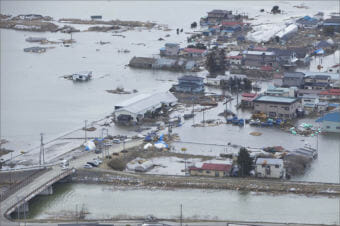
An aerial view of Ishinomaki, Japan, on March 18, 2011, one week after a devastating 9.0 magnitude earthquake and subsequent tsunami.(Lance Cpl. Ethan Johnson/U.S. Marine Corps)
The worst case scenario for flooding from a tsunami along the Pacific Northwest coast just got even worse.
Washington’s Department of Natural Resources with help from the National Oceanic and Atmospheric Administration re-mapped the maximum tsunami threat from Grays Harbor down to the Columbia River mouth.
Chief Hazard Geologist Corina Forson said updated science about the offshore Cascadia fault zone produced a bigger surge.
“There are places in Ocean City where you have 50 to 60 feet of inundation modeled from this map,” she said. “It is quite shocking. That’s on the outer coast if you’re standing on the shoreline.”
Forson said the biggest difference from previous maps published in 2005 is that the tsunami waves penetrate higher up river and creek valleys.
As before, all of Ocean Shores, Washington, most of the Long Beach Peninsula and downtown Aberdeen and Hoquiam could be more than 6 feet under water.
Forson’s takeaway is that low-lying coastal areas should be thinking about escape methods.
“This is really a tool to push for vertical evacuation structures and informing residents of the hazard where they live,” Forson said in an interview Wednesday. “Our next step is working with local emergency managers and planners to update the evacuation routes and educate the community on where the best place to go to evacuate is.”
Forson said the earlier and the new tsunami inundation maps both assumed a magnitude-9 earthquake, but the newer modeling produced a bigger movement of the seafloor at the Cascadia subduction zone, yielding a bigger tsunami.
The first waves would arrive at the Southwest Washington coast about 15 to 20 minutes after the earthquake.
Forson said her division has a work plan to next publish updated tsunami maps for Bainbridge Island,
Whatcom and Snohomish Counties and then the central and northern outer coast.
At a Wednesday meeting convened by Washington Gov. Jay Inslee’s office to discuss seismic safety, the superintendent of the Aberdeen School District said tsunami evacuation was under active consideration as the district wrestles with whether to rebuild, relocate or retrofit six old and vulnerable schools.
Dr. Alicia Henderson said an elevated tsunami evacuation platform would get serious consideration if the school at the top of the list for replacement, Stevens Elementary, could not be moved out of the inundation zone.
The neighboring Ocosta School District drew national attention two years ago when it dedicated a new gym at the elementary school in Westport.
The flat top of this man-made hill would have offered refuge for townspeople and visitors who otherwise couldn’t get to distant high ground in time to escape a tsunami spawned by a major offshore earthquake.
But the latest modeling of wave heights suggests that the proposed elevation is not high enough.
Close
Update notification options
Subscribe to notifications
Subscribe
Get notifications about news related to the topics you care about. You can unsubscribe anytime.