An earthquake early warning system under development for the West Coast gets a major boost in the new federal budget that President Donald Trump signed into law Friday.
President Trump’s original budget proposal for 2018 zeroed out funding for earthquake early warning. But Congress dramatically reversed that. The new federal budget increases spending to build a warning system to $23 million this year, more than double the $10 million that the U.S. Geological Survey got for this purpose last year.
UC Berkeley seismologist Richard Allen said the budget boost keeps the system on track for a “limited” public rollout late this year.
“Thinking about warning times, we’re talking about seconds, tens of seconds. The best case scenario is a few minutes,” Allen said. “We should be thinking about how we can react with warnings of a few seconds.”
The system designers say a short advance warning could be used to open fire station doors, slow down trains, pause surgeries or stop and open elevators at the next floor.
Down the road, the general public will be able to get alerts to drop, cover and hold on via a smartphone app, TV screens and other connected devices.
Allen said the new funding for the earthquake warning system will pay for things like additional sensors and for fine tuning the software to automatically detect damaging quakes and issue alerts. At this point, the system has about half of the desired seismic stations in place, which will eventually encompass a wide network of more than 1,000.
USGS and partner institutions including the Pacific Northwest Seismic Network, University of Washington, University of Oregon and UC Berkeley have trademarked the name ShakeAlert. The prototype has successfully alerted researchers to moderate earthquakes before shaking reached their locations.
A Geological Survey outreach coordinator said a selection of people in the transportation, utilities, health care and education sectors would be invited to try out the ShakeAlert system on a pilot basis late this year.
A social science committee continues to study and tweak the interface to figure out how best to convey a useful warning and educate users to respond appropriately.
“The (prototype) system is running very well in regions that have stations that are pretty dense already, which is primarily the urban areas up and down the West Coast,” Allen said. “I’m very excited about the possibility of the limited public rollout later this year. I think the greatest challenge frankly, is fear of screwing up.”
“The system might make a mistake and people are very concerned about that,” Allen explained. “It is good to recognize that, but I think we really have to get past this.”
Allen said the early warning systems already in service in other countries such as Mexico are imperfect too.
“What we have learned from Mexico is that the receivers of the information, the public, they understand that there are technical limitations to these systems. They recognize that the system is not perfect, but they still see it as being valuable.”
During the same event, University of Oregon seismologist Diego Melgar described a goal of adding accurate tsunami prediction and warning capabilities to the emerging ShakeAlert warning system.
“I think overall the outlook is quite positive,” Melgar said. “With continued effort for Cascadia, we will have warnings for tsunamis in under five minutes.”
Melgar added a caveat that real-time tsunami modeling using very sensitive GPS and ground motion sensors on land will always be somewhat uncertain. The U.S. national tsunami warning centers currently use offshore buoys and supercomputer models to assess tsunami hazards and issue advisories over broadcast channels and NOAA weather radios.
“In the Pacific Northwest we know the next big earthquake or tsunami is not a matter of if, but when,” tweeted Congressman Derek Kilmer, D-Wash.). He said early warning systems “will buy folks on our coasts lifesaving time in an emergency.”
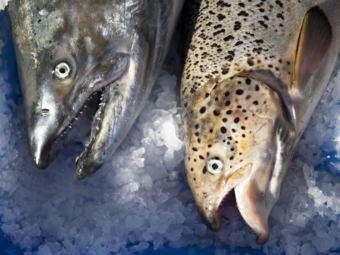
Washington state posted an identification guide to help fishers distinguish native Pacific salmon species from Atlantic salmon on the right. (Photo by Megan Farmer/KUOW)
Atlantic salmon farming has been banned from Washington state waters after Gov. Jay Inslee signed the restrictions on nonnative fish farms into law last week in Olympia.

“These present a risk to our wild salmon runs that we cannot tolerate,” Inslee said.
The move comes eight months after an ill-fated fish farm near Anacortes started to come undone in a strong current on an otherwise calm summer day.
The floating farm, owned by New Brunswick, Canada-based Cooke Aquaculture, tore apart a month later, letting as many as 250,000 Atlantic salmon escape into Puget Sound.
While lawmakers included a provision stating that the Legislature would research and revisit the issue as new science becomes available, Inslee vetoed that section, bringing what appears to be a decisive end to at least three decades of Atlantic salmon farming in Puget Sound.
Opposition to the farms grew after one of Cooke Aquaculture’s three net pens off Cypress Island imploded in August. Fish from another ocean quickly swam north into Canada, south past Tacoma and up several rivers, raising fears among tribes and environmentalists that the invaders could harm the region’s struggling runs of wild Pacific salmon.
While officials and early media accounts blamed a solar eclipse for the collapse, state investigators later concluded that the farm’s poor condition — corroded and overgrown with tons of mussels and other sea life — made it more vulnerable to the push of tidal currents that arrive like clockwork in Puget Sound.
The state’s remaining Atlantic salmon farms, all owned by Cooke, could be gone by 2022, once their existing leases with the Washington Department of Natural Resources expire.
The controversy over these fish might not be over.
Earlier this year, Cooke, which raises salmon on three continents, threatened to sue under the North American Free Trade Agreement if Washington officials tried to curtail its operations here.
“Our company and our rural sea farming employees are deeply disappointed by the Governor’s decision to ignore the science and sign the bill,” Cooke spokesman Joel Richardson wrote in an email after the signing.
He said the company was evaluating all available options.
An MH-65 Dolphin rescue helicopter similar to this one was involved in a near-miss with a drone Saturday over Port Angeles, Washington. (Photo by Master Sgt. Rick Cowan/U.S. Coast Guard)
A U.S. Coast Guard helicopter came within 50 feet of colliding with a drone over Port Angeles, Washington.
The Coast Guard said an air crew was doing low altitude training exercises near Fairchild International Airport when it had to take evasive action.

Lt. Cmdr. Brent Schmadeke said a near miss last weekend with a drone has not happened before in the two years he’s been at Air Station Port Angeles.
“With the increasingly popularity of model aircraft and drones for personal use — taking pictures, recordings and what not — I can only see it happening more,” he said.
It’s illegal to fly a drone within 5 miles of an airport unless the airport authority and control tower give permission.
Schmadeke said the errant drone operator in this case could not be located.
Schmadeke said the air crew told him after landing safely that they were flying at 300 to 400 feet when they saw what they thought was a bird.
“It turned out it was not a bird. It was a drone, a quadcopter drone,” Schmadeke said in an interview. “They were close enough for the pilot to be familiar with the model and the make of the drone.”
“They were very concerned,” Schmadeke said. “They were able to maneuver to avoid the drone.”
Saturday’s near miss involved a Coast Guard MH-65 Dolphin rescue helicopter, the workhorse model for the air stations along the U.S. West Coast.
The Federal Aviation Administration’s voluminous database of dangerous incidents involving unmanned aircraft systems includes one other recent case involving a Coast Guard helicopter.
The pilot of an MH-65 Dolphin sighted a small drone at the same altitude of 300 feet while on landing approach in San Diego last July. That Coast Guard pilot did not need to take evasive action.
The San Diego Police Department responded on the ground, but could not locate the drone operator.
The FAA said reports from pilots, citizens and law enforcement about airspace violations by drones have increased dramatically.
The agency now fields more than 100 such reports each month.
The FAA and industry partners are promoting the use of a smartphone app called B4UFLY, which gives drone operators “situational awareness” and shows airspace restrictions in the vicinity of the user’s location.
Katie McKenna speaks on the steps of the Alaska State Capitol building in Juneau at a student walkout protest Wednesday, March 14, 2018. Students and Juneau Rep. Justin Parish, wearing the coat and tie, listen. (Photo by Mikko Wilson/KTOO)
After a teenage gunman killed 17 people at a Parkland, Florida, high school last month, schools across the country were hit by a wave of copycat threats.
In Colorado, at least two high school students were arrested based on information sent to the state anonymous tip line and mobile app, known as Safe2Tell.
“They had a list, they had weapons, they knew exactly what they wanted to do,” said Colorado Attorney General Cynthia Coffman, whose office administers the program.
States across the country are responding to high-profile school shootings and rising teen suicide rates by creating tip lines modeled on Colorado’s. The programs aim to prevent young people from behaving dangerously, whether that means bullying, using drugs or killing someone.
Coffman said that Safe2Tell has saved lives in Colorado, and that such a system could have prevented the Parkland shooting. Nikolas Cruz, the expelled student who has admitted to shooting his former classmates at Marjory Stoneman Douglas High School, had a long record of disturbing behavior but it didn’t provoke a sufficient response from local authorities. A tipster’s warning to an FBI hotline was never communicated to local law enforcement.
Tips that are sent to Safe2Tell, in contrast, are required to be passed on to school districts and often police departments, and local officials are required to investigate. That might mean setting up a meeting between a student and a school counselor, or it might mean sending a police car straight to a student’s home.
“Something like Safe2Tell would have led to an intervention,” Coffman said of the shooting in Florida. “I feel very confident saying that.”
Tip lines, which are relatively inexpensive and don’t affect gun control laws, are one of the few policy responses to mass shootings that Republicans and Democrats can agree on.
Colorado launched Safe2Tell after Columbine in 1999. Since 2014, Michigan, Nevada, Oregon, Utah and Wyoming have launched similar programs, prompted in part by the Sandy Hook massacre in 2012.
In the wake of the Parkland massacre, the Colorado Safe2Tell office has fielded calls from the Trump administration and interested state and local officials nationwide. “We’re getting calls from all over the country now, it’s crazy,” said Susan Payne, the director of Safe2Tell.
The Colorado Attorney General’s Office is working with its Florida counterpart to potentially set up a tip line there. In Arizona, a bill setting up a similar program is making its way through House and Senate committees. And this week the U.S. House passed legislation that would authorize grants for such programs along with other school safety initiatives.
“Solutions on the state level — including in my home state of Utah — can help show us the way forward,” Republican Sen. Orrin Hatch said in a speech last month announcing the school safety legislation. Utah’s anonymous tip line has investigated 86 credible school attack threats since it launched in 2016, according to University of Utah Health, the health care system that manages the program.
A response to Columbine
Payne came up with the idea for Safe2Tell in the 1990s when she was working as a police detective in Colorado Springs. At the time, youth violence was rising locally, and she found that young people often had valuable information about what was going to happen and needed trusted adults to tell — and a reliable way to do it.
She envisioned a system that would teach children that speaking up was their civic responsibility and doing so didn’t make them a tattletale. Unlike the national tip line Crime Stoppers, there would be no cash reward for providing information. Safe2Tell expanded statewide in Colorado in 2004, initially as a nonprofit.
Today, Colorado state patrol officers respond to tips that reach Safe2Tell by phone, mobile app or website 24/7, and ask tipsters detailed questions to gather information about a potential problem. Alerts are sent out to local officials soon after the interview ends.
John McDonald, head of security for Jefferson County Public Schools, said he’s been woken in the wee hours by his phone buzzing with an incoming alert. Often, he said, young people submit their reports when they’re up late worrying about something.
He has responded to tips about everything from suicidal thoughts to underage keg parties. Sometimes, tips lead to dramatic rescues. He and Coffman both shared the story of a middle-school-aged boy who tried to hang himself in a park. The boy’s teenage brother found him and saved his life after a principal received a tip and called the family in alarm.
Payne says that non-emergency reports are important, too. For instance, a report that a child has been cruel to animals can help a school district intervene and address his violent tendencies early on.
Last school year, more than 9,000 tips were submitted statewide. The most common tip involved a suicide threat. Other common tips involved bullying, drug use, cutting and depression, and about 300 involved planned school attacks. Anyone can use the service, including parents, teachers, college students and other community members.
Social media has made it easier than ever for users to spot and share safety threats. Sometimes tipsters will share pictures students have posted online of themselves wearing body armor and posing with a gun.
To make sure the program is being used, Safe2Tell officials team up with schools and nonprofits to educate students about it. “Just a tip line, by itself, I don’t think is the answer,” Payne said.
Not a magic solution
Yet some acts of violence have slipped through the cracks. In 2013, a student entered a Denver-area high school armed with a shotgun, a hunting knife and three Molotov cocktails. He shot a classmate in the head and then shot himself. Both teenagers died.
Although several students had had concerns about the student’s violent tendencies, nobody called the state tip line. “If just one student or teacher had called Safe2Tell, this tragedy might have been averted,” a report from researchers at the University of Colorado at Boulder and the University of Northern Colorado said about the shooting.
The researchers found that, among other mistakes, the high school never properly taught students and staff about Safe2Tell. The program was advertised on posters in the hallways, and stickers on the back of student identification badges, but students had not been trained to use it.
School districts need a system for keeping track of and addressing worrisome behavior way before a student reaches a crisis point, said William Woodward, one of the report authors and director of training and technical assistance at the Center for the Study and Prevention of Violence at the University of Colorado. The center is working with Colorado schools to improve intervention.
And schools also need the resources to follow up. Nevada, for instance, hired more school social workers before it launched a tip line this year. “We didn’t want tips to come in, and nobody ready to respond,” said Christina McGill, director of the office for a safe and respectful learning environment at the Nevada Department of Education.
“I will kid you not: It is labor intensive,” McDonald said of the Safe2Tell program. Tips can come in at any time of day and might involve a coordinated response from school administration and the police. “You’re waking up a lot of people,” he said.
Coffman said that policymakers and school officials in other states have told her that they’re worried some schools may not have the capacity to adequately respond to a high volume of tips.
The number of tips submitted in Colorado have increased dramatically over the past decade, which Coffman attributes partly to rising awareness of the program and partly to rising incidence of mental illness among young people in Colorado and nationwide. “I think that is an undercurrent through all these statistics,” she said.
States that want to set up a program similar to Safe2Tell should start with legislation that guarantees anonymity for tipsters, Payne said, and they can reach out to Colorado for advice. Safe2Tell cost less than $600,000 to run last year, she estimated.
Payne said she has encouraged the White House to establish a national umbrella to oversee all the state programs, as tips can come in to Colorado’s system that affect other states, and vice versa.
Although the White House has not commented on the umbrella organization idea, President Donald Trump supports school safety legislation passed by the House this week, according to spokeswoman Sarah Huckabee Sanders.
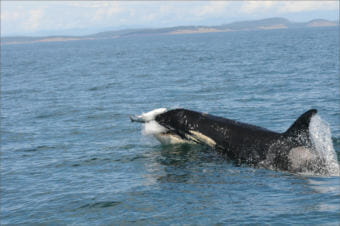
An endangered Southern Resident orca pursues a coho salmon off San Juan Island. Photo courtesy Candice Emmons/NOAA Fisheries/Northwest Fisheries Science Center)
The Pacific Northwest’s beloved orcas will not survive unless humans do more to ensure adequate food and cleaner, quieter waters.
The population of genetically-distinct resident orcas has dwindled to a critically low level. Deaths outpace births. Only 76 remain as of the last count.
“This is a dangerously low number for a species that is already endangered under the federal Endangered Species Act,” Jeff Parsons of the Puget Sound Partnership said at a legislative hearing in Olympia earlier this month.
”We’re at a critical juncture with orcas and we need to act now if we’re to save the species,” added Bruce Wishart, a Sierra Club lobbyist.
The resident killer whales face three main threats topped by lack of prey. Their favorite food is Chinook salmon, which is also dwindling. Then there’s disturbance from vessels and underwater noise. A third threat is toxic pollution in the water and marine food chain.
“If they’re not getting enough food, they’re going to use their blubber where contaminants can often be stored,” said Lynne Barre, the federal orca recovery coordinator at NOAA Fisheries. . “But once they’re using that blubber and they circulate, it can cause immune dysfunction and that may be affecting reproduction as well.”
So is this dwindling population doomed?
“I don’t think it’s doomed,”Barre said. “We have seen the whales be at an even lower level in the past but that was following removals for public display and aquariums. So following those removals and low numbers we’ve seen in the past, we have seen this population be resilient and be able to grow—and even at a pretty high rate of two percent or more per year.”
That’s what Barre is hoping happens again now that the federal and state governments have complementary recovery plans. Inslee on Wednesday signed an executive order directing seven state agencies to take a wide variety of short and long-term actions.
“There is no one panacea for the orcas,” the governor said. “Everyone in the state of Washington has some role to play in this. That is a serious thing to say. Everyone in the state of Washington has both something about the orca they feel special about and something they can bring to the table that involves change.”
Inslee described near-term elements to the state’s orca recovery plan. The Legislature provided a modest sum to pay for these in its just-completed session. First, make more food available for the killer whales by increasing salmon hatchery production by up to 5 million extra fish. Second, provide quieter waters and consistent separation from boaters by deploying more marine enforcement patrols. Third, provide cleaner waters by treating more storm water runoff.
Inslee handed off potentially more painful measures to a newly created Southern Resident Killer Whale Task Force. They’ll get to wrestle with questions such as whether to introduce vessel speed limits for noisy tankers and ferries. Plus, should commercial and recreational salmon fishing be curtailed to leave more food for the whales. And even whether farm and water use practices in Eastern Washington should change to benefit salmon and by extension, orcas.
Two brothers from the Lummi tribe sang a whale song at Inslee’s task force announcement held at a Seattle park overlooking Puget Sound. Suquamish Tribal Chairman Leonard Forsman said he can hear the orcas calling for help.
“Those are our ancestors talking to us,”he said. “So we really cannot let this happen. We have to protect the orca whale.”
Forsman said Northwest tribes are glad to see action to prevent extinction.
“The tribes stand ready, have been ready,” he said. We think this is a way overdue effort.”
Washington’s Department of Fish and Wildlife says it could take a long time to confirm a turnaround in the killer whale population trend. In the shorter term, things to look for include whether you see fatter orcas. And how many calves are born and survive.
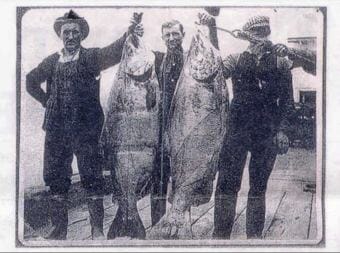
Chinook salmon on display in 1910 at Union Fisherman’s Dock in Astoria, Oregon (Wikimedia image)
While the orcas of Puget Sound are sliding toward extinction, orcas farther north have been expanding their numbers.
Their burgeoning hunger for big fish may be causing the killer whales’ main prey, chinook salmon, to shrink up and down the West Coast.
Chinook salmon also are known as kings: the biggest of all salmon.
They used to grow so enormous that it’s hard to believe the old photos now.
Fishermen stand next to chinooks almost as tall as they are, sometimes weighing 100 pounds or more.
“This has been a season of unusually large fish, and many weighing from 60 to 70 pounds have been taken,” the Oregonian reported in 1895.
“It’s not impossible that we see individuals of that size today, but it’s much, much rarer,” University of Washington research scientist Jan Ohlberger said Monday, more than a century later.
Ohlberger has been tracking the downsizing of salmon in recent decades, but salmon have been shrinking in numbers and in size for a long time.
A century’s worth of dam building, overfishing, habitat loss and replacement by hatchery fish cut the average chinook in half, size-wise, studies in the 1980s and 1990s found.
Few fish are making it to old age, which for a chinook salmon means spending five or six years in the ocean after a year or two in freshwater.
“The older fish, which normally come back after five years in the ocean, they come back earlier and earlier,” Ohlberger said.
The trend is clear, the reasons less so.
Two species eat more chinook salmon than any others: orcas and humans.
The 2,300 or more resident killer whales in the Northeast Pacific Ocean eat about 20 million pounds of chinook salmon a year – roughly equal to the annual commercial catch of chinook in recent years, according to the new study.
“There is a large number of resident killer whales out there that really target chinook, and they target the large chinook,” Ohlberger said.
A study from federal researchers in November found that orcas’ consumption of chinook salmon in the Northeast Pacific Ocean has doubled since 1975, surpassing humans’ catches, which have fallen by a third over that time.
“As far as we can see, the killer whales are taking the older and bigger fish,” said Craig Matkin, a whale researcher with the North Gulf Oceanic Society in Homer, Alaska.
Matkin, who was not involved in Ohlberger’s paper, studies Alaskan orcas’ diets.
“We go along with the animals and scoop up fish scales and bits of flesh from where they kill something,” Matkin said. “They’re sloppy eaters.”
“They’re going to go for the biggest, oiliest fish there are,” Matkin said. “That’s chinooks.”
Salmon born in Oregon and Washington spend most of their lives out at sea, often in Alaskan waters, where orcas aplenty await.
“Our (orca) populations have increased faster than anywhere else, and they’re eating chinook from all over the place,” Matkin said.
In short, it seems Puget Sound orcas are having their lunch stolen by their better-off Alaskan relatives.
“It is an interesting twist to blame the marine mammals,” Ken Balcomb with the Center for Whale Research on San Juan Island said in an email. “I would first ask how the chinook evolved to be so big during the preceding 12,000 years in the presence of hordes of such size-selective natural predators throughout their range. Large size was selected by Mother Nature for chinook salmon in spite of natural predation.”
Balcomb points to overfishing, habitat loss and salmon hatcheries that have diluted the gene pool of wild chinooks.
Today’s smaller chinook salmon lay fewer eggs than bigger ones can. They also have a harder time digging out gravel nests deep enough to protect their eggs from scouring streamflows.
Chinooks’ downsizing could spell trouble for all the mammals who want to catch them, whether they have fingers or fins.
“Predators are also going to adapt to this change in size and numbers,” Matkin said. “You can’t look at it as a static situation.”
“Ultimately, the whales must eat to survive, and humans have not sufficiently allowed for that in their fisheries management calculations,” Balcomb said.
Close
Update notification options
Subscribe to notifications
Subscribe
Get notifications about news related to the topics you care about. You can unsubscribe anytime.