Northwest News Network

Forecasts predict low salmon returns in Washington this year

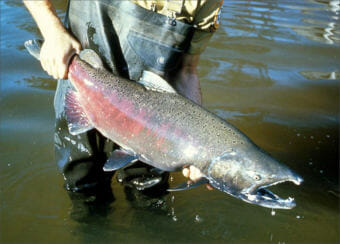
Wildlife officials expect returns of salmon in Washington state will be low this year. (File photo courtesy U.S. Fish and Wildlife Service)

Every year, wildlife officials keep track of how many salmon return to their spawning grounds. This year, they expect low returns of salmon in Washington state — and that could change the fishing outlook.

Forecasts for four species of salmon — chinook, coho, sockeye and chum — are likely to limit fishing opportunities this year.

Kyle Adicks is the intergovernmental salmon manager for the Washington Department of Fish and Wildlife.

“We have a growing population that isn’t necessarily good for salmon habitat,” he said. “We have a lot of people that value salmon—like to go out and catch them, like to see them spawning in our streams, like to see killer whales eating them in Puget Sound, but it’s kind of a resource that has been shrinking over time.”

That shrinking could be connected to declining ocean conditions, among other factors.

With the forecasted numbers in hand, fisheries managers will kick off a month-and-a-half long process next week to craft the guidelines for the 2018 fishing seasons in Puget Sound, along the coastline and up and down the Columbia River.

Washington state House votes to pass bump stock ban

Lawmakers in Washington state on Friday passed a ban on bump stocks, a gun modification that allows certain weapons to fire more rapidly.

They debated the ban under the shadow of last week’s school shooting in Parkland, Florida.
Democratic Rep. Laurie Jinkins said people are asking that lawmakers take action.

“No single thing we do will end it but there are many many steps we can take that will advance our ability to curb gun violence,” she said.

But Republican Representative Jay Rodne said banning bump stocks won’t work.

“We are going to trample on the rights of law abiding citizens, criminalize lawful conduct for a bill that will do nothing to address gun violence in our culture,” he said.

The amended bump stock ban will head back to the Senate before going to Gov. Jay Inslee’s desk.

Meanwhile a Democratic state senator is reintroducing a new version of a bill that would require that people be 21 to purchase a military-style rifle. Right now, you only have to be 18. It would also require stronger background checks.

The new bill introduced will also create a way for students to anonymously report potential threats and provide school districts with grants to improve their emergency response systems.

Remember NAFTA? It might keep Atlantic salmon farms in Puget Sound

Cooke Aquaculture's ruined Atlantic salmon farm off Cypress Island on Aug. 28. (Photo courtesy Washington Department of Natural Resources)
Cooke Aquaculture’s ruined Atlantic salmon farm off Cypress Island on Aug. 28. (Photo courtesy Washington Department of Natural Resources)

The Canadian owner of an Atlantic salmon farm that collapsed last summer near Anacortes vows to use the North American Free Trade Agreement to save its fish farms in Puget Sound.
New Brunswick, Canada-based Cooke Aquaculture says it will pursue mandatory arbitration under NAFTA if the Washington legislature tries to phase out Atlantic salmon farming.

Both chambers in Olympia have passed bills that would phase out farming of Atlantic salmon in Washington waters.

If legislators reconcile the bills’ differences, then Gov. Jay Inslee is expected to sign the phase-out of Atlantic salmon farming into law.

Company vice president Joel Richardson said Cooke has been willing to compromise, even offering to raise only female fishes in order to prevent escaped Atlantic salmon from spawning and taking over wild salmon streams.

“The Senate and the House is really leaving us with very few options to continue our operations here,” he said Monday night.

Richardson said the company will seek to recover the $76 million it has invested in its fish farms in Washington, as well as costs and lost profits.

“They’re taking that investment away unjustly, and that deserves compensation, and there’s a very real possibility that could be arbitrated under NAFTA,” Richardson said.

Washington state officials estimate that 250,000 Atlantic salmon escaped Cooke’s farm near Anacortes after it collapsed in August. The company says 160,000 of the farm’s 305,000 salmon escaped.

The previous, American owners of Cooke’s eight Washington fish farms also had major structural failures and salmon escapes in the late 1990s, according to the Washington Department of Fish and Wildlife:

  • 1996: 107,000 fish swim free after an anchor line fails on a salmon farm
  • 1997: 369,000 fish escape while a salmon farm is towed away from a toxic algae bloom
  • 1999: 115,000 fish break loose from a net-pen during a strong tidal current

“Those American companies that owned the same facilities that we owned had escapes actually larger than ours, and the state did nothing about it,” Richardson said. “Nor did they introduce a ban to eliminate the industry.”

Cooke, now the only commercial producer of farmed salmon in the United States, purchased Seattle-based Icicle Seafoods and its eight Washington state salmon farms in 2016. The Canadian aquaculture giant  owns Atlantic salmon farms on three continents.

Under NAFTA, governments in Canada, Mexico and the United States have to treat foreign investors as favorably (or as favourably, of course, in Canada) as they do domestic investors. Foreign investors, like Cooke in Washington state, can seek damages from governments in private, binding arbitration.

If Cooke were to successfully use NAFTA arbitration to block or be compensated for a state law, it would be a first: the United States has yet to lose such an arbitration case under NAFTA or other trade agreements.

Washington Department of Natural Resources spokesperson Carlo Davis declined to comment Monday night.

Washington Sen. Kevin Ranker of Orcas Island, who sponsored legislation to ban Atlantic salmon farms from state waters, could not be reached for comment Monday night. Nor could representatives of Puget Sound-area tribes, which strongly oppose Atlantic salmon farms.

Cooke announced its possible NAFTA strategy at 5:01 p.m. Monday, on the U.S. Presidents Day holiday, possibly echoing Washington state officials’ announcement of violations at Cooke’s Bainbridge Island salmon farm on Oct. 9: Canadian Thanksgiving.

Atlantic salmon grower calls effort to ban fish farms in Puget Sound ‘foolishness’

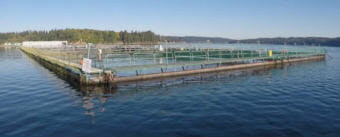
Cooke Aquaculture's Atlantic salmon farm near Bainbridge Island, Washington. (Photo courtesy Washington Department of Natural Resources)
Cooke Aquaculture’s Atlantic salmon farm near Bainbridge Island, Washington. (Photo courtesy Washington Department of Natural Resources)

The head of Cooke Aquaculture says he’s furious about “scare tactics” that he says are driving a push to end Atlantic salmon farming in Puget Sound.
The Washington Senate voted 35-12 Thursday to phase out aquatic leases for net pens holding non-native fish.

The August collapse and massive escape from Cooke net pens near Anacortes, Washington, energized Atlantic salmon farming opponents at the Washington Legislature.

Cooke Aquaculture CEO Glenn Cooke and other company leaders watched from the Senate gallery as a bipartisan majority effectively voted to boot the company’s operations out of Washington waters.

The charge was led by Democratic Sen. Kevin Ranker.

“If we want to talk about protecting jobs, what we need to do is protect our Salish Sea and get these net pens out of the water,” Ranker said.

“It was foolishness,” Cooke said. “It was incredible, some of the charges and comments.”

Cooke flew in from New Brunswick, Canada, where his family’s multinational seafood company is based.

“Think of this, this is the United States of America and you’re banning an industry?” he said.

Cooke said the net pen failure off Cypress Island last August was an aberration for his company. He disputes that escaped Atlantic salmon pose a risk of colonization or competition with native Pacific salmon.

He also disputes the frequent charge that net pens spread disease or pollution.

Cooke said about 180 jobs in fish production and processing are at risk if the state of Washington terminates all of Cooke Aquaculture’s Atlantic salmon farm leases.

The lively state Senate debate Thursday centered on the potential risks to struggling wild salmon stocks posed by farming Atlantic salmon in Pacific Northwest waters.

The legislation sponsored by Ranker would ban new aquatic leases for farming of non-native fish and forbid the renewal of existing state leases when they expire.

“In the months since the escape of hundreds of thousands of invasive Atlantic salmon from the net pen failure, we have learned the extent of the mismanagement and negligence of Cooke Aquaculture,” Ranker said. “This sort of careless behavior is unacceptable for any company in Washington state. The state ban is a strong stance to ensure the protection of our marine environment and native salmon populations in the Salish Sea.”

Senators on the losing side argued that the ban is based on questionable science and ignores less punitive options such as requiring non-native fish aquaculture rear only a single sex to eliminate the possibility of reproduction by escapees.

“I am very, very disappointed that the path forward today is the closure of an industry that has been very good to the state of Washington,” Republican state Sen. Judy Warnick said.

The Senate legislation now goes to the state House for further consideration. Various state representatives previously introduced a range of proposals from more severe to less ambitious, none of which have advanced very far.

Gov. Jay Inslee went on the record Thursday in support of the state Senate’s approach to ending leases for Atlantic salmon farms. He said he was motivated to speak out after reading the state’s investigative report on the Cypress Island net pen collapse.

“What we saw is a catastrophic failure due to a, in my opinion, very negligent failure to maintain these pens,” Inslee said. “What it told me is that we are going to see failures in the future if we continue down this road. They are inevitable given the tides, and the consequences of lack of maintenance, and the fact that we can’t have inspectors out there every single day.”

Western Washington tribes are also actively advocating for an end to Atlantic salmon aquaculture in the state.

Cooke raises Atlantic salmon at four locations around western Washington, as well as in Maine, Canada, Chile and Scotland.

The family-owned Canadian company took over the Washington locations in 2016 after buying Seattle-based Icicle Seafoods. Cooke is now the only commercial-scale operator of Atlantic salmon net pens in Washington waters.

Washington’s Department of Natural Resources is in the midst of reviewing all of Cooke’s leases in local waters. After inspecting the Port Angeles and Cypress Island facilities, the agency notified Cooke that it would terminate those leases as soon as the company could safely wind down operations. The termination letters cited numerous breaches of the lease terms including another net pen allegedly “in danger of catastrophic failure” off Cypress Island.

“We have fish there to grow out and harvest and we’re going to be allowed to do that,” Cooke said in an interview Thursday. “In the end, I am hoping that we can come to some kind of resolution with the commissioner of public lands and her department that she can live with, feel happy with and we can.”

Cooke said many of the existing net pens his company inherited from Icicle Seafoods are slated to be replaced and upgraded.

Oregon, California and Alaska effectively ban saltwater fish farms in their waters.

As one Washington wolf poaching case comes to a close, others remain a mystery

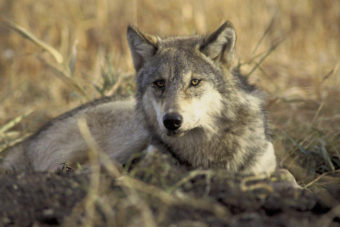
In the wake of finding 12 dead cows killed by wolves, Washington Fish and Wildlife offiicals plan to kill an entire wolf pack inthe northeast corner of the state (File photo U.S. Fish and Wildlife Service)

Last month, a Washington state resident was fined more than $8,000 for poaching three wolves in 2016.

DNA evidence linked him to three separate kills, but other poaching cases remain unsolved.
Last month, Terry Leroy Fowler of Liberty Lake pleaded guilty to two counts of unlawfully killing wolves in Pend Oreille County in 2016.

A third count was dismissed in a plea agreement.

“It’s no secret that wolves are an endangered species and classified as such in the state of Washington,” Washington Department of Fish and Wildlife Police Capt. Dan Rahn said. “I don’t think there was any question there whether the person knew that it was unlawful or not, when you’re taking wolves and trapping and killing them.”

Rahn said evidence at the scene led investigators to Fowler, but that doesn’t happen in every poaching case.

Back in December, two wolves were found dead elsewhere in northeastern Washington. The unlawful kills prompted environmental groups to offer a $20,000 reward, but officials say so far, that hasn’t incentivized anyone to come forward.

Washington state terminates lease for Atlantic salmon farm in Puget Sound

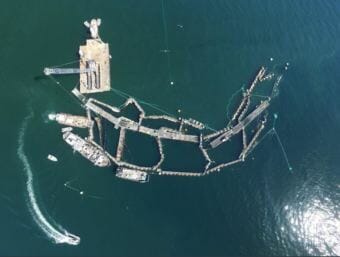
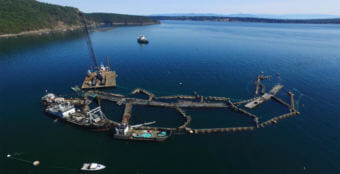
Drone view of collapsed Cypress Island net pens, which resulted in the escape of more than 200,000 non-native Atlantic salmon into Puget Sound. (Photo courtesy Washington Department of Natural Resources)

Over the weekend, Washington state tightened the screws again on an Atlantic salmon farming operation.

On Saturday, the state Department of Natural Resources terminated the lease for Cooke Aquaculture‘s Cypress Island fish farm near Anacortes.

That’s where one of three floating net pens collapsed last August, releasing an estimated 250,000 non-native salmon into Puget Sound.

State Commissioner of Public Lands Hilary Franz said an investigation found multiple violations of the lease terms.

“Given the number of violations of Cooke’s lease at Cypress and the refusal to be open and honest about their operations, I do not have any other choice but to terminate the lease,” Franz said.

The initial reaction from the fish farming company was measured.

“Given that Cooke Aquaculture Pacific received the notice of termination on a Saturday, we will reserve comment until we’ve had the proper time to review the letter and assess its impact on our operations and our employees’ livelihoods,” Vice President for Public Relations Joel Richardson said via email.

Franz said the termination of the fish farm lease, which would have run through 2023, is permanent.

“This is just another step toward ending Atlantic salmon net-pen operations in the waters of the Salish Sea and in the native fishing grounds of The Samish Indian Nation and other area tribes,” said Samish Tribal Chairman Tom Wooten in a statement. “The time is now to join our neighbors on the West Coast and end the practice of farming an invasive species in our waters.”

Cooke raises Atlantic salmon at four locations around western Washington, as well as in Maine, Canada, Chile and Scotland. The Canadian company took over the Washington locations in 2016 after buying Seattle-based Icicle Seafoods.

In December, DNR terminated the lease for Cooke’s Port Angeles harbor fish farm, citing “serious safety problems” and anchor lines outside the permitted zone there. Cooke disagreed with the findings and has filed suit against DNR in Clallam County Superior Court.

August’s fish farm collapse and massive escape energized salmon farming opponents at the Washington Legislature.

State lawmakers are presently considering options that range from terminating all non-native salmon net pen leases immediately, to gradually phasing out the industry or extending a current moratorium on new net pen facilities out to mid-2020.

In January, many Cooke workers came to a packed state Senate hearing in Olympia to defend aquaculture and their jobs.

They said a shutdown of salmon net pens would be unjustified.

Cooke managers testified the proposed move would jeopardize investment in Washington state from outside and the mortgages and livelihoods of caring people.

“I definitely looked at this context and understood that there are jobs that will be impacted as a result of this,” Franz said in an interview after she approved the Cypress Island net pens lease termination. “At the same time, my responsibility is to make sure I am caring for the lands and waters that I manage.”

In the termination letter to Cooke Aquaculture Pacific, DNR alleged the company failed to keep its facility “in good order and repair” and said one of the remaining net pen groupings was “in danger of catastrophic failure.”

The letter also took issue with the addition of a feed barge and floating office platform without the state’s approval and anchors outside the leasehold.

Franz said DNR is in the process of inspecting the other Cooke fish farm operations in Puget Sound and may take further actions.

The other Atlantic salmon net pens are near Bainbridge Island and off Hope Island, which is by the mouth of the Skagit River.

Oregon, California and Alaska effectively ban saltwater fish farms in their waters.

Site notifications
Update notification options
Subscribe to notifications