Workers at Hanford began filling a collapsed section of a rail car tunnel near the PUREX Plant on Wednesday morning. (Photo courtesy U.S. Department of Energy)
Six Hanford Site workers have shown up as possibly contaminated since Dec. 8. One worker was possibly contaminated twice.
Workers have been steadily working to tear down the Plutonium Finishing Plant — a massive building that used to make so-called plutonium buttons for bombs since 1949 — since 2016. It’s nearly done.
They think it will be slab on grade in January.
The workers wear small lapel meters on their collars. Those gave the signals that there might have been elevated levels of radioactive material around them.
The workers now have to undergo a bioassay. They test each workers’ feces to see if they might have ingested some radioactive material.
Those tests will take about a month to get back.
The president of CH2MHill Plateau Remediation Company, the contractor doing the work for the federal government, said what’s vexing is that the contamination doesn’t appear to have any clear signature or single source.
It will take investigating to find out where this material might be coming from.
“We don’t ever take contamination events lightly,” company president Ty Blackford said. “And if we don’t understand what it is, or where its coming from—the safety of the people first.”
Some of the contamination events happened about 150 yards away from the demo site, while the others happened in a load out area 400-500 yards away.
Of the possible contaminations three samples have decayed away already Blackford said, suggesting radon.
The company said they will only restart work when the possible contamination events have been sorted out.
There have been about six other incidents of radiological contamination alerts at the Plutonium Finishing Plant demo job, but the workers didn’t get any dose, the company said. Contract workers will be off for Christmas starting after work Dec. 22.
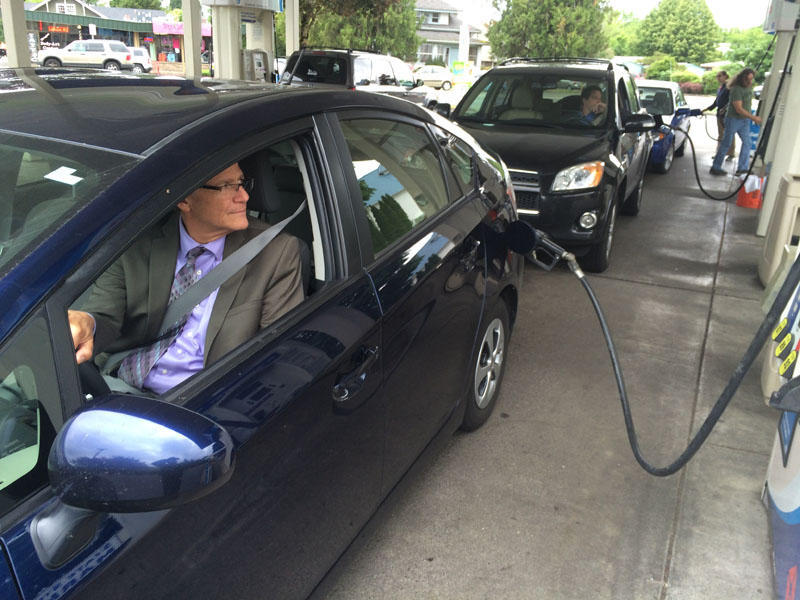
Oregon Department of Transportation spokesperson Tom Fuller fills his tank at a gas station in Salem, Oregon. (Photo by Chris Leman/Northwest News Network)
Beginning early next year, a group of Washington drivers will be keeping close tabs on the number of miles they drive and how much they spend on gas.
They will be part of a pilot program to test out a proposed pay-by-the-mile road tax, similar to what Oregon rolled out in 2015.
The Washington State Transportation Commission is recruiting 2,000 people who represent a broad range of drivers—from east and west of the Cascades, and from cities and rural areas.
They are looking for people who drive both often and occasionally, and who come from a variety of racial, ethnic and socio-economic groups.
“We hear a lot of concern from people across the state about what this program will mean to them,” said Reema Griffith, the executive director of the Washington State Transportation Commission. “We want to have as much representation of different kinds of drivers and to have a richer data set to see how it will impact people.”
Pay-by-the-mile is a new idea for Washington state drivers.
Drivers in Washington currently pay a 49 cent per gallon state gas tax that goes to fund transportation projects.
But as vehicles become more fuel-efficient, state officials expect the gas tax will soon fall far short of what the state needs to maintain roads, bridges and the ferry system.
By 2035, the state estimates gas tax revenue will decline by 45 percent.
With the so-called road usage charge drivers would pay for the number of miles they drive in the state, not the amount of gas they use.
As in Oregon, volunteer study participants in Washington can track their mileage by using GPS devices or by having their odometers checked periodically.
Washington’s pilot program also offers a new option: a cellphone app that distinguishes between miles driven in state and out of state.
Washington will give study participants a choice among five different ways of reporting their mileage.
Washington and Oregon are among seven states that received federal grant money to fund pilot projects.
The idea at the federal level is to seed many state level experiments to sort out the most equitable means of paying for transportation infrastructure in the future.
The transition date would be a political decision, highly uncertain when for now.
“We all use the roads, so its important that we pitch in to make sure that the roads are there for us in the future,” Griffith said.
Washington state’s trial program will roll out sometime in late January or early February.
Volunteers will not actually pay a road tax, they will just keep track of their mileage and compare the estimated cost with the amount they actually pay at the gas pump.
By 2020, the Commission must report its final findings from the pilot program to the governor and the legislature.
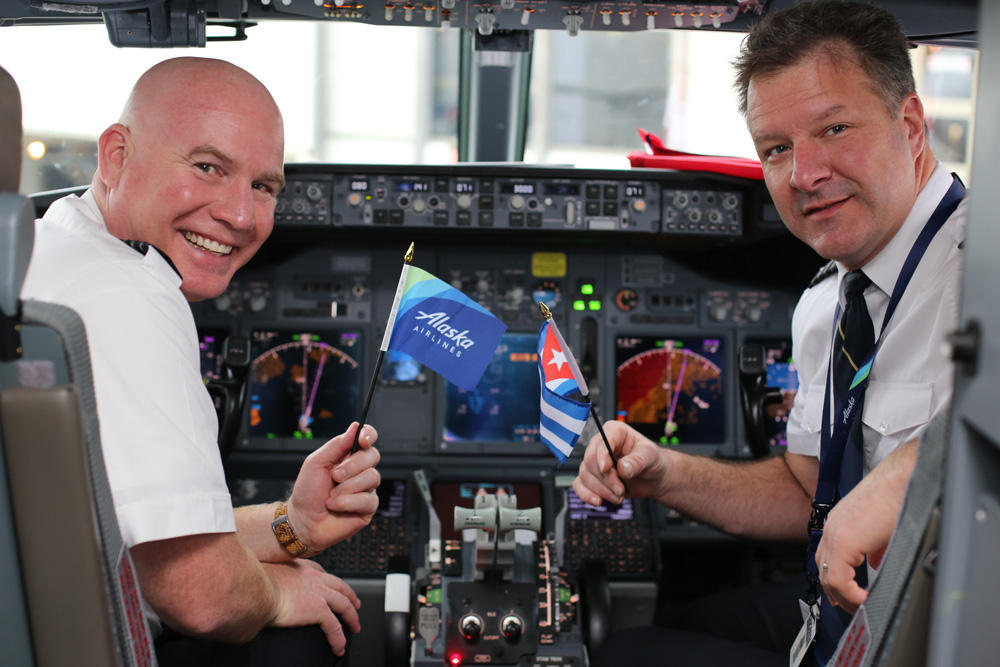
Pilots waved flags in the cockpit before taking off on Alaska Airlines’ inaugural flight to Havana, Cuba on January 5, 2017. (Photo courtesy Alaska Airlines)
“Looking at the precipitous drop-off in bookings coupled with the fact that 80 percent of our traffic can no longer take advantage of the people-to-people education option, we just felt there were better opportunities for us,” Kirby said.
Alaska Airlines launched service on a Seattle-Los Angeles-Havana route with much fanfare last January.
Alaska’s last flight to Havana will depart on January 22, 2018, meaning the service to Cuba lasted just over a year.
The U.S. Treasury Department last week reimposed Cuba travel rules that basically make Americans join expensive, tightly-regulated group tours or have a valid business exemption.
Alaska Airlines said passengers who have reservations for travel to Havana after January 22 will be booked on another airline or offered a full refund.
Spirit Airlines, Frontier and Silver Air also have pulled out of Cuba, leaving American, Delta, JetBlue and Southwest as the main U.S. carriers flying reduced schedules to the Caribbean island.
Kirby said the anticipated pent-up demand for travel to Cuba materialized in the early going.
Alaska’s planes to Havana flew 80 percent-90 percent full in the spring and early summer.
After July, the level of interest dropped precipitously.
“A severe hurricane season didn’t help,” Kirby added. “I think there was some evidence of confusion. It was difficult to figure out how to go.”
Kirby said the Boeing 737 now assigned to the Cuba route will be redeployed to bolster capacity between Seattle and Orange County, California.
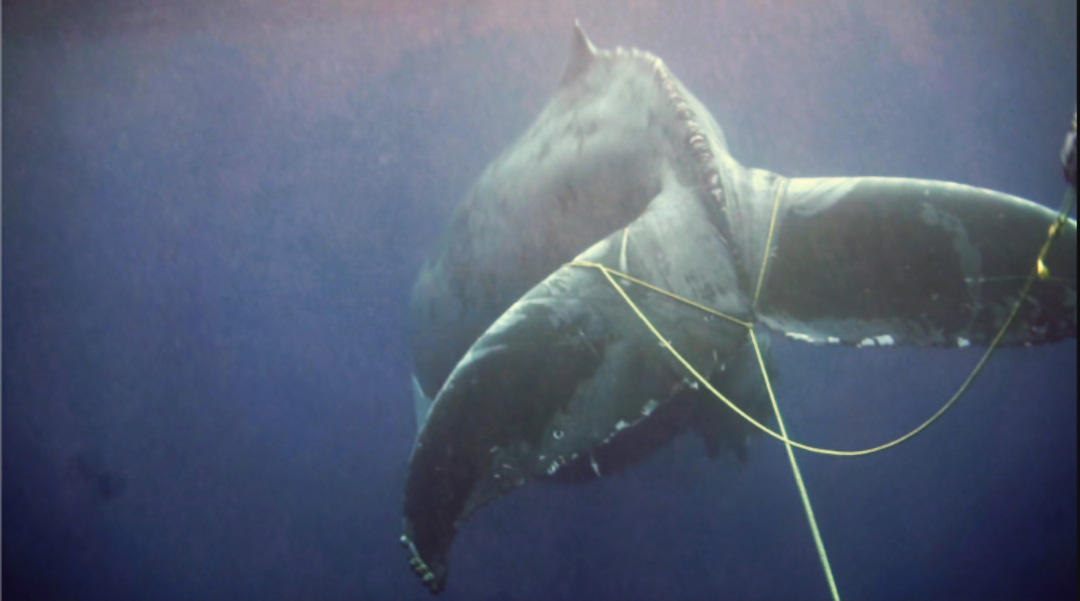
Humpback whale entangled in commercial lobster gear, sighted off San Diego in 2015. (photographed under NOAA permit #: 18786) (Photo courtesy NOAA Fisheries)
More than 30 times this year, the federal government has received reports of whales tangled in fishing gear along the West Coast.
Sometimes the whales manage to wriggle free. Other times you see heart-rending pictures on the news or a rescue mission.
The culprit often involves Dungeness crab pot lines. Now Oregon crabbers are working with marine scientists to make the seas safer for whales and to avoid a black mark on their brand.
Bob Eder has fished commercially out of Newport, Oregon, for decades.
“Over 45 years of pulling crab pots — I think I’ve probably hauled in close to a million — I’ve never encountered an entangled whale,” he said.
‘We want to be proactive’
Eder often sees whales at sea and recognizes just one bad outcome blamed on fishing gear could be all it takes to cause a PR nightmare.
Whale numbers are up, but so are sightings of humpback whales, gray whales and the odd blue whale entangled in fishing lines and buoys — especially in California.
“We want to get out ahead of it. We want to be proactive,” Eder said. “We don’t want to be sued by the Center for Biological Diversity. We want to see what we can do to mitigate the situation.”
The Center for Biological Diversity is an environmental group and it did just sue the California Department of Fish and Wildlife.
The group wants a federal judge to order the state regulator to make crab fishermen do more to avoid harm to endangered whales.
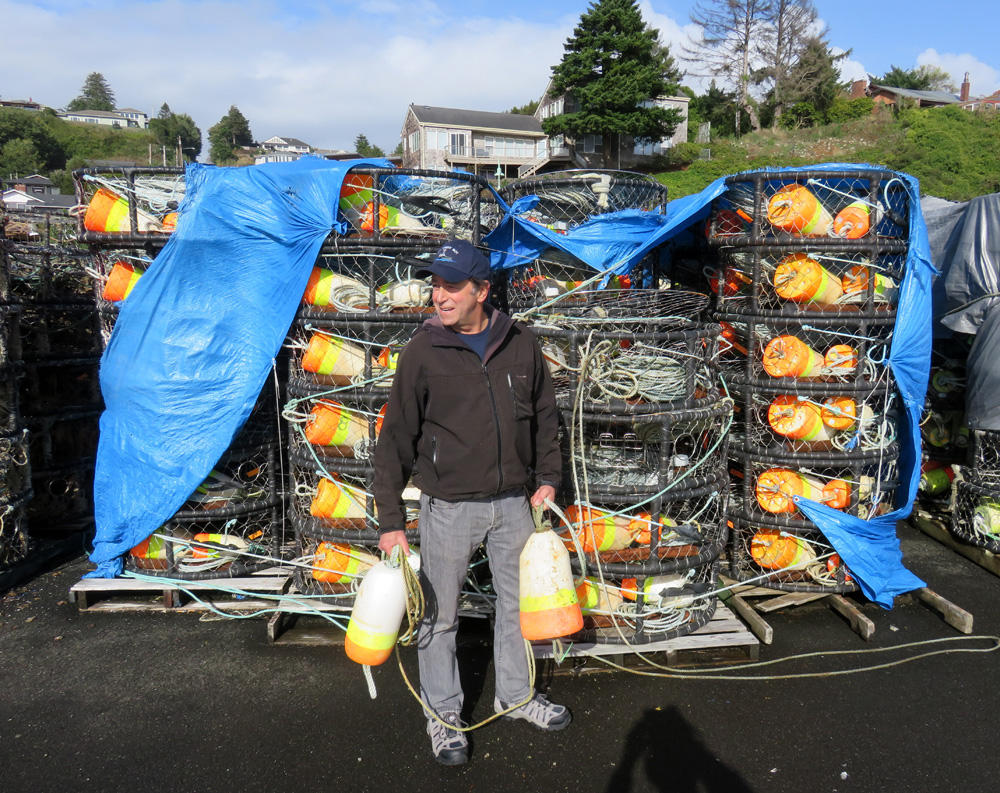
Crab traps themselves are not the problem, but rather the heavy-duty ropes stretching from the seafloor to one or more buoys at the surface.
Whales can snag a fin or a tail and get all tangled up if there’s too much slack in the vertical line or excess floating on the surface.
“They normally don’t come in where our gear is,” said Hugh Link, executive director of Oregon Dungeness Crab Commission. “But when we get warmer water and the feed comes in closer to shore, then we have an issue.”
Link and Eder are two members of a work group of crabbers, marine biologists and government agency and nonprofit representatives. They’ve been meeting in Oregon since March.
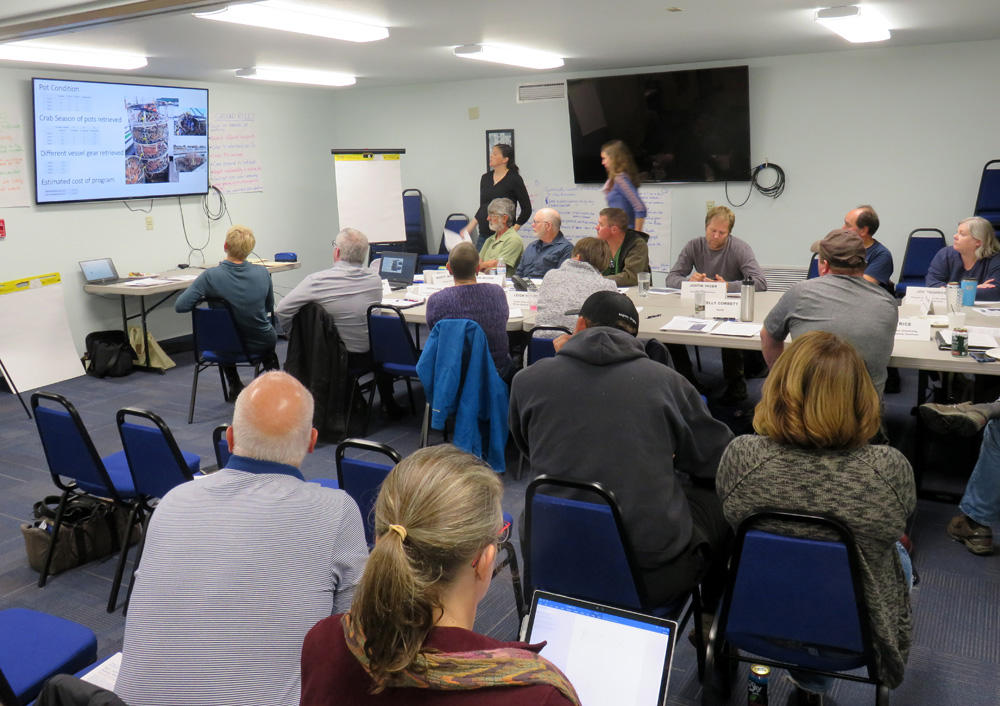
Members of the Oregon Whale Entanglement Working Group met in various coastal ports to gather info and consider fishery modifications. (Photo by Tom Banse/Northwest News Network)
A grant from NOAA Fisheries launched what is known as the Oregon Whale Entanglement Work Group, which is facilitated and now supported by Oregon Sea Grant.
Washington state crabbers and other interested parties plan to meet Nov. 8 in Montesano to hear an update on whale entanglements and discuss whether the Washington-based/the local fleet should launch a proactive work group too.
The work group agreed to distribute a flyer to crab boat operators ahead of the season opener next month with best practices for setting and tending gear.
Oregon and Washington also have programs to retrieve lost or derelict fishing gear.
The work group next plans to survey the fleet about potential season modifications and area closures to keep whales away from gauntlets of ropes.
“To really take a swipe at minimizing co-occurrence between our fishing gear and the whales it may take shortening the season or shortening the amount of pots that can be fished,” Eder said. “This becomes highly controversial.”
Commercial crab fisherman Bob Eder of Newport, Oregon is part of a whale entanglement working group. (Photo by Tom Banse/Northwest News Network)
Voluntary measures… or mandates
Those are however some of the very things the Center for Biological Diversity wants to see happen.
Oakland-based Center attorney Kristen Monsell applauds the Pacific Northwest crab fleet for trying to get out ahead of the issue.
“I think it’s great to hear that our neighbors to the north are meeting,” Monsell said. “I think if California had done so earlier — years and years ago — then we wouldn’t be seeing the number of entanglements that we’re seeing off our coast now.”
Monsell said she has no plans to expand the California lawsuit to the Oregon and Washington Dungeness crab fisheries at this time. That could change if there were an unanticipated surge in whale entanglement numbers in the Pacific Northwest.
One yellow flag for the environmental lawyers is the choice of voluntary versus mandatory whale avoidance measures.
“We don’t think voluntary measures will work,” Monsell said, because they are not always followed. The Oregon working group’s “directives” to prevent whale entanglements are merely suggestions, not requirements.
The Center for Biological Diversity has leverage because any harassment of an endangered whale constitutes an illegal “take” under federal law.
The Endangered Species Act prescribes heavy penalties for guilty parties unless NOAA Fisheries has issued an “incidental take permit” for a fishery, which it has not done for crabbers.
Blue whales and humpback whales are listed as endangered or threatened along the U.S. West Coast.
The gray whale population has rebounded such that it was removed from the threatened list in 1994.
The Dungeness crab fishery is in the focus right now because its their gear that is cut off of entangled whales most often.
The buoys have traceable numbers on them. But whales have also been sighted tangled up in gear from other fisheries, including gill nets and black cod or shrimp traps.
It’s also common for the source of the entanglement to go undetermined.
The number of West Coast whale entanglement cases successively set new records in 2014, 2015 and 2016. The pace of sightings of whales in distress in 2017 is lower than last year’s record of 71 separate cases, but still of concern.
A breakdown of this year’s whale entanglements provided by NOAA Fisheries had 32 separate cases reported through mid-October, of which 22 were listed as confirmed. As in prior years, the majority of sighting came from California waters (27 whales — 19 confirmed), with the rest from Oregon (1 unconfirmed), Washington (3 whales — 2 confirmed) and Mexican border waters (1 confirmed).
‘A risky endeavor’
Oregon State University marine mammal biologist Jim Rice manages the rescue response when a whale is reported entangled in Oregon waters.
“It has to be done very carefully,” Rice said. “Disentangling a whale is a risky endeavor. There is a great risk to personal safety and even a risk of humans getting killed in the process of trying to remove gear.”
“You can’t talk to the whale,” he continued. “It’s a wild animal. It’s programmed for survival. It may see would-be rescuers as potential threats.”
Rice remembers four instances in recent years when Oregon responders were activated to free an entangled whale.
In three of those cases, the rescuers could not find the whale.
In the final case, the entangled whale was a calf being guarded by its mother.
“They were swimming quite quickly. The line was lightly attached,” Rice said. “They basically did not slow down. The mother was not interested in letting us get too close to the calf.”
Rice does not know whether the calf survived.
Most of the time, NOAA can’t say either what eventually happened to a whale reported to be in distress because they become difficult to track at night.
A Portland-based spokesman for the NOAA Fisheries said that in only one of this year’s entanglements — near San Diego — was there strong suspicion that the whale died.
Unless an affected whale is later re-sighted free of fishing lines, the final outcomes are mostly unknown.
“I mean when you’re out there in a small boat looking for an entangled whale, you realize that it is a huge ocean and you’re in a tiny boat,” Rice said. “Your odds of finding that whale are actually really small unless you have eyes in the air looking down or you have a large vessel that has been following this whale for you.”
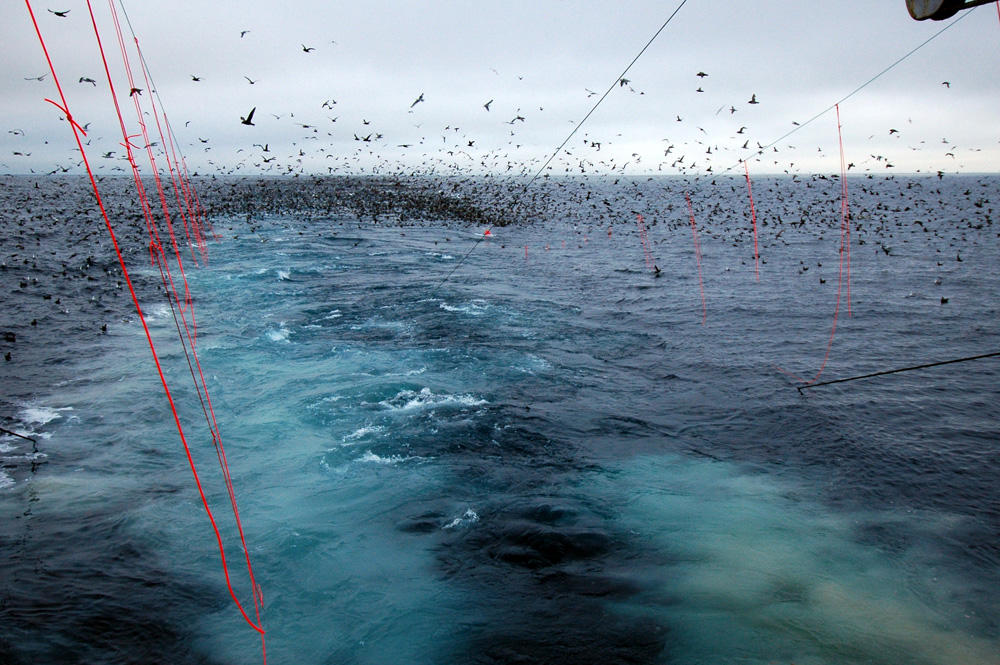
Bird-scaring lines at work on a West Coast long-line vessel. (Photo by Amanda Gladics/Oregon State University)
When commercial fishermen spool out long lines in pursuit of sablefish— better known to consumers as black cod — seabirds looking for an easy meal dive to steal the bait off the series of hooks.
Some unlucky birds get hooked and drown as the line sinks to the deep. And when the drowned bird is an endangered species such as the short-tailed albatross, it triggers scrutiny.
“Just one was all it took. Yeah, just one,” said Amanda Gladics, a coastal fisheries specialist with Oregon Sea Grant. “Because they are endangered there is a lot of scrutiny on every single time any of those albatrosses are caught in a fishery.”
Gladics and colleagues from Oregon and Washington went to sea to determine the best tactics to avoid bycatch and published those in the journal Fisheries Research.
The paper recommends either fishing at night or deploying bird-scaring streamers on a line towed from a mast.
Citing the research, the U.S. Fish and Wildlife Service recently directed regulators at NOAA Fisheries to require the West Coast long-line fleet use one of the two options.
The Pacific Fishery Management Council is scheduled to discuss the matter in mid-November and may provide similar recommendations.
Gladics said the changeover from voluntary to mandatory seabird bycatch avoidance measures might take several years to go through the rule-making process.
NOAA Fisheries already requires all longline fishing boats in Alaska waters to employ “bird avoidance techniques” such as streamer lines to avoid killing protected seabirds. Canada requires the same for its West Coast sablefish and halibut long-line fishery.
The U.S. Fish and Wildlife Service and Washington Sea Grant began giving away free streamer lines to long-line vessels around 2009.
In late 2015, use by the largest vessels became mandatory coast wide.
The research team from Oregon Sea Grant, Oregon State University, Washington Sea Grant and NOAA Fisheries judged the bird-scaring lines to be highly effective.
The lines dangle rubber streamers or tubes overhead as the vessel crew deploys their long lines of baited hooks.
“That creates a visual barrier preventing the birds from diving in on the sinking (fishing) line,” Gladics said.
Gladics traveled out to sea with cooperative vessel captains to make observations about how birds interacted with the streamers.
Meanwhile, her co-authors drew conclusions about the effectiveness of fishing at night by studying 12 years of data from federal fishery monitors who rode with the U.S. West Coast fleet in pursuit of sablefish.
“Not only did we find that night fishing reduced bycatch—it did so dramatically,” said co-author Ed Melvin, a fisheries scientist at Washington Sea Grant.
”We found that albatross bycatch was 30 times lower when vessels fished at night (after civil dusk) and target catch was 50 percent higher compared with daytime fishing,” Gladics said.
The study Gladics led focused on vessels from Bellingham to San Francisco who fish the continental shelf. In an email to fishing vessel collaborators this month, she said fishermen and birds could both come out ahead by taking seabird avoidance measures.
“Night fishing isn’t right for every vessel, so that is why it is great to have fishery-specific options that you can do,” she said in an interview Friday in Newport, Oregon.
According to a U.S. Fish and Wildlife Service report published earlier this year, there has been one confirmed case of a short-tailed albatross being killed in long-line gear since 2002 off the Oregon, Washington and California coasts.
Other species of concern caught at higher rates in long-line fishing gear include black-footed albatross, Laysan albatross and shearwaters.
The short-tailed albatross is the largest of the three albatross species found in the North Pacific, which makes it the largest seabird you could encounter off the West Coast, period.
Adults can grow to have an 8.5 foot wingspan. The long-lived, slow-to-reproduce bird has a distinctive bubblegum-pink bill.
The International Union for Conservation of Nature, or ICUN, estimates the world population at about 4,200 and increasing. The short-tailed albatross was federally-listed as endangered in the United States in 2000.
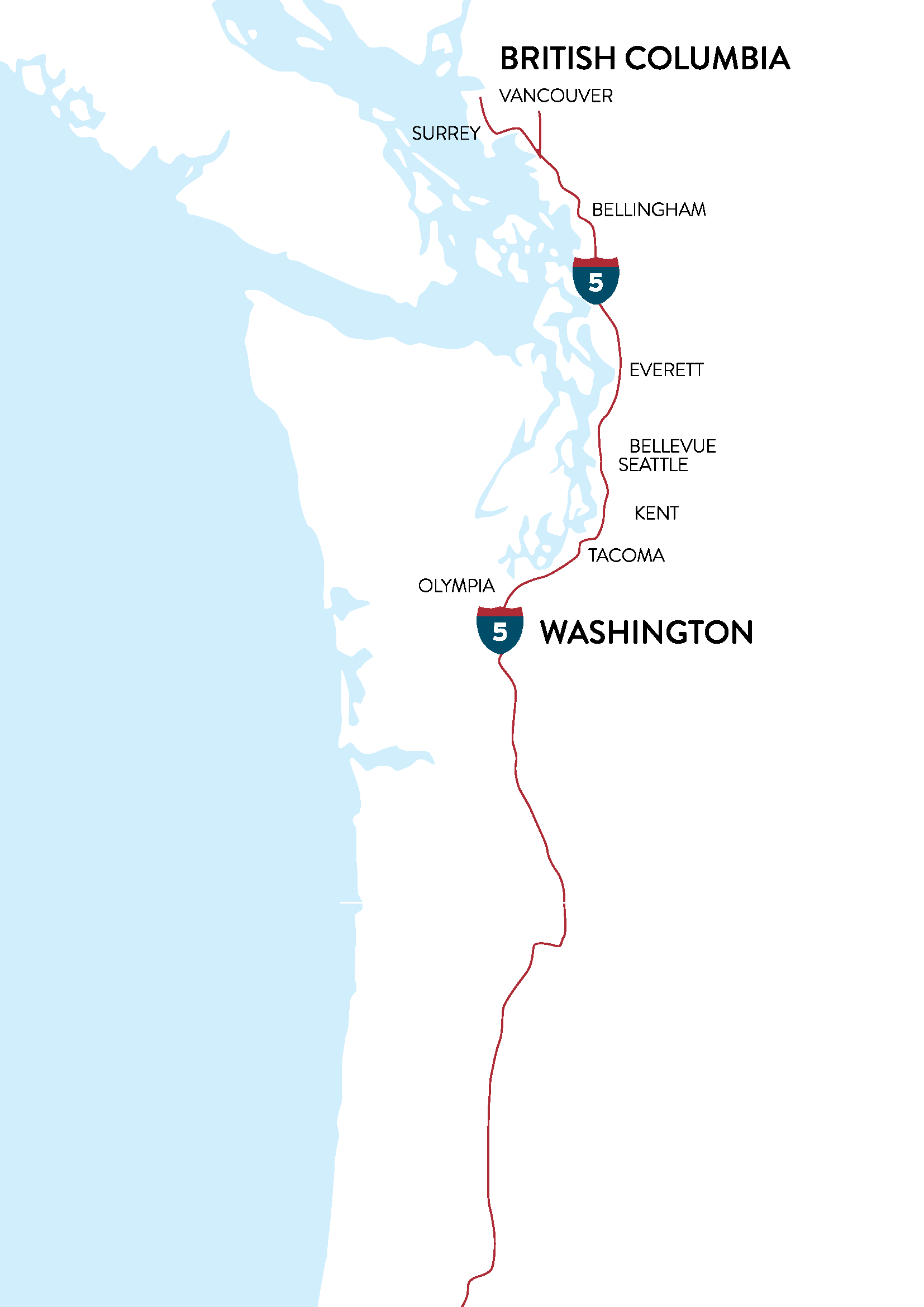
Tech investors want to turn HOV lanes on Interstate 5 between Seattle and Vancouver into shared lanes with autonomous vehicles. It would be the first step toward an exclusively autonomous vehicle highway. (Image courtesy Madrona Venture Group)
Self-driving cars would one day take over Interstate 5 to the exclusion of human drivers under a proposal aired out before Washington state transportation advisers Tuesday.
Tech investors are pitching dedicated lanes for autonomous vehicles on Interstate 5 between Seattle and Vancouver. (Image courtesy Madrona Venture Group)
High-tech investors in the Seattle area hatched the idea to gradually convert Interstate 5 into a corridor for autonomous vehicles. Their proposal envisions smoother, safer travel between Seattle and Vancouver, British Columbia, with the possibility to expand south to Portland later.
Consultant Scott Kuznicki of the Transpo Group and Cascadia Center think tank Director Bruce Agnew on behalf of Madrona Venture Group Managing Director Tom Alberg presented a tentative timeline to the Washington State Transportation Commission.
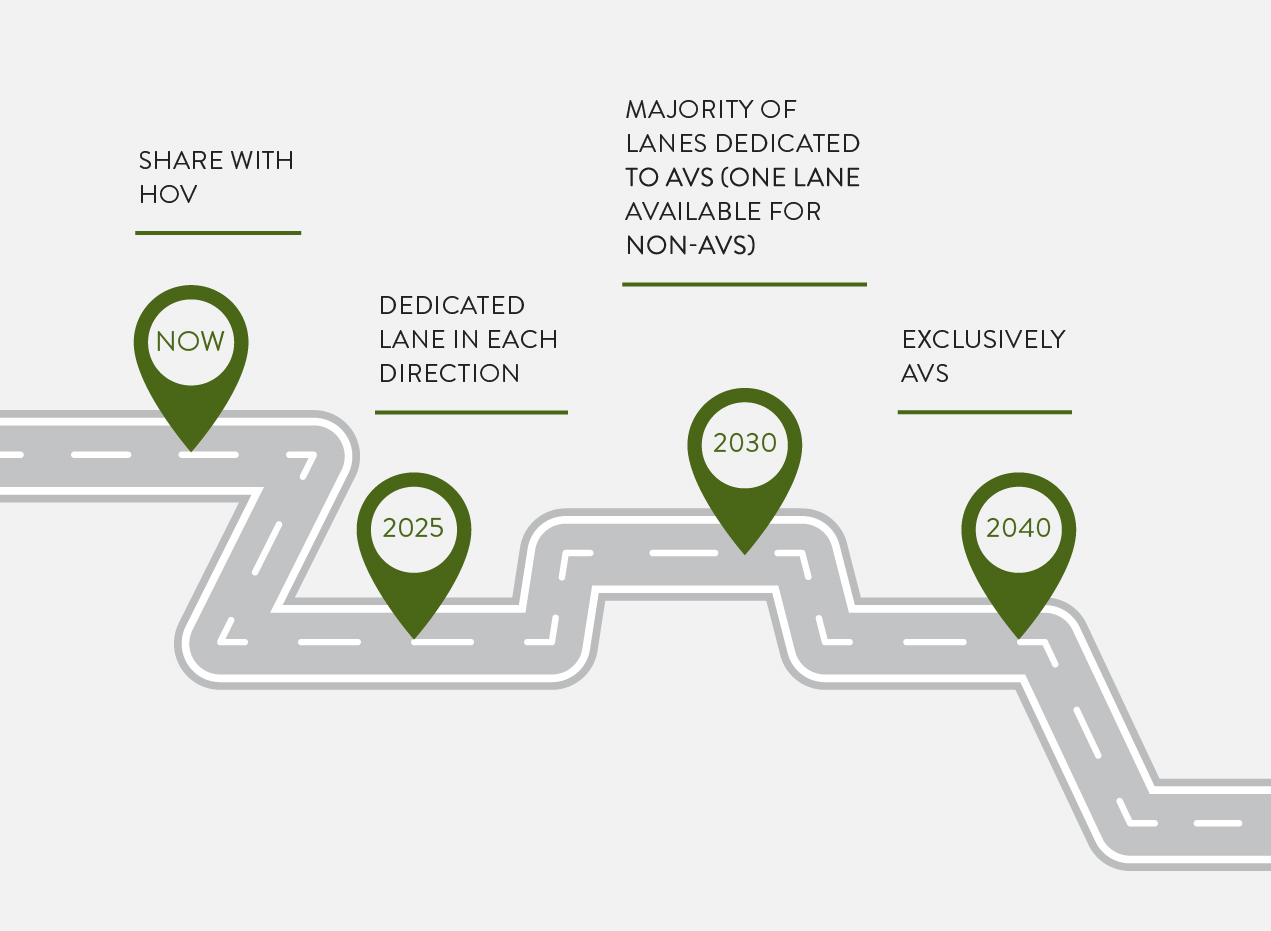
They said autonomous cars should first get to use the carpool lane and then get their own lanes beginning in 2025.
“If this technology goes the way that leading experts are predicting, we could see the entire corridor as a freeway could be autonomous by 2040,” Kuznicki said.
At that point, human drivers would only be allowed on low traffic nights and weekends.
The state policy advisers gave the idea an interested hearing, but the decision making authority lies elsewhere. It falls to Washington and British Columbia legislators to decide when and if the rules of the road will change. They’ll get briefed in the near future.
“It’s very thought provoking obviously and a lot of questions emerge,” said Washington State Transportation Commission Executive Director Reema Griffith. “For us, in the backdrop is how do you pay for this stuff? It’s great and it’s cool, but the funding is going to be the driver of how this moves. Then the other piece is, how do you bring everyone together to start thinking about all the implications it has … on users of the highways.”
The most skeptical view came from a commissioner whose day job is at the environmentally-minded Transportation Choices Coalition. Policy analyst Hester Serebrin said dedicated autonomous vehicle lanes would have “social equity implications” since the properly equipped vehicles might not be affordable to lower income folks.
Kuznicki predicted cars capable of fully autonomous driving would be on the road in the near future, but it would take 20 years “to see turnover of the vehicle fleet” to the extent that it would make sense to exclude human drivers from the majority of the highway.
Tech investors pitched this timeline for converting Interstate 5 to an exclusively autonomous vehicle highway between Seattle and Vancouver. (Image courtesy Madrona Venture Group)
“Taking bold, proactive action to improve the flow of people and goods along the Cascadia Corridor will allow us to begin to reap the benefits of improved transportation systems in the next few years without waiting for the construction of major new transportation infrastructure projects and their attendant massive costs and time delays,” the paper’s authors wrote. “It will also send a message that Seattle and Vancouver embrace new ideas and new ways of thinking, further cementing a reputation for innovation in the Cascadia Corridor.”
Madrona Venture Group, a venture capital firm based in Seattle, has invested in a number of area companies that make components or software for autonomous vehicles including Echodyne, Mighty AI and Impinj.
Close
Update notification options
Subscribe to notifications
Subscribe
Get notifications about news related to the topics you care about. You can unsubscribe anytime.