Northwest News Network

Some tribes see failure, but Kalispel Tribe sees victory in Yellowstone grizzly delisting

The Yellowstone grizzly bear has been delisted from the Endangered Species Act. (Photo courtesy Jim Peaco/Natioanl Park Service)

Endangered species protections were lifted for grizzly bears in Yellowstone National Park Monday. Many tribes prepared for the delisting last fall by signing a treaty to protect the bears.

But one tribe in the Northwest looks at it differently.

Ray Entz, the director of Wildlife and Terrestrial Resources for northeastern Washington’s Kalispel Tribe, called delisting the Yellowstone grizzly a victory for the Endangered Species Act.

“Getting a species identified as being at risk and recovering it and having it move off of that list,” Entz said. “It also frees up resources.”

Those resources, according to Entz, could be used to help recover three other grizzly populations that live on traditional Kalispel land.

Those bears are currently listed as threatened under the Endangered Species Act.

The Kalispels traditionally hunted those bears in winter, but haven’t been able to in recent years. The bears live in three distinct ecosystems: Montana’s North Continental Divide, northeastern Washington’s Selkirk and the Cabinet-Yaak, which stretches from Montana into Idaho’s panhandle.

Entz said if those populations were ever to recover, the Kalispels would want an opportunity to take part in a cultural practice that’s been lost.

“Our tribe in its history did hunt and procure grizzlies in the winter and they would want to have that opportunity in the future as a cultural practice,” Entz said.

Hunting opportunity is part of the reason the Kalispel tribe opted not to sign the grizzly treaty last fall — 125 other tribes did sign.

The goal was to protect the bear on all tribal lands. Among the nine articles is one that prohibits hunting grizzlies on all that territory.

Other Northwest tribes that signed include the Confederated Tribes of the Colville, the Tulalip, Coeur D’Alene, Spokane and Puyallup tribes and others.

When Nisqually Tribal Councilman Willie Frank III signed the treaty last October, he quoted his father as saying, “As the salmon disappear, so do our tribal cultures and treaty rights.”

Frank went on to say at the signing, “In this case, just substitute the grizzly bear for the salmon, and the meaning and consequences are exactly the same.”

Ray Entz said the Kalispels support much of the content of the treaty.

“I think there’s a lot of that is very positive and very pro-education. All those things are really important and we support that,” he said. “But in its totally, it just didn’t work because of some of those kind of restrictive pieces of language”—about hunting.

Entz said the Kalispels could have potentially signed on, “had we … had more opportunity to comment on it before it was finalized.”

Leadership from tribes that signed said they did so in part because consultation between the federal government and tribes regarding the delisting of the Yellowstone grizzly was not sufficient.

Alaska Airlines profits despite pilot shortage, operational challenges

Alaska Airlines passengers wait for their bags at Gustavus Airport on June 29, 2017. (Photo by Jeremy Hsieh/KTOO)

Alaska Airlines is still ironing out operational wrinkles following the acquisition of Virgin America last year. At the same time, its smaller, regional airline is still grappling with a pilot shortage.
The acquisition of Virgin America gives Alaska Air Group access to larger markets, like San Francisco and Los Angeles.

CEO Brad Tilden said during a quarterly earnings conference call that means the company is dealing with more congestion and constraint.

“It’s not only air space and long taxi times, but the airplane comes in and there’s not a gate available,” Tilden said.

Fewer on-time arrivals and more delays and cancellations in the Northwest are the result of a pilot shortage at the company’s smaller, regional Horizon Air.

Tilden said they need to improve pilot recruitment and better understand demand.

“I think we fell short there, candidly,” he said.

Meanwhile, Alaska Air group reports a $36 million increase in second quarter earnings compared with last year.

Washington’s new, tougher distracted driving law takes effect Sunday

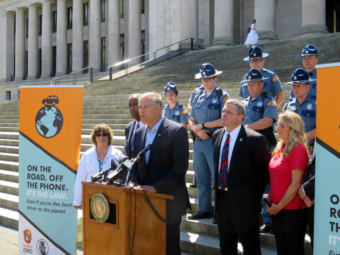
Washington Gov. Jay Inslee discusses a new distracted driving law on the state Capitol steps Monday. Tina Meyer, the mother of a distracted driving crash victim, is at far left.
Washington Gov. Jay Inslee discusses a new distracted driving law on the state Capitol steps Monday. Tina Meyer, the mother of a distracted driving crash victim, is at far left. (Photo by Tom Banse/Northwest News Network)

Texting or holding a phone to your ear while driving is already illegal in Washington state. But starting Sunday, Washington state troopers and local police will begin enforcing a toughened law against distracted driving.

This spring, the Legislature expanded the distracted driving law to forbid handling a phone behind the wheel for any reason, even when stopped in traffic or at a red light.

Washington State Patrol Chief John Batiste said you can also get a ticket for eating, sipping coffee, starting a video or grooming if a trooper sees you driving badly as a consequence.
The citation for being “dangerously distracted” by something other than an electronic device could only be enforced as a secondary offense, meaning another infraction such as an improper lane change would need to be observed to pull you over.

“It’s a hands-free situation,” Batiste said. “Before you get in your vehicle, if you’re going to use GPS, get that started before you turn the key. If you’re going to listen to music, get that all programmed and started before you head off down the roadways.”

Using voice commands to make a phone call or get directions while the phone is in a cradle or connected to your car via Bluetooth is still allowed. Hands-free devices must not take more than “minimal” finger touches to activate or deactivate.

Using a CB radio is OK. Picking up the phone to call 911 in an emergency is a permissible exception.

Batiste said troopers are likely to give more lectures than tickets during the initial three to six months under the toughened law.

“Our first effort is to educate folks as we typically do with new laws,” Batiste told reporters in Olympia Monday. “We go on a heavy emphasis of educating folks. So we’ll give out a lot of warnings.”

Another change from current law highlighted at a photo op and media event in Olympia Monday was that cell phone violations will be reportable to auto insurance companies from now on. Previously, cell phone tickets were exempted from disclosure to your insurance company.

A first ticket for driving under the influence of electronics—or E-DUI—will cost you at least $136. A second violation within five years will cost at least $236.

The stiffer consequences were welcomed by Tina Meyer of Arlington, who tearfully recounted how her 23-year-old son Cody was run down by a distracted driver in 2015 while he was working as a flagger in a construction zone near Issaquah. Cody eventually died from his injuries.

“By making this change in the law, it is going to save a lot of lives,” Meyer said.

Another standoff threatens another budget in Washington state

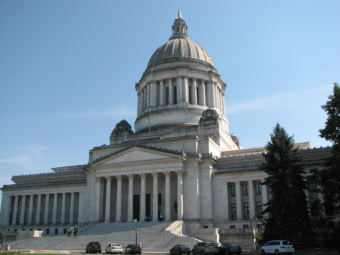
The Legislative Building of the Washington State Capitol, Olympia. The building is in afternoon sun. An "open" sign invites visitors inside to see the dome interior, tiffany chandelier, marble panels, and artwork. (Creative Commons photo by Gerald Hawkins)
The Legislative Building of the Washington State Capitol, Olympia. The building is in afternoon sun. An “open” sign invites visitors inside to see the dome interior, tiffany chandelier, marble panels, and artwork. (Creative Commons photo by Gerald Hawkins/Flickr)

Time is running out for Washington lawmakers to pass a capital construction budget. Less than one week remains in the state’s third overtime session of the Legislature.

It would be unprecedented for the state to go without a capital budget. It funds classroom construction, improvements at state mental hospitals and prisons and myriad local projects.

It also funds environmental cleanup.

Without a capital budget, the governor’s office says hundreds of projects won’t get built and tens of thousands of jobs won’t be created.

Among the projects at risk, according to the Office of Financial Management, is the addition of 115 forensic beds at Western and Eastern state hospitals. The state is under court order to shorten the time jail inmates must wait for competency evaluations and restoration services. The new beds are designed to reduce wait times.

But perhaps the biggest impact of not having a capital budget would be to classroom and school construction.

More than 75 projects worth nearly $1.5 billion face uncertainty. That includes projects that are already under construction, shovel ready projects and projects that are still in the design phase.

The Washington House has already passed the $4 billion budget. But Senate Republicans say there can be no capital budget without first addressing something else: a Washington Supreme Court decision that limits new drinking water wells in rural areas.

The so-called Hirst decision limits non-permitted wells on private property. As a result some property owners have been unable to obtain building permits.

In dueling tweets Senate Republicans say House Democrats are blocking a fix for rural families. House Democrats counter that thousands of families are at risk because Republicans’ refuse to pass the capital budget.

The standoff shows no signs of ending.

Budget deal announced to avert Washington state government shutdown, fund schools

Washington Gov. Jay Inslee speaks with reporters Tuesday after a bill signing. At the time there was no budget agreement and he said that was creating "considerable anxiety" as a government shutdown loomed. (Photo by Austin Jenkins/Northwest News Network)
Washington Gov. Jay Inslee speaks with reporters Tuesday after a bill signing. At the time there was no budget agreement and he said that was creating “considerable anxiety” as a government shutdown loomed. (Photo by Austin Jenkins/Northwest News Network)

After months of partisan deadlock and weeks of brinksmanship as a government shutdown loomed, Washington legislative budget negotiators have reached an “agreement in principle” on a two-year budget designed to fully fund schools, as required by the state Supreme Court.
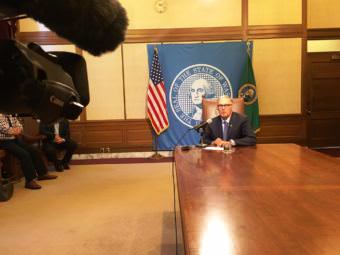
The deal came together early Wednesday morning following an all-night, marathon negotiating session at the Capitol.

No details on the deal were immediately released, but Senate Majority Leader Mark Schoesler, a Republican, said he believes the budget will help equalize school funding statewide.

“No longer will a student in Washington be funded on their zip code,” Schoesler told reporters gathered in the Senate wings.

House Majority Leader Pat Sullivan, a Democrat, also predicted it will pass constitutional muster.

“It will get my vote, I can tell you that,” Sullivan said. “And I wouldn’t be voting for it if I didn’t believe it satisfied the McCleary case.”

McCleary is the name of Washington Supreme Court case that says the state is not amply funding public schools. The 2017-19 operating budget is viewed as the third and final down payment on that 2012 ruling.

Lawmakers left the costliest and most difficult piece for last—shifting the responsibility for funding teacher and staff salaries from local districts back onto the state. The cost to fully fund the McCleary obligation over the next four years has been pegged at more than $7 billion.

Last spring, Senate Republicans proposed to solve McCleary with a new state property tax levy for schools of $1.55 per $1,000 of assessed value, along with the elimination of local maintenance and operation school levies. Republicans pitched the levy swap as a tax break for most Washington property owners.

Democrats panned the idea saying it would harm school districts and unfairly jack up property taxes in central Puget Sound.

By contrast, House Democrats proposed a multi-billion dollar tax package that included a new capital gains tax, changes to the real estate excise tax and a plan to capture sales tax from more online sales. But they never voted on the tax package, leading Senate Republicans to say they wouldn’t negotiate with “ghost dollars.”

Gov. Jay Inslee, a Democrat, later took the capital gains tax off the table, even though he supports the idea as a way to make Washington’s tax system less regressive.

The final budget and tax deal is likely to include elements from both plans.

Lawmakers now have less than 72 hours to pass the budget and send it to Inslee for his signature before midnight on Friday, June 30, the end of the fiscal year. That would avert a partial government shutdown on Saturday, July 1, including the temporary layoff of more than 30,000 state employees and the shuttering of state parks just before the Fourth of July holiday.

“We could have some unforeseen disaster, but we are all committed,” said Senate Majority Leader Mark Schoesler. “I will continue to believe we will not shut government down.”

“Yes, it will avoid a government shutdown,” added House Majority Leader Pat Sullivan, a Democrat.

Despite the clock running out on the session, legislative leaders said they wouldn’t release details of the budget until noon on Thursday, after they brief their respective caucuses. Voting on the budget could happen as early as Thursday afternoon or evening. That would leave very little time for lobbyists or the public to scrutinize the budget.

After the budget is signed into law, lawmakers will have 30 days to report back to the Supreme Court, which has retained jurisdiction in the McCleary case. The state is currently in contempt of court and paying a $100,000-a-day fine for not complying with a previous court order. If the justices aren’t satisfied, they could increase the current fine or impose a more dramatic sanction, like invalidating all tax exemptions.

Besides education funding, the budget is expected to put more money into mental health and into addressing homelessness. The budget may also create a new Department of Children, Youth and Families.

This is the third time since 2013 that Washington lawmakers have taken budget negotiations right up to the end of the fiscal year before forging a bipartisan agreement.

The legislature has been in session continuously since January and is currently meeting in a third, 30-day special session.

Washington lawmakers inch closer to budget deal after marathon weekend

House budget chair Timm Ormsby, second from left, and Senate budget chair John Braun, on right, say they are working to get a budget deal by June 30 to avoid a government shutdown. (Photo by Austin Jenkins/Northwest News Network)

It’s do-or-die week in Olympia. It’s cliché to say, but if lawmakers don’t pass a budget and send it to the governor for his signature before midnight on Friday, state government will go into partial shutdown.

Washington lawmakers are optimistic that won’t happen.

They hunkered down through the weekend heatwave and in the words of one lawmaker “things are really progressing.”

House Democrats and Senate Republicans need to get agreement on how much the next budget will spend, where the money will come from and how the state will comply with a Supreme Court mandate on school funding.

The situation is reminiscent of two years ago when the Washington legislature also went into a triple overtime because of a budget standoff.

The final deal came together with just four days to go before a shutdown.

Besides the operating budget, other issues that could be part of the final package of bills to pass, include:

  • Family leave: A bipartisan deal to provide paid family leave to workers to care for a newborn or sick family member.
  • Family, children department: Formation of a new Department of Children, Youth and Families by combining the Department of Early Learning with the state’s Children’s Administration, now part of the Department of Social and Health Services.
  • Hirst water rights: A “fix” to the Supreme Court’s decision in the Hirst water rights case to allow property owners to dig an exempt well so that they can build a home.
  • Car taxes: Relief for central Puget Sound car owners who are seeing their car tabs spike because of the vehicle valuation system Sound Transit uses to determine taxes owed.
  • Infrastructure projects: A capital budget to fund construction projects around the state, including water infrastructure in eastern Washington and southwest Washington.
Site notifications
Update notification options
Subscribe to notifications