Northwest News Network

COVID-19 hasn’t interrupted Alaska’s resupply lifeline from Pacific NW, and woe if it does

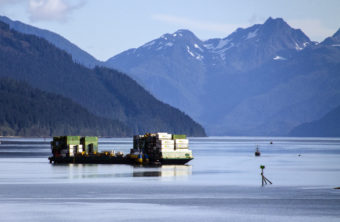
A barge departs from the Alaska Marine Lines dock in downtown Juneau.
A barge departs from the Alaska Marine Lines dock in downtown Juneau. (Photo by Heather Bryant/KTOO)

The coronavirus pandemic has served to remind many of us how much we count on strangers staying healthy so we can restock our cupboards and go about daily life. That’s especially true for Alaskans who depend on a marine cargo lifeline from the Pacific Northwest for the majority of their goods.

Most days of the week, at least one ocean-going tugboat heads out from Puget Sound going north to Alaska with a heavily laden barge in tow. The tug crews fit into a category of essential workers the general public rarely sees — even less so now that shore leave by mariners and visitors boarding the vessels are almost completely forbidden.

“It’s good to be a part of the system that keeps the area where you grew up and raised your family supplied,” said Captain Pete Erickson, who helms the Western Titan, a tug in the Western Towboat Company fleet. “It’s really personal for me.”

Erickson shared the cozy confines of the tug with a crew of five as they set out from Seattle bound for Ketchikan, Juneau and other Southeast Alaska ports. The barge they had in tow was stacked 40 feet high with containers full of all the things sold in grocery and hardware stores, plus construction equipment, vehicles, and last but not least, alcohol.

When barges come back, they carry Alaska fish to market, along with empty shipping containers, containerized municipal garbage destined for the large regional landfills near the east end of the Columbia River Gorge and a bit more alcohol sometimes — beer for the Lower 48 from Alaskan Brewing Company in Juneau.

Erickson said dealing with the coronavirus has made the roundtrips to Alaska a lot different this summer compared to years past. The state of Alaska required tug companies to file plans for how they’d keep their crews healthy, as well as how to avoid spreading the virus into small towns with limited medical care.

One big operational change is that tug and barge crews now have to stay onboard throughout their voyage. Western Towboat Vice President Russell Shrewsbury explained that contact with people on shore must be minimized. Previously, crews would go to the store when they got to Alaska and resupply on produce and other kinds of stuff.

“We can’t do that now,” Shrewsbury said in an interview. “If they have friends there, they used to be able to come visit. We haven’t been able to do that.”

Interactions with customers and port staff are basically done over a telephone now.

The caution extends to the downtime between voyages. Shrewsbury said he advises his crews to avoid contacts with people besides family members when they’re home. Western Towboat does temperature screenings before reboarding, but the company is not enforcing a strict pre-departure quarantine or ordering COVID testing like some Northwest seafood companies did with seasonal workers they sent to Alaska this year.

“We’re not going to chain anybody to their homes,” Shrewsbury said. “We just want people to be really smart about who they interact with because the implications it could have on the supply chain for Southeast Alaska could be devastating if we started having the virus run through the tugboats and people were getting sick.”

So far, so good, said Shrewsbury. Other marine cargo companies on the Alaska circuit such as Cook Inlet Tug & Barge, Foss Maritime and Centerline Logistics said they too have not had crew members get sick with the virus at sea.

Tote Maritime and Matson transport containers and vehicles from Tacoma to Anchorage and southwest Alaska on large cargo vessels. Tote said it is maintaining its regular schedule but limiting interactions between ship crews and people on shore to avoid COVID exposures, like the tug and barge companies do.

“The barges never stopped coming and we don’t want them to stop coming,” said Mila Cosgrove, deputy city manager in Juneau and the local COVID-19 incident commander.

Cosgrove said it would be very bad if there were an interruption in the marine supply links. In an interview, she noted that a lot of Alaska towns, including hers, are geographically isolated by virtue of not having a road connection to the outside world. Resupply comes either by airplane, which is very expensive, or by sea.

“It’s not an option to say we’re going to get it from someplace else,” Cosgrove said.

The relative isolation helped keep COVID away for a good while. But now the West Coast’s interconnected economies and the relentless nature of the virus are converging. The COVID case count in Alaska soared recently. Partly, that’s due to outbreaks in seafood processing plants and on board a factory fishing trawler based out of Seattle.

On a per capita basis, Alaska diagnosed 113 new cases per 100,000 people over the past seven days, which means Alaska surpassed Washington state (68 cases per 100,000) and Oregon (51 per 100,000).

Alaska breaks down its COVID statistics between residents and non-residents, with the latter category including seasonal workers and travelers who test positive in the state.

Where things get extra complicated is when crew changes happen and relief crews fly in from the Lower 48. The marine cargo vessel crews are considered “critical workforce,” so the workers get some latitude for how to observe the otherwise mandatory 14-day self-quarantine for all travelers who arrive in Alaska. The state allows critical workers to go straight to their vessel and start working. COVID testing is not required for vessel crewmembers, but the state highly recommends it.

The president of Anchorage-based Cook Inlet Tug & Barge said his company has increased the duration of on-duty shifts to decrease the number of crew changes and travel.

“The 14-day quarantine comes kind of natural to our guys,” Johnson said in an interview Tuesday. “They work in pretty remote areas.”

In the wheelhouse of the Western Titan with the chatter of marine radios softly crackling in the background, Captain Erickson mentioned one silver lining of the pandemic. He noted the absence of big cruise ships on the water, which can create bottlenecks and tight squeezes in the narrow channels and ports along the Inside Passage. The Canadian and American governments shut down the 2020 Alaska cruise season to reduce the risk of virus spread.

“My stress level has gone down a lot as I navigate between Seattle and Alaska,” Erickson said. “I know a lot of people depend on that tourism money. For my own selfish reasons, I don’t miss them one bit.”

Erickson himself was forced off the water for six weeks this spring when he contracted COVID-19 at a Seattle hospital while attending to his dying father. Relatives organized surprise welcome back greetings in Petersburg and Skagway on Erickson’s first work trip north after his recovery to show he was missed as well as show appreciation for everyone maintaining the marine supply line. Erickson was raised in Southeast Alaska, but now lives on Camano Island, Washington.

“We had no clue what was going on,” Erickson said, remembering his first thoughts upon noticing unusual crowds lining the shore as his tug and freight barge motored by in late April.

“What the heck are all the firetrucks doing down here? Why are all those people at the dock?” Erickson asked as the tug pulled in to Skagway. Then he saw the flags and signs, heard the honking and figured it out.

“That was pretty cool.”

Erickson’s status as a recovered COVID patient with immunity makes him a rare exception under Alaska’s COVID mitigation rules, allowing him to leave his vessel while in Alaska to visit friends and family on shore.

Two former Jesuit officials resign from Gonzaga University after revelations about abusive priests

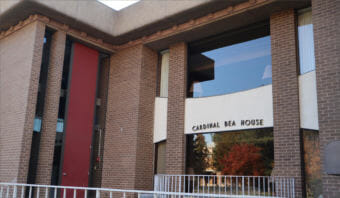
Situated on Gonzaga’s campus, between the university’s business school and the St. Aloysius Rectory, Cardinal Bea House played host to at least 20 Jesuit priests accused of sexual abuse.
Situated on Gonzaga’s campus, between the university’s business school and the St. Aloysius Rectory, Cardinal Bea House played host to at least 20 Jesuit priests accused of sexual abuse. (Photo by Emily Schwing for Reveal)

This story was produced in partnership with Reveal from the Center for Investigative Reporting and PRX.

Two priests in high-level positions at Gonzaga University resigned Friday. Both previously held leadership roles in the Jesuits’ Oregon Province while it sent Jesuits accused of sexual abuse to live in a home on campus.
President Thayne McCulloh announced the resignations of Father Frank Case, university vice president and men’s basketball chaplain, and Father Pat Lee, vice president for mission and ministry, in a brief statement emailed to the Gonzaga community. Both men served on the University President’s cabinet.

Case was named in an investigation by the Northwest News Network and Reveal from The Center for Investigative Reporting about sexually abusive Jesuits whose victims were predominantly Native girls, boys and women in Alaska and the Northwest. A Jesuit home on Gonzaga’s campus, Cardinal Bea House, became a retirement repository for at least 20 Jesuit priests accused of such sexual misconduct dating back as far as 1986.

In 1989, while serving as head of the Jesuit order’s Oregon Province, Case wrote a letter to the Catholic chaplains association backing Father James Poole’s application to become a chaplain at St. Joseph Medical Center in Tacoma, Washington.

“(Poole) is a Jesuit priest in very good standing, and it is my strong expectation that he will serve in such a ministry in a manner that is both generous and effective,” Case wrote. Poole got the job, working at the hospital until 2003 when he was removed from ministry and sent to live at Gonzaga.

Poole was a serial sexual predator. The Catholic Diocese of Fairbanks has received at least 19 reports of abuse by Poole. In 1988, Poole had been removed from his position at a radio station in Alaska after young women who had volunteered at the station wrote letters to the bishop in which they accused Poole of sexual misconduct.

In a 2008 deposition, Case said he did not review Poole’s personnel file before writing the letter because he had no indication of misconduct. In a statement through Gonzaga University’s public relations office last week, Case said he did not have access to Poole’s personnel file.

Father Patrick Lee led the former Oregon Province through bankruptcy proceedings brought on by abuse claims between 2009 and 2011. The Oregon Province merged with the Jesuits’ California Province to become Jesuits West in 2017.

“It is the only way we believe that all claimants can be offered a fair financial settlement within the limited resources of the province,” Lee reportedly said in statement at the time.

Cardinal Bea House is located in the middle of Gonzaga’s campus, but is owned by the Jesuit order and Gonzaga does not make decisions about who was assigned there. Priests living in the house who had been accused of abuse were given “safety plans” to restrict their interactions with students. Our investigation found they were not rigorously enforced.

Priests accused of sexual abuse were assigned to the house as far back as the 1980s. The last known Jesuit on a safety plan was moved off of Gonzaga’s campus in 2016.

Earlier this week, McCulloh issued a written statement to faculty, staff and students saying that he knew Jesuit priests accused of sexual abuse were living in a Jesuit residence on campus, but he had not been aware that any of them might be a threat to students.

McCulloh said he relied on Jesuit leadership “to inform us of any Jesuit whose history might pose a threat to our students or campus community. I deeply regret that I was not informed of the presence of (Father James) Poole, nor any other Jesuits who might pose such a danger.”

It’s unclear exactly when McCulloh learned about the accused priests living on campus. His statement provides what appears to be contradictory information.

“It is important for me to share with you, that in the years following the 2011 Oregon Province bankruptcy, I learned that there had been priests under supervised ‘safety plans’ living at the Jesuit retirement community (Bea House),” he wrote.

But in the next sentence, he says, “It was not until 2016, when the Province chose to begin relocating a number of retired men to the Sacred Heart Community in Los Gatos, that I learned that among them were Jesuits who had been on safety plans (and were moved).”

News organizations also reported on some of the accusations against Poole and his presence at Gonzaga as far back as 2005. McCulloh has worked at Gonzaga since 1990 and was appointed as interim president in 2009.

McCulloh would not make himself available to clarify his statement. He also had declined to be interviewed for the original investigation. McCulloch, Case and Lee could not immediately be reached for comment.

The revelations from the investigation are expected to be mentioned during Mass this weekend at St. Aloysius Church, a Jesuit-owned parish on Gonzaga’s campus. The church’s parish priest, Father Tom Lamanna, also a Jesuit, told us we should not attend the service and are not allowed to record the proceedings.

These priests abused in Native villages for years. They retired on Gonzaga’s campus.

(Illustration courtesy of Reveal)This story was produced by Reveal from The Center for Investigative Reporting, a nonprofit news organization. Get their investigations emailed to you directly by signing up at revealnews.org/newsletter.

This story was produced in partnership with the Northwest News Network.

Part 1: The Story

On the surface, Father James Poole seemed like the cool priest in Nome, Alaska. He founded a Catholic mission radio station that broadcast his Jesuit sermons alongside contemporary pop hits. A 1978 story in People magazine called Poole “Western Alaska’s Hippest DJ … Comin’ at Ya with Rock’n’Roll ’n’ Religion.”

Behind the radio station’s closed doors, Poole was a serial sexual predator. He abused at least 20 women and girls, according to court documents. At least one was 6 years old. One Alaska Native woman says he impregnated her when she was 16, then forced her to get an abortion and blame her father for raping her. Her father went to prison.

Like so many other Catholic priests around the country, Poole’s inappropriate conduct with young girls was well-known to his superiors. A Jesuit supervisor once warned a church official that Poole “has a fixation on sex; an obsession; some sort of mental aberration that makes him see sex everywhere.”

But the last chapter in his story reveals a new twist in the Catholic abuse scandal: Poole was sent to live out his retirement years on Gonzaga University’s campus in Spokane, Washington.
For more than three decades, Cardinal Bea House on Gonzaga’s campus served as a retirement repository for at least 20 Jesuit priests accused of sexual misconduct that predominantly took place in small, isolated Alaska Native villages and on Indian reservations across the Northwest, an investigation by the Northwest News Network and Reveal from The Center for Investigative Reporting has found.

A trove of internal Jesuit correspondence shows a longstanding pattern of Jesuit officials in the Oregon Province—an administrative area that included Washington, Oregon, Montana, Idaho and Alaska—privately acknowledging issues of inappropriate sexual behavior, but not releasing that information to the public, which avoided scandal and protected the perpetrators from prosecution.

When abuse was discovered, the priests would be reassigned, sometimes to another Native community.

Once the abusive priests reached retirement age, the Jesuits moved them to Cardinal Bea House on Gonzaga’s campus or another Jesuit residence, to comfortably spend the rest of their lives in relative peace and safety. The university administration did not respond to requests for an interview to answer whether the administration or student body were aware of the presence of known sexual offenders on campus.

Situated on Gonzaga’s campus, between the university’s business school and the St. Aloysius Rectory, Cardinal Bea House played host to at least 20 Jesuit priests accused of sexual abuse.
Situated on Gonzaga’s campus, between the university’s business school and the St. Aloysius Rectory, Cardinal Bea House played host to at least 20 Jesuit priests accused of sexual abuse. (Photo by Emily Schwing for Reveal)


The last known abusive priest was moved out of Cardinal Bea House in 2016, Jesuit records show. 

Father John Whitney, the former leader of the Oregon Province who ordered Poole to move into Cardinal Bea House, said the Jesuit order is obligated to provide for priests in retirement. He said it was the only facility in the province where past offenders like Poole, then in his 80s, could be contained effectively while also receiving necessary medical care. 

Poole resided at Cardinal Bea House from 2003 to 2015. If he had been allowed to live independently, without church oversight, he surely would have abused more people, even at his advanced age, Whitney said in an interview.

The house, Whitney said, was “a retirement community where he could be monitored.”

In a pair of depositions in 2005, Whitney said he did not inform Gonzaga administrators or police in Spokane about Poole’s history after moving him into Cardinal Bea House. A Spokane Police Department spokesperson said they had not received any reports, either from Gonzaga or the Jesuit order, about allegations against any residents of Cardinal Bea House.

Non-abusing Jesuits also lived at Cardinal Bea House, but there were specific “safety plans” for abusers that banned sexually abusive priests from commingling with students. The Oregon Province would not release copies of the plans. While we learned of no reports of residents abusing Gonzaga students, the restrictions were not rigorously enforced. 

In a deposition in one of the several lawsuits filed against him, Poole said he regularly went to the school library and basketball games. Poole said he met with a female student alone in the living room of Cardinal Bea House when she came to interview him for a report on Alaska. Student journalists and filmmakers in 2010 and 2011 were also permitted to interview residents, including Joseph Obersinner, who worked in Native communities in Montana, Washington and Idaho. He was accused of sexual misconduct against a minor.

“We love being right in the middle of campus,” Obersinner told the school’s student newspaper. “It’s a blessing to see the active energy and happiness of youth every day.”

A view of the Gonzaga University campus from Cardinal Bea House.
A view of the Gonzaga University campus from Cardinal Bea House. (Photo by Emily Schwing for Reveal)


Cardinal Bea House is a modest low-rise brick building, with large windows in front and a small carport behind. It resembles an unremarkable office building, save for the white statue of an angel-winged saint standing guard over the front entrance. On a recent crisp autumn day, a prankster had slipped a hand-rolled cigarette between the statue’s fingers.

While the building appears on campus maps and is listed in the campus directory, it’s not officially part of the private Jesuit university. Cardinal Bea House is owned by the Jesuit order of the Catholic Church.

Poole was joined at Cardinal Bea House by other priests whose abuse was known, often for years, by the Jesuit order.

Father James Jacobson, sent there in the mid-2000s, was accused of sexual abuse by members of the Alaska Native community of Nelson Island. He claimed he never forced anyone to have sex, saying in a deposition that he had consensual sex with seven Native women. He admitted to fathering four children and using church funds to hire prostitutes in Anchorage and Fairbanks when he was principal of a Jesuit boarding school in Glennallen.

Another priest, Henry Hargreaves, accused of sexually assaulting young boys, was sent to Cardinal Bea House by 2003, and subsequently allowed to lead prayer services in at least four Native American communities on two reservations in Washington state.

While Cardinal Bea House appears on Gonzaga campus maps and is listed in the campus directory, it’s not officially part of the private Jesuit university.
While Cardinal Bea House appears on Gonzaga campus maps and is listed in the campus directory, it’s not officially part of the private Jesuit university. (Graphic by Gabriel Hongsdusit/Reveal)


The abusive Jesuits at Cardinal Bea House were part of the Oregon Province’s outsized problem with sexual misconduct. The province had 92 Jesuits accused of sexual abuse, by far the most of any province in the country, according to data we compiled from church records, a database maintained by advocates for sex abuse victims, and information released earlier this month by the Jesuits. In addition, about 80 percent of accused abusers worked in Native communities in the Oregon Province.

Poole has been described as charismatic, outgoing and narcissistic, so he was perfectly suited for his role as the voice of KNOM, the radio station he founded in 1971. Elsie Boudreau, an Alaska Native, was a station volunteer and one of Poole’s victims. From the time she was 10 until she was 16, she volunteered at KNOM.

Boudreau said in an interview that when she was 11 or 12, during a Saturday music request show in which they were alone in the studio, Poole would kiss her on the lips and fondle her, something she didn’t realize was wrong until she was much older. He also made her sit on his lap and lie on top of his body.

For Boudreau, it was a slap in the face that Poole lived out his retirement comfortably until he died early this year. “To me, what that says is they are taken care of,” Boudreau said. “They are protected by the Catholic Church, when the victims were never protected.”

Continue to Part 2: The Reveal

Part 2: The Reveal

(Graphic by Reveal)
(Graphic by Reveal)


The Jesuits’ deep roots in Native communities

The Catholic Church was deeply embedded in the Native communities of Alaska and Indian reservations in the Northwest. In the early 1900s, the Jesuits had established a school and an orphanage in Elsie Boudreau’s hometown, the predominantly Alaska Native community of St. Mary’s in the Yukon-Kuskokwim Delta.

Jesuits, officially called the Society of Jesus, are a Catholic religious order founded in the 1500s. While Jesuits can work in various roles from parish priests to teachers, the order is known for its academic and socially conscious bent. There are more than 100 Jesuit high schools, colleges and universities in North America.

Jesuit priests were formidable figures in small Native villages, presiding over daily life from Mass to marriages, baptisms to burials; even teaching catechism lessons, where some of the abuse of the youngest victims took place. Boudreau said she viewed her Catholicism as more central to her identity than being Yup’ik. That religious identity was shattered by her abuse.

“The whole premise behind the Catholic Church and their mission with the Native people, with indigenous people, was to strip them of their identity,” Boudreau said. “And so sexual abuse was one way. I think it’s intentional when you have an institution that is aware of problem priests, perpetrator priests, and moves them to places where they believe that people are ‘less than,’ where they believed the people there would not speak out.”

In 2002, two other abuse victims in Boudreau’s community filed a lawsuit against the church. Learning of the suit from a news story, Boudreau, then in her early 30s, had a shock of recognition. She, too, had suffered abuse, and no longer wanted to remain silent.

After going public with her story of abuse, Elsie Boudreau (center) became an advocate for other survivors in Alaska Native communities through her nonprofit Arctic Winds Healing Winds. (Photo by Emily Schwing for Reveal)


Boudreau reported her abuse and was deeply unsatisfied with the response. The region’s presiding bishop eventually invited her to a meeting, but Boudreau said he didn’t seem to understand how the abuse had affected her life.

“It was very clear he didn’t care about what happened to me,” Boudreau said. “He didn’t acknowledge that little girl who was hurt and say, ‘I’m sorry this happened to you, what can I do?’ Instead, I became a liability.”

Yet, Jesuit leadership had known about James Poole’s behavior for longer than Boudreau had been alive. In a 1960 letter to a Jesuit official, local Jesuit leader Segundo Llorente fretted over Poole’s conduct. Poole regularly had long, one-on-one conversations with young girls about sex, Llorente wrote. Llorente’s letter speculated that Poole, “has a fixation on sex; an obsession; some sort of mental aberration that makes him see sex everywhere. Some think that may be (sic) he is projecting outwardly what is eating him inwardly … he is deliberately placing himself at all times in dangerous situations.”

There might have been some personal insight in those words. The names of both Llorente and the Alaska church official with whom he was corresponding, Father Paul O’Connor, appeared on a list released by the Fairbanks Diocese in 2009 of priests accused of sexual misconduct.

Despite Llorente’s warning, Poole’s abuse of minors and young women in Alaska went on for decades, according to attorneys who represented clients, as well as letters from church officials and other court documents. At least one victim accused him of rape.

In another letter from 1986, which has not previously been made public, Bishop Michael Kaniecki of Fairbanks wrote to Archbishop Francis Thomas Hurley of Anchorage: “Hopefully, my letter will nip this mess in the bud. Tried to cover all bases, and yet not admit anything.”

In 1988, Poole was removed from his position at KNOM after young women who had volunteered at the station wrote letters to the bishop in which they accused Poole of sexual misconduct.

The following year, Father Frank Case, the head of the Oregon Province, endorsed Poole for a new position. Case is currently vice president at Gonzaga, an adviser to the school’s president, and chaplain for the school’s nationally ranked men’s basketball team, the Bulldogs.

He wrote a letter to the Catholic chaplains association backing Poole’s application to become a chaplain at St. Joseph Medical Center in Tacoma, Washington.

“(Poole) is a Jesuit priest in very good standing, and it is my strong expectation that he will serve in such a ministry in a manner that is both generous and effective,” Case wrote. Poole got the job, working at the hospital until 2003.

In a 2008 deposition, Case said he did not review Poole’s personnel file before writing the letter because he had no indication of misconduct. In a statement through Gonzaga University’s public relations office, Case said he did not have access to Poole’s personnel file.

It wasn’t until 1997, 37 years after Llorente’s letter of caution, that church officials finally came to see their Poole problem as critical. That December, the bishop of Fairbanks sent a letter to the head of the Oregon Provinceat least the third provincial to deal with Poole’s sexual misconduct. “Unfortunately, more skeletons keep falling out of the closet … if we do not make a clean cut with Poole, it could jump up and bite us,” he wrote, noting a potential whistleblower was threatening to publicly expose the extent of Poole’s wrongdoings.

The following year, the bishop sent another letter to the province head urging Poole’s old sermons and ministerial messages be removed from the KNOM’s airwaves entirely. “(We could) end up with a public scandal and a possible law suit (sic),” the letter reads. “It is my fear … that if the wrong person hears Jim’s voice anywhere, it might just be the straw that breaks the camel’s back.”

Those fears were prescient. In 2003, the same year Poole was forced to retire to Cardinal Bea House, Boudreau became the first person to sue Poole and the church and not withhold her name from the public.

It was Boudreau’s only avenue of redress since the statute of limitations had run out on prosecuting her claim in criminal court. At the time, Alaska had a five-year time frame for prosecuting sexual abuse of minors. She’s one of over 300 Alaska Native victims of child sex abuse by clergy.

In a deposition for the lawsuit, Poole admitted abusing Boudreau. He denied ever raping anyone. He justified his actions with Boudreau and other victims because they fell short of sexual intercourse. “I thought I was bringing love into the life of other persons,” he said.

Gravestones at the Mount St. Michael cemetery in Spokane, Washington, where James Poole is buried amid 54 other Jesuits also accused of sexual abuse.
Gravestones at the Mount St. Michael cemetery in Spokane, Washington, where James Poole is buried amid 54 other Jesuits also accused of sexual abuse. (Photo by Emily Schwing for Reveal)


Boudreau’s suit was settled in 2005 for $1 million. It was followed by at least five other lawsuits specifically naming Poole and accusing him of widespread abuse.

Hundreds of other suits followed, naming dozens of other sexually abusive priests active in the Oregon Province. The Jesuits settled all of this litigation for a reported $166 million, the costs of which forced the province to declare bankruptcy in 2009. It was the third-largest settlementin Catholic Church history.

Stories like Poole’s echo across Alaska Native communities. St. Mary’s has just 500 residents, but at least 15 priests accused of sexual abuse were stationed there between 1927 and 1998. It was so pervasive that Boudreau says at least two of her seven siblings and two of her cousins were also sexually assaulted by Jesuit clergy.

The names of religious and lay people accused of abuse who lived in Alaska at some point in their tenure with the church must be listed and published every year by the Fairbanks Diocese as part of the 2010 bankruptcy settlement. As of late October, the diocese listed 46 people.

One man on the list is the aforementioned Father James Jacobson, accused of abuse in 1967 by members of the Alaska Native community of Nelson Island. In a letter at the time, the Jesuit superior in Alaska, Jules Convert, said he wasn’t sure of the veracity of the allegations against Jacobson because the people of Nelson Island “are not yet advanced enough to give impartial and true testimony.”

Jacobson was sent into retirement at Cardinal Bea House by 2005. Convert was also accused of sexually abusing over a dozen young boys in Alaska.

Continue to Part 3: The Coverup

Part 3: The Cover-up

(Graphic by Reveal)
(Graphic by Reveal)


‘I have to take responsibility for this’

In 2002, John Whitney was installed as the leader of the Oregon Province. He had to deal with a flood of accusations against priests in the province, starting days after taking the position. It was a situation, he said, for which his prior training had not adequately prepared him.

A year later, Elsie Boudreau filed her lawsuit, and Whitney took action against James Poole. He immediately ordered Poole to stop celebrating Mass and sent him directly to Cardinal Bea House. “You are not to have any unsupervised contact with any minors nor are you to meet alone with any women,” Whitney wrote.

Whitney said Cardinal Bea House was the only place where Poole could be monitored, but Poole moved freely throughout campus and, at least on one occasion, met alone with a female student.

Whitney told us in a recent interview that the order didn’t contact the local police department because Poole, and other priests with accusations against them, had not been criminally charged.

Gonzaga University wouldn’t answer questions about whether top officials knew about abusive priests at Cardinal Bea House. University officials declined multiple requests for interviews over a six-week period. Several top university officials, however, held leadership roles in the Jesuits’ Oregon Province as the sex abuse scandal unfolded.

Now a self-described “simple parish priest” in Seattle, Whitney is still processing his role in the crisis.

“I think some of the people deserved to be in jail,” Whitney said. “We knew we couldn’t put them in jail. I felt we had a responsibility to watch over them and that’s what we tried to do. Now, were sometimes the jailers overly beneficent, overly kind? Maybe. I don’t know. It’s hard to be a jailer.”

Whitney was candid about what he owed to survivors and their families. “I have to take responsibility for this, personally. It can’t be something that is delegated to someone else,” he said. “They deserved to confront me.”

The marker for where James Poole’s remains are inurned at Mount St. Michael in Spokane, Washington. Over the course of his life, Poole was accused of sexually abusing at least 20 women. (Photo by Emily Schwing for Reveal)


Asked if he thinks Poole is in hell, Whitney said he believes Poole is in a sort of purgatory. “What I believe purgatory to be is that we all have to be purged of the things we hold onto,” Whitney said. “In being purged of those things, we have to experience what we put others through.”

Whitney said the church needs to come to a public reckoning, an opening up of the archives to show it is serious about stamping out abuse. The recent grand jury report out of Pennsylvania, which showed decades of abuse kept hidden from public view by the church, is work that should have been done by the church itself, he said.

Earlier this month, Jesuits West, the new province created with the 2017 merger of the Oregon and California provinces, voluntarily released the names of priests accused of sexual misconduct with minors or “vulnerable adults.” But the new list omits at least 13 priests previously accused publicly in lawsuits and bankruptcy documents.

Tracey Primrose, a spokeswoman for Jesuits West, said more names could be added in the future after an external review due to be completed by spring, but did not explain the omissions.

Continue to Part 3: The Aftermath

Part 4: The Aftermath

(Graphic by Reveal)
(Graphic by Reveal)


The Jesuits have a new place to send abusers

There are no longer any known abusive priests at Cardinal Bea House. In the past couple of years, they have been relocated south to the Sacred Heart Jesuit Center in Los Gatos, California.

Sacred Heart is a former training school, where some of the abusive priests began their preparation for Jesuit life decades ago. The facility is hidden behind a hilltop winery, which also used to be owned by the Jesuits and was used to produce Communion wine. The order stopped its wine production in 1986 and the winery is now operated by a secular company.

The goal of the reshuffling, John Whitney said, was to place the priests in a more secure and isolated location. Since many of the offending Jesuits are older and declining in health, Sacred Heart was also a place where they could receive better medical care.

But Sacred Heart has problems of its own. By moving admitted sexual offenders into a facility that also services vulnerable people, it created an environment where predators had space to commit abuse.

In 2002, two mentally disabled men working as dishwashers at the facility received a combined $7.5 million settlement from the order for decades of sexual abuse by Jesuit priest Edward Thomas Burke and Brother Charles Leonard Connor. After a friend of one of the victims went to police, both men were convicted and required to register as sex offenders.

The abusive priests of Cardinal Bea House have been sent to Sacred Heart Jesuit Center in Los Gatos, California. But Sacred Heart has been the site of sexual misconduct.
The abusive priests of Cardinal Bea House have been sent to Sacred Heart Jesuit Center in Los Gatos, California. But Sacred Heart has been the site of sexual misconduct. (Photo by Emily Schwing for Reveal)


The Jesuits also settled a separate lawsuit for $1.6 million after an abused priest, James Chevedden, killed himself.

He, too, was sexually abused by Connor when he was sent to Sacred Heart after suffering a mental breakdown. When Chevedden learned Connor was returning to Sacred Heart, and that other abusive clergy were going to be sent there, he asked to be moved. When his request was denied, he killed himself, according to the lawsuit filed by Chevedden’s father.

California’s database of sex offenders only lists one person residing at Sacred Heart, Gary Uhlenkott, a Jesuit priest and former Gonzaga University music professor who was sentenced to six months in jail in May after pleading guilty to possessing child pornography. However, the list released earlier this month of priests accused of sexually abusing minors shows at least seven currently living at Sacred Heart.

James Poole died in March at Sacred Heart. His remains were sent back to Spokane, where they were inurned at the Jesuits’ grassy cemetery on the outskirts of town.

While he was stationed at Cardinal Bea House, Poole’s sole responsibility was to maintain the cemetery grounds.

There, Poole’s remains rest amid 54 other Jesuits who were also accused of sexual abuse. They’re outside the gate of a K-12 school.

The carefree voices of children the same age as Elsie Boudreau when she was abused float over the grounds during recess.

This story was edited by Andrew Donohue and Narda Zacchino and copy edited by Stephanie Rice.

Emily Schwing can be reached at emily@nwnewsnetwork.org, Aaron Sankin can be reached at asankin@revealnews.org and Michael Corey can be reached at mcorey@revealnews.org. Follow them on Twitter: @EmilySchwing, @asankin and @mikejcorey.

Pacific Northwest cities outsource policing of Airbnb-type rentals

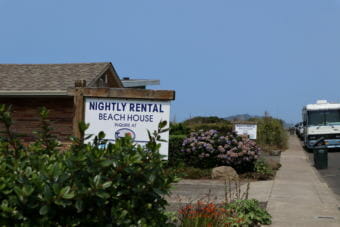
Listings for short-term vacation rentals in Newport, Oregon, are proliferating, as is the case for the Pacific Northwest at large. (Photo by Tom Banse/Northwest News Network)

Several startups in the Lower 48 see a business opportunity amidst the proliferation of short-term vacation rentals. They’re offering to help cities root out unlicensed or tax-dodging Airbnb-type rentals.

The cities of Portland and Salem made eyebrow-raising discoveries earlier this month when they compared the number of formally licensed short-term rentals with actual listings scraped off of the Airbnb platform. Around 80 percent of the listings appeared to be unregistered.

Now, cities are finding a new way to monitor unregistered listings: third-party vendors with names like Host Compliance and STR Helper.

Those two startups see a business opportunity in the proliferation of short-term vacation rentals. So they are offering to help Pacific Northwest cities root out unlicensed or tax-dodging Airbnb-type rentals.

“It helps with room tax collection because we can compare who we have records of,” said city of Newport community development director Derrick Tokos. “And then they’ll say, ‘Well, here’s some others that appear to have been rented. You may want to check it out.'”

Tokos said Newport hasn’t decided whether to sign a contract with either vendor, though both have pitched their services. He said a “courtesy scan” shared by Host Compliance estimated roughly 20 percent of the short-term rentals available in the Oregon beach town were unlicensed.

Tokos said one service that piqued local interest was the possibility of creating a 24/7 complaint hotline for neighbors to report problems. The city might pair that with a “three strikes and you’re out” policy for yanking the permit of a vacation rental unit, he said.

Eugene, Lake Oswego, Seaside, Gearhart, Hood River and Rockaway Beach in Oregon, as well as Vancouver and Nelson in British Columbia, have all signed up for short-term rental compliance support.

The vendors say they can do remote compliance monitoring and initial outreach to short-term rental proprietors listed on platforms such as Airbnb, Flipkey and HomeAway on a more cost-effective basis than if a city worker were assigned that task. The cost of the monitoring contract would ideally be covered by increased permitting fee revenue and lodging tax collections.

“We’re scraping data every night,” said STR Helper co-founder John Spuhler in an interview Wednesday.

Spuhler said Rockaway Beach collected $50,000 in back taxes within a couple of months of signing up for the software-based service earlier this year.

In an interview, League of Oregon Cities policy specialist Wendy Johnson said estimates for missed lodging tax revenue vary widely. She suspected the state may be “leaving money on the table.”

“It’s also fair to say that the sharing economy keeps evolving and it has been challenging for local governments and the state to enforce their respective lodging taxes within it,” Johnson said Wednesday. “Most don’t have the staff, resources or technology dedicated to monitor all the short term rentals that have proliferated in the last few years. They are not like the hotels that are obvious in a community.”

Portland audit of short-term rentals released this month noted that while large numbers of short-term rentals are not licensed, Airbnb, VRBO, Vacasa and other intermediary platforms are remitting lodging tax revenue.

The Portland city audit and Johnson both mentioned how the big online companies that facilitate rentals won’t disclose the addresses of hosts, making it difficult to verify whether taxes and code compliance are fully in order.

Airbnb did not immediately reply to an emailed request to elaborate on its regulatory compliance policies.

A public relations manager for the national vacation property management company Vacasa said it has remitted lodging tax revenue since its founding in 2009.

“It is our top priority to ensure that all short-term rentals managed by Vacasa adhere to market-specific rules and regulations and pay the required taxes,” wrote Vacasa’s Tracy Anderson in an email.

Site notifications
Update notification options
Subscribe to notifications