Reveal

Trump’s swap of ‘irreplaceable’ wilderness allows millions of dollars in seafood transport

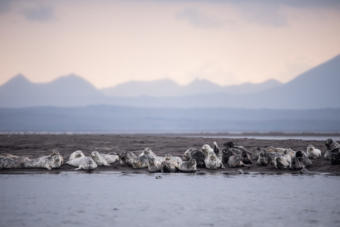
Harbor seals gather on a spit of land in the Izembek National Wildlife Refuge near Cold Bay, Alaska. For six decades, the refuge along the coast of the Bering Sea has been protected as one of the wildest nature spots on Earth.
Harbor seals gather on a spit of land in the Izembek National Wildlife Refuge near Cold Bay, Alaska. For six decades, the refuge along the coast of the Bering Sea has been protected as one of the wildest nature spots on Earth. (Credit: Ash Adams for Reveal)

This story was produced by Reveal from The Center for Investigative Reporting, a nonprofit news organization. Get their investigations emailed to you directly by signing up at revealnews.org/newsletter.

At the spot where a rugged chain of islands breaks away from the Alaska Peninsula, a secluded national refuge protects millions of seabirds, grizzly bears and caribou.

Framed by snow-capped mountains and smoky volcanoes, the refuge holds an irreplaceable underwater grass forest, where the world’s population of a tuxedo-colored sea goose – 150,000 of them – fattens up before a nonstop 60-hour migration to Mexico.

For six decades, the Izembek National Wildlife Refuge, tucked along the coast of the Bering Sea, has been protected as one of the wildest nature spots on Earth, remote enough to escape development.

But that isolation has been shattered. Seven noisy helicopters swooped down 80 times over two days in July to land on the narrow isthmus where animals nest, feed and migrate.

Then-Interior Secretary Ryan Zinke, prodded by President Donald Trump, ordered the surprise helicopter survey to prepare to bulldoze a 12-mile road through the refuge’s federally protected wilderness.

Almost a year ago, on a day that the federal government was briefly shut down, Zinke quietly signed a land swap, evading Congress, which has wrestled with the issue for decades. The Interior Department is trading the swath of Izembek’s wilderness to Aleut Natives so their cannery town of King Cove can build the final 12 miles of a 37-mile gravel road to the Cold Bay Airport. In exchange, the federal government gets an equal amount of Aleut land.

In crafting the deal, Zinke rejected the warnings of his department’s scientists. After a four-year study, the U.S. Fish and Wildlife Service, which oversees the refuge, concluded that allowing a road through the refuge would “lead to significant degradation of irreplaceable ecological resources.” It also would jeopardize the global survival of a migratory sea goose, called the Pacific black brant, as well as the emperor goose and other waterfowl, the agency said.

Trump and Zinke have worked behind the scenes to deliver the road to the rural Aleut government of King Cove, which has spent almost 50 yearslobbying Congress and the Interior Department. The Aleut say the road is essential to transport patients with medical emergencies to the Cold Bay Airport, where they could then fly to an Anchorage hospital.

Zinke, who left office last week amid multiple ethics investigations, billed his action as allowing a “lifesaving road” for the roughly 1,000 residents of King Cove.

But a close examination of the agreement and the history of the road deal suggests that it is more about selling seafood than saving lives.

A document dating back two decades shows that hauling fish, not patients, was the Aleuts’ original motive for building a road through the national refuge. When that strategy failed, they and Alaska Republican leaders switched to focus on medical necessity.

Now the new land swap deal includes a little-known provision forged by the Interior Department that would allow King Cove fishermen to transport tens of millions of dollars of salmon, crab, cod and other seafood on their way to lucrative Asian markets.

The economy of King Cove is almost totally dependent on commercial fishing. It’s home to the Peter Pan Seafoods cannery, owned by the world’s largest fish processor, Maruha Nichiro Corp. of Japan.

Under the agreement signed by Zinke, the road will be “generally for noncommercial purposes.” But the deal also contains this provision: “The commercial transport of fish and seafood products, except by an individual or a small business, on any portion of the Road shall be prohibited.”

The term “small business” can leave the wrong impression, though. A fishing business is defined as small when it has annual revenue no higher than $20.5 million for finfish, $5.5 million for shellfish or $7.5 million for other marine fish, according to federal codes.

The wording would prevent giant Peter Pan Seafoods, which reports about$225 million in annual sales, from driving fresh seafood to the airport to fly it to Asia and elsewhere. But King Cove’s commercial fishermen – including all of its Aleut leaders – would qualify under those income restrictions to use the road for transporting their fish and seafood, according to state data on seafood earnings. And Peter Pan could use it to transport its workers, up to 500 in peak salmon season.

Zinke and Aleut leaders never mentioned or explained the loophole when discussing the land swap in public.

King Cove’s economy is almost totally dependent on commercial fishing. It’s home to the Peter Pan Seafoods cannery, owned by the world’s largest fish processor, Maruha Nichiro Corp. of Japan. (Credit: Ash Adams for Reveal)

The provision “could easily be exploited” for business purposes, said Deborah Williams, a former Interior Department attorney. The agreement between Zinke and King Cove “could – but does not – restrict the use of the road to health and safety issues,” she said.

A road would disturb more than just its immediate path. It would bring traffic and noise and give King Cove subsistence hunters and visitors easy access to animals in dense, undisturbed parts of the wilderness. It also would bisect the land bridge for bear and caribou, which are sensitive to disturbance, according to wildlife biologists.

Lillian Sager, who is from King Cove and lives part time in Cold Bay, is a member of a large Aleut family that has tried to get the road built between the towns for decades.
Lillian Sager, who is from King Cove and lives part time in Cold Bay, is a member of a large Aleut family that has tried to get the road built between the towns for decades. (Credit: Ash Adams for Reveal)

The deal will decimate the “most important wildlife refuge in all of Alaska,” said Bruce Babbitt, who rejected the road when he served as interior secretary during the Clinton administration. “Izembek is a convergent point where seabirds migrating out of the Arctic feed. If that link is broken, we’re at risk of extinction of all those bird species.”

Leaders in King Cove say road opponents are valuing birds and other wildlife more than residents’ medical needs. Lillian Sager is a member of the large Aleut commercial fishing family that has tried to get the road built for decades.

“When I’m stuck in King Cove and the wind is blowing 100 miles an hour and I’m sick, you want to get out of that town. All that is more important than if there is garbage on the road or if (hunters) are going to shoot animals,” said Sager, whose brother is King Cove Mayor Henry Mack.

However, a medical expert disputes that a road through the refuge is a safe way to transport patients. And a federal report has outlined other reliable alternatives.

Dr. Peter Mjos oversaw medical evacuations in King Cove for 15 years as the Eastern Aleutian Tribes’ medical director. “Should the road happen, I foresee all sorts of calamity,” he says.
Dr. Peter Mjos oversaw medical evacuations in King Cove for 15 years as the Eastern Aleutian Tribes’ medical director. “Should the road happen, I foresee all sorts of calamity,” he says. (Credit: Ash Adams for Reveal)

A doctor who oversaw medical evacuations in King Cove for 15 years said traveling almost 40 miles on the gravel road during 60 mph winds and blinding snowstorms would be “suicidal” for patients and rescue teams.

“Should the road happen, I foresee all sorts of calamity,” said Dr. Peter Mjos, who was the Eastern Aleutian Tribes’ medical director until 2002. He retired from practicing medicine in 2015.

The road is the centerpiece of a campaign by Trump and Alaska’s Republican congressional delegation to monetize the state’s public lands by approving private development, oil drilling, mining and logging.

Also on Trump’s wish list are oil exploration in the Arctic National Wildlife Refuge, offshore drilling in the Arctic Ocean, logging in the Tongass National Forest and two mines, one in Bristol Bay and one in mountains west of Fairbanks.

Trump personally promised Alaska Sen. Lisa Murkowski that he’d get the road built. He scribbled a note to her on a copy of an Oct. 16, 2017, Washington Post story about the land swap.

“Lisa – We will get it done,” Trump wrote in a note Murkowski shared at a press conference.


President Donald Trump wrote this note to Alaska Sen. Lisa Murkowski on a copy of an Oct. 16, 2017, Washington Post story about the land swap.

Eight months later, a month before the helicopter land survey, Trump asked her, “How’s our beautiful little road doing in Alaska?”

Messaging behind the road shifts

King Cove’s harbors are filled with fishing vessels, battered from weeks at sea. Like their ancestors for the past 9,000 years, the Aleut depend on the ocean for their food, livelihood and transportation. The town is relatively well off – its median income of almost $73,000 is about 23 percent higher than the national median, though 1 out of every 7 residents lives in poverty.

In these remote parts of Alaska, villages are isolated; roads connecting them are rare. Many of King Cove’s Aleut are prosperous commercial fishing families with cars and trucks but few roads on which to drive.

Currently, people who need more care than a medical clinic can provide are evacuated to the Cold Bay Airport by helicopter or small plane, then flown to Anchorage. Such air transport, however, is hampered by high winds. On average, one or two patients are evacuated from King Cove per month.

Mjos, the retired doctor in King Cove, called the road “a folly.” The area has the highest average wind speeds of anywhere in the United States, and in winter, the road could be buried under several feet of snow and ice. He said it would be safer to transport patients across the bay by ferry.

The federal Army Corps of Engineers, which reviewed marine options for transporting patients, determined in 2015 that the cheapest, most effective solution would be to provide a terminal and ferry in King Cove capable of withstanding waves and ice, along with an improved Cold Bay dock, at an estimated capital cost of $30 million.

More than 30 other rural communities in Alaska that do not have roads use ferries, according to the report. In comparison, building the road would cost the state the same, an estimated $30 million, with unknown annual maintenance costs.

Pacific black brant fly over the Izembek National Wildlife Refuge and land on its eelgrass beds. The world’s population of the sea goose – 150,000 of them – fattens up here before a nonstop 60-hour migration to Mexico.
Pacific black brant fly over the Izembek National Wildlife Refuge and land on its eelgrass beds. The world’s population of the sea goose – 150,000 of them – fattens up here before a nonstop 60-hour migration to Mexico. (Credit: Ash Adams for Reveal)

In 1994, King Cove passed a resolution saying the road would “link together two communities having one of the State’s premier fishing ports/harbors (including North America’s largest salmon cannery) in King Cove with one of the State’s premier airports at Cold Bay.”

There was not a single mention of the road being needed to transport sick or injured people.

About 20 years ago, that messaging changed.

According to a review of their public stances, Alaska politicians and theAleutians East Borough and city of King Cove dropped references to commercial fishing and Peter Pan Seafoods and switched their focus to health and safety in their efforts to secure the road.

Rarely in recent years have Alaska politicians deviated from their public health message. However, in a 2011 visit, Murkowski, the senator, called the road a “critical ingredient in (our) thriving economic future.” And in May, then-Gov. Bill Walker reported to the Trump administration that it is for “enabling access to health services and movement of goods and people.”

Commercial uses “have always been the main reasons for the road,” said Deborah Williams, the former Interior Department attorney who is now a lecturer on public lands at the University of California, Santa Barbara. When she visited King Cove in the mid-1990s, “they told me, ‘We want that road to take fresh fish to Cold Bay to maximize the value of our fish.’ ”

President Barack Obama’s interior secretary, Sally Jewell, recalled that on a 2013 tour, she repeatedly asked King Cove leaders why they had extended the road right up to the wilderness, leading to nowhere.

“I was finally told, ‘Because we wanted to put pressure on you to build the road through the refuge.’ They actually said that,” she said.

Months later, she rejected the road, citing scientists’ concerns about the impacts on wildlife and concluding that “reasonable and viable transportation alternatives exist.”

The existing 17-mile part of the road leading out of King Cove, Alaska, ends right at the refuge’s wilderness boundary.
The existing 17-mile part of the road leading out of King Cove, Alaska, ends right at the refuge’s wilderness boundary. (Credit: Ash Adams for Reveal)

Documents show that the local leaders pushing for the road owncommercial fishing boats. The Mack family has 25 vessels, one of the largest fleets in King Cove. Five of the six members of the City Council own commercial vessels, and the sixth is in the Mack family.

Dean Gould, who is president of King Cove’s Aleut government and whose name is on the land agreement with Zinke, said he owns a 49-foot vessel; his large family owns seven other commercial fishing boats. Gould said he personally would not use the road to transport his salmon and other fish because he now delivers it to Peter Pan by tender, a vessel that services his boat while he’s at sea for weeks at a time.

So why was the small business provision put in the agreement? Gould said it’s because it “leaves a little bit of door open” if someone hauls “a couple cases … or a pound or two” or if anyone wants to commercially transport fish in the future.

Peter Pan Seafoods, which has been publicly silent on the road project, declined to comment. Henry Mack, the mayor, said the land swap is “still in the court, and I won’t be making a comment on anything to do with the road or commercial fishing.”

Little information has been released about the physical challenges, safety issues and costs that the state and Aleuts would face building and maintaining the road.

“Today, the road costs, maintenance, reliability due to avalanches and storms, and travel time under these conditions are remaining questionsthat have yet to be given to the public,” said Tony Knowles, Alaska’s governor from 1994 to 2002.

David Bernhardt, who is now Trump’s acting interior secretary, worked with King Cove to arrange the land swap. Shortly after he was confirmedas the department’s second in command in July 2017, Bernhardt held a video meeting with a King Cove group, before the idea became public, according to his calendar record. Bernhardt previously was a lobbyist for the state of Alaska and the oil industry in efforts to open up the Arctic National Wildlife Refuge to oil development.

‘Extraordinary wildlife and wilderness’

Overhead on a September day at the Izembek refuge, clouds of Pacific black brant are flying in by the tens of thousands from the Yukon Delta, Canadian Arctic and eastern Russia. They feed in North America’s largest eelgrass bed, the first to be designated as internationally critical to wildlife.

Nearly the entire emperor goose population and thousands of threatened Steller’s eiders also forage in the eelgrass at Izembek Lagoon. Tributaries run rife with salmon and host grizzly bears. Sea otters in the lagoon pop up with pups on their bellies. On the spits of land that form the estuary’s gate to the sea, hundreds of walruses and harbor seals grunt, roll and rest.

The existing 17-mile stretch of road ends right at the refuge’s wilderness boundary. It’s from this spot that Zinke’s deal would push another 12 miles through the wilderness to the airport.

The U.S. Fish and Wildlife Service concluded that “extraordinary wildlife and wilderness resources … recognized for their national and international significance” would be harmed and that the swapped land “would not compensate for the adverse effects.” The road poses major risks to the survival of brant, tundra swan, emperor goose, bear, caribou and fish populations and moderate risks to many others, according to the agency’sdata.

Brant travel almost 3,000 miles every spring and fall to feed on the refuge’s eelgrass. They are elegant-looking birds, mostly jet black with bands of bright white, somewhat like a tuxedo. Small for a goose, they must stay strong to survive their nonstop transcontinental journey.

Their survival rate already is dropping, largely due to degraded winter habitat in Mexico and California. And global warming is altering their behavior, which makes the refuge’s role in protecting them even more critical because they are spending more time there. About one-third of the 150,000 arriving at Izembek now stay for the winter, increasing every year by about 7 percent, according to research.

“Any threats to the Alaska wintering population have implications for the entire Pacific Flyway population,” the 2009 study says, adding that “this species is experiencing a long-term decline and is of conservation concern across its range.”

Christian Dau, a now-retired Fish and Wildlife Service biologist who was based at the refuge in the 1980s and ’90s and co-wrote the paper, said the road would shatter the remoteness that protects the birds.

“I go back to the farsighted founding fathers of the refuge. They always took the conservative approach,” he said. “When your options are narrow, you should act conservatively. You don’t open the floodgates and allow lots of development. In 20/20 hindsight, you might look back and say we made a mistake.”

Christian Dau, a former federal biologist at the Izembek National Wildlife Refuge who now lives in Wasilla, Alaska, says building a road through the refuge would shatter the remoteness that protects birds and other wildlife.
Christian Dau, a former federal biologist at the Izembek National Wildlife Refuge who now lives in Wasilla, Alaska, says building a road through the refuge would shatter the remoteness that protects birds and other wildlife. (Credit: Ash Adams for Reveal)

A few hundred miles to the north, in the Yukon-Kuskokwim Delta, where the brant breed and nest, Myron P. Naneng Sr. is a Yup’ik lifelong subsistence hunter and former president of a Native association of leaders representing 56 villages.

Beginning 35 years ago, the Yup’ik, Aleut and other Alaska Natives agreed to protect geese from subsistence hunting so they could recover from low numbers.

“Building a damaging road now, right through some of the most important and sensitive habitat for brant and emperor geese, would be contrary to the years of conservation work,” Naneng said at a hearing before a House subcommittee in 2017.

“All of us contend with weather delays, expensive travel and long trips to the city for medical care. … But it is not realistic to build roads to all of the Alaska communities,” he added.

The land deal with Zinke is not yet final, pending completion of the surveying and an appraisal. Nine environmental groups have filed suit to stop it.

A battle over its legality centers on two laws: the National Environmental Policy Act and Alaska National Interest Lands Conservation Act. The laws require a study of projects’ environmental effects and consideration of alternatives.

The environmental groups allege that the swap of refuge land is illegal because it does not have conservation purposes and needs a full review and congressional approval. The Trump administration argues that the Alaska act exempts conveying land to Native communities and that provisions don’t apply because it already traded away the land and, therefore, the road would not be built in officially designated wilderness.

A company town

It’s a Sunday morning in September in King Cove, and the Peter Pan Seafoods plant is operating 24 hours a day. Some 300 workers are packing pollock for fish sticks, Pacific cod and crab for restaurants and black cod for the most fortunate. In summer sockeye season, the workforce reaches 500 in one of North America’s biggest salmon canneries, which sells salmon under the labels Deming’s or Double “Q.”

Commercial fishing boats – as small as 30 feet and as big as 300 feet – operating in the Bering Sea and Gulf of Alaska are pulling up to the plant with their fresh catch. The fish and shellfish are processed and sent frozen atop 400-foot barges to markets in the Lower 48, Europe and Asia. The previous day, Peter Pan processed 800,000 pounds of seafood.

Wearing hairnets, smocks and earplugs, the workers tend to conveyor belts, freezer rooms and chopping tables. They sleep in dormitories in King Cove. Their long shifts, minimum-wage jobs and foreign languages separate them from the town’s more comfortable residents in fishing families.

On this Sunday morning, Irene “Koochie” Christiansen, 83, is carefully making her way from her home near the cannery to the Russian Orthodox church, where she gives weekly readings. As she lights candles, her soft prayers in Aleut and English fill the church adorned with icons and bells from another church in the nearby village of Belkofski, where she grew up.

Irene Christiansen, 83, lights candles in the Russian Orthodox church in King Cove, Alaska. A respected elder and one of only two in King Cove who speak Aleut, Christiansen is among the few in the town who speaks against the planned road through the wildlife refuge.
Irene Christiansen, 83, lights candles in the Russian Orthodox church in King Cove, Alaska. A respected elder and one of only two in King Cove who speak Aleut, Christiansen is among the few in the town who speaks against the planned road through the wildlife refuge. (Credit: Ash Adams for Reveal)

In the Aleut way, she invites some visitors back to her place for flaky salmon pie. Christiansen grew up trapping animals in Belkofski, which was settled by Russian fur traders. She worked 16-hour shifts at the cannery and is grateful for the wages that paid for her cozy house and the help she gets from prosperous Aleut fishing families.

Christiansen said that if she had a medical emergency, she wouldn’t want to travel over a winding 37-mile, windswept route. Only a respected elder such as Christiansen, one of only two in King Cove who speak Aleut, would feel confident speaking out against the road so popular with King Cove’s fishing families and political leaders.

One day, her son Cal took her berry-picking on the road that now ends at the refuge’s wilderness boundary. The road makes no sense to her.

“Let’s go home,” she told her son.

Travel for this project was provided by the Fund for Investigative Journalism.

This story was edited by Marla Cone and Andrew Donohue and copy edited by Stephanie Rice and Nikki Frick.

Jane Kay can be reached at JaneKayEnvironment@gmail.com. Follow her on Twitter: @JaneKayNature.

These priests abused in Native villages for years. They retired on Gonzaga’s campus.

(Illustration courtesy of Reveal)This story was produced by Reveal from The Center for Investigative Reporting, a nonprofit news organization. Get their investigations emailed to you directly by signing up at revealnews.org/newsletter.

This story was produced in partnership with the Northwest News Network.

Part 1: The Story

On the surface, Father James Poole seemed like the cool priest in Nome, Alaska. He founded a Catholic mission radio station that broadcast his Jesuit sermons alongside contemporary pop hits. A 1978 story in People magazine called Poole “Western Alaska’s Hippest DJ … Comin’ at Ya with Rock’n’Roll ’n’ Religion.”

Behind the radio station’s closed doors, Poole was a serial sexual predator. He abused at least 20 women and girls, according to court documents. At least one was 6 years old. One Alaska Native woman says he impregnated her when she was 16, then forced her to get an abortion and blame her father for raping her. Her father went to prison.

Like so many other Catholic priests around the country, Poole’s inappropriate conduct with young girls was well-known to his superiors. A Jesuit supervisor once warned a church official that Poole “has a fixation on sex; an obsession; some sort of mental aberration that makes him see sex everywhere.”

But the last chapter in his story reveals a new twist in the Catholic abuse scandal: Poole was sent to live out his retirement years on Gonzaga University’s campus in Spokane, Washington.

For more than three decades, Cardinal Bea House on Gonzaga’s campus served as a retirement repository for at least 20 Jesuit priests accused of sexual misconduct that predominantly took place in small, isolated Alaska Native villages and on Indian reservations across the Northwest, an investigation by the Northwest News Network and Reveal from The Center for Investigative Reporting has found.

A trove of internal Jesuit correspondence shows a longstanding pattern of Jesuit officials in the Oregon Province—an administrative area that included Washington, Oregon, Montana, Idaho and Alaska—privately acknowledging issues of inappropriate sexual behavior, but not releasing that information to the public, which avoided scandal and protected the perpetrators from prosecution.

When abuse was discovered, the priests would be reassigned, sometimes to another Native community.

Once the abusive priests reached retirement age, the Jesuits moved them to Cardinal Bea House on Gonzaga’s campus or another Jesuit residence, to comfortably spend the rest of their lives in relative peace and safety. The university administration did not respond to requests for an interview to answer whether the administration or student body were aware of the presence of known sexual offenders on campus.

Situated on Gonzaga’s campus, between the university’s business school and the St. Aloysius Rectory, Cardinal Bea House played host to at least 20 Jesuit priests accused of sexual abuse.
Situated on Gonzaga’s campus, between the university’s business school and the St. Aloysius Rectory, Cardinal Bea House played host to at least 20 Jesuit priests accused of sexual abuse. (Photo by Emily Schwing for Reveal)


The last known abusive priest was moved out of Cardinal Bea House in 2016, Jesuit records show. 

Father John Whitney, the former leader of the Oregon Province who ordered Poole to move into Cardinal Bea House, said the Jesuit order is obligated to provide for priests in retirement. He said it was the only facility in the province where past offenders like Poole, then in his 80s, could be contained effectively while also receiving necessary medical care. 

Poole resided at Cardinal Bea House from 2003 to 2015. If he had been allowed to live independently, without church oversight, he surely would have abused more people, even at his advanced age, Whitney said in an interview.

The house, Whitney said, was “a retirement community where he could be monitored.”

In a pair of depositions in 2005, Whitney said he did not inform Gonzaga administrators or police in Spokane about Poole’s history after moving him into Cardinal Bea House. A Spokane Police Department spokesperson said they had not received any reports, either from Gonzaga or the Jesuit order, about allegations against any residents of Cardinal Bea House.

Non-abusing Jesuits also lived at Cardinal Bea House, but there were specific “safety plans” for abusers that banned sexually abusive priests from commingling with students. The Oregon Province would not release copies of the plans. While we learned of no reports of residents abusing Gonzaga students, the restrictions were not rigorously enforced. 

In a deposition in one of the several lawsuits filed against him, Poole said he regularly went to the school library and basketball games. Poole said he met with a female student alone in the living room of Cardinal Bea House when she came to interview him for a report on Alaska. Student journalists and filmmakers in 2010 and 2011 were also permitted to interview residents, including Joseph Obersinner, who worked in Native communities in Montana, Washington and Idaho. He was accused of sexual misconduct against a minor.

“We love being right in the middle of campus,” Obersinner told the school’s student newspaper. “It’s a blessing to see the active energy and happiness of youth every day.”

A view of the Gonzaga University campus from Cardinal Bea House.
A view of the Gonzaga University campus from Cardinal Bea House. (Photo by Emily Schwing for Reveal)


Cardinal Bea House is a modest low-rise brick building, with large windows in front and a small carport behind. It resembles an unremarkable office building, save for the white statue of an angel-winged saint standing guard over the front entrance. On a recent crisp autumn day, a prankster had slipped a hand-rolled cigarette between the statue’s fingers.

While the building appears on campus maps and is listed in the campus directory, it’s not officially part of the private Jesuit university. Cardinal Bea House is owned by the Jesuit order of the Catholic Church.

Poole was joined at Cardinal Bea House by other priests whose abuse was known, often for years, by the Jesuit order.

Father James Jacobson, sent there in the mid-2000s, was accused of sexual abuse by members of the Alaska Native community of Nelson Island. He claimed he never forced anyone to have sex, saying in a deposition that he had consensual sex with seven Native women. He admitted to fathering four children and using church funds to hire prostitutes in Anchorage and Fairbanks when he was principal of a Jesuit boarding school in Glennallen.

Another priest, Henry Hargreaves, accused of sexually assaulting young boys, was sent to Cardinal Bea House by 2003, and subsequently allowed to lead prayer services in at least four Native American communities on two reservations in Washington state.

While Cardinal Bea House appears on Gonzaga campus maps and is listed in the campus directory, it’s not officially part of the private Jesuit university.
While Cardinal Bea House appears on Gonzaga campus maps and is listed in the campus directory, it’s not officially part of the private Jesuit university. (Graphic by Gabriel Hongsdusit/Reveal)


The abusive Jesuits at Cardinal Bea House were part of the Oregon Province’s outsized problem with sexual misconduct. The province had 92 Jesuits accused of sexual abuse, by far the most of any province in the country, according to data we compiled from church records, a database maintained by advocates for sex abuse victims, and information released earlier this month by the Jesuits. In addition, about 80 percent of accused abusers worked in Native communities in the Oregon Province.

Poole has been described as charismatic, outgoing and narcissistic, so he was perfectly suited for his role as the voice of KNOM, the radio station he founded in 1971. Elsie Boudreau, an Alaska Native, was a station volunteer and one of Poole’s victims. From the time she was 10 until she was 16, she volunteered at KNOM.

Boudreau said in an interview that when she was 11 or 12, during a Saturday music request show in which they were alone in the studio, Poole would kiss her on the lips and fondle her, something she didn’t realize was wrong until she was much older. He also made her sit on his lap and lie on top of his body.

For Boudreau, it was a slap in the face that Poole lived out his retirement comfortably until he died early this year. “To me, what that says is they are taken care of,” Boudreau said. “They are protected by the Catholic Church, when the victims were never protected.”

Continue to Part 2: The Reveal

Part 2: The Reveal

(Graphic by Reveal)
(Graphic by Reveal)


The Jesuits’ deep roots in Native communities

The Catholic Church was deeply embedded in the Native communities of Alaska and Indian reservations in the Northwest. In the early 1900s, the Jesuits had established a school and an orphanage in Elsie Boudreau’s hometown, the predominantly Alaska Native community of St. Mary’s in the Yukon-Kuskokwim Delta.

Jesuits, officially called the Society of Jesus, are a Catholic religious order founded in the 1500s. While Jesuits can work in various roles from parish priests to teachers, the order is known for its academic and socially conscious bent. There are more than 100 Jesuit high schools, colleges and universities in North America.

Jesuit priests were formidable figures in small Native villages, presiding over daily life from Mass to marriages, baptisms to burials; even teaching catechism lessons, where some of the abuse of the youngest victims took place. Boudreau said she viewed her Catholicism as more central to her identity than being Yup’ik. That religious identity was shattered by her abuse.

“The whole premise behind the Catholic Church and their mission with the Native people, with indigenous people, was to strip them of their identity,” Boudreau said. “And so sexual abuse was one way. I think it’s intentional when you have an institution that is aware of problem priests, perpetrator priests, and moves them to places where they believe that people are ‘less than,’ where they believed the people there would not speak out.”

In 2002, two other abuse victims in Boudreau’s community filed a lawsuit against the church. Learning of the suit from a news story, Boudreau, then in her early 30s, had a shock of recognition. She, too, had suffered abuse, and no longer wanted to remain silent.

After going public with her story of abuse, Elsie Boudreau (center) became an advocate for other survivors in Alaska Native communities through her nonprofit Arctic Winds Healing Winds. (Photo by Emily Schwing for Reveal)


Boudreau reported her abuse and was deeply unsatisfied with the response. The region’s presiding bishop eventually invited her to a meeting, but Boudreau said he didn’t seem to understand how the abuse had affected her life.

“It was very clear he didn’t care about what happened to me,” Boudreau said. “He didn’t acknowledge that little girl who was hurt and say, ‘I’m sorry this happened to you, what can I do?’ Instead, I became a liability.”

Yet, Jesuit leadership had known about James Poole’s behavior for longer than Boudreau had been alive. In a 1960 letter to a Jesuit official, local Jesuit leader Segundo Llorente fretted over Poole’s conduct. Poole regularly had long, one-on-one conversations with young girls about sex, Llorente wrote. Llorente’s letter speculated that Poole, “has a fixation on sex; an obsession; some sort of mental aberration that makes him see sex everywhere. Some think that may be (sic) he is projecting outwardly what is eating him inwardly … he is deliberately placing himself at all times in dangerous situations.”

There might have been some personal insight in those words. The names of both Llorente and the Alaska church official with whom he was corresponding, Father Paul O’Connor, appeared on a list released by the Fairbanks Diocese in 2009 of priests accused of sexual misconduct.

Despite Llorente’s warning, Poole’s abuse of minors and young women in Alaska went on for decades, according to attorneys who represented clients, as well as letters from church officials and other court documents. At least one victim accused him of rape.

In another letter from 1986, which has not previously been made public, Bishop Michael Kaniecki of Fairbanks wrote to Archbishop Francis Thomas Hurley of Anchorage: “Hopefully, my letter will nip this mess in the bud. Tried to cover all bases, and yet not admit anything.”

In 1988, Poole was removed from his position at KNOM after young women who had volunteered at the station wrote letters to the bishop in which they accused Poole of sexual misconduct.

The following year, Father Frank Case, the head of the Oregon Province, endorsed Poole for a new position. Case is currently vice president at Gonzaga, an adviser to the school’s president, and chaplain for the school’s nationally ranked men’s basketball team, the Bulldogs.

He wrote a letter to the Catholic chaplains association backing Poole’s application to become a chaplain at St. Joseph Medical Center in Tacoma, Washington.

“(Poole) is a Jesuit priest in very good standing, and it is my strong expectation that he will serve in such a ministry in a manner that is both generous and effective,” Case wrote. Poole got the job, working at the hospital until 2003.

In a 2008 deposition, Case said he did not review Poole’s personnel file before writing the letter because he had no indication of misconduct. In a statement through Gonzaga University’s public relations office, Case said he did not have access to Poole’s personnel file.

It wasn’t until 1997, 37 years after Llorente’s letter of caution, that church officials finally came to see their Poole problem as critical. That December, the bishop of Fairbanks sent a letter to the head of the Oregon Provinceat least the third provincial to deal with Poole’s sexual misconduct. “Unfortunately, more skeletons keep falling out of the closet … if we do not make a clean cut with Poole, it could jump up and bite us,” he wrote, noting a potential whistleblower was threatening to publicly expose the extent of Poole’s wrongdoings.

The following year, the bishop sent another letter to the province head urging Poole’s old sermons and ministerial messages be removed from the KNOM’s airwaves entirely. “(We could) end up with a public scandal and a possible law suit (sic),” the letter reads. “It is my fear … that if the wrong person hears Jim’s voice anywhere, it might just be the straw that breaks the camel’s back.”

Those fears were prescient. In 2003, the same year Poole was forced to retire to Cardinal Bea House, Boudreau became the first person to sue Poole and the church and not withhold her name from the public.

It was Boudreau’s only avenue of redress since the statute of limitations had run out on prosecuting her claim in criminal court. At the time, Alaska had a five-year time frame for prosecuting sexual abuse of minors. She’s one of over 300 Alaska Native victims of child sex abuse by clergy.

In a deposition for the lawsuit, Poole admitted abusing Boudreau. He denied ever raping anyone. He justified his actions with Boudreau and other victims because they fell short of sexual intercourse. “I thought I was bringing love into the life of other persons,” he said.

Gravestones at the Mount St. Michael cemetery in Spokane, Washington, where James Poole is buried amid 54 other Jesuits also accused of sexual abuse.
Gravestones at the Mount St. Michael cemetery in Spokane, Washington, where James Poole is buried amid 54 other Jesuits also accused of sexual abuse. (Photo by Emily Schwing for Reveal)


Boudreau’s suit was settled in 2005 for $1 million. It was followed by at least five other lawsuits specifically naming Poole and accusing him of widespread abuse.

Hundreds of other suits followed, naming dozens of other sexually abusive priests active in the Oregon Province. The Jesuits settled all of this litigation for a reported $166 million, the costs of which forced the province to declare bankruptcy in 2009. It was the third-largest settlementin Catholic Church history.

Stories like Poole’s echo across Alaska Native communities. St. Mary’s has just 500 residents, but at least 15 priests accused of sexual abuse were stationed there between 1927 and 1998. It was so pervasive that Boudreau says at least two of her seven siblings and two of her cousins were also sexually assaulted by Jesuit clergy.

The names of religious and lay people accused of abuse who lived in Alaska at some point in their tenure with the church must be listed and published every year by the Fairbanks Diocese as part of the 2010 bankruptcy settlement. As of late October, the diocese listed 46 people.

One man on the list is the aforementioned Father James Jacobson, accused of abuse in 1967 by members of the Alaska Native community of Nelson Island. In a letter at the time, the Jesuit superior in Alaska, Jules Convert, said he wasn’t sure of the veracity of the allegations against Jacobson because the people of Nelson Island “are not yet advanced enough to give impartial and true testimony.”

Jacobson was sent into retirement at Cardinal Bea House by 2005. Convert was also accused of sexually abusing over a dozen young boys in Alaska.

Continue to Part 3: The Coverup

Part 3: The Cover-up

(Graphic by Reveal)
(Graphic by Reveal)


‘I have to take responsibility for this’

In 2002, John Whitney was installed as the leader of the Oregon Province. He had to deal with a flood of accusations against priests in the province, starting days after taking the position. It was a situation, he said, for which his prior training had not adequately prepared him.

A year later, Elsie Boudreau filed her lawsuit, and Whitney took action against James Poole. He immediately ordered Poole to stop celebrating Mass and sent him directly to Cardinal Bea House. “You are not to have any unsupervised contact with any minors nor are you to meet alone with any women,” Whitney wrote.

Whitney said Cardinal Bea House was the only place where Poole could be monitored, but Poole moved freely throughout campus and, at least on one occasion, met alone with a female student.

Whitney told us in a recent interview that the order didn’t contact the local police department because Poole, and other priests with accusations against them, had not been criminally charged.

Gonzaga University wouldn’t answer questions about whether top officials knew about abusive priests at Cardinal Bea House. University officials declined multiple requests for interviews over a six-week period. Several top university officials, however, held leadership roles in the Jesuits’ Oregon Province as the sex abuse scandal unfolded.

Now a self-described “simple parish priest” in Seattle, Whitney is still processing his role in the crisis.

“I think some of the people deserved to be in jail,” Whitney said. “We knew we couldn’t put them in jail. I felt we had a responsibility to watch over them and that’s what we tried to do. Now, were sometimes the jailers overly beneficent, overly kind? Maybe. I don’t know. It’s hard to be a jailer.”

Whitney was candid about what he owed to survivors and their families. “I have to take responsibility for this, personally. It can’t be something that is delegated to someone else,” he said. “They deserved to confront me.”

The marker for where James Poole’s remains are inurned at Mount St. Michael in Spokane, Washington. Over the course of his life, Poole was accused of sexually abusing at least 20 women. (Photo by Emily Schwing for Reveal)


Asked if he thinks Poole is in hell, Whitney said he believes Poole is in a sort of purgatory. “What I believe purgatory to be is that we all have to be purged of the things we hold onto,” Whitney said. “In being purged of those things, we have to experience what we put others through.”

Whitney said the church needs to come to a public reckoning, an opening up of the archives to show it is serious about stamping out abuse. The recent grand jury report out of Pennsylvania, which showed decades of abuse kept hidden from public view by the church, is work that should have been done by the church itself, he said.

Earlier this month, Jesuits West, the new province created with the 2017 merger of the Oregon and California provinces, voluntarily released the names of priests accused of sexual misconduct with minors or “vulnerable adults.” But the new list omits at least 13 priests previously accused publicly in lawsuits and bankruptcy documents.

Tracey Primrose, a spokeswoman for Jesuits West, said more names could be added in the future after an external review due to be completed by spring, but did not explain the omissions.

Continue to Part 3: The Aftermath

Part 4: The Aftermath

(Graphic by Reveal)
(Graphic by Reveal)


The Jesuits have a new place to send abusers

There are no longer any known abusive priests at Cardinal Bea House. In the past couple of years, they have been relocated south to the Sacred Heart Jesuit Center in Los Gatos, California.

Sacred Heart is a former training school, where some of the abusive priests began their preparation for Jesuit life decades ago. The facility is hidden behind a hilltop winery, which also used to be owned by the Jesuits and was used to produce Communion wine. The order stopped its wine production in 1986 and the winery is now operated by a secular company.

The goal of the reshuffling, John Whitney said, was to place the priests in a more secure and isolated location. Since many of the offending Jesuits are older and declining in health, Sacred Heart was also a place where they could receive better medical care.

But Sacred Heart has problems of its own. By moving admitted sexual offenders into a facility that also services vulnerable people, it created an environment where predators had space to commit abuse.

In 2002, two mentally disabled men working as dishwashers at the facility received a combined $7.5 million settlement from the order for decades of sexual abuse by Jesuit priest Edward Thomas Burke and Brother Charles Leonard Connor. After a friend of one of the victims went to police, both men were convicted and required to register as sex offenders.

The abusive priests of Cardinal Bea House have been sent to Sacred Heart Jesuit Center in Los Gatos, California. But Sacred Heart has been the site of sexual misconduct.
The abusive priests of Cardinal Bea House have been sent to Sacred Heart Jesuit Center in Los Gatos, California. But Sacred Heart has been the site of sexual misconduct. (Photo by Emily Schwing for Reveal)


The Jesuits also settled a separate lawsuit for $1.6 million after an abused priest, James Chevedden, killed himself.

He, too, was sexually abused by Connor when he was sent to Sacred Heart after suffering a mental breakdown. When Chevedden learned Connor was returning to Sacred Heart, and that other abusive clergy were going to be sent there, he asked to be moved. When his request was denied, he killed himself, according to the lawsuit filed by Chevedden’s father.

California’s database of sex offenders only lists one person residing at Sacred Heart, Gary Uhlenkott, a Jesuit priest and former Gonzaga University music professor who was sentenced to six months in jail in May after pleading guilty to possessing child pornography. However, the list released earlier this month of priests accused of sexually abusing minors shows at least seven currently living at Sacred Heart.

James Poole died in March at Sacred Heart. His remains were sent back to Spokane, where they were inurned at the Jesuits’ grassy cemetery on the outskirts of town.

While he was stationed at Cardinal Bea House, Poole’s sole responsibility was to maintain the cemetery grounds.

There, Poole’s remains rest amid 54 other Jesuits who were also accused of sexual abuse. They’re outside the gate of a K-12 school.

The carefree voices of children the same age as Elsie Boudreau when she was abused float over the grounds during recess.

This story was edited by Andrew Donohue and Narda Zacchino and copy edited by Stephanie Rice.

Emily Schwing can be reached at emily@nwnewsnetwork.org, Aaron Sankin can be reached at asankin@revealnews.org and Michael Corey can be reached at mcorey@revealnews.org. Follow them on Twitter: @EmilySchwing, @asankin and @mikejcorey.

Site notifications
Update notification options
Subscribe to notifications