Pablo Arauz Peña, KTOO

Newscast – Thursday, September 17, 2020

In this newscast:

  • The developers of the proposed Pebble Mine aired an ad on Fox News last night, and it seems to have hit home with one viewer in the White House.
  • While commercial salmon fisheries in Southeast are looking to be a bust this year, that’s not the case for the Dungeness crab.
  • The brand new village of Mertarvik is one step closer to having a commercial runway.
  • Selling or giving away Alaska’s state-run ferry fleet is not a viable option.
  • Shell Offshore Inc. has submitted plans to drill for oil in state waters off the North Slope.

UAS enrollment is down, but better than expected

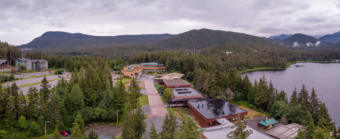
The University of Alaska Southeast campus in Juneau, shown on July 25, 2019 (Photo by David Purdy/KTOO)

Enrollment is down that the University of Alaska Southeast, but not as much as university officials were expecting.

Lori Klein, vice chancellor for student affairs and enrollment, said the university had been expecting a 10 percent drop.

“We’ve landed at 5 percent down so we are down compared to last year, but not as much as we anticipated,” she said.

Klein said universities across the country expected even steeper declines — between 20 and 40 percent. A June report from the credit rating agency Fitch estimated enrollment declines between 5 and 20 percent nationally.

Between the University’s Juneau, Ketchikan and Sitka campuses just over 2,000 students enrolled.

And, because there are more students on campus than university officials had planned for, faculty and staff had to adapt.

“As those enrollments bumped up, we had to go in and make physical adjustments to the classrooms,” Klein said.

Klein said students are following the university’s pandemic precautions. They are required to wear masks inside, but students are also masking up outside.

“In fact, my understanding is that they’re policing each other and making sure that people are appropriately being distanced, particularly when on campus,” she said.

It’s a quarter of the way through the semester, and Klein said the university is continuing to provide services, such as advising and counseling, remotely. Students can still request in-person appointments if needed.

Newscast – Wednesday, September 16, 2020

In this newscast:

  • Enrollment is down at the University of Alaska Southeast but not as much as university officials were expecting.
  • This summer is shaping up to be one of the worst ever in recent memory for bears in Juneau.
  • The U.S. Forest Service wants a do-over for an old growth timber sale that was halted by a federal court.
  • Residents in Ketchikan woke up to hazy skies as a result of smoke from wildfires burning in the Lower 48.

Newscast – Tuesday, September 15, 2020

In this newscast:

  • Six years after his death, Tlingit photographer Cyril George’s family donated a vast photo collection with the goal of making them available to the public.
  • The debate over a permanent home for Juneau’s cold weather shelter was put to rest last night when the Assembly rejected all of the proposals for new locations.
  • It looks like there’s a growing cottage industry for private tutoring in Juneau. One woman shared some insights about her new tutoring gig.

Newscast – Monday, September 14, 2020

In this newscast:

  • Bars in Juneau closed for indoor service on Saturday following a spike in residents testing positive for COVID-19.
  • Petersburg Borough assembly is considering writing an opinion on a draft senate bill that would give federal land to five Southeast communities.
  • Over the weekend, teams scoured the scorched earth at the Kodiak Pacific Spaceport to recover what’s left Astra’s 3.1 rocket.
  • Anchorage will receive federal support to aid in the suppression of the coronavirus outbreak among its homeless population.
Now streaming: Alaska Native and First Nations films during online festival

Vision Maker Media’s First Indigenous Online Film Festival is showcasing three films focused on stories about Alaska Native and First Nations history. The films are part of the festival’s history and environment showcase and are available to watch for a limited time.

Director Christopher Waats’daa Auchter preserves a special moment in the Haida’s recent past with his short documentary “Now Is The Time.”

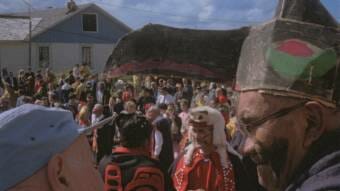
Auchter brings the viewer back to a day in 1969 when a totem pole was raised in the village of Old Masset on Haida Gwaii, just south of the Alaska panhandle. It was the first time a totem pole had been raised there in almost a century after a decades-long ban on First Nations art and culture.

Haida filmmaker Christopher Auchter's "Now Is the Time" tells the story of internationally renowned Haida carver Robert Davidson who was 22 years old, when he committed to carving the first new totem pole in Old Massett in almost a century. Auchter revisits August 1969, when the entire village gathered to celebrate the event that would signal the rebirth of the Haida spirit.
Haida filmmaker Christopher Auchter’s “Now Is the Time” tells the story of internationally renowned Haida carver Robert Davidson who was 22 years old, when he committed to carving the first new totem pole in Old Massett in almost a century. Auchter revisits August 1969, when the entire village gathered to celebrate the event that would signal the rebirth of the Haida spirit.

Auchter weaves archival footage with interviews of community elders who were there that day and with the totem pole’s carvers, Robert and Reg Davidson. In one scene, Auchter uses animation to bring Haida art and language to life.

“Imagine your world without art,” Auchter says in the film. “Now imagine if you were the one to help bring it back.”

Auchter says he was inspired by Barbara Wilson, a community leader who helped bring the National Film Board of Canada to produce a film from the original footage in 1969.

But Wilson was pushed out of the post-production process and didn’t see the film for another 50 years. Auchter says when she finally did see it, she wasn’t happy with the end result.

So he took up the task of directing the new documentary.

“I didn’t know about this story going into it and going ‘oh wow, this happened.’ and then every time I dug into the story a little more, it just became clear that it was such a pivotal moment in our recent history,” Auchter said.

When the totem pole is finally raised, Haida people celebrate with dancing a potlatch. And Auchter says the totem is still there today.

“Yes it is. It’s in marvelous shape,” he said. “I think it puts other 50-year-olds to shame. It looks so good.”

Haida filmmaker Christopher Auchter's "Now Is the Time" tells the story of internationally renowned Haida carver Robert Davidson who was 22 years old, when he committed to carving the first new totem pole in Old Massett in almost a century. Auchter revisits August 1969, when the entire village gathered to celebrate the event that would signal the rebirth of the Haida spirit.
Haida filmmaker Christopher Auchter’s “Now Is the Time,” weaves animation, interviews, and original footage shot by what was then known as the NFB’s Indian Film Crew to tell the story of a totem pole and what it means to the village of Old Masset on Haida Gwaii.

“Now Is The Time” is one of three films focused in and around Alaska showcased in Vision Maker’s First Indigenous Online Film Festival this week.

The others go back a little further in history in a two-part documentary mini-series titled “A Kayak To Carry Us: Lived Knowledge” and “Stories in Stone” about preserving Alutiiq Sugpiaq culture.

Directed by Mark Blaine and produced by Torsten Kjellstrand, the films take place on Kodiak Island, where Sven Haakanson Jr. grew up.

“I have a responsibility to make sure that we are able to share this knowledge with communities by bringing it home and giving the knowledge back to our community so that they can have a living context.”

Haakanson is a curator at Burke Museum in Seattle. He’s interviewed in both films about his efforts to preserve the past on Kodiak Island.

In “Lived Knowledge,” Haakanson shares his perspective of building a traditional Alutiiq kayak.

“What do you learn from building a boat? Well you learn patience, you learn that your assumptions are probably wrong and you gain a deep respect for the people that were actually making these boats,” he said.

In “Stories in Stone” he shows what it takes to document the 7,500-year-old petroglyphs carved in the rocks near the village of Akhiok. The ancient carvings are being eroded because of rising sea levels and increasingly strong storms.

And while both documentaries are centered on the old, Haakanson says he also learned something new during one of his visits to Akhiok.

One day, while he was pecking on the rocks where the petroglyphs are carved, a seal popped out of the water.

“I was sitting there pecking and it’s like, ‘oh, my goodness, a seal!’ Like I didn’t think anything of it. And then all of a sudden, it popped up even closer is like “Oh!” And so I tested it out, you know, tested it out again, but at the end of the week and it was like, ‘Wow, that actually worked.’”

All three films are available to watch for free on Vision Maker’s First Indigenous Online Film Festival page until September 14.

Site notifications
Update notification options
Subscribe to notifications