I help the newsroom establish daily news priorities and do hands-on editing to ensure a steady stream of breaking and enterprise news for a local and regional audience.
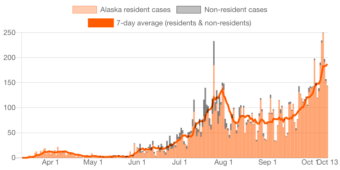
Alaska has reached another milestone of the COVID-19 pandemic with a single-day new case count of 355 people. This is, by far, the highest one-day increase in cases since the pandemic started.
The majority of the 13,535 people who have tested positive for the disease in Alaska have recovered; 68 people have died.
The new cases announced Saturday are spread across at least 28 communities but most concentrated in Anchorage, which saw 165 new people test positive. In Chevak, 42 new cases were identified and in Fairbanks 27 people tested positive.
News of the state’s jump in new cases comes a day after the U.S. announced a record high 83,757 new cases in one day. That’s according to data from John Hopkins University.
A Wall Street Journal analysis of that data shows a shift from earlier in the pandemic when there were generally higher case counts in metropolitan areas. Now the virus is spreading in rural and remote areas of the country that had yet to be hit hard by the pandemic.
The Anchorage Daily News reported Friday that state health officials are warning about the climbing numbers of patients hospitalized with COVID-19 — and the state’s inaccurate reporting of those figures.
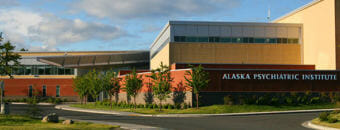
The Alaska Psychiatric Institute in Anchorage. (Photo courtesy Alaska Department of Health and Social Services)
Four patients at the Alaska Psychiatric Institute have tested positive for COVID-19.
In response, the state-run psychiatric hospital will not take any new patients for the next two weeks.
According to a Friday media release, the patients will be isolated from other patients and will be treated by fewer staff, to reduce the risk of exposure to the virus.
Staff will also be wearing N95 masks, eye protection, gloves and gowns, according to the release.
Eight people connected with the psychiatric facility, 3 staff and 5 patients, have tested positive for COVID-19 since the beginning of the pandemic.
According to the release, staff at the facility have attempted to keep the virus at bay by enforcing social distancing, screening employees and contractors for symptoms and requiring that all new patients have a negative test result before they’re admitted.
The state is seeing a surge of new coronavirus cases. On Friday, state health officials reported 242 new coronavirus infections, the second highest number of cases recorded in Alaska in one day since the pandemic began. The state has also reported triple-digit increases in new cases each day for the last month.
Scientists believe a massive glacial dam release recently occurred in Southeast Alaska. But, they probably would not have known about it if an observant local fisherman hadn’t tipped them off,
In the past week, the Yukon-Kuskokwim Health Corporation has announced more than 180 new cases of COVID-19 in Chevak, seemingly out of nowhere. How did such a large outbreak develop, and what’s being done in response?
Independent U.S. House candidate Alyse Galvin took some swipes at Republican Congressman Don Young at Debate for the State on Thursday. That debate continues Friday evening with candidates for the U.s. Senate: the Republican incumbent Dan Sullivan and independent Al Gross, running as the Democratic nominee.
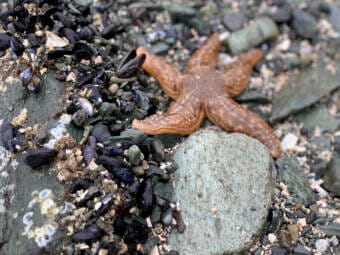
Blue mussels and sea stars clustered together on a beach on May 3, 2020, on Douglas Island. (Photo by Rashah McChesney/KTOO)
A lot of people know it’s not a good idea to eat shellfish in the summer. It has long been thought that eating shellfish this time of year is safer — but that’s just not true anymore.
Lindsey Pierce is an environmental technician with the Central Council of Tlingit and Haida Indian Tribes of Alaska. She’s based out of Juneau. And she’s the point person for their shellfish program.
That means part of her job is to go out to beaches where people are harvesting shellfish and gather some for testing. And they’re looking for a few different kinds: Cockles, butter clams, littlenecks if they can find them.
And they pry blue mussels off of the rocks — those are something of a super-filter, going through several gallons of water each day. Researchers say they can be an early warning sign that there are toxins in an area.
Sometimes, when she’s not working. Pierce heads back out to the beach to collect some for dinner. Generally, she’s looking for cockles and she has a lot of ideas about how to cook them.
“You can put them in the pan whole and then steam them open. Or, you can shuck them, you know, pry them open and get the meat out … it’s all in your preference,” she said. “You can do like a butter garlic sauce.”
Hungry yet?
Pierce isn’t. She laughed and said, “I collect them for my family, but actually, I don’t like eating clams.” It’s a texture issue.
So Pierce’s team collects samples from Point Louisa and Amalga — beaches in Juneau where they know people harvest shellfish. Other people in town have recommended they test Eagle Beach and Pt. Bridget too, but Tlingit & Haida hasn’t added those ones yet.
The shellfish samples that Pierce’s team collects get sent to a lab operated by the Sitka Tribe of Alaska. It’s part of a group called Southeast Alaska Tribal Ocean Research, commonly known as SEATOR. That lab tests shellfish for a group of 17 tribes in communities across the Gulf of Alaska.
“Each tribe has identified a beach or two that they feel their community members go to primarily for subsistence harvesting,” said Naomi Bargmann who runs the lab in Sitka.
She says the ultimate goal of the shellfish testing is to help tribes manage their resources. It’s a food security issue. But they also make the data available to the general public. And right now, they’re the only ones doing that. The state only tests commercially harvested shellfish.
Despite the regular testing, Bargmann makes it clear they are not certifying any beaches as safe.
“We never say a beach is safe because there’s always a risk when consuming wild shellfish,” she said.
You can’t cook or freeze the toxins out. You often can’t see the algal blooms that cause them. You can’t taste them, and sometimes shellfish from the same spot on the beach will have wildly different levels of toxins in them. It’s basically an invisible killer.
The data is meant to help tribal citizens, and others, make educated decisions about where and when they’re harvesting. There are some ways to be safer. First, all commercially harvested shellfish in the state are tested. So you can always just buy them. In fact, that’s what the state suggests doing.
If you do want to collect them for yourself, you can pay to send samples of your haul to the state’s lab. Or, for about $50, you can send them to the lab in Sitka.
The Sitka Tribe of Alaska’s lab put out its latest test results on Wednesday. Researchers are warning about toxins in butter clams harvested in Craig, Ketchikan, and Kodiak — and for all species they tested from beaches in Hoonah, Juneau
A report co-written by former Alaska budget director Donna Arduin ranks her former boss, Gov. Mike Dunleavy, as the second-worst governor in the country on what it calls “economic freedom,”
At least 38 people who are currently homeless in Juneau have tested positive for COVID-19 in the past two weeks. Now, with temperatures dipping below freezing this weekend, local shelters must weigh the risks of staying open or closing to slow the spread,
Reducing the size of the state’s ferry fleet was among the cost-saving recommendations from a work group looking to make the Alaska Marine Highway System more efficient. Now, the state is redoubling its efforts to sell its two fast ferries,
A data nerd in Juneau who likes digging through Alaska’s voter rolls found something strange: scores of apparently double votes in the August primaries, and one person who already appeared to have voted twice in the November general election.
So far, 64 Alaskans have died since the beginning of the pandemic.
In addition to the people who died, 144 more people were diagnosed with COVID-19 infections by Tuesday, including one non-resident of the state. Most of them from the Anchorage area where 102 people tested positive. But there are more than a dozen from the Fairbanks North Star Borough and scattered around 15 other communities in the state.
The state’s positivity rate — that’s the percentage of all coronavirus tests performed that are positive — is at 4.48% for the last week. That can be a measure of how fast the virus is spreading in the community.
State and federal health officials have said that anything over a 5% positivity rate can indicate that the virus is spreading undetected and communities may need to do more testing.
But, while the state’s average is below that threshold – some communities are well above it. State data shows that the Dillingham Census Area has a positivity rate of more than more than 16% (16.67%). While the North Slope Borough (11.21%), Denali Borough (14.29%) and Yukon-Koyokuk Census Area (11.11%) are all above 11%.
The Fairbanks North Star Borough and the Matanuska-Susitna Borough also have higher test positivity rates than that 5% threshold.
Medical officials reported that 56 people in the state are currently in the hospital being treated with COVID-19, or are waiting on test results.
Editor’s note: This story has been updated with more information about the people who died.
Close
Update notification options
Subscribe to notifications
Subscribe
Get notifications about news related to the topics you care about. You can unsubscribe anytime.