Juneau School District superintendent Glen Gelbrich will remain in his job for a while. He has not been selected to lead Kalispell Public Schools.
Gelbrich was one of five finalists for superintendent in the Montana community near Glacier National Park. He interviewed with the district’s education board earlier this week.
Cle Elum, Wash. superintendent Mark Flatau was the front-runner, according to the Daily Inter Lake newspaper in Kalispell.
Gelbrich said last month that he applied for the job because it would have put him closer to family.
He has been superintendent in Juneau since 2009 and last year signed a three-year contract with the Juneau School District. It expires in June 2016.
Meanwhile, Juneau teachers and the administration go into negotiations again Thursday. Teachers have been working without a contract for nearly a year and have unable to reach agreement.
The Juneau Education Association still hopes the district will agree to a raise, but has scaled back its proposal.
Dirk Miller is JEA spokesman. He says the latest proposal was presented to the district last week in what was described as a positive meeting.
Teachers have been picketing school board meetings this fall and even threatened a strike if efforts fail to produce an agreement. Their one-year contract, which included no financial increases, expired last June.
Miller says teachers are more positive as negotiating teams go into Thursday’s session.
“I can’t tell you how close, but we have come a lot closer. So we are moving, we are negotiating. I hope to see that same effort on the district’s side,” Miller says.
Calls for this story were not returned by district officials.
After several delays, the two sides await an arbitrator’s decision, due sometime next month. It will be advisory only.
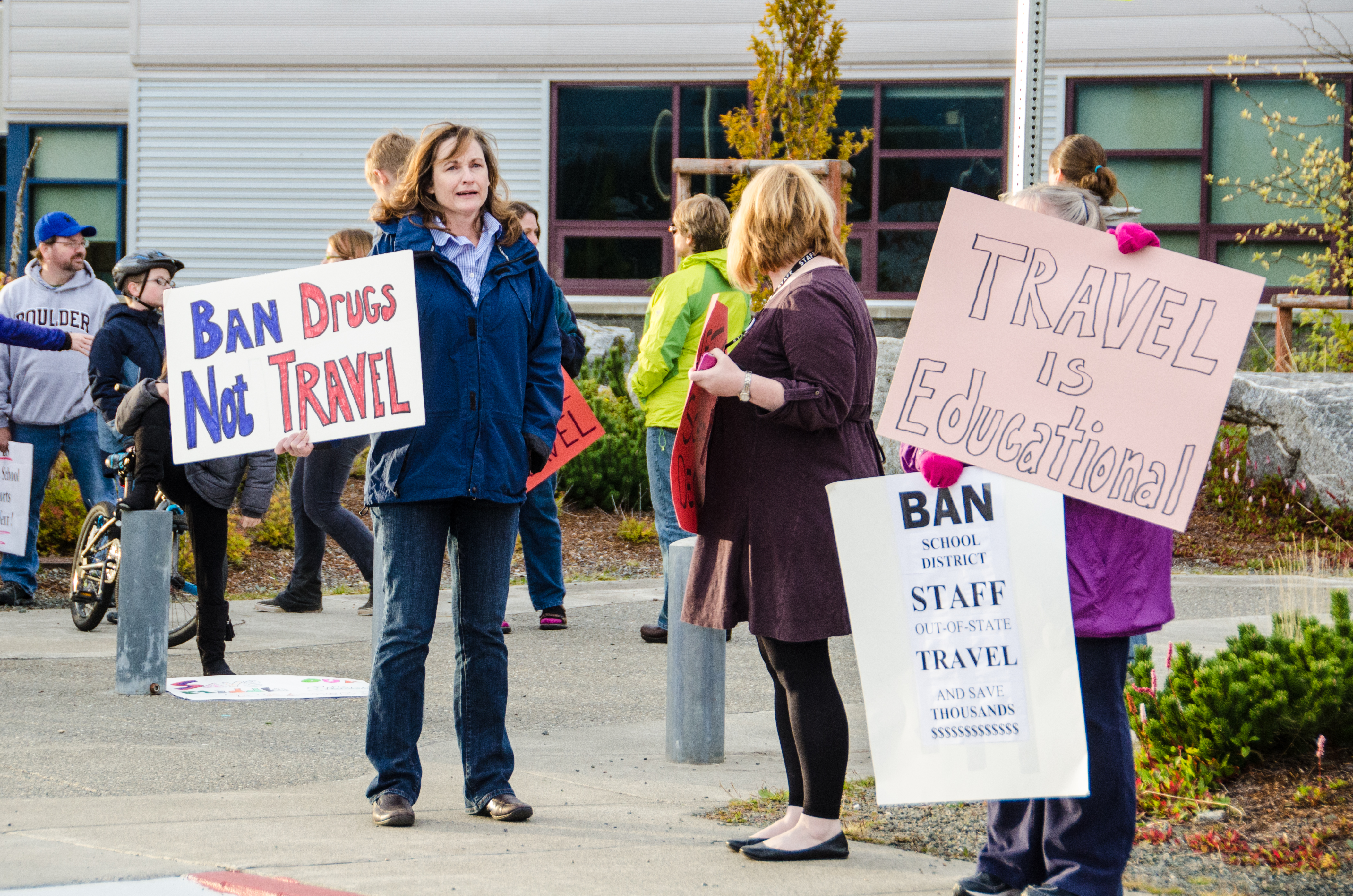
Students and parents protest the middle school sports travel ban during a school summit at Thunder Mountain High School in September. (Photo by Heather Bryant/ KTOO)
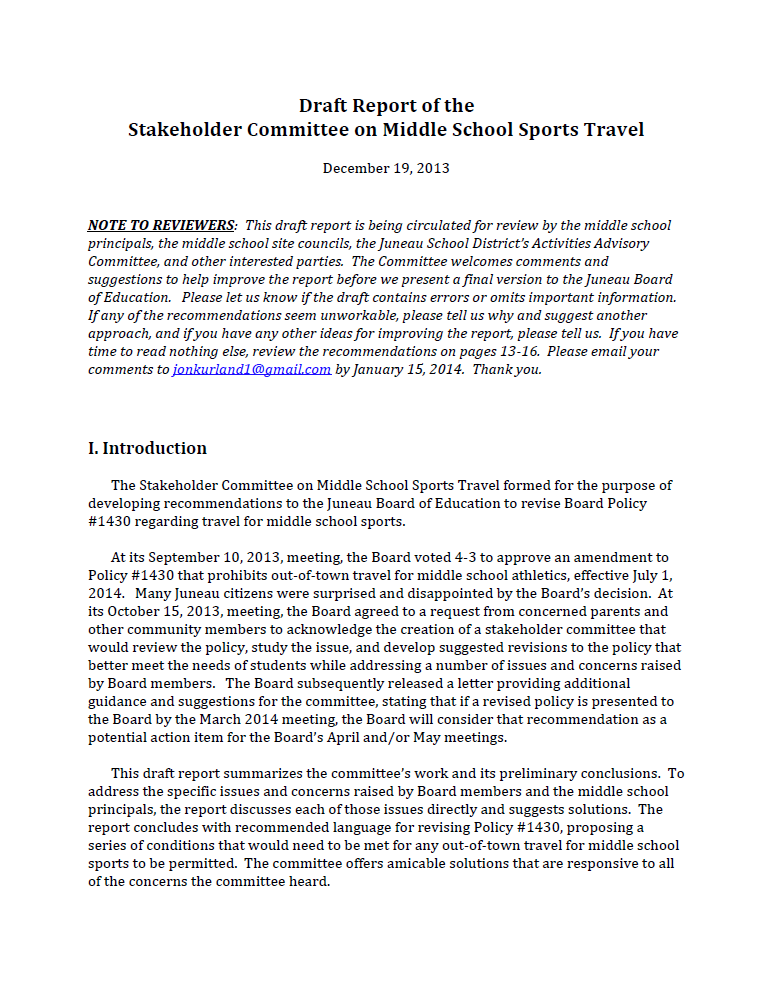
A community task force recommending middle school sports teams be allowed to travel is taking comments on its draft report.
The Juneau School Board in September voted to ban sports travel at the middle school level, prompting a public outcry and organization of the task force.
The group has researched the issue and come up with options that would allow 6th, 7th and 8th graders to travel outside Juneau for athletic competition.
Rhoda Yadao chairs the Floyd Dryden Middle School site council.
I hope the school board makes a decision that speaks the voice of the community.
From responses to the school board’s decision, it appears the public felt left out of the process leading to the policy limiting athletes’ travel at both Juneau middle schools.
So parent Jon Kurland organized the Stakeholder Committee on Middle School Sports Travel. The stakeholders included parents, teachers and coaches from Dzantik’i Heeni and Floyd Dryden middle schools as well as community members. It did not include any school board or district officials. When the committee formed, board president Sally Saddler said the school district had spent enough energy on the issue.
Dzantik’i Heeni has not allowed its sports teams to travel outside Juneau since the 2011-12 school year, while Floyd Dryden’s teams continue to compete with other Southeast Alaska schools. The new policy is to take effect next fall, putting Floyd Dryden on par with DZ.
Kurland said the committee tried to address concerns raised by school board members and principals at both schools, and offer solutions.
“And the hope is that both the principals would be able to get behind this or whatever the final version is and say OK there’s a reasonable set of conditions here and we can live with that and those are reasonable side boards to put on the rules allowing out of town travel.”
Last week Kurland took the draft report to each school’s site council for input. Yadao says she knows the Floyd Dryden site council will wholeheartedly endorse the committee’s options when the report is finalized.
“We’ve supported our travel teams. You know we live with the motto ‘no child left behind,’ that if there’s funding that ‘s needed for a child who financially can’t go that there are means, whether it’s the sports activity itself and its members, or the families of students in that sport, to contribute to allow for all students to be able to travel,” Yadao said.
The report suggests the Floyd Dryden travel policy would be a good model for the board to follow.
It recommends principals limit the cost per student for travel, as well as the number and length of trips.
Floyd Dryden teacher Molly Box was part of the Stakeholder Committee. She says it’s important the public understands that travel is not restricted to the best players.
“Traveling opportunity is for all kids regardless of skill level and regardless of economics. So that all kids can fund raise, we make sure that teams fund raise together as much as we can,” Box said.
With budget cuts, both schools have lost office staff, making travel logistics more difficult to coordinate.
The report offers several options to address the problem, including the most obvious – that the district could handle middle school arrangements as it currently does for some high school activities.
Kurland also took the report to the district’s Activities Advisory Committee, which did not endorse the ban, though the school board last fall said it had.
“That couldn’t be farther from the truth,” said long-time coach Tom Rutecki.
He has been an AAC member since it was formed in 2008. He said the group is adamant the school board retract its statement. But he also said the district should develop a philosophy for middle level sports programs before it comes up with a new travel policy.
School district athletic director Sandi Wagner said most middle school sports polices are based on high school athletics, and the belief is the younger students should be involved in more developmental than competitive programs.
“We need to come up with philosophy and guidelines for middle school activities,” Wagner said. “Probably the most important things about it is the concept that all kids should be involved and there should be a no-cut policy. ”
Wagner said an AAC subcommittee is just beginning to work on the middle school guidelines.
Meanwhile, Wednesday is the deadline for comments on the Stakeholder Committee’s report. Kurland plans to present the final recommendations to the school board next month.
The body of a 57-year old man was found on a trail Thursday between Switzer Village Trailer Park and Dzantik’i Heeni Middle School, according to Juneau police.
Lt. Dave Campbell says the body was discovered by a man walking on the wooded trail. He says the witness called police and took officers to the area.
From the condition, it looks as though the person had probably been there for a while. The preliminary investigation doesn’t show any kind of foul play to the person’s body.
Campbell says the body was identified as Juneau resident Hoyt Edward Galvan.
He says police are investigating the death. Galvan’s body has been sent to the state medical examiner’s office in Anchorage for an autopsy.
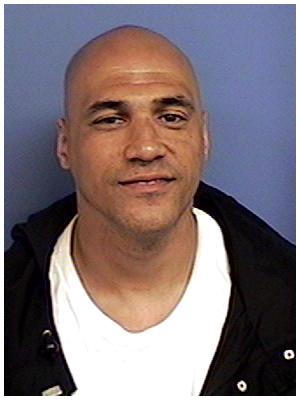
Juneau police are searching for Derek McMillan, who has a criminal history.
Juneau police are still looking for a 39-year-old man who walked away from a Juneau halfway house earlier this month.
Police say Derek McMillan left Gastineau Human Services Halfway House on Aisek Street on Jan. 3.
He reportedly ran to Glacier Highway in the direction of Grants Plaza.
Police say McMillian left the facility against staff instructions. He had possibly taken drugs in a bathroom.
McMillian’s criminal history in Alaska and Florida includes drug offenses, robbery, vehicle theft, and assault, according to police. His nickname is “Kilo.”
Police describe him as 6 feet tall, about 225 pounds, and Hispanic. He was last seen wearing blue jeans, a green sweatshirt and a gray hooded sweatshirt.
Police say if you see McMillan, do not approach him. Instead, contact the Juneau Police Department immediately at 586-0600, or the Juneau Crime Line website.
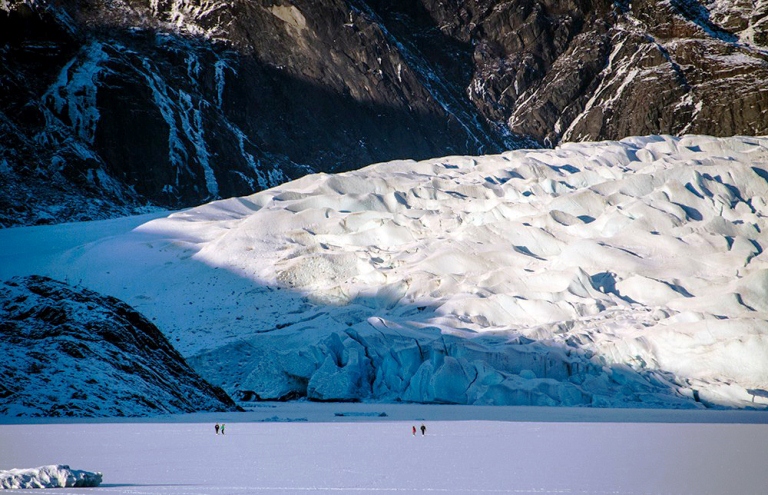
People on the ice in front of Mendenhall Glacier. (Photo by Heather Bryant / KTOO)
Juneau’s fickle winter is prompting lots of warnings to stay off lake ice. And on Saturday, Capital City Fire and Rescue and the Forest Service will hold ice safety training at the Mendenhall Glacier.
Events this winter at the glacier show just how unstable ice can be.
Rocks are sliding off Mount Bullard, Mendenhall Glacier is constantly calving, and Juneau has been in a freeze/thaw weather pattern for weeks.
The natural events that happen just tend to make that ice very unsafe.
Capt. Dave Boddy says it could even be a lethal combination.
Boddy is a first responder when someone falls through the ice in Juneau, a place with lots of lakes and ponds and opportunities to venture out during the winter.
He also understands the events that make ice unsafe.
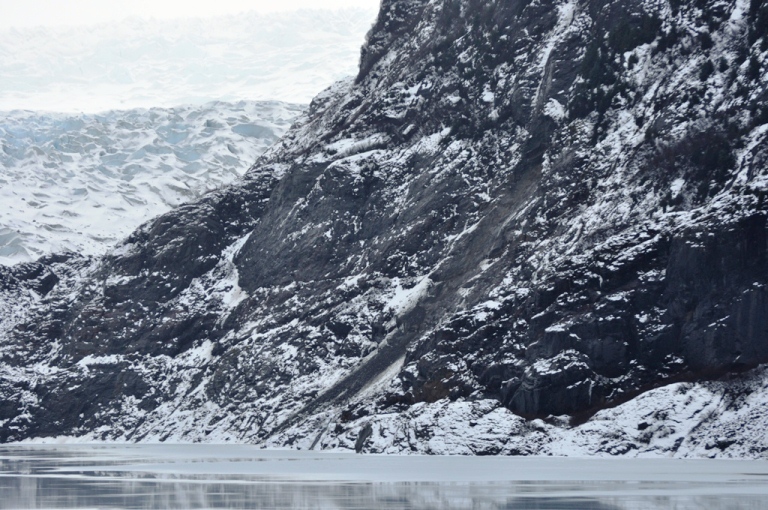
Like a recent rockslide down Mount Bullard near popular Nugget Falls.
The scar down Mt. Bullard from a recent rockslide. Photo courtesy of Laurie Craig, U.S. Forest Service.
Forest Service Naturalist Laurie Craig first spotted it late last week through the telescope in the Visitors’ Center observatory.
“This is just so obvious on the landscape, which is just sort of speckled with white and dark, and there’s this huge gash just right down, sliding down Bullard mountain,” and onto the ice, Craig says.
Another Mount Bullard landslide in late November actually created a tsunami under the ice.
University of Alaska Southeast Geologist Cathy Connor says this year’s freeze / thaw, rain/ snow cycle is compounding Mount Bullard’s rock slide activity.
“If you dump water into rock fractures and then freeze it, it acts like a hydraulic jack. So you do that over a lot of seasons for a long period of time, it doesn’t take much to set it off,” Connor says.
Then there are the ice bergs. Naturalist Craig often sees skiers and skaters approaching the beautiful blue bergs, though like the glacier, those bergs are always on the move.
“So even though they’re frozen into the lake, there are still changes happening because they are thawing underneath the lake ice in the water,” Craig says, “because there’s still a current flowing.”
So what do you do if you ski into an open hole of water under the snow and fall through the ice?
That’s one of the questions Capital City Fire and Rescue’s Captain Boddy and Captain George Reifenstein will answer during Saturday’s workshop.
“What are you going to feel? How long do you have that you muscles and your body is continuing to work and kind of do what you want it to do and what are the best techniques for either getting out of the hole or staying alive in a hole until somebody gets you,” Reifenstein says.
The water under that ice is likely to be in the mid to low 40s this time of year.
With the recent warming trend, Reifenstein says there are about 3 to 4 inches of slush on Juneau-area lakes. The ice underneath varies in thickness.
“I was auguring Auke Lake over the weekend and under the slush there was probably five inches of ice in the place that I augured,” he says. “But over at the glacier near the Visitors’ Center we went down through a foot of ice, under 4 inches of slush.”
Capital City Fire and Rescue’s ice rescue team was formed in 1992. Reifenstein and Boddy have been training and teaching others about ice safety ever since. Boddy says people often assume Mendenhall Lake ice is really thick because it’s in front of the glacier, but that’s not the case.
“One of the biggest fears we have is the instances that have traditionally happened in other parts of the country where people fall through the ice and other people try to go out and rescue them and they end up becoming victims themselves,” Boddy says. “That’s one thing we’re really trying to avoid is compounding the situation by getting more people stuck in the ice.”
Saturday’s ice safety training will start inside the Visitors’ Center and include video from Canadian researcher Dr. Gordon Geisbrecht, also known as “Dr. Popsicle” for his cold water immersion studies.
Then the Juneau team will move outdoors for an actual rescue from an icy pond next to the Visitors’ Center. The guinea pig from CCFR will be wearing an immersion suit. That’s usually not the case when most people fall through the ice.
Saturday’s ice safety training begins at 1:30 p.m. at the Mendenhall Glacier Visitors’ Center. The event is free.
(Editor’s Note: An earlier version of this story said the event begins at 11:30. It actually begins at 1:30 p.m. The story has been updated to reflect the actual time of the event.)
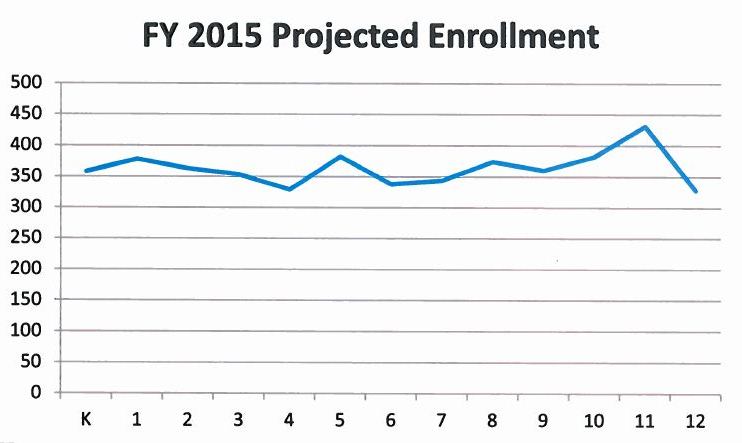
Juneau School District projected enrollment by grade. The estimate is 4,790 students. Actual students are counted in October. Graph courtesy Juneau School District.
A 17-member budget committee has begun crafting the Juneau School District spending plan for the next year.
The committee met Tuesday for the first time. It will meet six times over the next two months and produce a final report by March 4th. That report will contain committee priorities for the district.
The super-sized committee represents all school site councils, education unions, and the community. Juneau School Board member Phyllis Carlson chairs the group, and all members of the board will attend each meeting.
With a decline in the number of students, the school district is projecting about a $3 million deficit for the next fiscal year, especially if the Base Student Allocation remains the same.
Alaska school operating dollars are allocated to each district through the BSA, an amount for each student enrolled. It has not increased over the last three years, and Gov. Sean Parnell’s budget recommends flat funding.
It will be April — when the state legislature adopts the state budget — before the district will know how much state funding to expect.
To build a budget, districts must forecast enrollment for the following school year, though the actual number of students isn’t known until October. Juneau’s count was lower this fall than projected and the district lost state revenue. Some of the loss was offset by a carry-over from last-year’s budget.
Budgeting for next year is complicated by difficult negotiations with teachers, who are working without a contract. The district has proposed no increase, while the teachers union is asking for a cost of living raise over the next three years. An arbitrator’s advisory opinion has been delayed until February.
Close
Update notification options
Subscribe to notifications
Subscribe
Get notifications about news related to the topics you care about. You can unsubscribe anytime.