Juneau Meteorologist Tom Ainsworth calls the cold blast from Canada an “Alberta Clipper.” But the upper Midwest is certainly no stranger to cold air.
“The severity of the cold and the strength of the wind delivering it was really a difference and a headline maker this time,” Ainsworth says.
Meanwhile, Juneau’s weather pattern isn’t expected to change anytime soon.
We’re locked into warm rain.
The forecast calls for Juneau temperatures to remain in the mid to upper 30s through Sunday. That means rain at sea level.
“The cold air that’s making all the headlines back east has to retreat father north again and then the whole northern hemisphere pattern will change somewhat,” Ainsworth says, “but until that changes, we’re unusually warm just like they’re unusually cool.”
It’s so cold in Kentucky that an inmate who escaped a minimum security prison turned himself into police. He said it was too cold for a getaway.
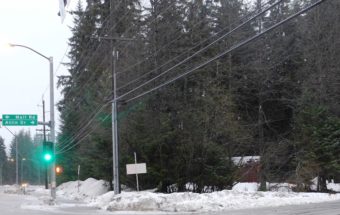
The two-acre parcel was once owned by the U.S. Forest Service. It’s been a buffer between busy Mendenhall Loop Road and Atlin Drive residents, who oppose a zone change to light commercial.
The old adage, “the third time’s the charm” didn’t work for Juneau developer Richard Harris, so now he’s working on his fourth attempt to get property he owns on Atlin Drive rezoned.
The Juneau Assembly on Monday afternoon will take up Harris’ appeal of a Planning Commission decision denying a change from residential to light commercial.
The Planning Commission first denied the rezone in 2011, because it doesn’t comport with the city and borough’s comprehensive plan for the area. Harris appealed to the Assembly and won – temporarily. The action was rescinded when the city attorney found it was illegal.
In 2012, he received a CBJ Conditional Use Permit to build 22 residential units on the two-acre parcel, with Duck Creek running through it. Soon after, he asked the city to amend the comprehensive plan for the area, which was rejected.
So Harris went back to the Planning Commission last fall with another request to rezone the parcel to light commercial. Commissioners denied it again, based on the comprehensive plan. Harris appealed to the Assembly.
The Assembly will hear both sides today at 5 p.m. in Assembly chambers at city hall.
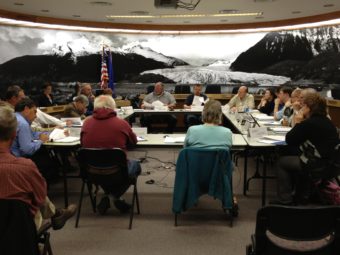
The CBJ Assembly and Planning Commission met in joint session in October to work on the noise ordinance. (Photo by Lisa Phu/KTOO)
Noise is the top issue on the agenda at Monday’s regular Assembly meeting.
A rewrite of CBJ’s Disturbing the Peace code has been in the works for years. The version now before the Assembly clarifies the intent of the ordinance, which is to prohibit “unreasonable noise.” It also defines unreasonable noise.

One of those unreasonable noises could be the tunes coming from a vehicle. The proposal makes it illegal for a person to blast any sound, music or vibration from a vehicle that can be heard 30 feet or more from that vehicle – at any time of day or night.
A previous version made the noise unlawful from 10 p.m. to 9 a.m., but the Assembly Committee of the Whole last month removed the time frame.
Here’s member Jerry Nankervis’ argument for keeping the hours in the law:
“I think we need to be consistent with our times,” Nankervis said during the December COW. “If we say you can blast it from your house, the neighbors have to hear that as well, even though I’m not driving by with my house. So in order to maintain consistency, we should leave that in there.”
But member Jesse Kiehl said it’s precisely because a car is on the move that it should be unlawful to play “obnoxious” noises at any time.
“I can go over and talk to my neighbors if the music’s too loud. There was a low-power station when my kids were very little and I would go over and talk to them at 10-something at night about the live drum performances. And you know, it took some neighborly interaction a couple of times, but by-golly we got ’er fixed,” Kiehl said. “I don’t have any way to do that when the car goes rolling bay and shakes the windows and wakes the children. I can’t go say ‘would you mind turning it off’ because they’re gone.”
The Assembly will take public testimony tonight during a hearing on the noise code. The meeting begins at 7 p.m. in Assembly chambers and can be heard live on KTOO-FM.
Juneau police say Dustin Daley and another man left the scene of a Jan. 1st assault in this truck. Police are still looking for the second man.
Juneau police are looking for a man and a gun allegedly used in an assault and robbery earlier this week in the Costco parking lot.
One man is in custody for the New Year’s Day incident in which a 20-year-old man was reportedly stunned by a taser, punched and robbed.
Twenty-nine-year old Dustin Daley has been jailed on charges of 1st degree robbery, two counts of 4th degree assault and one count of theft in the 3rd degree.
Police are still looking for another man, who was reportedly wearing a dark hooded sweatshirt, a black mask with the skull on it, and had a handgun.
Police say Daley and the unidentified man were in a four-door silver Dodge pickup with a broken driver’s side window covered in plastic. Police later found the truck and Daley as well as a Crown Royal bag containing what may be heroin, a white powder that may be another illegal drug, a marijuana pipe and marijuana. The mask was also recovered from the pickup.
Police did not release any information about the incident until Friday. They are asking for assistance in identifying the man with Daley.
They say anyone with information should log onto the Juneau Crime Line website and report their tip.
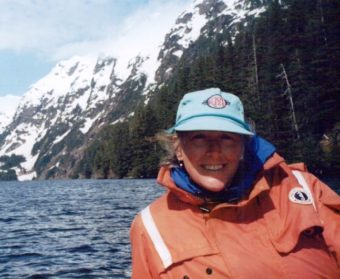
Juneau District Ranger Marti Marshall is retiring after 35 years with the Forest Service. Photo courtesy Marti Marshall.
After 35 years with the U.S. Forest Service, Juneau District Ranger Marti Marshall is retiring Friday.
She says January is a good time to step down and embark on other adventures from the work that has encompassed “all my dream factors in a job, including wilderness, outfitter guide issues, tourism, recreation.”
Marshall began her adventures with the U.S. Forest Service as a firefighter in Fish Lake National Forest in Utah.
“This was the late ’70s and it was a really interesting job because they weren’t really ready to have women in the workforce, but they were doing it,” she says.
She went on to Columbia River Gorge National Scenic Area as a backcountry ranger. Marshall says she grew up in that job and over the next 30-plus years bounced between the Pacific Northwest Region and the Tongass National Forest. She’s worked in regional offices and out in the field.
“And I think that’s worked really well for me, because I know what they do upstairs now,” she says, with a laugh.
Marshall’s Forest Service career included 13 years in the Sitka Ranger district, but her first job in Alaska was in Juneau as a recreation technician “in charge of campgrounds, cabins, trails, roads, facilities, just kind of the do-all recreation person.”
About four years ago, she came back to Juneau as ranger for Admiralty Island National Monument. When long-time district ranger Pete Griffin retired, she applied for that job.
She calls it the hardest and best of her Forest Service career.
Marshall has shared the district with Chad Van Ormer, now Admiralty Monument ranger, who will be interim district ranger until Brad Orr takes over on February 24th. Orr comes from the Sulphur Ranger District in Colorado’s Arapaho-Roosevelt National Forest.
According to Marshall, Orr’s experience will fit well in the Juneau Ranger District.
“He’s got a great background in a really big recreation district with marinas, concession campgrounds, a ski area, four wildernesses, a lot of recreation, special use permits,” she says. “I’m curious to see what he’ll think coming to Juneau Ranger District, because we think we’re overwhelmed with use and recreation issues.”
Like all Forest Service budgets, the district is facing major cuts. Marshall says 2014 will be a telling year for the Juneau Ranger District:.
“This coming year, recreation is down 14 percent, our facilities money is, I think, down 24 percent, trails is down slightly, maybe 5 or 7 percent. But the demands don’t stop just because our budget goes down,” she says. “We’re all a little stunned with the budget.”
Orr will face other revenue issues, including managing fees. For example, entrance fees to the Mendenhall Glacier Visitors Center have not gone up since 1999, when they were first established. Marshall says fees also need to increase for district cabin use.
While the budget is going down, with all its ramifications, the commitment by the district staff hasn’t, Marshall says. She is leaving a group of people she calls “amazing, phenomenal.” She says her successor will benefit from all their experience and their ability to work together to manage the largest ranger district in the nation.
Flu shots in Alaska public health clinics will be free through March.
While the vaccine itself is free to some Alaskans, they are still required to pay a $28 administrative fee. That fee will now be waived.
Spokesman Greg Wilkinson says the state Division of Public Health hopes it will encourage more people to get immunized. He outlines who is eligible:
“State supplied flu vaccine is available to children under the age of 3 and anyone who’s 3 and over that doesn’t have health insurance, who’s health insurance doesn’t cover vaccines, who has insurance but they haven’t met their deductible for vaccination coverage, if they don’t know if their health insurance covers vaccinations or not, or if they just have nowhere else to go in the community to receive the vaccine, they can come to a public health center,” Wilkinson says.
Both shots and the nasal spray vaccine are available at any of the state’s 22 clinics, including Juneau, and at other health centers that receive state grants.
At the end of December, 242 cases of the flu cases had been reported statewide. While Wilkinson says that’s similar to years’ past, flu season didn’t really start in Alaska until December.
He says two adults have died from the flu.
Until Dec. 29th, Alaska health care providers were required to only report children’s deaths to the state from the flu. Now they must report adult flu deaths to state public health. Before the regulations changed, Wilkinson says adult flu statistics were lumped in with pneumonia.
“So if you looked at death statistics on our website you would only see people who have died from what they call PNI, or pneumonia and influenza. What this will do now, is this requires health providers to report any adult who dies from influenza, and whether that’s they’ve had a lab confirmed case of influences, a rapid test confirmed case or influenza or the clinical diagnosis is influenza,” Wilkinson says.
The current strain is H1N1, also called swine flu. Wilkinson says so far, no children have died in Alaska from the flu.
Close
Update notification options
Subscribe to notifications
Subscribe
Get notifications about news related to the topics you care about. You can unsubscribe anytime.