Rosemarie Alexander

A look back at 2013 in Juneau

2013 included turmoil at Bartlett Regional Hospital; failed negotiations between Juneau teachers and the school district, and memorable summer weather.

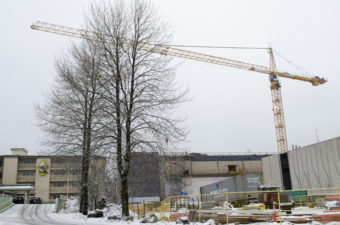
Juneau residents can see progress every day on the SLAM project. Photo by Sarah Yu / KTOO.

The year began with a ceremonial groundbreaking for the largest project to be built in the capital city in years.  The State Libraries, Archives and Museum, or SLAM, will house Alaska’s treasures in one building.  In early March, the 160-foot tower crane was put in place and Juneau residents can see progress every day.

In June, the ribbon was cut on three more miles of road north of Juneau, when Glacier Highway was pushed from Echo Cove to Cascade Point.  The extension was paid for with state funds.  Gov. Sean Parnell’s budget proposal for next year includes $35 million in state and federal funds for the Juneau Access project.

Also in June, the state of Alaska said new cubicles would replace some Juneau offices, prompting a union grievance. Many state workers said they couldn’t cram all their gear in the smaller space.  Arbitration is planned between the Alaska State Employees Association and the state on the so-called universal space standards.

No controversy here:  Juneau and the rest of Southeast Alaska had a great summer.  Rainfall in August was nearly an inch below normal. National Weather Service Meteorologist Joel Curtis says that was the downside.

You think about how the ecosystems work in Southeast Alaska, you really do want that normal rainfall and you do want it on the cool side, if nothing else than for our salmon spawning. 

Early this fall, most of the Bartlett Regional Hospital administration team resigned, amid allegations of a hostile work environment created by senior management officials.  The Human Resources Director, Chief Executive Officer, and Chief Financial Officer were hired after the hospital board ditched its long-term management company in 2012. Now an interim CEO is trying to establish better communications and a more stable work environment for hospital staff.

The Southeast Alaska Regional Health Consortium threatened to close Juneau’s Front Street Clinic for homeless and other low-income residents in October.   The agency blamed it on revenue shortfalls.

It didn’t take long for local social service organizations to raise funds to keep the clinic open.  When SEARHC gives up management in May, a new group will run the Front Street Health Center.  The group says it will be able to provide the same medical, dental and behavior health services as SEARHC, for less money.

Skiers get on Hooter chairlift Sunday at Eaglecrest.

A social media contest for best ski area in North America put Juneau’s city-owned ski area on the map.  In late October, Powder Magazine included Eaglecrest in its Ski Town Throwdown.  Eaglecrest became the “little mountain that could,” getting more Facebook votes than every winter resort it was paired against, until the end when it was runner up to Colorado’s Crested Butte.

Ski area GM Matt Lillard said everywhere he went, people were abuzz about Eaglecrest.

The exposure that we’re getting across the social media spectrum on Facebook , Instagram, and Twitter, as far as reaching down south and other areas, not just in Juneau, has been great.

Juneau teachers ended the year without a contract. The Juneau Education Association and school district have been negotiating for 11 months.  Mediation failed, and in October the two sides moved to arbitration.  They await the arbitrator’s opinion, which will be advisory only.  Teachers have authorized the JEA executive board to schedule a strike vote if bargaining efforts fail.

Winter driving class is Jan. 6

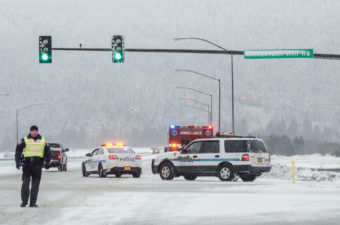
Police blocked the right lane of traffic at the intersection of Egan Drive and Vanderbilt Hill Road. (Photo by Sarah Yu/KTOO)
Police blocked the right lane of traffic at the intersection of Egan Drive and Vanderbilt Hill Road earlier this month after a two-car accident. Photo by Sarah Yu/KTOO

Juneau has had lots of winter driving already this year. If you or your teenage driver have had a close call – or just want some winter driving tips — you may want to attend this APOA  class.

This is the third year the Capital City Chapter of the Alaska Peace Officers Association is sponsoring the winter driving class, geared especially for teens, though all are welcome.

Lt. Kris Sell says the program is back by popular demand.

We have had some parents express to us that  it’s hard for them to convince their children of certain things and they would like to take their teenager to someone who actually studies the physics of vehicle accidents,” Sell says. 

Speed limit is a major issue and officers often find that teenage drivers don’t relate speed limit to conditions.

They believe that somehow the speed limit is a number that is stand alone, divorced of the environment, when in fact the speed limit is the maximum you’re allowed to go when conditions permit,” she says. 

While there won’t be any actual driving time during the class, Sell says pictures and the anatomy of Juneau accidents can tell a powerful story.  The class will be taught by Accident Investigation Specialist Sarah Hieb, a training coordinator for the Alaska Police Standards Council. For years, Hieb investigated and reconstructed accidents for the Juneau Police Department.

“When we would have accidents that were serious she would go out to look at the scene to tell us what happened.  She is very knowledgeable of the math and physics involved and the behavior of vehicles,” Sell says. 

JPD school resource officer Blain Hatch is also an instructor.  He knows a lot of young drivers in Juneau high schools.

At this point in the winter maybe people have had a few close calls and thought, ‘You know, that  trip to school or that trip to work was pretty nerve wracking.’ So maybe we can talk a little bit more about why that happened and what’s going to change the behavior of your car or not.  Are studded tires really worth it, how should you be braking, how should you be steering when something goes wrong?” 

The winter driving class will be held on January 6th     from 6 to 8 p.m., at JPD.  It’s free and no reservations are needed, but Sell says previous classes have been packed.


Food safety tips for holiday dining

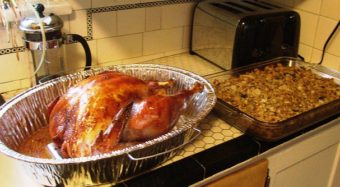
Stuffing can grow bacteria quickly if it's not properly handled. Photo by edgeplot, Flickr.
Stuffing can grow bacteria quickly if it’s not properly handled. Photo by edgeplot, Flickr.

Don’t invite Clostridium Perfringens  to your holiday dinners.

This foodborne illness is one of the most common and least known.  The Alaska Food Safety and Sanitation Program  says it’s a good idea to learn more about it before it becomes an unwelcome guest.

Program director Kim Stryker says Clostridium Perfringens  is typically associated with improper cooling of cooked food.

“Sometimes when you’re cooking for groups, you’re doing a lot of prep ahead of time, and you’ve got large containers or pots that you’re working with, maybe a soup, or a gravy, or stuffing or that kind of thing,” she says.  “When you cool it down, you want to make sure that you have it separated out into shallow containers,” she says.

Put those uncovered containers in the refrigerator right away.

“Leave the lids off until it’s been cooled down properly, so you’re not retaining heat in the containers.  People often think, ‘Oh, just leave it on the counter until it cools so you don’t warm up the refrigerator.’  It’s best to put it right in the fridge uncovered and once it cools down in those shallow containers then put your lids on,” she says.

Bacteria grow fastest between 40 and 140 degrees Fahrenheit.  Stryker advises throwing out food left at room temperature for two hours or more.

Cross-contamination of foods is another source of illness that many cooks don’t think about.

“So in other words, keep things separate.  If you are working with raw poultry or raw meat, make sure that you’re washing your hands and changing out cutting boards or utensils before working with things that are not going to be cooked, maybe a salad or appetizers or something like that,” she says.

Doing a buffet?  Keep hot foods hot and cold foods cold.  And the next day, reheat the  leftovers to at least 165 degrees.

ALWAYS:  Wash your hands when preparing food.


Middle school sports travel task force on schedule for recommendations

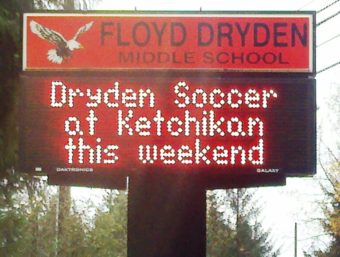
Floyd Dryden Middle School athletes continue to travel to games this school year.  That will end next year unless the ban is modified.  Photo by Rosemarie Alexander.
Floyd Dryden Middle School athletes continue to travel to games this school year. That will end next year unless the ban is modified. Photo by Rosemarie Alexander.

A community task force on middle school sports travel expects to have draft recommendations finished by the end of the month.

The group is called the Stakeholder Committee on Middle School Sports Travel, chaired by parent Jon Kurland, whose children are out of middle school and would not benefit if policies changed.

In September, the Juneau School Board imposed a ban on all travel for middle school athletes, to go into effect next year.  Dzantik’i Heeni Middle School eliminated sports travel last year. The board’s action extended it to Floyd Dryden students.

Kurland asked the board to create a committee to look at the policy, but the board said it would not be involved. The task force is comprised of parents, district officials, teachers and coaches.

Instead, the board will consider recommendations from the committee in the spring.

Kurland told school board members Tuesday he plans to have a draft to middle school principals and site councils in January.

“We want to get feedback from additional folks. They will doubtless point out areas that can be improved. We will make those improvements, we will build in that feedback and then we will come back to you with a final report, most likely in February,” Kurland said.

In an interview with KTOO, Kurland addressed what he called a misconception that school district funds are used for middle school travel.

“There are appropriated district funds that are used for travel at the high school level, but at the middle school level they’ve relied on fundraising for a long time,” he said. “There are some ancillary costs. There are costs of substitute teachers when the teacher coaches travel, and classes need to be covered. There are staff costs in just making the arrangements for travel and the logistics and so forth.  I don’t mean to suggest there’s no cost at all, but the actual cost of ferry tickets and what have you is not something the district’s been  paying for in the past.”

Kurland said the task force is following the school board’s direction to get the report and recommendations to members in time to take action at the May meeting – that’s if they agree the policy banning middle school sports travel should be changed.

Juneau teachers picket school board meeting

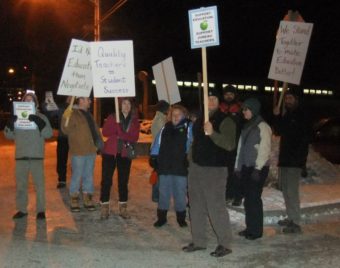
Teachers greeted Juneau school board members Tuesday as they entered JDHS for their monthly meeting.  Contract negotiations are at a standstill.  (Photo by Rosemarie Alexander/KTOO)
Teachers greeted Juneau school board members Tuesday as they entered JDHS for their monthly meeting. Contract negotiations are at a standstill. (Photo by Rosemarie Alexander/KTOO)

Juneau School Board members had to walk through a picket line to get to their meeting Tuesday night.

Teachers waived signs and sang union songs to show their solidarity for a new contract with the school district.

The Juneau Education Association and school district are in the 11th month of negotiations; frustrated teachers have grown louder at each school board meeting.

Small groups of teachers also greeted cars entering JDHS driveway. (Photo by Rosemarie Alexander/KTOO)

Smaller groups gathered at the driveway entrance to Juneau-Douglas High School, while many more assembled at the front doors.

Physical education teacher Dirk Miller is JEA vice president.

We’re here to greet the school board members.  Let them know that we have solidarity, we are united.

Then teachers filed into the meeting, carrying signs with such slogans as “I’d rather educate than negotiate.”

They are working for the second year on a one-year contract that did not include raises.

Amy Jo Meiners was the first to speak.  She’s been teaching in the Juneau School District since 1989 and reminded board members that they drastically reduced the travel budget for this year to save money.

“I’m not sure if travel expenditures are just so buried that you don’t see them, but I would like to suggest that the amount of travel for this past year alone could have paid for more than a 2 percent COLA,” Meiners said.

JEA is asking for a three-year contract with a 2 percent salary increase this year, 3 percent in the second and 2 percent in the third year.

It’s statements like Meiners’ that will be addressed in a work meeting this afternoon with negotiators from both sides.

Superintendent Glenn Gelbrich said the union thinks it has found pots of money in the budget that can be used for raises, but that’s not the case.

“Whomever is doing the budget analysis for JEA has suggested that there’s four million dollars out there for salaries.  And what we want to do is to take them back into the budget, clarify what those budget categories are for, so we can be talking apples to apples and making sure that we are understanding the facts in the same way,” Gelbrich said.

District officials say the teachers’ proposal would cost more than $10 million.

JEA SIGNS
Dozens of people turned out for the picket. (Photo by Rosemarie Alexander/KTOO)

JEA’s Miller said the union doesn’t agree with the district’s numbers.

“I’m trying to think of what numbers we do agree with, and I don’t know,”  Miller said.  “So that’s what this meeting is going to be about.  To really talk about the numbers, settle some of the differences, I hope. We’re very positive.”

But Gelbrich told the board there’s not much positive about the amount of state revenue expected to flow to the district next year.  Gov. Sean Parnell is proposing another year of flat funding for Alaska schools.

“So the base student allocation we had last year would be the base student allocation we have this year and he’s proposing it will be the base student allocations next year and fiscal year 16, so the following year,” Gelbrich said.

The Base Student Allocation is the amount of money per student each district gets from the state to operate schools. The legislature could increase it, but the last two years lawmakers have stuck to the governor’s proposal.

Meanwhile, JEA and the district await an arbitrator’s advisory opinion, due in mid-January.  Post-arbitration briefs, submitted earlier this month, show just how far apart the two sides are.

Gelbrich makes short list of candidates for Montana job

Glenn Gelbrich
Superintendent Glenn Gelbrich

Juneau superintendent Glenn Gelbrich has reached the second round in the selection process for a new superintendent of the Kalispell, Montana school district.

The Kalispell Public Schools Board of Trustees on Tuesday night narrowed the list of candidates from nine to five, according to Daily Inter Lake reporter Hilary Matheson, in an email to KTOO.  Interviews are scheduled on Jan. 13th and 14th.

Gelbrich came to Juneau in July 2009 from Oregon, where his wife and family still live.  He says the Kalispell job would put him closer to family.

“I think part of the reason for participating in the process is so that you understand the position very, very well and  you know what the work is, because you want to make sure that’s the work that you want to do,” Gelbrich says. “So if it were offered and if I understand it well enough and it feels like it’s a match, then yeah, otherwise I’m wasting their time.”

Gelbrich signed a three-year contract with the Juneau School District in March. It expires in June 2016.

He is currently making $155,000 a year. The Kalispell job was advertised at $125,000 plus benefits, depending on experience.

Site notifications
Update notification options
Subscribe to notifications