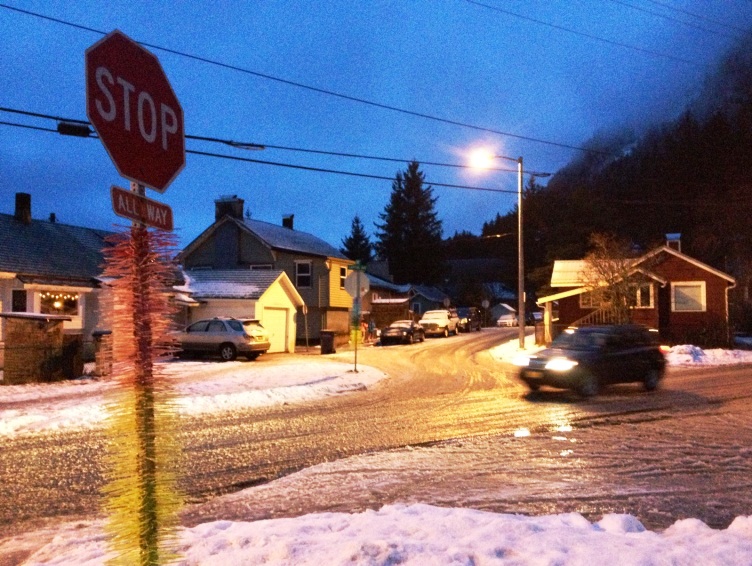
Juneau’s slushy streets will get messy with the new snow. Photo by Lisa Phu / KTOO.
A winter storm warning has been issued for Juneau through Thursday afternoon. Forecasters say the strength of storm depends on an Arctic front in northern Lynn Canal.
National Weather Service Warning and Coordination Meteorologist Joel Curtis says the Klondike area could get clobbered and Juneau could even see a lot of snow.
“The National Weather Service issues a watch when the hazardous weather that we see is in the distance and we have some likelihood that it would happen, but we’re not dead certain on it,” Curtis says. “Whereas when we issue a warning, and that’s a key word warning, we’re really certain that’s going to happen.”
The weather service has issued the winter storm warning for Juneau, Hoonah, Gustavus and on out to Elfin Cove and Pelican.
Curtis says forecasters are closely watching that Arctic front.
“On one side of the line will be heavy snow and on the other side of it will be rain. And if we’re wrong by just a few miles it could be a heck of a difference,” he says.
The winter storm warning is in effect until 4 p.m. Thursday, with a storm total of 13 to 24 inches.
Curtis says the snow is exactly what Eaglecrest needs to fill in the upper mountain. The ski area was able to open only the beginners’ runs on Saturday.
Juneau’s ski area also needs votes in the final round of Powder Magazine‘s Ski Town Throwdown. Eaglecrest is pitted against Crested Butte Mountain Resort in Colorado. Voting is once every 24 hours through Friday.
Water and sewer rates will increase after the rate study is done.
Juneau’s water and sewer system will need a $72 million upgrade over the next decade.
A city and borough utility study indicates rates will have to increase and other sources will be required to generate enough revenue to cover system operating, maintenance and updates.
CBJ Public Works Director Kirk Duncan and a consultant explained future revenue requirements to the Juneau Assembly Monday.
“Our current rates allow for operational costs, but do not allow for system replacement and upgrades,” Duncan said.
Across the country, Duncan said, local governments review their utility rate structure every five or ten years. The last CBJ study was in 2003 and rates went up just after. But most utility infrastructure projects were funded from a variety of sources.
Consultant Karyn Johnson of FCS Group worked on the last Juneau water and sewer rate study.
“From a financial accounting reporting perspective, both the water and wastewater utilities are operating at a financial loss. That’s primarily due to the fact that the rate revenues are not set at a level high enough to cover the annual depreciation expense,” Johnson said.
She said industry standards recommend having on hand a minimum of 30 to 45 days operating and maintenance expenses and a reserve fund for emergency repairs. She said rates should cover depreciation.
Johnson described four revenue scenarios for both water and sewer; each one assumes a rate increase.
Duncan said other revenue sources would include a portion of the CBJ 1 percent sales tax, and $8 million from Juneau cruise ship passenger fees, known as the head tax. That’s because the city provides water to cruise ships during the summer.
“To put things into perspective, we have 275 million dollars’ worth of water and wastewater assets. We’re recommending a 72-million dollar system upgrade over the next years. What that represents is 25 percent of the total system would be replaced in the next ten years, indicating that all the components can last 40 years,” he said.
On Wednesday, Johnson and Duncan will explain the utility system needs to the public, at 7 p.m. in city hall Assembly chambers.
By February, they expect to know how those needs will impact residential and commercial rates.
Once the study is complete, the Assembly will decide how the system will be funded.
Juneau teachers have authorized the executive board of their union to schedule a strike vote if bargaining efforts fail.
The Juneau Education Association represents 365 teachers in the Juneau School District.
At a meeting late last week, teachers said school district officials’ concerns that a small cost of living raise would harm student programs is unfounded. Instead, teachers argue it would help retain and recruit teachers, resulting in better quality programming.
JEA and the Juneau School District have been negotiating a contract for more than 10 months, and currently await an arbitrator’s decision, which will be advisory only.
The Alaska Public Employment Relations Act allows teachers to strike only after arbitration with the school district. The two sides met with the arbitrator in October. According to a JEA news release over the weekend, the JEA Executive Board will take no action regarding a strike vote until the arbitration award has been made.
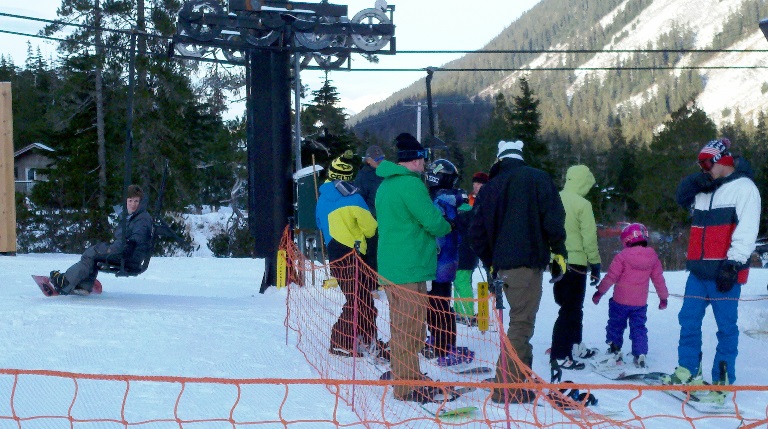
Skiers and boarders line up for a ride on Porcupine chairlift on Saturday. Only the beginning area opened this weekend. The rest of the mountain needs more snow.
Juneau’s Eaglecrest is poised to be the most popular ski area in North America – at least according to the thousands of people who have voted in Powder Magazine’s Ski Town Throwdown.
Now the small city-owned area is up against the destination resort of Crested Butte, Colorado. This is the final round in the contest, which started in October.
Beginning today, you can vote once every 24 hours through Friday on Powder Magazine’s Facebook page. Voting ends at 4 p.m. Alaska time on Friday.
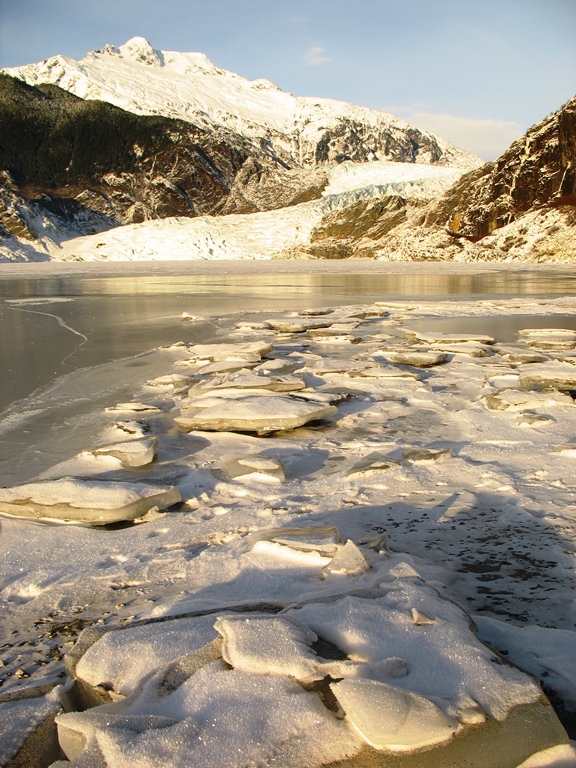
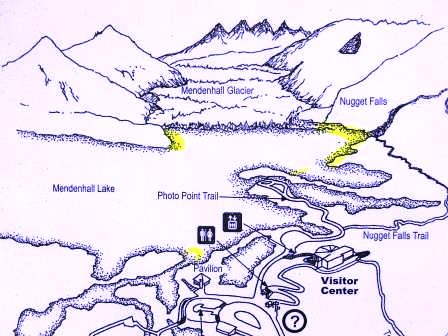
Slabs of broken lake ice on the beach, caused by a reverberation wave under the ice. Photo taken near Nugget Falls on Dec. 7, 2013 by Mendenhall Glacier naturalist Laurie Lamm.
A slide that sent rocks crashing onto frozen Mendenhall Lake in late November actually caused a small tsunami.
Apparently no one witnessed the rock slide, but Thanksgiving Day hikers on Nugget Falls Trail reported seeing jumbled piles of ice tossed by waves onto the beach. Refrozen ice plates 6 to 8 inches thick can still be seen on the lake.
“The first thing I noticed was that there was broken lake ice on one side and then there was broken lake ice on another side,” said Laurie Craig, a naturalist at Mendenhall Glacier Visitor’s Center.
With no evidence of glacier calving, Craig said trying to figure out what happened was like “geologic forensics.”
A spotting scope trained on Bullard Mountain showed evidence of a rockslide. Tree limbs also were seen in the rubble ice.
“We could clearly see evidence of where this narrow band of rock cascaded down off the mountainside and broke the lake ice that was right up against it,” Craig said. “And then it reverberated under the lake and hit against rock on the other side, which broke there as well.”
How does that happen?
If the rocks had hit water, there would be a big splash and a wave would travel across the lake. That’s simple enough, she thought, but Mendenhall Lake was covered with ice.
Naturalist Laurie Craig mapped the area where shattered ice was found after the rock slide.
Craig posed the question on Friday to Joel Curtis, Warning and Coordination Meteorologist at the National Weather Service in Juneau.
“How does the water pop up on the other side of the lake under the ice? Let’s say the ice is thicker out in the middle. It’s a very, very interesting physics problem and I am asking people who are geekier than I am to look at this,” Curtis said.
One of the scientists he consulted was Dr. Eran Hood at the University of Alaska Southeast, a hydrologist and glaciologist. The two came up with this:
“The wave that was formed propagated right along with the ice, although the wave was dampened because it had to lift the ice. But it still was enough to get across Mendenhall Lake and have water squirt out on the other side.”
Technically, Curtis said, it was like a small tsunami under the ice.
The take away?
Ice is not as rigid as most people think. While the ice on Mendenhall Lake may look stable, it is not, Curtis said. Definitely avoid the face of the glacier, ice caves, creeks, icebergs and the area where the lake flows into Mendenhall River.
“And of course, the freeze/thaw cycle can cause rock slides on any of the steep slopes,” he said. “We all really love the lake and love going out there, but you have to be safe when you do.”
On Jan. 11th, the U.S. Forest Service and Capital City Fire and Rescue will hold ice safety training and demonstrations at the Mendenhall Glacier Visitors Center.
KTUU has been carried on KATH-TV, Juneau, and KSCT-TV, Sitka for about a decade.
KTUU, Channel 2, will go off the air in Juneau and Sitka on Saturday.
An agreement between GCI Cable and the Anchorage NBC affiliate has fallen apart. At 12:01 a.m., Channel 2 programming will not be carried on KATH in Juneau, or KSCT in Sitka.
The two Southeast Alaska stations, and Anchorage station KTVA, were recently sold to GCI Cable.
On Nov. 22, the companies reached a four-year carriage agreement that would preserve the programming in Southeast and restore KTUU’s signal in 22 other communities across the state. GCI had pulled the station off the cable in early November, affecting about 7,000 viewers.
Instead, GCI Corporate Services Vice President David Morris says KTUU requested a similar agreement for an additional signal, should the television station ever acquire another one.
“We had hoped there was going to be some movement on it, but it appears right now there’s not going to be movement. It’s simply not a cost that we can afford so what we wanted to do is give viewers the heads up that this is likely to occur,” Morris says.
Morris describes the request as doubling the cost of carriage, while KTUU Marketing Director Brad Hillwig calls it future protection for the station. He says he still hopes for an 11th hour deal.
“We’ve served Southeast Alaska for more than a decade through our partnership with KATH and sister station KSCT. We’d love to continue that, but certainly now that GCI owns those stations it has to be under the right terms and conditions,” Hillwig says.
The companies have been negotiating terms of carrying the Anchorage TV station on cable since September.
GCI’s Morris says the nationally syndicated One America News Network will replace Channel 2 News on the Southeast stations until an Alaska news broadcast is available. GCI has not yet set a date for its launch of a television news program to be produced by its subsidiary, Denali Media.
Morris says the Juneau and Sitka stations will continue to get national NBC network programming.
GCI, General Communications, Inc., is the state’s largest telecommunications company.
Close
Update notification options
Subscribe to notifications
Subscribe
Get notifications about news related to the topics you care about. You can unsubscribe anytime.