Rosemarie Alexander

Always stay back from the face of Mendenhall Glacier

The Mendenhall Hall Glacier can calve and ice bergs can  roll at any time, posing a danger to people on the lake. (Photo by Rosemarie Alexander/KTOO).
The Mendenhall Hall Glacier can calve and ice bergs can roll at any time, posing a danger to people on the lake. (Photo by Rosemarie Alexander/KTOO).

Water is still rising in Suicide Basin on the Mendenhall Glacier, but if or when it will release isn’t predictable.

Suicide Basin is a natural collector of rainfall and snowmelt, and is dammed by the glacier. The dam has broken the last three summers, causing various levels of flooding on Mendenhall Lake and Mendenhall River.

The National Weather Service said on Friday that a visual check of the basin indicates the amount of water already exceeds 2012 levels when the dam released, and a  jökulhlaup could happen at any time.

Jökulhlaup is the Icelandic name for a glacial outburst flood. According to the weather service,  it takes one to two days for water from Suicide Basin to affect levels in Mendenhall Lake.

A pressure sensor in the basin shows when it starts draining, but can’t predict the volume of water that may be released, or whether it will come as an outburst or slow release.

The U.S. Forest Service is warning kayakers, rafters and hikers to be smart on and around the lake, due to potential flooding.

Mendenhall Glacier Visitors Center naturalist Laurie Lamm says the glacier poses a danger at any time.

The face of the glacier is never a safe spot to be, because the glacier calves without warning. And if you’re close to the face of the glacier there are a couple different potential dangers. There’s the actual piece of ice falling on you, the ice popping up from underneath, or the wave that’s created by the ice. It’s not a safe spot to be,” Lamm says.

Commercial operators must file an annual operating and safety plan with the Forest Service that includes the distance their boats will stay from the glacier.

“There isn’t a Forest Service standard in our management plan that says you shall stay back X-amount of feet, so it’s recommendations,” says Natural Resource Specialist Jessica Schalkowski.

Four commercial companies are operating on the lake this year. Depending on the tour, Schalkowski says, the plans range from 300 feet to 600 feet from the face of the glacier, and 150 feet from ice bergs.

Alaska Travel Adventures offers a Mendenhall Lake trip from Skater’s Cabin beach to Nugget Falls. Adventures Tours Manager Niles Hansen says the  operating plan recommends the 15-passenger canoes stay 300 feet from the face of the glacier, but they remain about a thousand feet back.

“We’re allowed to go closer, but with our canoes we just don’t feel like it’s safe,” Hansen says.

Schalkowski says it’s the inexperienced, unguided boaters that cause concern.

“Be it somebody that has a kayak personally or has rented a kayak,” she says. “They’re not with a guide that can kind of direct them to stay back from some of those dangers or recognize some of those hazards.”

The general rule of thumb: The farther away you are from the face of the glacier or ice bergs, the safer you are.

CBJ looking for volunteers for boards and commissions

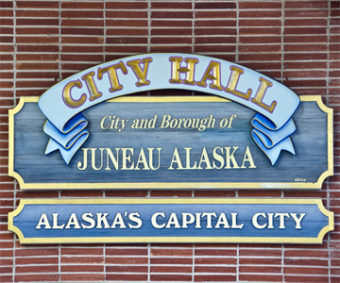
Juneau City Hall
Juneau City Hall sign. File photo.

Wednesday is the deadline to apply for a seat on several city and borough enterprise boards.

The Juneau airport, docks and harbors, Eaglecrest Ski Area and personnel boards are looking for volunteers.

Wednesday is also the deadline for the Commission on Sustainability and Historic Resources Advisory Committee.

Six other boards and commissions have vacant seats that are open until filled.

Deputy City Clerk Beth McEwen says selection is up to the CBJ Assembly. Once applications are filed, the full Assembly sits as a human resources committee.

They send out some advance interview questions then there’s a 5 to 10-minute interview with each one of the applicants conducted with all the Assembly members that can be present,” she says.

After the interviews, the Assembly deliberates in private to come up with a list of possible members. She says the Assembly often looks for “the strengths and weaknesses of the current board members and where there might be holes on the board” that can be filled with different expertise and professional knowledge.

McEwen says CBJ has a large number of boards and commissions and it’s sometimes difficult to fill all the seats. The Juneau Human Rights Commission, for example, has four openings. The commission has so few members it is unable to make a quorum to do business.

Interested in serving on a CBJ board or commission? Applicants can file on the CBJ website.

Two days left to enter Juneau’s Fourth of July parade

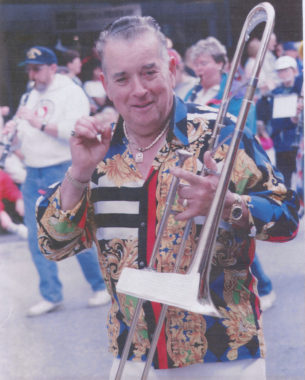
Dick Garrison, Juneau July 4th parade marshall
Long-time Juneau resident Dick Garrison is 2014 parade marshal. He usually plays his trombone in the parade marching band. (Photo courtesy Juneau Fourth of July Parade Committee)

It’s time to get ready for Juneau’s Fourth of July parade.

The 2014 theme is “I love a parade.”

Parade Director Jean Sztuk says 29 participants had signed up as of Monday, ranging from color guards to political candidates.

Entry forms are available at the Valley Library in the Mendenhall Mall and Cycle Alaska downtown. To be eligible for awards, entries must be turned in by Wednesday.

Long-time Juneau resident Dick Garrison will be grand marshal. For the past 60 years, he’s played his trombone in the volunteer parade marching band.

Parade entry fees range from $15 for animals to $75 for floats and big rigs. Active military, color guards and youth are free.

There’s an extra fee for late entries.

Float participants can choose the categories in which they want to compete, such as best use of theme, most Alaskan, most patriotic, or best commercial float.

Vehicle categories are custom, decorated, or best historical vehicle. This year, parade organizers have introduced a watercraft category for boats, jet skis, inner tubes or life jackets.

Marching units will be judged on their energy level.

Juneau police investigate high school hazing

Juneau police have launched an investigation into the alleged hazing of incoming high school freshmen.

Lt. David Campbell says two officers have been assigned to look into accusations reported earlier this week in the Juneau Empire about some upperclassmen paddling and injuring several students.

Campbell says the department had not heard from any victims prior to the story. Officers have since contacted a couple of parents of possible victims.

“We are actively investigating it to see what crimes were committed, if the victims and their families want to press charges,” he says.

Campbell says police are also working with the school district.

The alleged incidents happened after school was over for the summer and were not on school property.

District spokeswoman Kristin Bartlett says the administration has received reports of hazing and it doesn’t appear to be limited to one group of students.

“All three of our high school principals, from Juneau Douglas High School, Thunder Mountain High School, and Yaakoosge Daakahidi Alternative High School, are working together to follow any leads that they get on the issue,” Bartlett says.

Juneau School District has specific policies on bullying and hazing. The policies that define hazing as any act that endangers a person’s health or safety, or subjects them to physical discomfort and embarrassment because they’re part of a certain classroom, grade, or school activity.

Consequences can include expulsion.

It’s not clear how many students were involved in the recent incidents, but Bartlett says it’s important that parents and students tell school officials about the activity.

She also says it’s an opportunity to begin to change a culture that seems to accept hazing and bullying.

“If kids feel like this is something that just happens, we as a community need to speak up and make  sure that kind of an attitude gets addressed,” Bartlett says.

TMHS head football coach Jeep Rice claims some of his players have been injured in hazing. He has coached high school football for years in Juneau, beginning in the 1980s at JDHS.

He says he has no tolerance for hazing. He recalls the time when his teenager was hazed.

“We were in the same boat 25 years ago as a scared parent of an incoming freshman who was thrown into Gold Creek semi-naked with girls all around to laugh it up and whatnot, you know with seniors there. It wasn’t life threatening, but we were pretty upset, we were pretty scared,” he says.

Rice says he tells parents whose teens have been victims of hazing to “prosecute to the fullest extent of the law.”

Lt. Campbell says there are similarities between bullying, hazing, and domestic violence, including fear, retribution, and peer pressure, but there aren’t laws per se against bullying.

“You can’t turn to the bullying law in Title 11 of Alaska Statutes or in Title 42 of the CBJ statute, but a lot of the actions that get mentioned do meet some of the statutes and that’s what we have to look at,” he says. “Was a person injured, was a person placed in fear, was there offensive physical contact, were they engaged in challenging people to a fight, there’s all these things that do constitute violation of laws and we have to see if we have the elements of those offenses.”

Campbell says the officers assigned to the investigation are following up with witnesses, victims and parents to see if JPD can proceed with an actual case.

Juneau airport gets second scanner for checked baggage

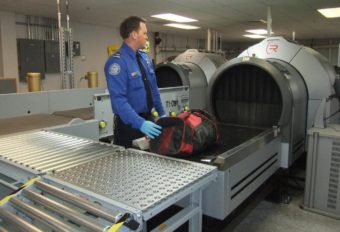
Juneau airport baggage scanning machines
TSA Officer Noah Teshner guides a bag into the new CT scanner. The Alaska Airlines conveyor belt, left, runs to the original machine. (Photo by Rosemarie Alexander/KTOO)

TSA and Juneau airport officials hope the recently expanded screening system for checked baggage will reduce airline departure delays.

After numerous requests, federal funding was finally realized for a second machine at the Juneau International Airport, just in time for the arrival of Delta Airlines.

Delta’s daily summer flight between Juneau and Seattle adds another aircraft at the busiest time of the day, says deputy airport manager Marc Cheatham.

“There’s four aircraft in the morning from 6 o’clock to about 8 o’clock,” he says. “And adding on Delta’s aircraft, that’s five aircraft now. That’s a lot of bags to be going through one machine.”

The reconditioned second scanner cost about $330,000, according to TSA spokeswoman Lorie Dankers. Both machines were made by Reveal Imaging Technologies, and use computer tomography (CT scan) to detect explosives and produce a 3D image.

“We know that not only today, but for several years, explosives remain the number one threat against aviation security. So all checked baggage must be screened,” Dankers says.

Bag exits CT scanner
A bag exits the new CT scanner. The scan produces a 3-D image, seen on a monitor (above left). An alarm sounds if the computer flags a bag as suspicious. (Photo by Rosemarie Alexander/KTOO)

If the scan flags a piece of luggage as suspicious, an alarm sounds and a TSA officer pulls it aside for additional screening.

“We’re going to go inside the bag and look specifically for an item that alarmed the machine,” says TSA officer Noah Teshner. “Once we’ve located that item, we’re going to run a test on it and ensure the item is permitted to go. And then we’re going to repack the bag and send it on its way.”

Teshner says TSA does not open luggage unless the alarm goes off.

At check-in, Alaska Airlines’ ticket agents put baggage on a conveyor belt that runs to the original CT scanner. The Delta desk doesn’t have conveyor access yet.

“Delta employees actually cart them in and put them up the rail and into the new CT,” Cheatham says.

With four aircraft departing in the morning, Alaska Airlines is also utilizing the second machine.

“They can have an employee here that sends it from the bag belt system to the new CT 80 and through it, so they can do a lot more bags much faster,” Cheatham says.

Delta’s seasonal service ends in September. He says Delta will likely not get its own conveyor belt system until the carrier comes back to Juneau next summer.

Even without it, he says, the new baggage screening equipment is expected to end the morning bottleneck.

“The delays for the aircrafts will be limited, hopefully,” Cheatham says.

Related Story:

TSA Pre-Check looking for Southeast applicants

Crime Line: Thief steals film crew’s stuff from local hotel

Juneau police are looking for information about the theft of $2,000 worth of gear stolen from an international film crew visiting the capital city.

Police report electronics and personal items were taken from Guesthouse Inn and Suites near the airport when the documentary team from England was out.

The hotel was supposed to have locked the items in a conference room while crew members were shooting on Prince of Wales Island. When they returned, they found the room open and their stuff gone.

Lt. Kris Sell says police are asking anyone with information to notify Crime Line.

It’s a case I wanted to run for Crime Line because it’s kind of a cringe-worthy case as a Juneau citizen. You know you read it and you’re like, ‘Oh, that’s so embarrassing. So awful that it happened to visitors,’ ” she says.

Sell says it’s not clear if the hotel has compensated the film crew for the stolen items, which she describes as things the public should be able to identify.

“The person probably has the type of property that somebody else is going to notice with the iPods, the Apple DVD driver and then a whole bunch of the clothes; $350 worth of clothing would be something that would be kind of noticeable,” she says.

The film crew has returned to England.

Sell says anyone with information should log onto Juneau Crime Line.

Site notifications
Update notification options
Subscribe to notifications