Artist Glo Ramirez stands next to one of her original cute monster creations (photo courtesy of Glo Ramirez)
Glo Ramirez is a Puerto Rican artist and guest of Lingít Aaní for the last six years, where she has been regularly exhibiting her illustrated monster creations. She describes her style by saying “I make cute but cool stuff.” Her latest show opens this First Friday at the Alaska Robotics Gallery. Ramirez sits down with Sheli DeLaney to discuss art and more on this episode of Juneau Afternoon.
Also on today’s show, we’ll hear about return of the Fly Fishing Film Tour, brought to you by Trout Unlimited and back after a two-year hiatus. The Foundation for the End of Life Care will be here to talk about their workshop to help children and teens deal with grief. And we’ll get a rundown of this First Friday’s features from the JAHC.
Guests:
Jon Heifetz, president, Tongass Chapter of Trout Unlimited
Monica Southworth, board member, Tongass Chapter of Trout Unlimited
Seanna O’Sullivan, president, Foundation for End of Life Care
Hal Geiger, board member, Foundation for End of Life Care
Glo Ramirez, artist
Kathleen Harper, Juneau Arts & Humanities Council, Centennial Hall House Manager
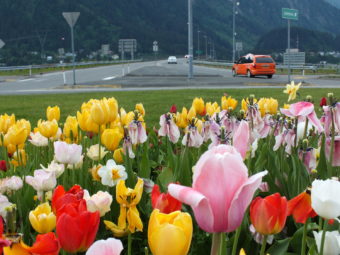
Daffodils bloom in a North Douglas flower bed lined with seaweed mulch. (Photo by Matt Miller/KTOO)
Now is the time to get flower bulbs in the ground before it freezes. For an impressive display of blooms in the spring, plant a lot of them.
Master Gardener Ed Buyarski recommends planting flower bulbs such as crocuses, daffodils, and tulips in a location with good drainage. They don’t need to be in full sun all year long, just in the spring.
“So we can plant them at the edge underneath deciduous trees, which will leaf out in late May and June,” Buyarski says.
Buyarski plants bulbs by the bucketful in the fall. He digs large six-inch deep holes or trenches that wind around his raised beds, scratches in fertilizer, and places bulbs in groups of five to ten. “The mantra is pointy-end up,” he says.
Buyarski suggests packing them in and planning for just one season of blooms.
“With tulips, we’re often treating them like annuals, just because the second year they don’t come back very well. And the third year just leaves.” he says. “You can plant them just about touching, four- or five-hundred bulbs, a spectacular show of color.”
Bulbs bloom in the middle of the Douglas roundabout earlier this spring. (Photo by Matt Miller/KTOO)
If the goal is a spring cutting garden, productivity of bulbs can be extended by strategically planting mid-season and late-season blooming daffodils and tulips varieties in the fall.
“You can have six weeks of cut flowers from that little patch of ground in front of your house.” Buyarski says.
After the daffodil and tulip bulbs are in the ground, he covers them up halfway. “So now you’ve got a three-inch-deep hole,” he says. “You can plant some short bulbs, like crocus and snowdrops and Blue Scylla.”
Although spring is half a year away, planting bulbs now is not only easier before the ground freezes, it also gives gardeners something to look forward to.
“You know, at this time we’re dreaming. We’re hoping and we’re planning all this stuff for six months from now.” Buyarski says. “And you know, we gardeners are an optimistic bunch.”
Dave Gregovich, Wildlife Habitat Analyst for ADF&G and local mushroom enthusiast (photo by Sheli DeLaney/KTOO)
Dave Gregovich, Wildlife Habitat Analyst for the Department of Fish and Game, is a mushroom enthusiast on the hunt for winter chanterelles. He starts the search in a forest near the North Douglas highway, and looks for areas with hemlock trees and blueberries.
“It’s not a super specialized mushroom,” Gregovich said. “In most places where you have old growth forest, you have at least a few winter chanterelles.”
Edible mushrooms found in Southeast Alaska can be foraged throughout the fall and into early winter, but winter chanterelles have very distinct characteristics that make them especially easy to identify, especially for beginners.
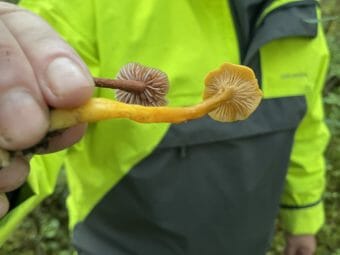
Winter chanterelles (right) have ridges under the cap, rather than the sharp gills found on other mushroom species (left) (photo by Sheli DeLaney/KTOO)
“A lot of mushrooms have these really sharp blade-like gills on the underside of the cap. But winter chanterelles have these kind of ridges on the bottom of the cap.” Gregovich said. “And they are shaped like a funnel. They’ve got a hole in the top, and it funnels down to a hollow stem.”
Winter chanterelles are small, so it takes quite a few for a meal. And their texture can be pretty wet when you bring them home. But they are really good to eat, Gregovich said.
Winter chanterelles have a funnel-shaped cap, with a hole in the center and hollow stem (photo by Sheli DeLaney/KTOO)
“What I like to do is put them under a fan for an hour or so, no heat,” he said. “And the other thing you can do is you can dry-sauté them. Before you add any oil or butter, put them in the pan just dry and let some of the water kind of evaporate from the mushrooms.”
In the temperate rainforest of Southeast Alaska, mushrooms almost always have plenty of moisture and good growing conditions in their environment.
“But one thing that is the case, you really don’t see most of these mushrooms until kind of the start of August, mid-August, and then they really start to pop.” Gregovich said. “A couple of species, including the winter chanterelle, can be around in November or even December.”
There are hundreds of species of mushrooms around Juneau. But Gregovich advises the average forager stick to the four that are easiest to identify: winter chanterelles, golden chanterelles, porcinis (aka King boletes), and chicken-of-the-woods.
“So you can just stick with those four kinds, and you can get out and find something that’s easy to identify and good to eat,” he said.
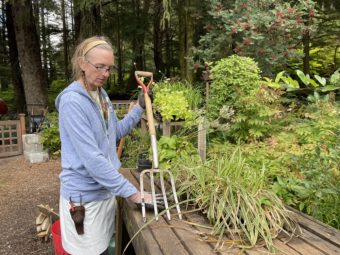
Ginger Hudson displays a digging fork, her preferred tool for removing plants from the ground without cutting their roots (photo by Sheli DeLaney/KTOO)
Early fall is a great time to dig up, divide, and transplant perennials. Plants can better adapt to new locations when the weather is cool and they are finished blooming.
At the Jensen-Olson Arboretum, horticulturist and manager Ginger Hudson demonstrated how to divide Japanese sedge, or Carex morrowii, that she found creeping into a walkway. She removed it from the ground using her preferred tool — a digging fork.
“If you use a shovel — that’s a big knife. You’re just going to cut a lot of roots,” Hudson said. “So a digging fork leaves as many roots intact as possible.”
Hudson used her fingers to loosen the large mass of soil, roots and greenery. At times she needed clippers to release the plants from each other, but she was careful not to cut away too much.
“You want a healthy mass of roots with the plants that you transplant,” she said. “You want large feeder roots, you want little thin hairy roots coming off those bigger roots.”
Plant clump of primula florindae being divided (Photo by Sheli DeLaney/KTOO)
Some other perennials that can be divided this time of year are Primula florindae and Primula denticulata, popular varieties that grow well in Southeast Alaska.
“Because they like living here so well, they really reproduce well,” Hudson said. “They spread by plant clumps, which is vegetative. They also reseed themselves.”
Hudson says Juneau is renowned for being a great habitat for primulas, and the arboretum has a nationally recognized collection.
But they have thick, entangled root systems that take some patience to divide. Hudson works the clumps apart slowly with her fingers, then cuts away dead and damaged parts of the sections she separated.
“This year I have an extra step to add in, and that’s I’m going to be trimming foliage,” she said. “Because the slugs have really done a number on them, and they’re not pretty.”
A newly divided and trimmed primula florindae plant (photo with Sheli DeLaney/KTOO)
Hudson says early fall is an ideal time of year to divide and transplant Primula florindae because their roots can get established before winter. Plus, primula are likely to lose their blooms if they are transplanted while flowering.
“The plant is then is going to spend energy trying to get reestablished trying to get its roots eating again. And so it’s not going to be able to feed the flowers,” she said.
A chalkboard sign at the entrance lists what’s in bloom at the Jensen-Olson Arboretum. (Photo by Sheli DeLaney/KTOO)
At the Jensen-Olson Arboretum — a source of inspiration for gardeners of Southeast Alaska — late-season flowering perennials are in bloom.
“And one of our favorites is the Primula florindae, which blooms in mid-to-late summer and sometimes will go on until frost,” manager and horticulturist Ginger Hudson said. “They love the cool moist temperatures — they love to be cold over winter.”
Yellow is the standard color for Primula florindae flowers. But when planted alongside a primula of a different color, the flowers can bloom in a variety of shades.
“There are some oranges and they will cross with each other,” Hudson said, “So we have one that’s a kind of a mango color. And even one that’s a deeper mustard yellow.”
A buttery-yellow variety of primula florindae in bloom at the Jensen-Olson Arboretum (photo by Sheli DeLaney/KTOO)
Not only does the Primula florindae bloom longer than other primula and attract pollinators, it’s also easy to propagate.
“This variety of primula spreads easily in the garden, Hudson said. “Not only by clumps expanding, but also seeds being carried away and washing away in our rains.”
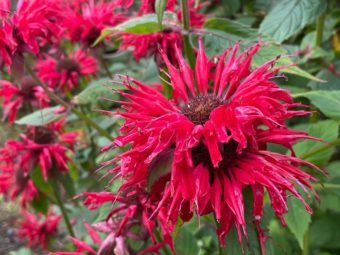
Monarda, also known as bee balm, is another late-blooming perennial that produces copious amounts of flowers.
“Really red” variety of bee balm (monarda) in bloom at the Jensen-Olson Arboretum. (Photo courtesy of Sheli DeLaney/KTOO)
“We have two different kinds of bee balm growing here at the arboretum, a pink shade and a deep, deep fire-engine red shade,” Hudson said. “You want to plant them in the best sun possible to get the maximum amount of blooms.”
As the name suggests, bee balm attracts pollinators as well — primarily, bees.
Ginger Hudson, manager and horticulturalist at the Jensen-Olson Arboretum, inspects a patch of bee balm. (Photo by Sheli DeLaney/KTOO)
“We have a lot of bumblebees here even in Southeast Alaska and they love these, as well as lots of other little flies and late season butterflies,” Hudson said. “But mostly you’ll see bumblebees.”
Phlox and hostas are two other perennials that are still in bloom this time of year, and Hudson says she’s even seen hummingbirds visiting the hosta flowers. While attracting pollinators, the flowers and foliage are also entertaining through the autumn.
“And makes you think, well, summer’s not really over because look at this big head of flowers that just keeps on going,” Hudson said.
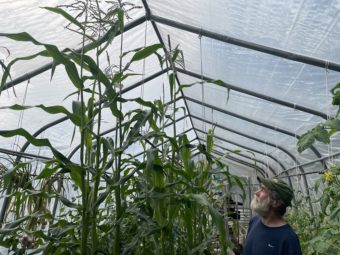
Master gardener Ed Buyarski grows corn inside a greenhouse. (Photo by Sheli DeLaney/KTOO)
Greenhouses expand the possibilities of what can be grown in cool, wet climates. Certain cucumber and tomato varieties do particularly well in Southeast Alaska.
Growing cucumber plants vertically can increase air circulation and reduce mold and mildew (photo by Sheli DeLaney/KTOO)
Master gardener Ed Buyarski uses some of his greenhouse space to experiment with dry-weather crops, such as corn. While his corn is tall, it’s not quite maturing.
“The corn has reached the ceiling, but it’s gonna be a while before we get any of that,” he said.
The rest of the space is dedicated to tomatoes and cucumbers. Buyarski selects varieties that are adapted to growing in a greenhouse, such as the Manny cucumber.
“Manny, I’ve grown for two or three years now,” Buyarski said. “They’re tasty. They’re smooth-skinned slicing cucumbers — they’re considered a European-style cucumber.”
Inside the greenhouse, Buyarski has staked the cucumber plants to grow vertically instead of flat on the ground.
“Cucumbers tend to get mold and mildew on them pretty easily, unfortunately,” he said. “I’ve got them strung up in the hopes of getting good air circulation in between the plants.”
A cluster of ripening, greenhouse-grown Siberian tomatoes (photos by Sheli DeLaney/KTOO)
Sungold, Siberian, and Glacier are examples of tomato varieties that consistently produce good harvests. The plants were started indoors from seed in April and transferred to the greenhouse in mid-May. The green tomatoes just started to show colors in early August.
And for gardeners without greenhouses, it’s still possible to grow tomatoes in the rainforest.
“Fourth of July is a short-growing tomato, determinate tomato, which could be grown in good-sized hanging baskets or in pots.” Buyarski said.
Close
Update notification options
Subscribe to notifications
Subscribe
Get notifications about news related to the topics you care about. You can unsubscribe anytime.