Sheli DeLaney

KTOO

Garden Talk: Creative solutions for controlling weeds — like eating them

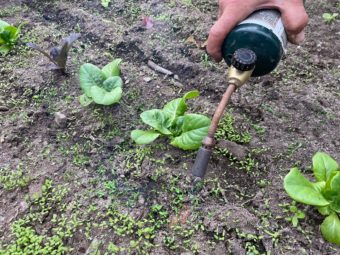
A propane torch burning unwanted chickweed sprouts in a lettuce bed. (Photo by Sheli DeLaney/KTOO)

Taking a propane torch to the rows between crops is a quick, easy solution to controlling weeds in the garden. But many weeds can be harvested and eaten.

White goosefoot (aka Lambsquarters) is an edible and nutritious garden weed closely related to spinach (Photo courtesy of Ed Buyarski/Ed’s Edibles)

Master gardener Ed Buyarski carefully burned away hundreds of tiny sprouts threatening his lettuce rows.

“Like we see between two lettuce, there’s about 50 chickweed plants, and it will steal the nutrients from them,” he said.

The torch eliminated hundreds of weedlings in a matter of minutes, along with any pests that may be in its path.

“Slugs should beware,” Buyarski said.

Other weeds can end up on the dinner table. Lambsquarters, for example, is a close relative to spinach that can be tossed into salad or lightly sautéed with olive oil and balsamic vinegar.

“You can even layer it in something like a casserole.” Buyarski said. “It’s very tender, very mild, and it’s terribly good for you. Not to mention, we’re eating the weeds, so you get extra points for that.”

Chickweed (Photo courtesy of Jennifer Nu)

Chickweed, if it escapes the torch, is also edible. It has a mild taste as well and is nutritious when eaten fresh.

“We can eat a lot of these weeds, and I try to,” Buyarksi said. And he introduces other people to them when he can. “Certainly, I subject friends to it, put in their salad.”

Garden Talk: Air-drying garlic and herbs

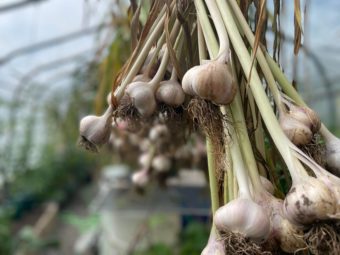
Hardneck garlic bulbs hanging up to cure inside a greenhouse (Photo by Sheli DeLaney/KTOO)

After garlic is harvested, it can be cured by hanging in a warm, dry place with good air circulation for a few weeks.
Master gardener Ed Buyarski says that he has garlic hanging in his greenhouses, his furnace room and his garage.

“In fact, last week I bought a dehumidifier to go in my garage underneath the garlic, and I’m emptying it twice a day.” Buyarksi says. “So I’m hoping that it will dry it better so it keeps better.”

Some of the garlic has been set aside to be eaten fresh rather than preserved. They show signs of the fungus disease botrytis. Buyarski recommends keeping them separate from unaffected garlic plants and giving them a quick rinse in a 10% bleach solution.

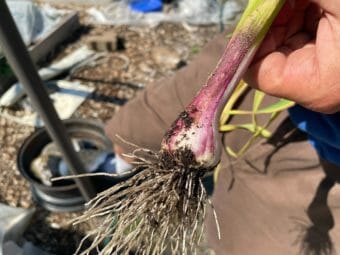
Garlic bulbs with the tell-tale pink streaks of botrytis should be eaten fresh rather than preserved (Photo by Sheli DeLaney/KTOO)

“We’ll eat them, friends will eat them. But we will not use that for the replanting later on in late September and October.”

A couple of days of air-drying is all that’s needed to preserve garden herbs, too, such as the oregano Buyarski grows in his greenhouse.

“Dry it just on cookie sheets in the open. I don’t bother to put it in a dehydrator.” he recommends. “Because if you heat it then you lose some of the volatile oils.”

Buyarski has even experimented with drying garlic leaves.

“That was quite a failure, that was in a dehydrator,” he says. “Made the house smell wonderful. But the next morning when we went to taste the dried crunchy garlic leaves, there was no flavor left.”

For other herbs that lose flavor when dried, like basil and chives, or are too tender for the drying process, Buyarski suggests freezing them in a baggie or even in ice cubes.

Garden Talk: A tour of Taay Hít, Tlingit and Haida’s new greenhouse

Master Gardener Lindsey Pierce is surrounded by sunflowers as she looks up at the top of the dome in Táayi Hít, the “Garden House” at Central Council of the Tlingit and Haida Indian Tribes of Alaska. (Photo by Sheli DeLaney/KTOO)

A year after completion, the greenhouse built by Central Council of the Tlingit and Haida Indian Tribes of Alaska has produced its share of successes and setbacks.
“The name is Taay Hít, which means ‘garden house’ in Lingít,” says Lindsey Pierce, master gardener and environmental specialist at Tlingit and Haida.

Also referred to as “the dome” because of its shape, the structure was assembled from a kit by local contractors last July. This year marks the second growing season for the greenhouse.

Cer Scott, also a master gardener and environmental specialist, said he was new to indoor gardening and overwhelmed at first. For him, one of the first challenges was deciding what to grow.

Cer Scott, Master Gardener and Environmental Specialist at Central Council of the Tlingit and Haida Indian Tribes of Alaska .(Photo by Sheli DeLaney/KTOO)

“We’re trying to decide, you know, should we grow things that are not as accessible at our stores?” Scott said. “Or should we grow things that people that are more, you know, wanted in the region, like cultural traditional foods. So we kind of did a mixture of both.”

One of the successes from this season included multiple crops of Swiss chard.

“We had several harvests and made a nice big lunch for the staff,” Scott said.

A lot of it also went to Smokehouse Catering, the tribe’s event company, who use produce from the dome in the meals they serve.

Tomatoes also did well, but basil was an especially big hit.

“It’s one of those things that it’s right next to the door, so when you walk in you get a waft of some fresh basil,” Scott said.

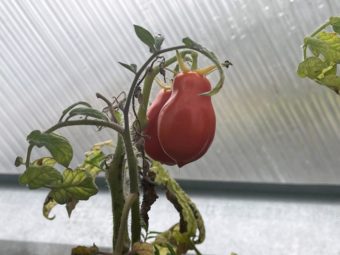
Ripe beefsteak tomato on the vine under the dome at Táayi Hít. (Photo by Sheli DeLaney/KTOO)

They had a few setbacks however, like pests and heat.

“We did have some cabbage here but we lost that unfortunately to some of the aphids,” Scott explains. “Aphids took over those so we just ended up pulling them to kind of help combat that.”

And a long stretch of hot weather earlier in the summer threw off the timing of their broccoli.

“While we were still trying to figure out the environment inside the greenhouse, as far as climate control, our broccoli ended up bolting. And flowering.” Scott explained. “It’s just their life cycle.”

“You can eat the flowers though,” Pierce added.

Lindsey Pierce, Master Gardener and Environmental Specialist at Central Council of the Tlingit and Haida Indian Tribes of Alaska, holds out edible broccoli flowers from a plant that bolted. (Photo by Sheli DeLaney/KTOO)

Scott and Pierce both completed the Alaska Master Gardener Program, and they agree that they have learned a lot in just two growing seasons under the dome.

“Last July is when it started. And it’s just been a ride ever since.” says Pierce.


Garden Talk

Correction: An earlier version of this story misspelled Taay Hít, the name of the greenhouse.

In ‘Berry Song,’ Lingít illustrator Michaela Sheít.een Goade shares her own story

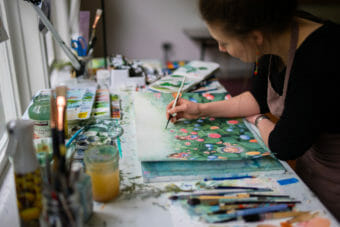
Michaela Goade working on an illustration for her new book, Berry Song (Photo by Bethany Goodrich).

Lingít illustrator Michaela Sheít.een Goade released her first self-authored picture book this week. “Berry Song” was an opportunity to tell her own story and create images inspired by her homelands.

Goade began her career as a picture book illustrator at Sealaska Heritage Institute as part of the Baby Raven Reads program. She has since worked with authors from many different Indigenous nations. The books she illustrated were picked up by major publishers, and in 2021 she was awarded the Caldecott Medal for her illustrations in “We Are Water Protectors,” by Carole Lindstrom.

“And so everything just sort of expanded,” Goade said. “I was able to learn about all of these different cultures and places around the country and into Canada.”

With “Berry Song,” Goade brings her focus back to Alaska. The story and the imagery are inspired by her childhood here in Lingít Aaní, where she was born and raised. It is also the first book that Goade has both written and illustrated herself.
 

She says it took her some time and experience with the format before she felt ready to tell one of her stories in a picture book.

“Because it’s its own unique art form,” she said. “It has things like the page turn and pacing and narrative storytelling and all of these different elements that I wasn’t familiar with.”

Cover of “Berry Song,” written and illustrated by Caldecott Medalist Michaela Goade

And after helping other authors bring their stories to life with her pictures, she found comfort in illustrating the familiar scenes of Southeast Alaska.

“Getting to work on “Berry Song,” going into the experience of writing the story and then illustrating it, it just felt like coming home. Like I could take all of that experience and return to where I started illustrating and where I grew up.”

Goade hopes “Berry Song” will add to greater inclusivity and representation of Indigenous people in the publishing world. She also wants to help readers understand more about the lifestyle, cultures and land in the Tongass National Forest.

“It’s such a special, unique and incredibly important ecosystem and part of the world,” she said. “Trying to share some of that with a wider audience has been very inspiring.”

The full interview with Goade is available here.

Garden Talk: Thinning carrots and planting more peas

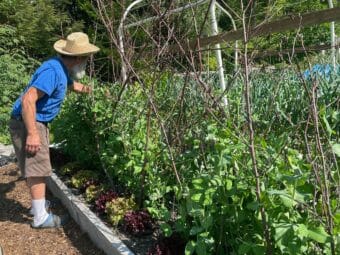
Pea plants with alder bough trellis (photo by Sheli DeLaney/KTOO)

Peas planted this spring are ready to be picked, but it’s not too late to start a second crop. And carrots due for harvest this fall likely need some thinning. With both plants, the shoots, tips and leaves are edible and delicious in salads and sauces.
Master gardener Ed Buyarski’s crop of peas was planted outdoors from seed in early May, then covered with agricultural fabric to protect the sprouts.

“We’re standing in front of my pea patch with all these alder sticks coming up out of it, which are my low-budget pea trellis,” he said. “The peas are blooming and very quickly. In fact, I noticed there are some little tiny peas I’m looking forward to eating.”

Buyarksi prefers the varieties with edible pods, like snow peas or snap peas.

“In my youth I planted and harvested and shelled peas, which is tedious,” he said. “Tasty, but tedious.”

Ed Buyarski holds out a pea shoot with pods and flowers (photo by Sheli DeLaney/KTOO)

In addition to the pea pods, the shoots, tips, leaves and even flowers can be eaten.

“Of course if you eat the flowers, you don’t get peas,” Buyarski said.

Peas are cold-hardy and can be planted even as late as mid-July for a fall harvest. Which is just in time for the carrots to come out of the ground.

“Our regular harvest for carrots for storage is usually after the first frost, so late September, October. I’ve harvested them into November,” he said. “It’s best to do it before the ground freezes because it’s a lot more convenient that way to get the carrots out of the ground.”

Garden box with carrots, ready for a mid-summer thinning. The carrots need a few more months but their tops are edible now. (Photo by Sheli DeLaney/KTOO)

Buyarksi recommends direct-sowing carrots in late April if conditions allow, then covering the bed with plastic sheeting over hoops while the weather warms up. They will need to be thinned to about an inch apart as they grow.

Whatever gets pulled while thinning carrots can be set aside for salads and sauces. As with peas, the leaves and shoots of carrot plants are edible, too.

When Buyarski finds himself short on basil or other greens, he’ll chop up carrot tops, pea shoots or kale to make pesto and chimichurri. He says that every batch is different.

Garden Talk: Botrytis in the soil can take a toll on garlic harvests

Ed Buyarksi points out a garlic plant infected with botrytis. (Photo by Sheli DeLaney/KTOO)

Starting now through mid-August, garlic plants will be ready to harvest. But master gardener Ed Buyarski says gardeners should look out for botrytis, a fungus disease that can spread throughout crops.

“It’s mostly in the soil already, assuming that we’ve been gardening for a while — or even in the wild soil.” he said.

Buyarski pulled a garlic plant that was showing signs rot due to botrytis and pointed out pinkish-red streaks running down the base of the stalk to the bulb.

“Not a good thing this time of year,” he said.

A garlic bulb with the telltale red streaks of a botrytis infection on the skin. (Photo by Sheli DeLaney/KTOO)

Buyarski said each leaf of the garlic plant’s stalk corresponds to a layer of protective skin over the bulb.

“If they’re rotting, they don’t protect it,” he said.

He peeled away layers of red-streaked skins from the stalk to reveal the bulb and its cloves. Those are healthy and can be eaten fresh, but they are too small to be saved for curing.

A garlic bulb with botrytis-infected skins peeled away. (Photo by Sheli DeLaney/KTOO)

Botrytis is very common and attacks plants when conditions are right, such as too much moisture or not enough air circulation. Buyarski said that having good drainage and air flow in beds and greenhouses will help reduce the fungus, and that gardeners should set aside affected plants to prevent more contamination.

“When I am harvesting the garlic a month from now, six weeks from now, I will sort out any of these that I am suspicious of, if I see that red streak going down into the bulb,” he said.

Email Sheli Delaney if you have questions for Garden Talk.

Site notifications
Update notification options
Subscribe to notifications