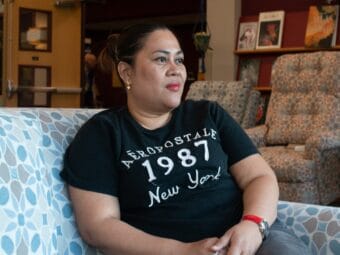
Marilyn Lumba poses for a portrait at the Pioneer’s Home in August 2023. (Photo by Tasha Elizarde/KTOO)
This is the first installment of Tongass Voices, a series from KTOO sharing weekly perspectives from the homelands of the Áak’w Kwáan and beyond.
Marilyn Lumba is the director of nursing at the Juneau Pioneer Home and an assistant professor of nursing at the University of Alaska Southeast. She began working at the Pioneer Home in 2010, just three months after migrating to Juneau from Tagum City in the Philippines. And while she loves her career now, she didn’t think health care would become her passion.
Listen:
This transcript has been lightly edited for clarity.
Marilyn Lumba: Our facility consists of four neighborhoods. So we have Twin Lakes Lodge. We have 10 residents in here.
I always like think, “Okay, what will be the best for the resident? If this is my grandpa, what I’m going to do for them to be happy?”
If you observe, we don’t have uniform. Because this is a home. In your home, you don’t wear uniform, right? So we wanted the resident to feel that this is their home. So we have cats. We have two cats. It depends on the color. If it is Ginger, of course, it’s ginger colored. And Smokey is smoky colored. And we have birds. Before, we even have fish also.
Actually, I wanted to be an accountant — a CPA, a certified public accountant. But my best friend wanted to be a nurse. I said, “Okay, let’s just be a nurse together.” Because we wanted to go together to the same school and all that. And so, I just completed it because my mom doesn’t want me to stop.
I started working here in JPH [Juneau Pioneer Home] in 2010 as an assisted living aide, and I moved here because my husband is here. Like, he petitioned me, together with my daughter. And then I become an assistant professor, in like 2019.
I made the right choice in staying as a nurse because being a nurse is not just — you know how they always say passing meds, like in elderly people? Like here, in a long term care facility, they say, “Oh, you just pass?” No, being here and being a leader, there’s a lot. Like, you have a big impact on this resident — we call them resident, we don’t call them patient.
You become their family, and you wanted — like for me because it becomes my passion — I wanted them to be successful in what they wanted. Like, the quality of life that they deserve.
Fely Elizarde (second from left), grandmother of Mga Kuwento host Tasha Elizarde, dances at a Christmas party hosted by Filipino Community, Inc. in Juneau with other elders, date unknown. (Photo courtesy of Tasha Elizarde)
Tasha Elizarde grew up listening to her mom greet friends in Tagalog, practicing Tinikling at community gatherings and walking the streets downtown, where she’d find food stands serving lumpia and adobo.
Although it might sound like it, she didn’t grow up in the Philippines. Her hometown is almost 6,000 miles away, in a place called Juneau, Alaska.
So, how did she and so many other Filipinos end up building a home in this small corner of the U.S.?
A century before Elizarde was born, Juneau started growing into a thriving metropolis for migrants coming from all over the Philippine islands. Today, she’s just one of thousands of Filipinos living here.
On the first episode of Mga Kuwento, we explore two central questions of the series: how did Filipinos get to Juneau, and just as importantly, why do they stay?
Mga Kuwento Host and Executive Producer Tasha Elizarde guides us through the journey her family and so many other have taken to find financial security and a place to call home.
Lope Elizarde, father of Mga Kuwento host Tasha Elizarde, dances with his mother Fely Elizarde inside her home in Juneau, date unknown. Elizardes still own this house, where many of them lived when the family first migrated to Juneau, Alaska. (Photo courtesy of Tasha Elizarde)
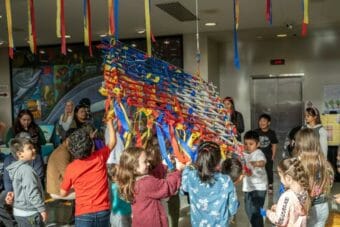
Children grab for goodies attached to a pabitin at Ketchikan’s Fil-Am Festival on Oct. 15. (Photo by Eric Stone/KRBD)
The Alaska Legislature passed HB 23 on Friday, establishing the month of October as Filipino American History Month in state statute.
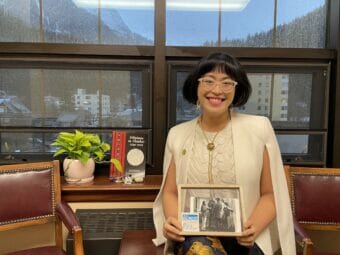
Freshman Rep. Genevieve Mina, D-Anchorage, introduced the bill. She is Alaska’s second Filipino legislator after Rep. Thelma Buchholdt was elected 50 years ago, and HB 23 is Mina’s first bill.
“I just feel overwhelmingly proud because this bill wouldn’t have passed, not just without the support of the Legislature, but also without the decades and decades of advocacy and community work and just the existence that Filipinos have had in Alaska and in our nation,” Mina said on Friday after the bill passed.
HB 23 has 43 co-sponsors — over half of the Legislature. Sen. Elvi Gray-Jackson, D-Anchorage, brought HB 23 to the Senate floor on Friday.
“From seasonal migrant cannery workers to health care workers and political leaders, Filipino Americans are a part of the fabric of Alaska’s diverse history,” Gray-Jackson said on the floor. “Unfortunately, the history of the Filipino community is not often told, which results in the erasure of both the history of this community and the people themselves.”
Rep. Genevieve Mina, her mother Evelyn Mina, and Lt. Gov. Nancy Dahlstrom pose for a photo after Rep. Mina’s oath of office. Mina chose her outfit, including a traditional Filipino shirt called a barong, beaded Philippine flag earrings and a necklace made by T’boli artisans to represent her Filipino heritage. (Photo courtesy of Genevieve Mina)
In 2019, two bills establishing February as Black History Month and November as Alaska Native Heritage Month were signed into law. Jackson says she sees HB 23 as an addition to these bills’ efforts to recognize the diverse cultures of Alaska in state statute.
Recalling the most rewarding moments she had when carrying the bill, Mina shared the time she spoke to Juneau’s Filipino Community Inc. for their biennial legislative reception earlier this year.
“What I really was honored to experience after giving that speech was all of the love from people that I’ve never met before,” she said. “And that’s the type of representation that I hope this bill and enshrining Filipino American History Month in state statute will provide, because we’ve gone so long not seeing ourselves represented.”
The bill passed the Senate in a 19-0 vote, with Sen. Bert Stedman, R-Sitka, absent. The bill now goes to Gov. Mike Dunleavy to be signed into law.
Correction: This story has been updated to correct the spelling of Bert Stedman’s name.
Rep. Genevieve Mina is sworn-in as the second Filipino legislator since Thelma Buchholdt in almost 50 years. (Photo courtesy of Genevieve Mina)
In 1974, former Rep. Thelma Buchholdt, D-Anchorage, made history as the first Filipino to be elected to the Alaska Legislature. Now, almost 50 years later, Rep. Genevieve Mina, D-Anchorage, is making history as Alaska’s second.
Mina took office in January. She represents House District 19 in Anchorage, which covers the Airport Heights, Mountain View and Russian Jack neighborhoods.
Like Buchholdt, who represented Spenard for 8 years, Mina has a strong connection to the Anchorage community. It’s where she was raised by her mother, an Ilonggo nurse, and her father, an Ilocano grape farmer and Alaskero who fell in love with the state.
“There are so many people that I grew up with, that I went to school with, who have family in these neighborhoods who I would come over to hang out and watch TV, or have sleepovers, or do Dungeons and Dragons, or have tea parties,” she said.
Despite being elected at 26, Mina never thought she’d go into politics. She says she was shy and quiet as a kid, but she wanted to break out of her shell. At East High School, she began volunteering with school groups and realized her love for serving her community.
While studying at the University of Alaska Anchorage, she was introduced to the debate team by a friend. It was a welcome break from her biology degree that quickly transformed into a passion that redirected her future plans. Then, the same friend who introduced her to the debate team asked Mina to help out on her first political campaign.
“And I just got hooked from there,” Mina said.
Mina joined the Alaska Young Democrats and College Democrats, and was elected to be a delegate to the 2016 Democratic National Convention. She’s worked on numerous campaigns, interned in state and municipal political offices, and with policy firms in Alaska and Washington D.C. Her involvement in community groups expanded her interests in health care, public transit, economic empowerment and women’s rights.
“The more I realized how much I love doing this type of work of talking with people, building relationships, making policies into reality and leading groups, the more I felt that it was a natural fit for me to eventually run one day, whenever the timing was right,” Mina said.
Inheriting a passion for health care
Mina grew up in a health care family, where she watched her loved ones care for others as a career.
Her mother, a nurse from Iloilo City in the Visayas region, was the first in her family to go to college.
“My mom is a nurse. She’s the first nurse on her side of the family,” she said. “My brother became a nurse, my sister-in-law’s a nurse, my aunt is a caretaker. All of my immediate family works in the healthcare industry.”
Rep. Genevieve Mina stands next to her mother, Evelyn Mina, as she sits in her daughter’s seat on the Alaska Legislature’s House floor. (Photo courtesy of Genevieve Mina)
For almost 20 years, her family ran assisted living homes. The business, called the Genevieve Assisted Living Home, is named after her.
“I grew up around more old people than people my own age,” Mina joked.
When she was young, her father passed away by suicide. And after that, her mother lost Medicaid approval for their family business. When trying to appeal her case with the state, Mina said her mother felt she experienced barriers and discrimination. Eventually, her mother connected with other Filipino-American assisted living home administrators experiencing similar challenges from the state.
The group lost the case, but the experience shaped Mina’s love for health care policy.
“It was really gratifying and fulfilling to be able to help someone understand what is going on, when they’re trying to deal with a very difficult system,” she said. “Health policy is truly an avenue where you are trying to work through the system to literally save lives, and I think that’s a beautiful thing.”
Learning who came before
In 2017, Mina interned with former Rep. Ivy Spohnholz at the Alaska Legislature.
“I was in the Capitol for the first time, being an intern. And I was just like, you know what, I wonder if there’s ever been a Filipino elected to the Alaska State Legislature?” she reflected. “And I looked it up, and I learned about Thelma Buchholdt.”
Before getting into politics, Buchholdt dedicated tireless hours to communities in Alaska. She was involved in Anchorage’s NAACP chapter, the Filipino Community of Anchorage and worked alongside rural Alaska communities to increase their access to health, education and social services.
She worked for years as a school teacher and first ran for the Anchorage school board in the 1960s. While she lost that first election by a small margin, she was elected to the Alaska House of Representatives in 1974 as one of the first Filipino-American women to be elected as a legislator in the U.S.
Buchholdt spent her eight years in office passionately representing the concerns of her working class district in Anchorage. She served as vice-chair of the Finance Committee and chair of the Health & Social Services Committee, and her accomplishments include establishing the Alaska Commission on the Status of Women and the Asian Alaskan Cultural Center in Anchorage.
Even after leaving office, Buchholdt continued her mission for civil rights. She founded the Alaska chapter of the Filipino American National Historical Society, compiled a historical book about Filipinos in Alaska, and served 30 years on the Alaska State Advisory Committee for the Commission on Civil Rights.
“I think that my mother was very aware of the lack of representation of Filipinos in the United States,” Buchholdt’s daughter, Titania Buchholdt, said. “And she took it very seriously as the amount of change she had the ability to create in her role.”
“I could see myself doing this work, because I saw Thelma doing it,” Mina said. “Learning about her history, learning about the work that she did, and the other parallels that I love, like that she was an ad hoc young Democrat.”
Reclaiming her Filipino identity
Buchholdt was born in Luzon, in the Philippines. She didn’t come to the U.S. until the 1950s for college.
Mina, on the other hand, was born in the U.S. in Alaska. But, growing up with family members that were all born in the Philippines, she says that when she was young she didn’t feel she was truly Filipino.
Rep. Genevieve Mina poses in her new office with a photo of former Rep. Thelma Buchholdt in January 2023. The photo was gifted to her by Christine Marasigan, a former legislative staffer who has mentored Mina around being a Filipina in politics. (Photo by Tasha Elizarde/KTOO)
“Between people who emigrated in their adult life with folks who were born here, it’s a huge cultural difference,” she said. “A big challenge that I have personally had is my family constantly speaking in a language that I don’t fully comprehend. That’s a very alienating feeling to have on a daily basis, where you don’t fully know what’s going on in your own home.”
Mina is now proud of her Filipino identity. It took an intentional effort exploring ways she could connect with her family – through food, learning her family’s language, attending Filipino community events and organizations and teaching herself that her differences didn’t make herself any less Filipino.
Still, she emphasizes that her feelings of isolation aren’t abnormal in Filipino households, or in any home. As a public servant, she hopes to see other Filipinos feel included and take pride in who they are. She believes that talking through feelings of alienation, isolation, and depression is crucial to not only finding pride in our identities, but to supporting our mental health.
“Mental health is a huge issue in the Filipino community. I’ve been very open about how my dad died by suicide when I was very young,” she said. “There are ways to take pride in who you are. I own who I am, as someone who kind of knows Tagalog but not really, who didn’t grow up involved in the Filipino community, who wasn’t raised Catholic, but I’m just as Filipino as other folks from my community.”
Mina is known for putting together outfits that share the facets of her identity. On the day she was sworn in as a lawmaker, Mina wore a barong, a traditional Filipino blouse, gifted by her mom and jewelry made by T’boli artisans in the Philippines.
In her office in the Capitol, she has a framed photo of Thelma Buchholdt speaking to a group of taller male legislators. The photo was gifted to her by Christine Marasigan, a former legislative staffer and one of many accomplished Filipinos she credits with her journey into politics.
Speaking of women leaders standing up to white men politicians, here’s Thelma Garcia Buchholdt: the 1st Asian American elected to the Alaska State Legislature (1974) & the 1st Filipina American elected to a legislature in the United States.#FAHM2019#PinayVisionaries#PinayPowerpic.twitter.com/wnLQederw0
Mentors like Marasigan are why Mina introduced her first piece of legislation, HB23, which would establish October as Filipino American History Month in state statute. The bill will have its first committee hearing next week.
She hopes the bill will help the public recognize the complexities within the Filipino community while also challenging Alaskans to better understand the community’s history.
“We have this assumption that Filipino-Americans work only in canneries, only in hospitality, only in health care. And when you think about these different Filipino groups, Ilocanos, Ilonggos, Tagalogs, Kapampangan, there’s a lot of complexity within our cultures,” she said. “And so I want to go deeper in that conversation and challenge the public. To learn more about who we are, why we came here, and why we take so much pride in being who we are.”
She hopes to see more Filipinos, and anyone else from an underrepresented community who doesn’t feel heard by the government, feel like they can be civically engaged.
“I just hope that I am able to live up to the work of (Buchholdt) and many other people who have come before me, to inspire others to to get involved and do the same after me,” she said.
Rep. Mina will be speaking at the Filipino Community Inc.’s installation of board officers ceremony and dinner on Saturday, Feb. 25 at 5 p.m. at Filipino Community Hall. The event is open to the public.
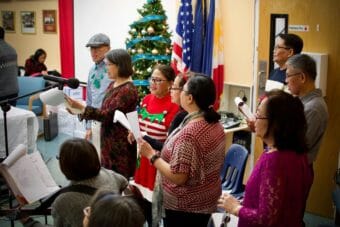
Members of the Filipino Community Inc. sing carols at the organization’s 2019 Christmas Party. (Photo courtesy of the Filipino Community Inc.)
For the first time in two years, the Filipino Community Inc. will be holding its annual Christmas party in Juneau. It’s the organization’s first since the start of the COVID-19 pandemic.
Rachel Carrillo Barril, a FilCom board member, says she’s been going to the parties since she was a child.
“We’ve always done Christmas parties,” she said. “Usually we have a mixture of American and Filipino food for the holiday and some dessert and drinks.”
Carrillo Barril says the party traditionally includes Christmas carols followed by games and presents for kids — and there’s usually a door prize.
“After all that, it’s usually dancing,” she said. “Usually, a lot of the elders like to do their cha-cha dancing or their line dancing and that kind of stuff.”
Carrillo Barril says the party is FilCom’s next step toward re-engaging the Juneau community after the long absence of in-person events during the pandemic.
“We’re hoping that this event will just bring back interest into the community and we could start getting people comfortable with participating in the meetings, and providing our other services and programs,” she said.
The Christmas party will be held this Saturday, Dec. 10, beginning at 5 p.m. at the Filipino Community Hall downtown. There is no entry fee, and everyone in the Juneau community is welcome to attend.
This story is part of KTOO’s participation in the America Amplified initiative to use community engagement to inform and strengthen our journalism. America Amplified is a public media initiative funded by the Corporation for Public Broadcasting.
America Amplified
KTOO is amplifying the voices of Filipinos in Alaska. We want to hear from you. What stories would you like to share or learn more about?
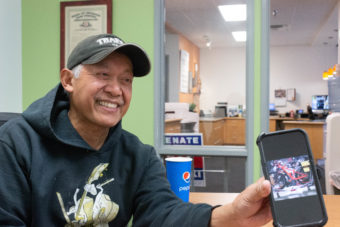
Bayani “Bing” Carrillo smiles while presenting an image from his phone of an electric bike he has repaired on October 26, 2022, at the IBEW building in Juneau. Bike repair is one of Bing’s many hobbies. (Photo by Tasha Elizarde/KTOO)
Bayani “Bing” Carrillo has volunteered for Juneau arts events for years. He’s the go-to guy for designing inventive sets and solving technological problems.
His first volunteer project was Wearable Arts, the annual fashion show hosted by the Juneau Arts and Humanities Center, years ago. Since then, he’s been recruited to help out practically every arts group in Juneau.
“Other things started to come up, like Perseverance [Theater] stuff, working on sets. So I would go help some of the guys cut lumber, put pieces together,” he said. “And then I started doing other things like for the Folk Festival, helping set up the stage, setting up the mics.”
Carrillo helps hang the lights downtown before Christmas. He sets up the power for vendors at the Maritime Festival. One year, he made a giant sparkly high heel for the GLITZ Drag Show. Between running countless shows and managing other volunteers, Carrillo says the wide range of activities he does is challenging but satisfying.
“It’s fun, but it’s a little bit, you know, what’s the word? You gotta be on your toes,” he said.
One of his most memorable projects is a set he created for the 2020 Wearable Arts event.
Bing Carrillo shares an image of rings of lights he created for the 2020 Juneau Wearable Art show. (Photo by Tasha Elizarde/KTOO)
The show is about making something out of the things you have, and Carrillo did just that. He made a colorful backdrop of interlocking rings framed by string lights for the runway. And the entire set was made out of construction pipe.
“I have friends that I know that own, you know, construction companies, and I say, ‘Hey, you got any pipe?’ They say, ‘Yeah, we got some pipe, come over and grab it’,” he said. “So these come in like 20 foot lengths, and they’re like six or four inches wide, but [the set] is all pipes.”
Carrillo’s creative set-building is one reason why he was named this year’s Patron of the Arts by the Juneau Arts and Humanities Council for the Kathy Kolkhorst Ruddy awards. Another reason is to honor his service as JAHC board vice president for the last six years.
“He’s probably one of the longest serving board members,” said Kathleen Harper, who has worked with Carrillo through her role as the facility manager for the council. “So I think that a large part of it was just like, he’s given so much to the arts community, what can we do to honor that service?”
At first, the selection committee thought about nominating him for the Volunteer for the Arts award. That was until they realized he had already won that award a decade ago, in 2012.
Carrillo’s technical expertise didn’t come from nowhere. After graduating from Juneau-Douglas High School in 1974, he tried his hand at college and a state job before deciding to pursue a trade. For about 25 years, he says, Carrillo traveled around Southeast Alaska pursuing electrical jobs before landing in the metering department at AEL&P.
Once he retired, Carrillo began applying his technical expertise outside the workplace. He says it was a natural fit.
“I knew other people that were [volunteering], so they asked me, ‘Hey, want to help out?’ since I’m knowledgeable regarding building things and electrical stuff,” he said.
With all of his years volunteering in the Juneau arts community, Carrillo has not forgotten his time as an electrician. He’s equally known for his support of the International Brotherhood of Electrical Workers, where he has twice been recognized as his local’s Volunteer of the Year.
He is famous for providing elaborate appetizers and setting up his block rocker for music at the union’s annual picnics. He even made a Rosie the Riveter-themed cornhole set.
Nona Dimond, office manager at the IBEW Local 1547, remembers countless times Carrillo has been up for helping out the union.
Bing Carrillo in front of the awards shelf in the IBEW building on October 26, 2022. He has four awards in the building, including two for volunteering for his union. (Photo by Tasha Elizarde/KTOO)
“He just is one of those really dependable people, but also very thoughtful in making sure that everybody has everything they need in order to really get that sense of brotherhood, and he doesn’t ask for anything in return,” Dimond said. “They should call an award the Bing Carrillo award. Because if you’re getting a Bing Carrillo award, that means you’re stepping up and going above and beyond.”
Carrillo’s sense of community extends to the rest of Juneau, and his roots in the town run deep. His parents are from the Philippines, and his father worked for canneries in Southeast Alaska and his mother for the state. At one point, Carrillo’s father and uncle owned a downtown bar called the Dreamland Club. Carrillo lived above the bar when he was very young, until the family moved into the home on Starr Hill that he shares with his mom to this day.
Carrillo was born here, and other than his travels around Southeast Alaska when he was working as an electrician, he’s never left Juneau. He also doesn’t want to. He has a wealth of hobbies in Juneau anyway, including photography and building electric bikes.
For all the years Carrillo has lived in Juneau, he has become someone respected and appreciated within the community. It’s become a joke among his friends that everywhere you go in Juneau, you’re likely to find Carrillo helping out with something.
“And that’s just kind of how he is,” Dimond said. “He just shows up out of nowhere and solves all your problems.”
This story is part of KTOO’s participation in the America Amplified initiative to use community engagement to inform and strengthen our journalism. America Amplified is a public media initiative funded by the Corporation for Public Broadcasting.
America Amplified
KTOO is amplifying the voices of Filipinos in Alaska. We want to hear from you. What stories would you like to share or learn more about?
Close
Update notification options
Subscribe to notifications
Subscribe
Get notifications about news related to the topics you care about. You can unsubscribe anytime.