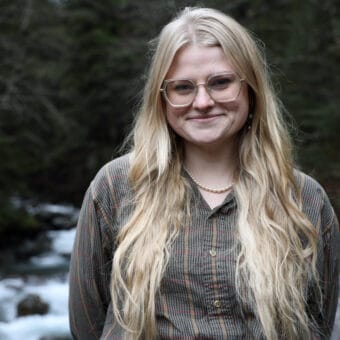
Yvonne Krumrey

Justice & Culture Reporter, KTOO

"Through my reporting and series Tongass Voices and Lingít Word of the Week, I tell stories about people who have shaped -- and continue to shape -- the landscape of this place we live."
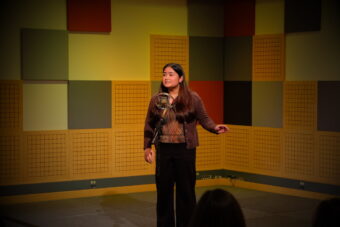
Tongass Voices: Ldaan.aat Laurie Cropley and Yuxgitsiy George Holly on making space for tribal values

Elder Ldaan.aat Laurie Cropley and elder-in-training Yuxgitsiy George Holly will lead dawn prayers at the annual Elders and Youth conference in Anchorage this year. Oct. 8, 2025. (Photo by Yvonne Krumrey/KTOO)

This is Tongass Voices, a series from KTOO sharing weekly perspectives from the homelands of the Áak’w Kwáan and beyond.

Lingít elder Ldaan.aat Laurie Cropley and elder-in-training Yuxgitsiy George Holly are leading dawn  prayers at the annual Elders and Youth conference in Anchorage next week. 

The prayers are from 8 a.m. to 9 a.m. Monday through Wednesday, and they involve singing, dancing, sharing thoughts. This year, they plan to lead a talking circle about tribal values across Alaska Native nations afterwards.

Listen: 

The following transcript has been lightly edited for clarity.

Yuxgitsiy George Holly:  These are the words of Seigeige’i Emma Marks, when   she shared about an old way of greeting the morning, greeting each other in the morning. And she expressed that she said, though all those old peoples would say that “Again upon us, a day has broken.”

Maybe I can share with you the Dena’ina word for dawn prayers: Yetałqun duch’idatqeni. 

Dawn is for everybody. The whole earth turns itself towards the sun each morning, and you can hear the animals waking singing, and it is a time for everyone to enjoy. So dawn prayers is for everybody. It’s time for singing, it’s time for language. It’s time for making connections and really centering ourselves in a healing story.

Ldaan.aat Laurie Cropley: We all live by some values. We all have values that we live by. And in this particular case, we’re going to follow dawn prayers with tribal values circle, and we’re going to talk about how much we love holding each other up, how important it is to show reverence and respect for elders and others, and we’re going to spend some time just remembering and renewing our commitment to that way of life.

Yuxgitsiy George Holly: I don’t at all feel like an elder. I’m learning, you know, I’m learning. We all are learning. I mean, that, of course, is the truth. Lori is one of our elders.

Ldaan.aat Laurie Cropley: How old are you? 

Yuxgitsiy George Holly: 55. 

Ldaan.aat Laurie Cropley: He’s a cusp. I’m 80. So I’m claiming, I’m just recently claiming it. Really, it’s hard to be an elder. There’s pressure, there’s expectations, sometimes unrealistic. You maybe haven’t been able to practice your language or your lifestyle — like he mentioned — early in your childhood, and now here we are, you know, just trying to encourage and hold up others who are really focusing now on language and tribal values. And so, yeah, I’m an elder.

But that’s why this elders and youth conference is so important, working together with the young people who are really coming up in the language and the culture and elders who have some history and stories to share. 

What I found so interesting is that our values are such a way of life that when you ask a group of adults or youth, what are the values that they live by, they can’t mention them. They can’t verbalize them.

And so I found that talking circles about tribal values, it’s just like these lights go on, like, “Ah! we hold each other up, we’re reverent, we’re respectful.” It’s just our way of life. We’re all just relatives, we’re all family. We’re all beginning to realize that we have the same needs and wants. Want to be seen and heard and respected and held up and loved so all that kind of disappears in a talking circle because you’re sitting shoulder to shoulder. 

Yuxgitsiy George Holly: That’s so beautiful, Laurie. Gosh, yeah, it’s true. It’s all true. 

Dismissed charges in Fultz case show limitations of Alaska’s sexual assault laws

Judge Larry Woolford in the Dimond Courthouse in Juneau on August 14, 2025. (Photo by Yvonne Krumrey/KTOO)

It’s been a month since the sexual assault trial against a former Juneau chiropractor ended with two acquittals and 14 charges declared mistrials. Although Jeffery Fultz wasn’t found guilty, those charges are still active and he could stand trial again. 

But earlier this month, the judge in the case dismissed one of those remaining charges. And this dismissal reveals a gap in state laws that makes it harder for alleged victims of sexual assault to achieve justice.

Listen:

More than a dozen former patients have accused Jeffrey Fultz of sexual assault under the guise of medical care while he worked as a chiropractor at Southeast Alaska Regional Health Consortium in Juneau. 

Judge Larry Woolford recently ruled that one alleged victim’s testimony doesn’t match the legal definition of the sexual assault by a medical provider charge. The acquittal order says the charge is being dismissed because the woman accusing Fultz was aware that the contact she received was “sexual and that it was not part of legitimate medical treatment.” 

In other words, Judge Woolford dismissed the charge because the victim knew she was being assaulted. That’s because a key part of the legal definition of sexual assault by a medical provider requires that the alleged victim isn’t aware of sexual contact happening at the moment.

State Prosecutor Jessalyn Gillum says the statute was originally written in response to a crime where a medical provider was sexually assaulting women behind a sheet, so they could not see the act. 

“Somebody who is receiving treatment and believing the behavior of the health care professional is consistent with that treatment, and then later finding out that that might not be the case,” she said. “That is a sort of a different kind of scenario than what was perhaps initially intended.”

So while that statute does apply to many of the women testifying against Fultz, some, like the one whose charge was dismissed after the trial, might fall through the gaps in the laws.

Jennifer Long is a former prosecutor and founded AEquitas, a nonprofit that advises prosecutors in sexual violence cases. She said that stipulation in the law doesn’t make sense. 

“To put that element in, that a victim is unaware that something is inappropriate, doesn’t really align with the dynamics of this kind of crime,” she said. 

She said that just because patients may realize that they are being assaulted doesn’t mean they are able to speak up or to leave an appointment immediately, especially when they are desperate for medical care. 

“You know what’s happened to you is wrong, and you have felt that it’s wrong, you may have still blamed yourself, or again, try to give the benefit of the doubt,” Long said. 

And Long said the power dynamic between a doctor and patient can be used to get patients to accept abuse or dismiss it. 

“This is just one other area where someone in a position of power is using a weapon, and it’s their power,” she said. “It’s no different than a gun. It’s no different than another threat. It’s just another way to get someone to comply.”

Let’s take a step back.

When the state first arrested Fultz in 2021 and charged him with assault, prosecutors were limited in what they could charge him with. 

At the time the alleged crimes were committed, the statute for sexual assault in Alaska required prosecutors to prove that the crime was committed under force, or threat of force. Almost all the alleged victims in Fultz’s trial said force was not involved.

The general sexual assault law changed in 2023, and the threat or use of force is no longer needed to prove assault. The new definition requires that a person did not freely give consent. But because that definition wasn’t law at the time of the alleged incidents, Fultz can’t be charged under it. 

The law change came amid a broader reckoning with sexual violence laws in Alaska. In 2018, an Anchorage judge faced public backlash, and was voted out, for accepting a plea agreement in a sexual violence case that he said reflected the state laws at the time.

So prosecutors in the case against Fultz had to choose between two limiting definitions of assault: one where there was a threat of force or one that specifies the defendant is a medical provider, and that the victim was unaware they were being sexually assaulted. They chose the second option. 

Fultz’s former defense did not respond to a request for comment on this acquittal, and a spokesperson from the Dept. of Law said over email that judges do not comment as a rule, “in order to maintain the integrity of their decisions.”

Three charges of the original 16 have now been dismissed.

The state plans to retry the 13 remaining charges. A status hearing to decide what will happen next in the case is scheduled for Oct. 15.

Former Juneau chiropractor accused of sexual assault has been assigned a public defender

Former Juneau Chiropractor Jeffrey Fultz and his defense team at the Dimond Courthouse in Juneau on Thursday, July 31, 2025. (Photo by Yvonne Krumrey/KTOO)

A former Juneau chiropractor accused of sexual assault now has a public defender. 

More than a dozen former patients have accused Jeffrey Fultz of sexual assault under the guise of medical care while he worked at Southeast Alaska Regional Health Consortium. 

Last month, his trial ended in a mistrial on 14 counts of felony sexual assault, and two not guilty counts. The state is pushing forward to retry the remaining charges that are eligible to be considered again.

Fultz’s new lawyer will be a public defender. People accused of crimes are generally eligible for a public defender if they can’t afford a private lawyer.

At a hearing this week, state prosecutor Krystyn Tendy said that Fultz is living in an expensive home in Colorado that he purchased for $900,000, and his high housing payments don’t make him eligible for a public defender. 

“He is choosing to spend over $5,500 a month on housing,” Tendy said. “I think there is a very, very big difference between somebody being unable to pay in terms of they’ve leveraged themselves, and somebody who is truly indigent.”

But Judge Larry Woolford ruled that he did qualify, despite his financial situation.

“It is certainly true that on paper, in some ways, the defendant is a man of some substance,” Woolford said. “It is also unquestionably true that he has for many years now been dealing with the legal consequences of the allegations against him, and that he has spent a significant amount of money doing so.”

Fultz disclosed that he has just under $200,000 in assets between his house and vehicles, but Woolford argued that those assets are not easy to sell to pay legal fees. 

A status hearing, when all parties meet with the judge to determine next steps in a case, is scheduled for Oct. 15.

Juneau descendants of boarding school survivors sing to remember what wasn’t lost on Orange Shirt Day

People sing at an Orange Shirt Day event at the Zach Gordon Youth Center on Tuesday, Sept. 30, 2025. (Photo by Clarise Larson/KTOO)

Tuesday was Orange Shirt Day, a day of remembrance for Indigenous children who were separated from their language, families and culture and sent to residential schools across North America from the late 1800s well into the 20th Century.

At the Zach Gordon Youth Center, people wore orange shirts and came together to educate young people about the history of residential schools and to celebrate Native languages and cultures that thrive in spite of that history. 

There was drumming, singing and dancing, and tables with crafts like beading or tea-making. 

Ha’naxgm Ggoadm ‘Tsoal Naomi Leask stands at a table with a bowl of medicine — Labrador tea, which is called s’ikshaldéen in Lingít. 

Leask is with Haa Tóoch Lichéesh Coalition, a local nonprofit focused on healing.  She said 26 members of her family were taken to the first, and one of the most notorious, residential schools in the United States: Carlisle Indian Industrial School in Pennsylvania. It’s a part of her family’s history. 

“That’s where my grandma’s uncle escaped,” she said. “That’s over 3000 miles away. He ran and he ran and he ran and he ran, and when he made it back to British Columbia, they hid him away at grease camp.”

Ha’naxgm Ggoadm ‘Tsoal Naomi Leask asks the audience to answer her questions about the history of residential schools at an Orange Shirt Day event at the Zach Gordon Youth Center on Tuesday, Sept. 30, 2025. (Photo by Clarise Larson/KTOO)

Áak’w Ḵwáan elder Seikoonie Fran Houston said her mother went to the Wrangell Institute as a child. It was a boarding school in Wrangell intended to assimilate Alaska Native children into white culture. Years later, her family learned more about her time there.

“We looked at my mother’s report card,” she said. “You know what was on there? It had nothing to do with reading, writing, arithmetic, science, history, none of that. It was sewing, cleaning, cooking, washing clothes, being a housemaid, and if she didn’t do that, she got punished. Speaking her language, she got punished.”

Houston said she asked her mother for years why she didn’t teach her the Lingít language. Her mother told her she didn’t want Houston to experience the violence she did at school. 

As Xeetli.éesh Lyle James prepared to lead a song, with his drum in his hand, he said not every child made it back home. Many died at these schools, from abuse and neglect, and the government lied to their families. 

“We know that there were many families who were told that their kids ran away,” he said. “We don’t know what happened to them. They disappeared, but in reality, they had passed away, and they didn’t tell the truth.”

James said Indigenous families are left with the loss of loved ones, and that can’t be fixed. But gatherings like this, he said, help with building a path toward healing. 

“We’re not forgetting where they’re at,” he said. “That their memory doesn’t leave when they disappear, it’s going to multiply like sand every time we sing, every time we talk about our history.”

And as Leask said, those efforts to erase language and culture didn’t work. There is still singing. 

Declan Whitson, 2, and Emma Lott, 8, play drums at an Orange Shirt Day event at the Zach Gordon Youth Center on Tuesday, Sept. 30, 2025. (Photo by Clarise Larson/KTOO)

Juneau churches step in to feed people after Glory Hall limits services

Volunteer Xenia Fuamaila packs up a hot meal in a donation food truck on Friday, Sept. 26, 2025. (Photo by Clarise Larson/KTOO)

Standing outside a white food truck, nine-year-old Katrina Aitaoto handed out Styrofoam boxes of hot food to the people lined up in the rain in the parking lot of Juneau’s Salvation Army. Friday night’s menu was a classic: breakfast for dinner. 

She asked how many dinners each person wanted, and shouted the order back to her fellow volunteers in the truck. Most asked for more than one, for other people they were camping with.

Katrina was there with her youth group, from Aldersgate United Methodist Church. She said she didn’t mind spending her Friday evening in the pouring rain.

“It’s because I want to help people just get some food so they can eat,” she said.

Fourteen-year-old Xenia Fuamaila is another youth group volunteer. She put some French toast in a to-go box. Xenia said it meant a lot to her, to be able to help. 

“I’m just really happy that people are being able to get meals when they’re able to,” she said. “Seeing that smile on their face.”

In August, the Glory Hall reduced its day services due to what staff say is an unsafe environment on the streets around the shelter.

The city’s winter warming shelter opens in mid October. It offers food in the mornings and evenings. But until then, the city’s unhoused population has limited options for finding a warm meal.

So kids like Katrina and Xenia, along with volunteers from several other churches, stepped in. Before the Glory Hall reduced its services, several churches distributed meals every Tuesday in the Mendenhall Valley. Now, more churches are joining in. They’ve brought their operation downtown, and serve food three times a week. 

Inside the truck, Melanie Venables directed the youth chefs as they made and distributed about 100 meals over the course of the evening. 

“Our youth group does all the cooking and the serving,” Venables said. 

She said community members have really responded to the food distribution, including those who need food, and those who want to help. 

“A lot of churches jumped right in to help, and it’s gotten more and more people every week,” Venables said. “So like, it’s been busy.” 

Katrina Aitaoto (center) packs up a meal at a food distribution truck run by volunteers on Friday, Sept. 26, 2025. (Photo by Clarise Larson/KTOO)

Harold Lloyd Hassell is one of those people. He said he’s been coming to this food distribution when it’s open, as he navigates living outside. 

“I’ve never been accustomed to being jobless or homeless in Juneau,” he said. 

He said that especially on a cold and wet evening like Friday, a warm meal is more than just food. 

“[It] means a great deal, considering that some of the organizations that you know were around, aren’t around to help, such as the Glory Hall and some other places,” Hassell said. “But it’s good that Juneau pulls together when it does.”

As she handed out more boxes in the pouring rain, Katrina said any kids who want to volunteer, like she is, should try it. 

“Just don’t be scared,” she said. “Just have fun.”

The food truck serves hot meals in the Salvation Army parking lot Mondays at lunchtime, and Wednesdays and Fridays 6 to 7 p.m. until the warming shelter opens on Oct. 15. 

Juneau’s Crimson Bears football team may be part of Super Bowl feature

A video team from NBC records a JDHS football team on Sept. 20, 2025. (Photo by Yvonne Krumrey/KTOO).

Listen:

The crowd erupted in cheers as Juneau’s high school football team made a tackle on the soggy turf field in Adair-Kennedy Memorial Park on Saturday afternoon. 

The Crimson Bears were playing against last year’s state champions, Anchorage’s Dimond High School. Spectators in rain jackets packed the stands and others stood out in the weather, lining the track with umbrellas.

Cheerleaders got a break from the rain when they donned white cowboy hats between routines. It was a classic Crimson Bears game. But there were some unfamiliar faces. 

A team of five reporters and cameramen from national TV network NBC were chasing the action on the field with big cameras covered in plastic bags. 

The crew flew in to catch a very rainy game. It may end up part of a feature the network plans to air on the day of the most-watched sporting event in the United States – the Super Bowl. 

Ken Brown is a middle school teacher and wrestling coach. He was standing with a few other teachers on the track in the rain. He said the turnout is about the same as it usually is, TV cameras or not.

“It’s just a big community atmosphere,” Brown said.

Brown comes to games because he likes to see his former wrestlers play, and he said it makes sense that NBC would choose Juneau as one of the games they plan to feature. 

“Down here we’re in the middle of a rainforest,” he said. “It’s really wild.”

A video team from NBC records a JDHS football team on Sept. 20, 2025. (Photo by Yvonne Krumrey/KTOO).

Longtime NFL sports reporter Peter King stood under a giant inflatable Crimson Bear at one end of the field. He had one eye on the game as he spoke. 

He covered the NFL for four decades. He retired last year, but pitched a story to NBC that found him battling the driving rain in Juneau.

“I suggested the story, ‘Let’s go out and look at five or six high school football teams across the United States, and let’s take the temperature of why high school football matters,’” he said.

King’s team already visited the Winnebago reservation in Nebraska. He said he wanted to go to far-flung places: the team initially planned to go to Hawaii, to a school where the football field has a view of the Pacific Ocean.

“And I said, ‘How great. But it just felt a little bit too pretty,’” King said.

The weather in Juneau is a different story. 

Longtime sports reporter Peter King (second from left) directs an NBC camera crew at a Crimson Bears football game on Sept. 20, 2025. (Photo by Yvonne Krumrey/KTOO)

“There are some times when it stops raining, and you say, ‘Wow, it was just raining five minutes ago, and then it stopped raining, and now it’s pouring again,’” he said. “And I say, ‘This is some interesting weather you have here.’”

But he was pleased with it. He said the rainy day only makes the footage more real —and more reflective of what makes Juneau special. 

“This whole thing is awesome, I love it,” King said. “I’m so happy we chose Juneau. And the kids — you know, we’re going to do some interviews with the players, and I was in their locker room before the game. They’re marvelous. They’re absolutely marvelous.”

King said he saw the Crimson Bears’ star player helping his teammates tape up their ankles. 

Juneau’s sense of community and ruggedness is what King’s looking for in the football teams he visits, including a girls flag football game in Alabama. 

Super Bowl LX will take place Feb. 8 in Santa Clara, California. As for Saturday’s game, the Crimson Bears narrowly beat Dimond High, 15-14. 

Site notifications
Update notification options
Subscribe to notifications