"Through my reporting and series Tongass Voices and Lingít Word of the Week, I tell stories about people who have shaped -- and continue to shape -- the landscape of this place we live."
Families played in the water at Auke Lake on a very warm June 1, 2022. (Photo by Paige Sparks/KTOO)
It was a rather dry and warm May in Juneau, but you don’t have to feel guilty for enjoying it.
Juneau got 2.78 inches of precipitation the entire month of May. The average temperature — for day and night — was 48.1 degrees.
Parker Fenumiai and Isaiah Sipniewski do cannonballs at Auke Lake on June 1 2022, (Photo by Paige Sparks/KTOO)
According to the National Weather Service in Juneau, that wasn’t too far out of the norm for May in Southeast Alaska. Meteorologist Rick Fritsch says it was drier than normal but not approaching drought.
Fritsch says that part of the reason there’s minimal concern is that last winter was very wet.
“From 1943 up until now, that December, January, February was the wettest on record,” he said.
One impact of the recent dry spell is that the difference between daytime and nighttime temperatures has been a lot higher than usual. That’s because clouds aren’t around to trap heat in after the sun goes down.
So, while it’s been hot during the day, it’s been colder than normal at night.
For now, it looks like the dry and sunny weather will last through Friday. The highs are predicted to be in the mid 70s, with lows in the 50s.
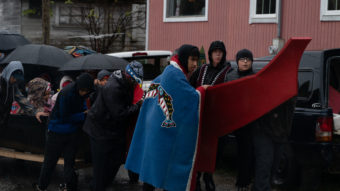
Celebration 2018 grand processional June 6, 2018, Juneau. Celebration hasn’t been celebrated in person since then due to the COVID-19 pandemic. (Photo by Adelyn Baxter/KTOO)
It has been 40 years since the first Celebration, which was hosted to celebrate the survival of Lingit, Haida and Tsimshian cultures.
This year, the theme is Celebration 2022: Celebrating 10,000 Years of Cultural Survival. This will be the first time the event has been in person since 2018, and after two years in a pandemic, the term “survival” is even more meaningful.
Sealaska Heritage Institute President Rosita Worl said that, especially before the vaccine, the organization was committed to keeping the community as safe as possible.
“We saw how [the pandemic] was affecting our elders,” Worl said. “And so the elders became kind of a symbol, a critical symbol for us of the survival of our culture.”
Worl said that this is something they’ve anticipated and planned for since the official decision back in January to host Celebration in person.
“We’re monitoring those numbers very closely,” Worl said.
The gathering has become a vital time for Southeast Alaska Native communities to connect, she said.
“Over 40 years, it is now significant for us to gather together to celebrate our culture,” Worl said. “You put that on top of all of these other events where we were not able to gather, and it becomes really important.”
Around 1,200 dancers are registered to perform, and Worl is expecting around 3,000 people to attend. This is smaller than the usual crowd of 5,000, but higher transportation costs and tight lodging options have prevented some from coming.
To limit spread during the events, all staff will be tested daily, temperatures will be taken at the door of each event, and masks will be required. Moderators will enforce the mask requirement.
Juliana Hu Pegues, author of “Space-Time Colonialism: Alaska’s Indigenous and Asian Entanglements.” (Photo courtesy of Juliana Hu Pegues)
Juliana Hu Pegues is a professor at Cornell University. Last year, she released a book called “Space-Time Colonialism: Alaska’s Indigenous and Asian Entanglements.”
Inspired by her experiences growing up in Juneau and hearing the history of Juneau through her family, she began researching local legends of Asian residents more in-depth.
She told KTOO’s Yvonne Krumrey that the book’s intention is to interrogate what histories are told — or not told — about Alaska Native and Asian people in Juneau.
This interview has been edited for length and clarity.
The cover of “Space-Time Colonialism: Alaska’s Indigenous and Asian Entanglements” by Juliana Hu Pegues. (Image courtesy of Juliana Hu Pegues)
How did you enter this field of study?
I really wanted to try to look at different communities of color and linkages. And also think about race, gender and sexuality in conversation.
I kind of quickly realized I wanted to also have indigeneity be really central to what I was doing. I’m now a professor and I teach primarily in race, indigeneity, gender and sexuality. And I’m really wanting to look at Asian American histories, Asian American cultural action in relation to Indigenous peoples, lands and knowledges. So that’s really how I think of my work now.
What in your research on Juneau did you find to be the most surprising or, conversely, validating based on your experience growing up here?
Well, I started with stories that I knew, stories that I had heard growing up. That was a lot of the way that I found the specific kind of histories that I would look at, for my book. I think in terms of Juneau, I want to think primarily around China Joe.
I had always suspected that there was more to the story, even though there’s a lot of the story that is told over and over around China Joe. Often people said he was the only Chinese in Juneau and, realizing that he wasn’t the only Chinese, that there were other Chinese immigrants who had come in and out of the city, through the years in his life.
It became clear that I wanted to look at the 1883 lynching of three Lingít men and how we don’t know that part of the history, the way that we know China Joe’s story and the driving out [due to the Chinese Exclusion Act] that happens only three years after.
I call it a lynching, because it was vigilante violence. Two of the men were hanged and one man was shot. The white miners of the town, 60 to 70 white men, collectively pulled on the hanging rope to avoid individual responsibility. So I want us to think about that. This wasn’t random. It wasn’t bad apples. This was the functioning of the town. These are the foundational violences of the town and I want us to think about that, right?
And that was both surprising to learn about, and sort of unsurprising, and thinking about the long history of frontier towns and unfortunately, frontier violence.
China Joe is a figure in ‘Space-Time Colonialism.’ Who was he?
I look at China Joe in two ways. I look at him as a historical figure. He is a Chinese immigrant who’s important to Juneau’s founding history. He came to Alaska as part of the Gold Rush period, originally in the 1870s, in Cassiar, in Canada, and then he was in Juneau by 1881. And he establishes the city’s first bakery, and he remains in Juneau for the rest of his life until he passes away in 1917. So we know about him as a historical figure. That’s pretty important, right?
People who grew up in Juneau and spend time in Juneau or even some folks who come off the tour ships will be familiar with the folklore: that he, in the 1870s saved starving prospectors during a winter freeze in the Cassiar mining district, present-day British Columbia, and Tahltan-Athabaskan homelands. There were prospectors who were trying to wait out the season. And it was a particularly bad one. The last steamboat didn’t arrive with provisions and people were starving. And China Joe the baker baked and saved everybody, right? And in some ways, it’s a Loaves and Fishes story. With his flour, he fed everyone and he saved prospectors.
Then the second part of his story is that, in 1886, when Chinese miners were driven out of Juneau, the old-time sourdoughs, those who remembered him from the Cassiar, protect China Joe, and don’t allow him to be taken and driven out. As the law would have it, he’s the only Juneau Chinese who’s allowed to remain in Alaska’s gold country. Right? That’s the folklore. I look at China Joe both as a historical figure and a folkloric figure. And I want to reconsider both the person and the mythology.
What impact has the tourism landscape had on Asian people living in Juneau now?
I think this is really important when we talk about which stories get carried forward to tourists. It redeems white male heroics. This time, in the service of one lone Chinese baker, it somehow redeems the city. It somehow redeems the founding of a town.