Yvonne Krumrey

Justice & Culture Reporter, KTOO

"Through my reporting and series Tongass Voices and Lingít Word of the Week, I tell stories about people who have shaped -- and continue to shape -- the landscape of this place we live."
Newscast – Tuesday, May 17, 2022

In this newscast:

  • Two bills that would tighten PFAS regulations are stalled in committee, and activists are worried,
  • The cruise industry and Pacific Northwest ports announced that they are working to try and eliminate gas emissions from cruising in the region,
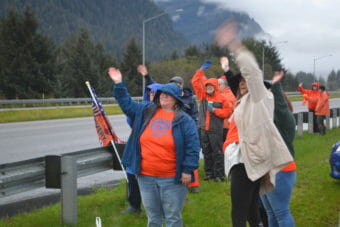
  • Demonstrators gathered on Ketchikan’s cruise ship docks on Saturday to show support for abortion rights,
  • The U.S. Coast Guard searched for an overboard cruise ship passenger today

The Ironman race is coming to Juneau, and the city asked residents to house athletes

The Flats neighborhood in downtown Juneau. (Lyndsey Brollini/KTOO)

There are around 1,500 participants signed up for the Ironman Alaska race in Juneau this August. Racers usually bring a few three to five support people, and so for about a week this summer, there will be few thousand people in need of housing.

The city has about 1,300 rooms in its hotels, inns and bed & breakfasts. So, to add capacity, TravelJuneau, the destination marketing organization for the city, came up with a plan to incentivize Juneau residents to go on vacation and rent their homes to athletes for a week. 

One athlete, Michael Bissell, says that he was late to the game when looking for a place to stay, but he got something arranged fairly painlessly. 

“I was looking at hotels for about two weeks,” Bissell said. “And after no luck there — like, seriously, none — I started on a Facebook page.”

The Facebook page for Ironman Alaska has an accommodation thread with over 700 comments.

“And then within 30 seconds, 30 minutes, I had two people who have messaged me already,” Bissell said. “It just took a couple of days to see what was best for me and my crew that was coming out.”

His crew is his mom, his brother and a friend. They’re paying $1,000 a night for four nights, and he’s still hoping his crew will help him with that. 

The comments on the Facebook thread started back in October, with people mostly looking for housing in Juneau during the race. 

In January, there were a lot of discouraged commenters saying that they were really struggling to find a place to stay. Shortly after, more and more renters began commenting on those comments, offering places to stay. 

Since then, there have been more comments posting places to stay than those seeking.  However, there are still some complaining about prices.

One comment reads: “Very frustrated that the only places I’ve found so far are 5 to 6 times more expensive than they are the week before or after… Figures people would cash in, but I can’t afford to pay $5,000 a week for an Airbnb studio…”

One of the Ironman Alaska Facebook page’s admins replied: “There’s making the most of a situation and then basically ripping people off. Sounds like that falls into the latter.”

Kara Tetley, with Travel Juneau, said that Ironman considered a lot of variables before settling on Juneau as its first Alaska race location, including hotel capacity.

“They came and they visited a couple of times,” Tetley said. “Different members of the Ironman staff would come in and kind of look at things.”

Travel Juneau has a page on their Ironman site telling Juneau residents how to register their businesses and how to qualify for a discount with Alaska Airlines for that week if they do.

Tetley said that the demand for housing during the event seems to have been quelled.

“From what we can understand, there was some concern in the beginning, just because they kind of wanted to get everything settled right away,” Tetley said. “But it’s really quieted down, and it seems like a lot of athletes are set up or not as concerned about that anymore.”

City and Borough of Juneau finance director Jeff Rogers says the city doesn’t track the number of rental units. They only have the number of businesses registered in the short-term rentals category, which is 170. 

“I’m not even sure I’d have a good way to know how many of those are people who may just be registering for, you know, the sole purpose of a week for Ironman,” Rogers said. “Even if we had seen, and I mean, I would guess we’ve seen a lot of new registrations this spring. But they may or may not have anything to do with Iron Man.”

Neither Tetley nor Rogers have any way to tell if some of the people who are registering businesses as short-term rentals will continue to rent out their places after the Ironman. 

It’s also still uncertain that everyone coming into town will have a place to stay, though the accommodation thread bodes well for those still looking. 

In the meantime, Bissell will be training and preparing for some of the race obstacles that are more unique to Alaska.

“Yeah, I guess I’ll be running with some bear spray,” Bissell said.

The first paragraph of this story has been modified to clarify how many people are coming to Juneau for the race. The number of hotel rooms available in Juneau has been corrected. And finally, a previous version of this story had Kara Tetley’s name misspelled. 

Newscast – Monday, May 16, 2022

In this newscast:

  • The Alaska Senate passed a bill that would recognize the state’s 229 federally recognized tribes,
  • Skagway is moving ahead with a public vote to determine whether SEARHC will purchased its medical clinic,
  • A heavy snowpack led to more wildlife deaths in the eastern Interior this winter, and the snow melting is creating further issues,
  • Alaska coal miner and philanthropist Joseph E. Usibelli died last week

Newscast – Friday, May 13, 2022

In this newscast:

  • A Central Council of Tlingit and Haida Indian Tribes of Alaska Former Chief Justice has been appointed to the Not Invisible Act Commission,
  • Last fall, a company left two barges to freeze in Y-K Delta rivers, and one has dislodged and become a floating ghost barge,
  • Alaska Native Tribal Health Consortium held a carnival to celebrate their nursing staff

Newscast – Thursday, May 12, 2022

In this newscast:

  • Sen. Jesse Kiehl was the only member of the judiciary committee to move to vote against an anti-trans youth athlete bill,
  • Two pairs of Vans sneakers designed by Wrangell High School students have made it to the top 5 in a competition,
  • The Iditarod Trail Committee has partially reversed its penalty for two mushers who sheltered their dog team during the race

Former Tlingit & Haida chief justice appointed to national commission on missing and murdered Indigenous people

A group gathers at the steps of the Alaska State Capitol in Juneau on May 5, a national day of awareness for missing and murdered Indigenous People. (Photo by Paige Sparks/KTOO)

Central Council of Tlingit and Haida Indian Tribes of Alaska former chief justice Michelle Jaagal Aat Demmert has been appointed to the Not Invisible Act Commission. 

According to the Department of Justice, the commission was created to “combat the epidemic” of missing and murdered Indigenous people. Secretary of the Interior Deb Haaland announced the commission on May 5, Missing and Murdered Indigenous Peoples Day.

“This is not an easy commission to be part of, we will have to take testimony we will have to hear stories,” Demmert said.

She anticipates that these testimonies from victims’ families will make her eager to see change enacted quicker.

“And of course, you know, as a problem solver, what I want to do is help find solutions,” Demmert said. “And I may not be able to immediately respond in that way.”

She said she expects she will need support from elders, which the commission lacks right now. 

“Missing from the commission, I think, is a named tribal elder who could really hold space for us in, send us off in a good way,” Demmert said. “And also, you know, just help us. Because this is going to be really, this is going to be really hard.”

When the commission meets for the first time in two weeks, Demmert says they plan to start broadly in their look at communities impacted by high rates of missing and murdered Indigenous people. She says they will look into systemic issues and why those led to the crisis.

“And of course, it’s not an easy ‘why’ to answer because it’s a historical factor. And so we have to acknowledge the issues that led us to this situation,” she said.

From there, the commission plans to look at using research to influence and shape policies, and improve communication between tribal, state and federal resources.

The commission has 37 members that include tribal leaders, survivors, families of those who have been missing and murdered, and law enforcement.

Site notifications
Update notification options
Subscribe to notifications