Yvonne Krumrey

Justice & Culture Reporter, KTOO

"Through my reporting and series Tongass Voices and Lingít Word of the Week, I tell stories about people who have shaped -- and continue to shape -- the landscape of this place we live."
Juneau rallies for Ukrainians: ‘We are here, but our soul, our mind and hearts are there’

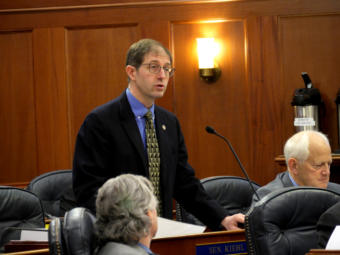
A group of about 40 people gathered at Marine Park in solidarity with Ukraine on Saturday, Feb. 26, 2022 in Juneau. Russia invaded Ukraine on Feb. 22, touching off protests within its border and around the world as well as widespread economic sanctions and a buildup of troops in nearby NATO countries. (Photo by Yvonne Krumrey/KTOO)

With just a day’s notice, dozens of Juneau residents gathered on Saturday afternoon in their winter gear at Marine Park Pavilion, carrying blue and yellow and wearing “Alaskans Stand with Ukraine” and “#JuneauStandsWithUkraine” buttons.

Nick Moe organized the rally along with Lisa Denny. 

“I think we’ve all been watching the news, the horrible things that have been going on,” he said. “A friend sent me the TikTok video from a young woman in Ukraine, in a bomb shelter, pleading for the international community to do something and organize protests. And we thought, we got to do it, we’ve got to do it here in Juneau.”

Russia attacked Ukraine on Feb. 24, sending thousands of people fleeing into neighboring countries and others arming themselves to fight. Videos of tanks and bombs and the experiences of people in Ukraine taking shelter from the fighting have spread far and wide. 

Moe spoke to the experience of doomscrolling this invasion — witnessing the conflict from afar via social media — and the need for collective action.  

“I think it’s really important, we get off our phones, get off the TV screen, and build community,” he said.

Seventeen-year-old Viktor Tkachenko took the mic to share his pride in his hometown of Rivne in western Ukraine, where he moved from just a year ago. 

“You can’t even imagine how much it means for my Ukrainian friends — every person going out there … and trying to do outreach and support — and how much it means that you are here,” Tkachenko said. “My best friend’s brother, he’s 13, and his friends and him are running around looking for marks from Russian soldiers on the ground and under buildings. And those marks are for rockets. And in my home city in the last 24 hours. It was seven sirens telling about planes with bombs coming to our city. It’s just scary.”

He said he has been trying to coordinate his friends across Ukraine to get to safety, pairing those who have cars with those without transportation. 

“It’s at least something that I can do because it’s impossible to sleep, to eat, to be calm now,” he said. 

Tkachenko was there with his mother Svitlana Bell and grandmother Valentyna Matviichuk. Svitlana came to Juneau 7 years ago and was able to relocate her children to Juneau last year. Her 69-year-old mother arrived a month ago.

Bell said she’s glad to be in Juneau, but the family is  still very connected with their home in Ukraine.

“We are here, but our soul, our mind and hearts are there. Especially these days. We have our families there, and a lot of friends there. And I want to say that Ukrainians, they are extremely kind, extremely patient, and extremely hard workers. But never make them mad. They fight hard. And I’m proud that a lot of the world stands with Ukraine,” Bell said. 

Juneau State Sen. Jesse Kiehl called the invasion “Vladimir Putin’s aggressive war, a war of empire, a war that is a land grab, a war based on lies.”

Anchorage Sen. Tom Begich weighed-in, too.

“Look into each other’s eyes and remember we are neighbors who love each other and care about each other,” he said. 

For Moe and Denny, it was important that Tkachenko and his family, as well as people experiencing the violence directly in Ukraine, know that Juneau cares about what is happening. 

This is the first event that Denny has organized.

“Yeah, no, we don’t have an organization. We’re just two individuals that care a lot and wanted to show support,” she said. 

Denny said they wanted to act quickly, even if that meant giving short notice for the rally. 

“Nick and I were just very deeply moved by the conflict that has broken out. And we wanted to respond to the Ukrainians’ call that we protest in solidarity with them. This is our response,” Denny said.  “We’re saying, ‘Hey, we see you, we hear you, we love you. We hope the best for you.’ We hope for peace for everyone involved. And we’re taking a stance to support them, and spread awareness. To say there’s people here in Juneau give a f—.”

Moe said they are collecting ideas of further ways to support Ukraine from Juneau and want people to stay connected to continue to engage with supporting those impacted by the Russian invasion of Ukraine. 

Correction: Svitlana Bell’s first name was misspelled in an earlier version of this story.

Newscast – Friday, Feb. 25, 2022

In this newscast:

  • The man who was shot at by a Juneau police officer shares his experience,
  • Juneau Police Department has released the the name of the officer involved in that shooting,
  • An Alaska House member proposed taxes in retaliation to a proposed Washington state tax on exported fuel,
  • Alaska’s congressional delegation condemned Russia’s attack on Ukraine with mixed comments on President Biden’s response

Newscast – Wednesday, Feb. 23, 2022

In this newscast:

  • The Alaska Legislative Council voted to drop the State Capitol’s mask mandate today,
  • A two-sided totem pole is being carved in Juneau to represent the Lingit, Haida and Tsimshian tribes,
  • Alaska may finally sell a ferry that hasn’t sailed in two years,
  • Ketchikan residents found a fanciful way to celebrate 2/22/22,
  • The Biden administration is reeling back permission for Ambler Road, which would support mining in Northwest Alaska,
  • Another Ketchikan resident has died of COVID-19, bringing the city’s death toll to 21

Newscast – Tuesday, Feb. 22, 2022

In this newscast:

  • The Juneau School District has narrowed its search for a new principal down to three candidates,
  • The state Senate will soon vote on legislation that would change the PFD formulas,
  • Juneau’s Barnacle Foods is able to recover most of the products in its warehouse collapsed from snow,
  • This year’s Iditarod has a thorough COVID prevention plan

Historian details Alaska’s legacy of racial segregation

Photograph of Governor Egan signing the Human Rights Act. Identified are left to right Sen. Mike Gravel, Dick Hedberg-AFL-CIO, Maria G. Bowman and Willard Bowman-NAACP. (Photo courtesy of the William A. Egan Papers, Elmer E. Rasmuson Library, University of Alaska Fairbanks, (UAF-1985-120-555)

Photograph of Governor Egan signing the Human Rights Act. Identified are left to right Sen. Mike Gravel, Dick Hedberg-AFL-CIO, Maria G. Bowman and Willard Bowman-NAACP. (Photo courtesy of the William A. Egan Papers, Elmer E. Rasmuson Library, University of Alaska Fairbanks, (UAF-1985-120-555)

Stories of housing discrimination in the 20th century are often set in the lower 48, but Alaska has its own legacy of racial segregation. In his book “Black History in the Last Frontier,” Ian Hartman outlines how racial segregation looked in Alaska compared to the rest of the country.

For example, housing covenants in Anchorage and Juneau prohibited the sale of houses to anyone who wasn’t white. In some instances, they were specifically written to exclude Black Alaskans and Alaska Native buyers. And in some areas, those historical boundaries impact the ways that neighborhoods look today.

“In Juneau, again, with with the largest minority population being Alaska Natives, you’d probably find very explicit references forbidding the sale of a home to anyone who was not of quote ‘Caucasian extraction’ or whites only are able to sell or whatever the case would be. And then there would be these exclusionary clauses that would encapsulate the various minority populations,” he said.

Black History in the Last Frontier
Book cover of “Black History in the Last Frontier” by University of Alaska Anchorage history professor Ian Hartman.

Hartman is a history professor at the University of Alaska Anchorage. He said it took him some practice to know what to look for while he was looking through historical documents because the racial language was often extremely outdated.

“You have to kind of train your eyes to read these documents, but entire neighborhoods in Anchorage really bear the imprint of racially exclusive buying,” he said.

In 1948, the Supreme Court ruled that racial covenants like these were unconstitutional. That opened the door for Black families to move in. Hartman’s book details that in Anchorage, white supremacists burned down the homes of those pioneering Black families. Those fires, and the pushback from Black activists, led to the NAACP opening its first branch in Alaska in 1951.

In November of 1969, Ebony magazine printed an article saying Alaska’s prospects were open to Black Americans who were willing to work hard. However, the magazine also acknowledged that Black men were excluded from the fishing industry in Ketchikan, and Black Americans and Alaska Natives talked about encountering housing segregation in Juneau, Anchorage and Fairbanks.

Hartman’s book also details instances where Black Alaskans faced further discrimination and racial hostility in the 1970s and 80s as more and more white people moved to Alaska from the South and brought white supremacist views with them.

“I think that there’s a belief among Alaskans, right? The famous line, we don’t, we don’t care how they do it Outside, or, you know, we’re going to do it our own way. And that can have quite a costly impact on communities of color who may be steamrolled by the process — particularly again, in the Cold War era when Alaska really boomed in terms of its population. Then, of course, again, with the with the establishment of the trans-Alaska pipeline in the oil boom in the 70s,” he said.

But the 70s were also the time when Alaskans elected their first Black politicians.

The first Black state representative pushed for a committee to develop a survey on discrimination in Alaska — the group focused on Southcentral Alaska. Hartman details that final report, which showed high levels of housing segregation. It concluded that white residents had deliberately locked minorities out of the housing market and pushed them onto the least desirable land.

Hartman says he wrote the book after years of reading the same stories of the history of Alaska, which left out whole communities of people. And he says that while there’s a historical era of racial tension that has to be confronted, it’s also important to be realistic about the present.

“If you were to look at life expectancy, access to health care, access to quality education, generational transfers of wealth, things like that, I mean, you know, Alaska still does bear the imprint of the historical legacy of, of racism and racial inequality,” he said.

Hartman says he wants people who read his book to see the value in the state’s diversity. He’s expanding on his 2020 book with a new edition set to come out in the fall of 2022 “Black Lives in Alaska: A History of African Americans in the Far Northwest.”

Site notifications
Update notification options
Subscribe to notifications