Arts & Culture

‘Stories of Kake’ combines Lingít and English literacy with storytelling for students

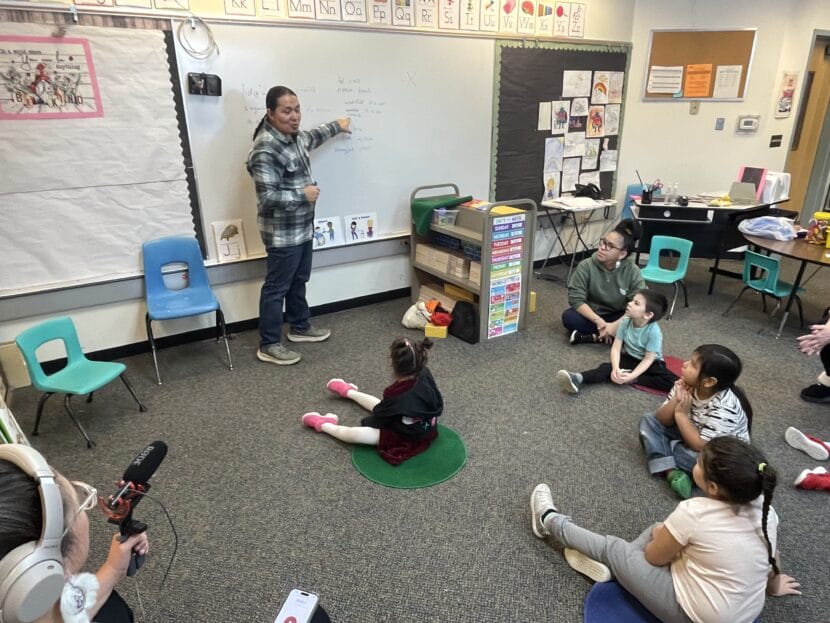
X̱'unei Lance Twitchell points at writing on a whiteboard in front of Pre-kindergarten students.
X̱’unei Lance Twitchell teaching pre-kindergarten students. (Photo courtesy of “Stories of Kake” team)

Listen here:

Learning a language is hard. Learning a language without a teacher regularly checking in is even harder.

But this year, Kake City School District students got the chance to learn Lingít while creating multilingual poems that give people a glimpse of where they come from.

“I am from the air — daséikw. Salty — li.éil’,” reads third-grader Jessica Padgett.Like summer. Like fish — xáat. Cold winter, like ice water — si.áat’i héen.”

Switching between English and Lingít, Padgett describes some sights and tastes of Kake in a poem about where she’s from.

This is part of “Stories of Kake,” a project where students from preschool to high school develop literacy skills in English and Lingít through storytelling.

Poems include descriptions of Kake through the five senses, including wildlife and food.

Third-grader Robert Wooten wrote about black bears in his part of the poem.

“I am from black bears —  s’eek,” he reads. “They’re always by my creek. They are big. They are black. t’ooch’ yáx̱ yatee. They eat coho — l’ook. They eat humpies —  cháas’.”

These poems and more will be featured in a community event and an episode of “A Piece of Kake,” a podcast that features stories and culture of the people in Kake.

“Stories of Kake” began as a grant funded project to improve literacy for preschoolers in Kake, but it expanded to teach elementary and high school students Lingít through storytelling and poetry.

X̱’unei Lance Twitchell is an Alaska Native language professor at the University of Alaska Southeast. He’s the main language teacher for the project. Twitchell said he hopes to give students the skills to speak Lingít more in the community.

“Hopefully they’ll be able to share these words with each other and start communicating in the language with the language to one another, as we sort of try and create a transformation, where you create generations that just use the language more,” he said.

Padgett and the other students said their favorite part of the project was learning more Lingít. Padgett said they learned by making up movements for different words.

“We had music on and we just made up movements, and she said a word in Lingít and English, and we had to do the movement and walk around and do the movement,” Padgett said.

Ryan Conarro is one of the project leaders. He said having Twitchell there means he and classroom teachers are able to learn the language with the students.

“There’s a lot of enthusiasm in this school district for Lingít language, for project based learning. Lot of the classrooms have posters on the wall with Lingít language vocabulary, that the teachers are motivated and they also are looking for support,” he said. “And so we’re psyched that this project has provided some of that support, and that Sarah and I both come in and say, ‘Look, we’re like you. We’re also learning, but we’re going to try to be brave, and keep trying.’”

Sarah Campen is the other project leader and co-hosts the “Piece of Kake” podcast. She and Conarro are learning Lingít together alongside teachers and students with the project as Twitchell teaches the language. Campen said learning, making mistakes and improving together with students makes them more willing to try and improve. She said that’s shown in the podcast.

“One of my favorite pieces, is two students working with X̱’unei and working with Ryan, and saying some words over and over again, and just trying and practicing and not getting it quite right, but practicing and just seeing that evolution over time is so fun, because eventually we get better,” Campen said.

Kake City School District will hold the showcase at the school this Wednesday at 3:15. Campen said the podcast episode “Goodáx Xát Sáyá? / Where Am I From?” is expected to come out on the same day.

Correction: this story has been updated with the correct spelling of certain Lingít words.
Lingít Word of the Week: Atx̱aan Hídi — Smokehouse

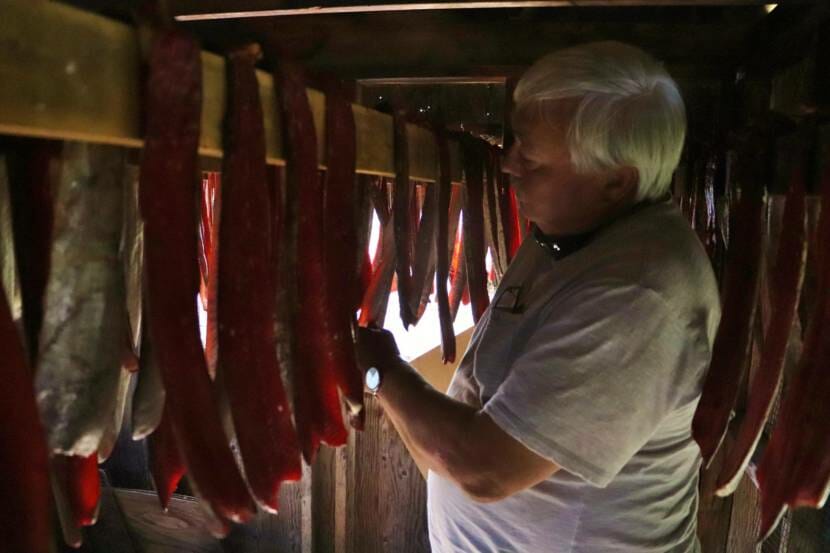
Gene Carlson checks red salmon strips in his smokehouse. July 16, 2021. (Izzy Ross/KDLG)

This is Lingít Word of the Week. Each week, we feature a Lingít word voiced by master speakers. Lingít has been spoken throughout present-day Southeast Alaska and parts of Canada for over 10,000 years.

Gunalchéesh to X̱’unei Lance Twitchell, Goldbelt Heritage Foundation and the University of Alaska Southeast for sharing the recorded audio for this series.

This week’s word is atx̱aan hídi, or smokehouse. Listen to the audio below to learn how to say atx̱aan hídi.

The following transcript is meant to help illustrate the words and sentences. 

Kaxwaan Éesh George Davis: Atx̱aan hídi. 

That means smokehouse.

Here are some sentences:

Kaxwaan Éesh George Davis: Atx̱aan hídi áx̱ ashayaawatée du xaadí. 

He hung his fish in the smokehouse.

Keihéenák’w John Martin: Lingít x̱áat has ax̱ʼán nooch atx̱aan hídi ax̱ has aléiyix̱.

People always make dry fish in the smokehouse by putting it up high.

Keiyishí Bessie Cooley: Atx̱aan hídi yeix̱ ashaayawatee wé tʼá.

They hung up the king salmon in the smoke house

Kooshdáakʼu Bill Fawcett: Ḵúnáx̱ áwé ya’kéi wé x̱áat atgaxtoox̱’aan atx̱aan hídi.

It’s very good, the fish that was smoked in a smokehouse. 

Ḵaakal.áat Florence Marks Sheakley: Atx̱aan hídixʼ yakʼéi wé sʼeiḵ.

The smoke used in smokehouses is good.

You can hear each installment of Lingít Word of the Week on the radio throughout the week. 

Additional language resources:

Find biographies for the master speakers included in this lesson here.

Learn more about why we use Lingít instead of Tlingit here.

Watch a video introducing Lingít sounds here.

‘Molly of Denali’ will stop producing new content after fifth season airs

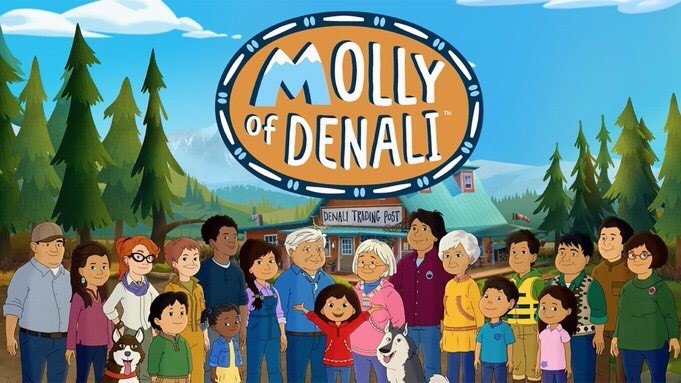
Molly of Denali (Image courtesy of PBS Kids)

The next season of the PBS KIDS show “Molly of Denali” will be the last for the foreseeable future. 

The team behind the award-winning children’s TV show will stop working on new content. Molly of Denali is widely celebrated in Alaska because it features an Alaska Native lead character and showcases Indigenous culture.

This comes as the Trump Administration is cracking down on federal funding for NPR and PBS. But Alaska State Writer Laureate Vera Starbard, who is a writer and story editor for the show, said that’s not the full story.

While she and other writers knew the decision was in the works before the presidential election last year, she said they didn’t get the official announcement until last week. And she said she doesn’t think there’s just one reason for the decision.

“What I don’t want is for a show this great and this exceptional to be put into this very polarized political lens of ‘it’s x person that did it. It’s this x action that did it,’” she said. “It’s actually a lot of sort of typical television reasons combined with, ‘yes, I do think [the] funding atmosphere that has been tough for a while, political atmospheres, those all for sure contribute to the much bigger reasons.”

This isn’t the end for the show though. GBH produces “Molly of Denali.” In an email, a spokesperson wrote that there’s still another season that will air, but that PBS KIDS is not commissioning another season of the show.

“Molly of Denali” premiered in 2019 and was the first nationally distributed children’s program to feature Indigenous main characters. The show won its first Emmy Award earlier this year for an episode written by Juneau resident X̱’unei Lance Twitchell. He and Starbard are among several Alaska Native writers who contributed to the show during its run. 

Starbard said the news is bittersweet.

“It was just sort of a mix of emotions, hearing about it, being proud that we accomplished this thing all together, at the same time knowing it’s potentially over,” she said.

PBS confirmed new “Molly of Denali” episodes will continue to air through the next year and beyond. The show’s library of episodes, podcasts and games will still be available to people in the coming years.

Federal government may soon return tribal land to Douglas Indian Association

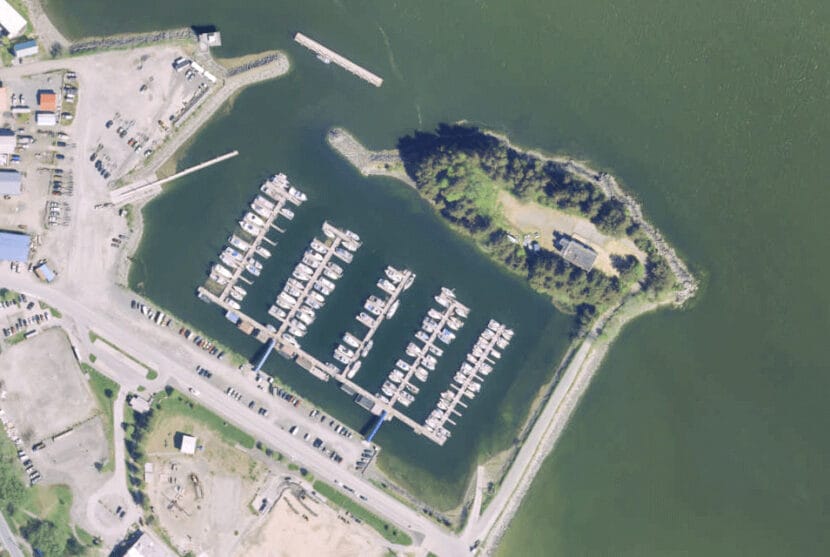
Mayflower Island viewed from Gastineau Channel on Saturday, March 23, 2024. (Photo by Clarise Larson/KTOO)

The federal government may soon return a traditional subsistence site connected to Douglas Island to its original tribal owners. 

Mayflower Island is a small, 3-acre island adjacent to Douglas Harbor and Sandy Beach. It’s connected to Douglas via a short road and sits near the site of the former Douglas Indian Village, which Douglas’ city government burned in 1962. The City and Borough of Juneau formally apologized for the burning last fall.

At a Juneau Assembly lands, housing and economic development committee meeting earlier this week, members gave initial approval for a plan that would acquire the island from the federal government and then give it to the Douglas Indian Association. DIA officials did not respond to a request for comment. 

Dan Bleidorn, the city’s lands and resources manager, said this is a plan that has been years in the making. 

“This is on the list of 2025 Assembly goals for community wellness and public safety. The goal states to ‘support Douglas Indian Association’s efforts to acquire Mayflower Island,” he said. 

This is an aerial photo of Mayflower Island. (Courtesy/City and Borough of Juneau)

The island once served as a traditional subsistence site and yielded a herring run and spawn used by the Douglas Indian Village. The DIA is currently in the process of building a cultural learning center at the former site of the village.

According to the U.S. Bureau of Land Management, the property has been under the federal government’s stewardship since 1890. The island was originally reserved for the U.S. Navy to use as a naval station. But, in 1948, it was transferred to the Federal Bureau of Mines, which built a mineral laboratory on the site to process ore samples for research. 

The BLM took over the property in 1996 when Congress closed the Bureau of Mines. The U.S. Coast Guard also used the site under an agreement with the BLM, but that ended in 2023. 

Bleidorn said the actual property transfer is likely still a few years out. But the Assembly’s approval is the next step in moving that process along. The resolution will still need to come before the Assembly for final approval.

Juneau Arts and Humanities Council director resigns after organization cuts DEI language from its website

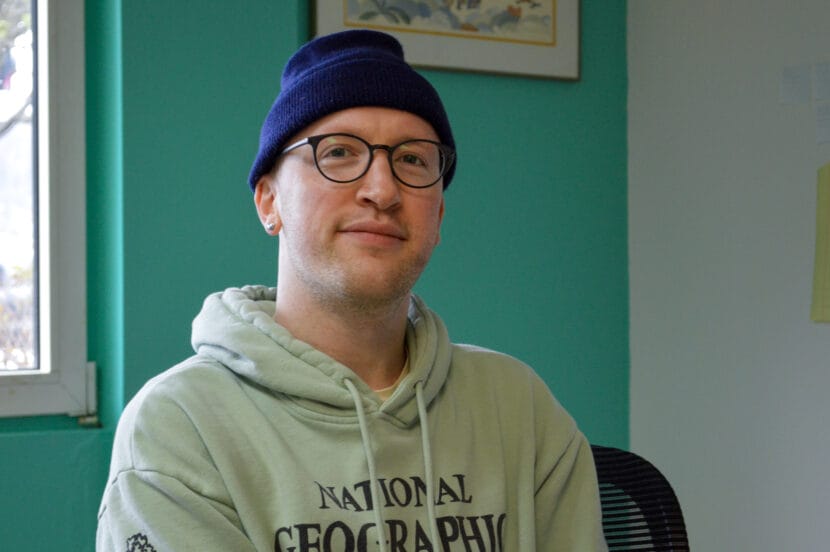
Phil Huebschen at their office on May 6, 2025. (Photo by Yvonne Krumrey/KTOO)

The executive director of the Juneau Arts and Humanities Council will resign following the board’s decision to cut diversity, equity and inclusion language from its website.  

The organization announced Monday that Phil Huebschen is leaving the nonprofit after two years.

“I found myself unable to authentically engage in implementing the decision of the board,” Huebschen told KTOO.

The board says its February decision to cut DEI language from the website is temporary, in the hopes that it would help the JAHC continue to receive federal grants. It comes in response to the Trump administration’s threat to cut funding to organizations that use DEI language in their programming. 

The board plans to rearticulate and restore the language at a later date. 

Several local arts and culture organizations have been impacted by canceled federal grant funding unrelated to DEI language. 

Huebschen said they understand the board’s decision. 

“Both options it was faced with were poor options, frankly,” Huebschen said. “One of them was to potentially lose critical funding for programs that are very strategically important for the JAHC, and the other was to just completely comply with federal directives, which is very much against our mission, our vision, our values, all of it.” 

The JAHC board released a statement Wednesday that explained its reason for removing the language, and said the decision wasn’t unanimous.  

“The very purpose of these directives from a federal level is to create lateral conflict,” the statement reads. “We understand experiencing anger surrounding these decisions, but do not want this to pit the JAHC against the communities we serve.”

Huebschen said that the federal grant funding in question makes up about 15% of the JAHC’s budget, and it’s not money that can be easily replaced. 

“I’ve heard people comparing the JAHC to Harvard – the JAHC does not have a $53.2 billion endowment,” they said. “We do not have a pillow of funding, flexible operational funding that can fill in that gap. So if that money were to go away, those programs disappear. And we cannot fund them.”

As of Wednesday, Huebschen said they don’t know if the nonprofit will get the grants anyway. Their last day as executive director will be May 14.

Juneau organizations react to sweeping federal grant cuts to arts and culture programs

Actors Ben Brown, Travis Clark Morris, Kristen Rankin and Lauren Parkinson perform a scene from “The Thanksgiving Play” at Perseverance Theatre. (Photo Courtesy/Frank Delaney)

The Trump Administration has started canceling federal grants that fund arts and culture programs across the country, including here in Juneau. 

The cuts involve millions of dollars in grant funding doled out through the National Endowment for the Arts and the National Endowment for the Humanities. The president has also proposed eliminating the agencies altogether in his 2026 Discretionary Budget Request.

Among those affected locally are Perseverance Theater, Juneau Jazz and Classics, Sealaska Heritage Institute and the proposed Capital Civic Center in downtown Juneau. 

Frank Delaney, Perseverance’s managing director, said the theatre was among the hundreds of other art groups across the country that received an email from the NEA on Friday notifying them that their grants had been terminated. 

He called the Trump Administration’s actions short-sighted.

“They are misguided in what they think they are achieving,” he said. “I think that if the NEA does go away, America will be much worse off than it was with that program in place.”

Delaney said the email targeted a grant that had already been spent, and it’s unclear if the theatre will have to repay that money. He said the broader implications of the cuts and program terminations will have a chilling effect on the local arts community.

The nonprofit that is backing the proposed Capital Civic Center says the project has also taken a financial blow. The long-proposed convention and arts facility in downtown Juneau is meant to replace the existing Juneau Arts and Culture Center. 

Bob Banghart, executive director of the nonprofit, said he received notice that the National Endowment for the Humanities canceled a $750,000 grant for the project a few weeks ago. 

He said, despite the news, he remains optimistic. 

“With the inexperience and incompetence demonstrated by this administration, we’re kind of hoping that things will flip again, because they flipped everybody else around,” he said. 

The center is estimated to cost up to $60 million. Banghart said the grant cancellation won’t stop the project from moving forward, but they’ll still have to find that money somewhere else. 

Sealaska Heritage Institute also confirmed the cancellation of grant funding from the National Endowment for the Humanities. A representative for the Juneau Arts and Humanities Council, Phil Huebschen, said they don’t yet know what losses the nonprofit could face from the grant cancellations.

Huebschen announced their resignation Monday.

This post has been updated. 

Site notifications
Update notification options
Subscribe to notifications