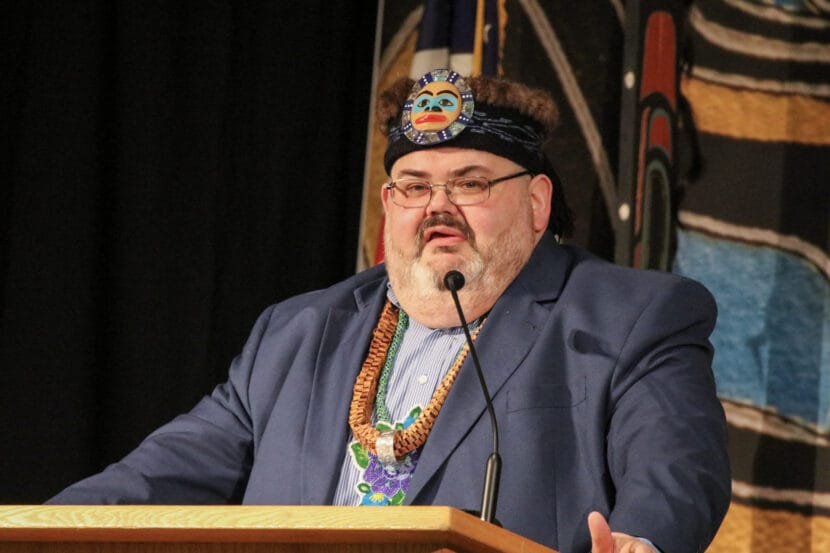
Chalyee Éesh Richard Peterson, president of Central Council of the Tlingit and Haida Indian Tribes of Alaska, speaks at the 90th annual Tribal Assembly in Juneau on Wednesday, April 18, 2025. (Photo by Clarise Larson/KTOO)
The Central Council of the Tlingit and Haida Indian Tribes of Alaska announced on Tuesday that it is rejoining the Alaska Federation of Natives.
The move comes almost exactly two years after the tribe withdrew its membership from the statewide Alaska Native organization over concerns that tribal voices were not being equitably represented.
In a written statement, tribal officials say the reversal is in response to the current political climate, which “demands greater unity among Alaska Native peoples.”
The decision was made by the tribe’s executive council. It comes a few months after the Fairbanks-based Tanana Chiefs Conference also rejoined AFN after withdrawing around the same time as Tlingit and Haida.
AFN has a membership of more than 200 tribes and corporations and promotes cultural preservation, political advocacy and economic development. Tlingit and Haida is Alaska’s largest federally recognized tribe.
According to the statement, the tribe says rejoining AFN is not a reversal of its concerns, but “a commitment to ensure that tribal governments have a seat at every table where decisions are being made.”
AFN also released a statement saying it is honored to welcome the tribe back.
Their return strengthens our collective voice and enhances our ability to advocate for the rights and needs of Alaska Natives,” said the organization’s president Benjamin Mallott. “Together, we can continue to make impactful strides toward self-determination and unity across our communities.”
Tlingit and Haida recently concluded its annual tribal assembly last month. The topic of rejoining AFN was not an agenda item. The tribe’s president was not immediately available for comment.
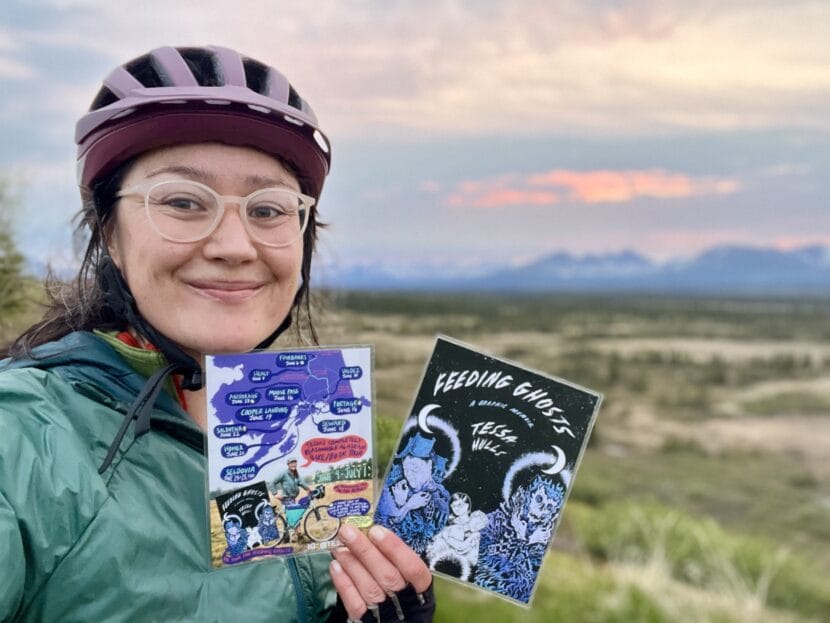
Artist and author Tessa Hulls published the graphic memoir Feeding Ghosts last year. It chronicles her family’s history with political oppression and mental illness. (Photo courtesy of Tessa Hulls)
A Juneau-based author’s graphic memoir won a Pulitzer Prize on Monday for autobiography and memoir.
Tessa Hulls spent close to 10 years writing — and drawing — what would become “Feeding Ghosts.” KTOO interviewed Hulls last month about the memoir.
“I didn’t feel like I had a choice,” she said. “My family ghosts literally told me I had to do this.”
The story is detailed, and meta. It isn’t a quick read. Every page takes time to digest.
It’s the story of her grandmother’s life, and how she lived through the Maoist revolution in Shanghai and chronicled her experience in a book after she fled Hong Kong.
“And for her, writing was the way in which she tried to assert her own reality, even as she watched the government take over and deny everything that was happening,” Hulls said.
Soon after publishing her memoir, Hulls’ grandmother began to lose her sense of reality, and the story follows her daughter — Hulls’ mother — and eventually Hulls herself, as they travel to China and Hong Kong, piecing together their family history.
“So the places where there weren’t clear answers, I forced that uncertainty on my reader and said, ‘look, it’s kind of a choose your own adventure here,’ because there’s no way to actually discern what actually happened, and here are the competing narratives,” she said. “And I leave it up to you to decide what path to take through it.”
Hulls has lived in and out of Alaska for years. She would alternate seasonal work for the state with jobs in restaurant kitchens, and take a couple of months for an extended bike trip in between.
That pattern stopped about a decade ago, when Hulls felt a deep calling to start the project that would eventually become her memoir. Now, in the wake of this project, she’s living in Juneau and working at the Alaska State Capitol.
Hulls is launching the softcover version of “Feeding Ghosts” Tuesday at 5:30 p.m. at Alaska Robotics Gallery.
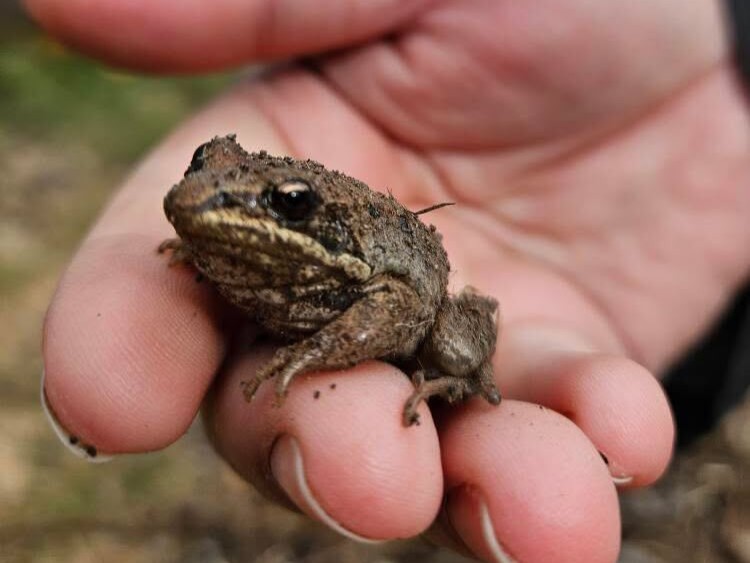
A hand holds a wood frog fresh out of winter hibernation. (Photo by Toben Shelby/Alaska Public Media)
This is Lingít Word of the Week. Each week, we feature a Lingít word voiced by master speakers. Lingít has been spoken throughout present-day Southeast Alaska and parts of Canada for over 10,000 years.
Gunalchéesh to X̱’unei Lance Twitchell, Goldbelt Heritage Foundation and the University of Alaska Southeast for sharing the recorded audio for this series.
This week’s word is xíxch’, or frog. Listen to the audio below to learn how to say xíxch’.
The following transcript is meant to help illustrate the words and sentences.
Kooshdáakʼu Bill Fawcett: Xíxch’.
That means frog.
Here are some sentences:
Kooshdáakʼu Bill Fawcett: Ḵunax̱ áwé shayadihéin wé xíxch’.
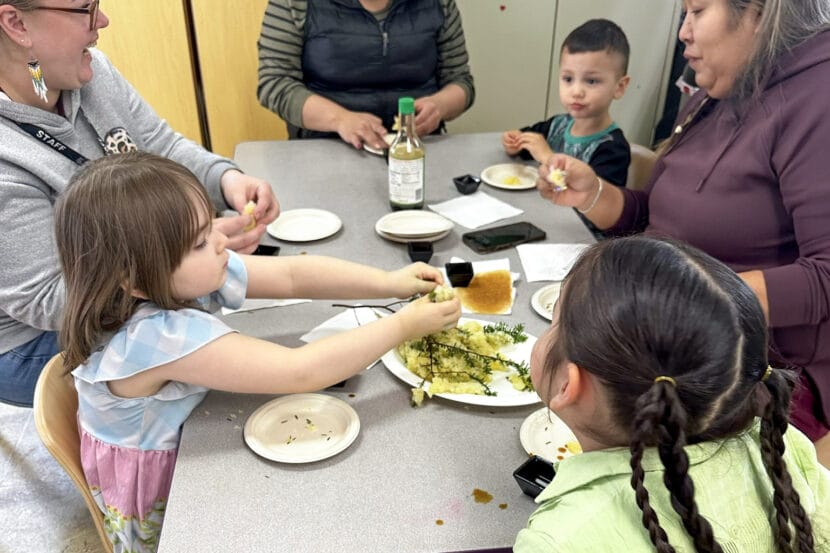
Hoonah Head Start students try herring eggs. (Courtesy of the Central Council of the Tlingit and Haida Indian Tribes of Alaska)
Springtime is herring egg season in Southeast Alaska. Usually that means that the region’s largest tribal government would be setting up to deliver tens of thousands of pounds of the traditional food to tribal citizens across the region and beyond.
But this year, those distributions won’t happen.
The Central Council of the Tlingit and Haida Indian Tribes of Alaska announced this week that its annual traditional food distributions were canceled this year. In March, the federal government canceled a funding agreement with the tribe.
For the last three years, the tribe distributed herring eggs, salmon and black cod to tribal citizens in each of its recognized communities — from villages in Southeast to cities like Anchorage and Seattle.
But the U.S. Department of Agriculture canceled funding that provided the tribe’s food assistance program. A USDA notice to Tlingit and Haida said that the tribe’s community food distributions “no longer effectuates agency priorities and that termination of the award is appropriate.”
Aaron Angerman is Tlingit and Haida’s food security program manager. He said the community distribution program started in 2022 to promote self-sufficiency, and to reduce reliance on food shipped from the Lower 48.
“Our answer to that, and then our heavy reliance on barge systems and things like that, was to turn back the clock a bit about food sovereignty, which is something that our people have relied on since time immemorial,” he said.
The tribe planned to use more than $500,000 from the USDA for the distribution. The money was allocated to the tribe in January, but USDA sent Tlingit and Haida a notice in March that said the agreement had been canceled.
The money was part of a program called the Local Food Purchase Assistance Agreement which was intended to encourage local governments to buy from farmers and food producers.
And that aligned with the tribe’s goal to keep more traditional foods that are harvested in Southeast Alaska in the fridges and freezers of tribal members.
“For us to be able to take a food that was purchased from commercial vendors, to contract those vendors who are tribal citizens, to keep not only that funding within the tribe and the region,” Angerman said. “But also take a food source that was harvested in our area and typically sent overseas to bring that food back to our people and to be shared.”
The herring egg distribution is special for this reason: because of overfishing and exporting of herring and herring roe, the fish now only spawn in very limited areas.
Angerman said his team is working to get more secure funding. But there’s a lot of other work they are doing to further the understanding and use of traditional foods in the meantime.
“We need to work with elders and those with traditional ecological knowledge to see why and where and how we harvested previously,” he said. “Then to not only do that, but to teach people how to harvest themselves, how to process that food, how to put up or prepare that food.”
Because, he said, if a salmon ends up on someone’s doorstep, and they don’t know how to process it, that isn’t food sovereignty.
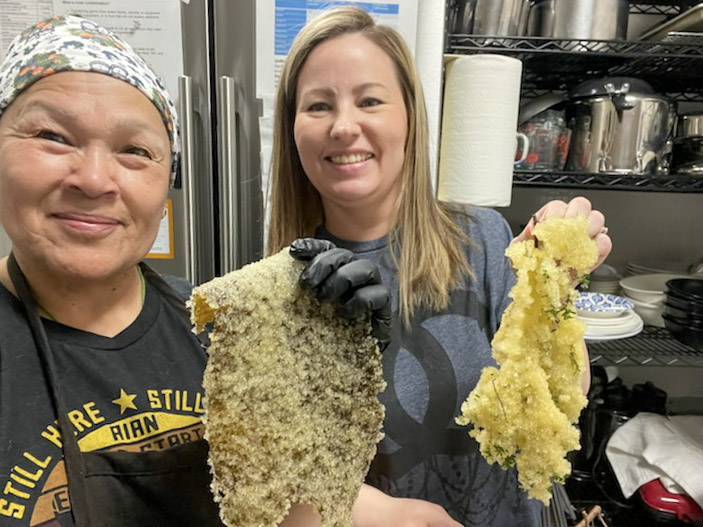
Sitka Head Start Teacher Aide Carolyn Moses and parent Evelyn Edenshaw hold up herring eggs they prepared for Head Start preschool students. (Courtesy of the Central Council of the Tlingit and Haida Indian Tribes of Alaska)
Angerman said Tlingit and Haida was able to purchase enough herring eggs to bring to some of their tribally-run and federally-funded Head Start preschool classrooms this year, so the youngest tribal citizens can still learn about the importance of traditional food and land stewardship.
And some distributions in Washington and Oregon will still happen, according to the tribe’s release. The local tribal council in Seattle used different funding sources to set aside money for distributions to reach elders outside of Alaska.
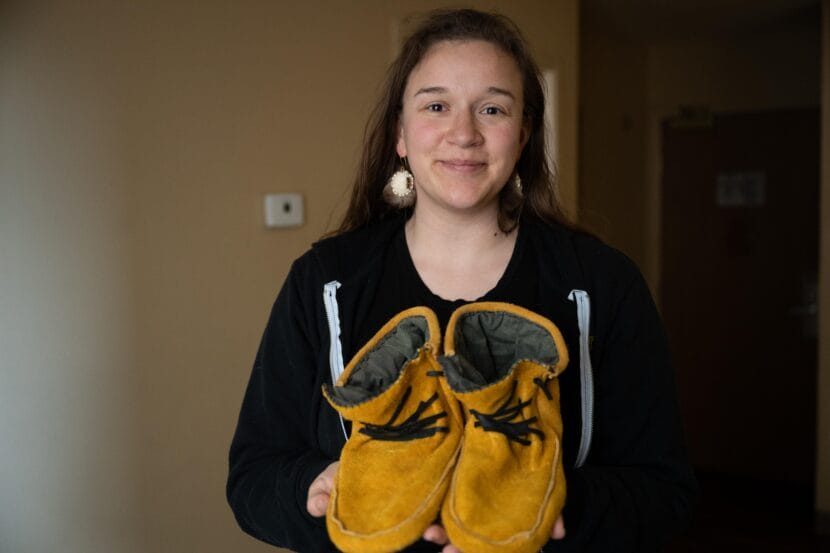
Reine Pavlik holds hand-sewn moccasins in April 2025. (Matt Faubion/Alaska Public Media)
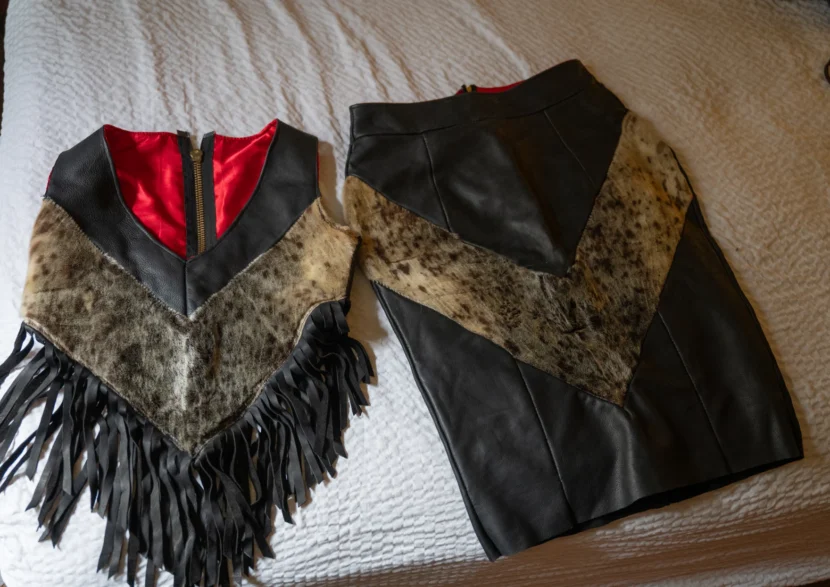
Reine Pavlik sorted through a large collection of her latest work. She pointed to a pair of jeans with seal skin flare, a women’s suit made of deer skin and seal hide and several more hand-made pieces of clothing. Many of the pieces had ornate beading.
“Sometimes I feel like beading a straight line is really hard,” she said, holding up a pair of hand-sewn moccasins. “This pair of moccasins is made with deer and moose skin.”
Skin sewing, or hide sewing, and bead work are vital art forms in Southeast Alaska’s Lingít culture. Pavlik, who is from Yakutat, is blending those art forms with contemporary style.
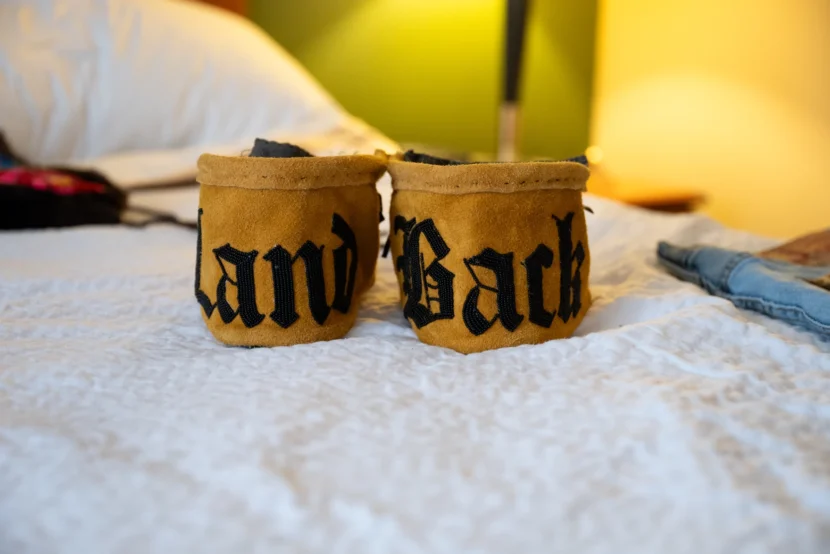
She turned over the hand-sewn moccasins, revealing beadwork on the back.
“I feel like I can see my progress in my beadwork,” she said. The beaded letters read “Land Back” in an Old English typeface. “Behind these moccasins is ‘Land Back,’ which is a message for the world we live in today to hopefully give Indigenous peoples their land and sovereignty and right to stewardship.”
In beadwork, Reine Pavlik spells out “Land Back” on a pair of moccasins. (Matt Faubion/Alaska Public Media)
Pavlik said she grew up surrounded by artists.
“That was just always part of our lives is just doing art. It was just part of the activities that we did,” she said.
She first learned from her mother how to sew items like pillowcases and, for a while, she said that was all she knew how to sew. Few members of her family practiced skin sewing on animal hides like sea otter and moose.
But eventually, Pavlik learned skin sewing from her aunt, Jennie Wheeler. Wheeler is a Lingít artist who creates skin-sewing pieces, beadwork and spruce root weavings.
Wheeler taught Pavlik to make moccasins.
“Making moccasins really was a way to connect to my family and my ancestors,” she said. “I feel like it’s so ingrained in our family stories.”
Now Pavlik’s community knows her for her beadwork and skin-sewn garments. She said her art weaves together tradition with modernity, and is inspired by her Lingít heritage. That blending of old materials with new designs gives her work meaning and momentum, she said, describing the process as almost spiritual.
“Using the traditional materials and using it in a modern way feels like I’m honoring my ancestors but I’m also modernizing some of the ideas that people have attached to traditional materials,” she said.
Reine Pavlik designed and created this women’s suit made of deer skin and seal hide. (Matt Faubion/Alaska Public Media)
Sustainability is another way she connects to the traditional and she tries to only use materials from donations or thrift stores. She said she’s aware of the damage fashion causes to the environment and hopes people think twice before buying for convenience.
“I also kind of felt like it’s something that our ancestors would do is they’d use what is near us and make things out of what is close by,” she said. “So I felt like that was a good way to honor them.”
But keeping culture alive while making room for personal expression isn’t always easy, and Pavlik acknowledged the pressures facing Indigenous artists today. She said there is a push for Indigenous artists to modernize and step away from tradition. But, she said she is committed to exploring her own voice within the context of Lingít art.
“It just feels like something I’m supposed to do,” she said.
Pavlik said her art practice connects her to ancestral knowledge and traditions. It’s something her father noticed when she started skin sewing.
“There was sort of an excitement there for my dad to see that, like something that his mom knew how to do his daughter knows now how to do as well,” she said.
Pavlik said she wants to explore new ways to pass on her skills to the next generation by teaching others her crafts.
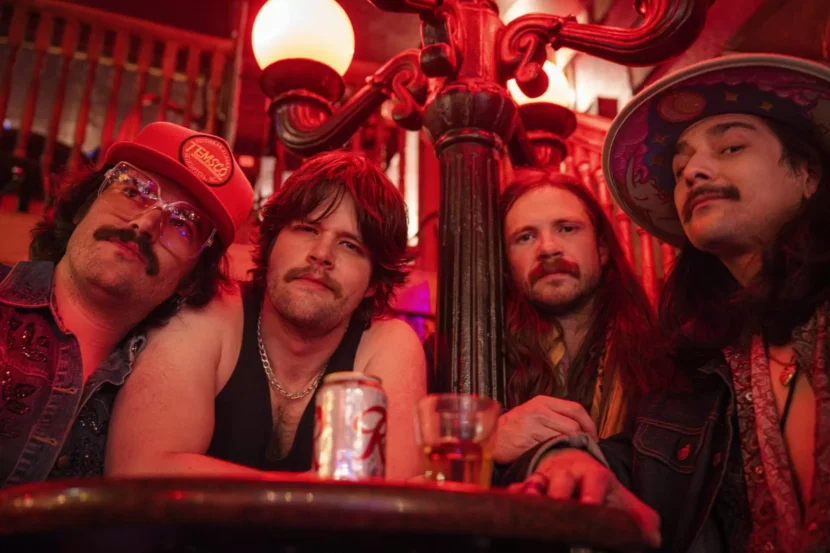
From L to R: Dude Mtn frontman Cullen McCormick, bassist Chazz Gist, Joel Forlines, and drummer Kalijah LeCornu at the Alaskan Hotel & Bar in Juneau. 2025. (Photo courtesy if Patrick Troll)
The Alaska Folk Festival wrapped up earlier this month in Juneau. The festival was celebrating its 50th anniversary. Pickers and folk fanatics flocked from all over the state and country and packed into Centennial Hall and other bars and stages around the Capital City.
Andrew Heist, the president of the festival’s board of directors, told the crowd on closing night that they’d had a record-breaking week selling Alaska Folk Festival merchandise. And they weren’t the only ones that broke records during the festival.
Ketchikan band Dude Mtn headlined shows at the Crystal Saloon and the Alaskan Bar. The shows, which also featured Juneau pop-punk band the Rain Dogs, broke both bars’ all-time records for alcohol sales.
Its been a big year so far for the psychedelic rock trio. They have a live album in the works, recorded during a show at the Mean Queen pub in Sitka, and a headlining gig lined up at Southeast Alaska State Fair in Haines this summer.
Front man Cullen McCormick, bassist Chazz Gist, and drummer Kalijah LeCornu sat down with KRBD’s Jack Darrell to talk about their run in Juneau and the ups and downs of trying to tour in Southeast Alaska.
Note: This interview has been edited for length and clarity.
Jack Darrell: So you guys are fresh off of Folk Fest. How was it?
Cullen McCormick: Well, it was the 50th Folk Fest, and it was legendary. A lot of cool people. We got to hang out with all of our music homies from around Southeast Alaska and the Interior and all converge on one city. Everybody got to do their thing, and we got to watch people do their thing, and they got to watch us do our thing. It was super cool.
Jack Darrell, KRBD: So you guys broke a couple records with beer sales. What does that look like? Was it just tearing down the house?
Cullen McCormick: One would think it’s maybe “tearing down the house,” but I think a lot of it has to do with just the vibe that’s going on in the room. Normally, the vibe that’s going on in the room when we’re playing is like –
Kalijah LeCornu: ‘Let’s drink some beer.’
Cullen McCormick: Sure, people drink beers, you know, or people drink whatever. But at the same time, we don’t put up with any weirdness. We make sure that we cultivate a specific vibe in our shows where everybody feels comfortable.
Jack Darrell, KRBD: This isn’t your first Folk Fest. Obviously, you guys have played a lot of shows, and at this point, have gotten it down to a bit of a science. Have you noticed the Alaska Folk Festival scene change over recent years?
Chazz Gist: Obviously, there’s gonna be a lot of folk music in Juneau for Folk Fest. So, us coming up there and having just a vastly different kind of sound has always been part of the draw. It was just a couple years ago when we first – we’ve been breaking records pretty consistently at The Alaskan at the very least. This is the first year that we broke both our own sales record at the Alaskan and also broke the record at the Crystal Saloon, which is usually held by another band also at Folk Fest.
We’ve just been doing very good in Juneau for a long time. And this was a bigger Folk Fest – the 50th annual. And so I think numbers are just bigger all around for everybody.
Jack Darrell, KRBD: Do you guys feel like the broader music scene in Southeast Alaska is different than when you started?
Kalijah LeCornu: People are paying more attention to it now. Everyone has been so artsy in Southeast Alaska. I feel like forever it’s been such a rich environment for people to create and everyone consumes in in Southeast Alaska. I think we just are more of a part of it now, which is a blessing. But no, I think the scene has been growing regardless of if we’re all along for the ride or not.
Chazz Gist: But interconnecting a lot more than it has in previous years.
Cullen McCormick: Oh, yeah. I think that has a lot to do with COVID. Like, back during COVID, everybody was kind of like, ‘Oh, dude, as soon as this is over, we’re gonna get out and we’re gonna do this, and we’re gonna do that.’ Then COVID ended, and everybody was like, ‘All right, yeah, we are getting out and doing this.’
That’s when this band started. During COVID, we would just lock ourselves in a garage and and literally jam for hours.
I think there’s been a big bloom of artists who have just been waiting. I know it’s 2025, now, but there’s been this bloom. You’re seeing it. The artists who are really starting to do the thing in Alaska have bloomed out of COVID and into this thing that they wanted to be. It’s phenomenal.
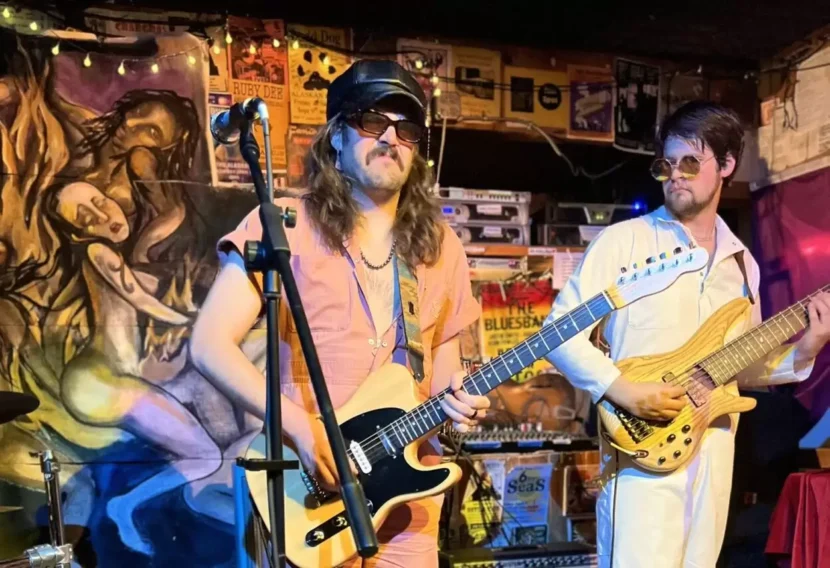
Dude Mtn’s Cullen McCormick (L) and Chazz Gist (R) on stage at the Alaskan Hotel & Bar during Alaska Folk Festival in 2023. (Photo courtesy of Brittany Rickard)
Jack Darrell, KRBD: So, you guys have said in the past that when you guys first started, the band was called the Dude Mountain Boys, right? And you changed that to kind of get away from the “O Brother, Where Art Thou?“-esque vibe.
Cullen McCormick: Yeah, it was a little novelty.
Jack Darrell, KRBD: Was part of that distancing at all from folk and Americana because it was outside of your sound? Obviously Alaska Folk Festival is kind of stepping back into that. Did you kind of change at all for Folk Fest?
Cullen McCormick: I think we dropped the “boys” because we wanted to take ourselves more seriously. At first, it was kind of a pet project. We’d wear overalls all the time and and then it was like, ‘Oh, let’s take it more seriously.’
And in regards to the folk thing – we don’t play folk, but we are a few folks that play music. That’s what we always say in Juneau.
Kalijah LeCornu: The first time we had to say something like that, because we really didn’t know what to expect. Its called “Folk Fest.” Well,
and we got in on a fluke too.
It was because there was that volcano that happened too, that really just kind of helped our little fan base in Juneau, mainly because there was no other bands that could make it. And it’s something I could have never imagined coming from a little COVID band, but man, it does warm my heart.
Jack Darrell, KRBD: How did your beer come about? Denali Brewing’s “Dude Mountain Hazy IPA”?
Kalijah LeCornu: It was Cullen’s fault.
Cullen McCormick: I was tweeting at Alaskan Brewing Company during our first Folk Fest because I was like, ‘Dude, name a band that has a beer. That would be sick.’ And Alaskan was like, ‘Haha.’ And they retweeted it, and they were toying with the idea but they were just fooling about.
And then the Denali rep, Tommy Vrabec, was at the show and heard about it, and was on Twitter and he hit us up, and asked if they can make us a beer and we said absolutely. It’s been this cool partnership.
Chazz Gist: Up north, we’re still pretty unknown. Southeast Alaska is like a totally different country to people up north.
Jack Darrell, KRBD: Touring in Southeast Alaska must be an incredibly, uniquely difficult thing to do. How do you schedule a show when you can barely schedule a flight half the time?
Cullen McCormick: So, that’s the pain of it all. First of all, you gotta get that figured out on time. Then, you have gear, right? You want to travel with your gear. You know how it sounds and how it operates. A lot of times, if you borrow somebody else’s gear, it sounds wonky, you know, it’s like driving somebody else’s car for a week. You get used to it, but it’s still not your car. So, we’re traveling around with gear, and it can be a pain because a lot of it is overweight, and we have a lot of gear and a lot of road cases. And so Alaska Airlines is charging $100 for each overweight item, and it’s like, ‘Oh my god, we have all these bags.’
So that can be a hard part, especially for other bands who are just starting out, if they want to travel and play.
Chazz Gist: I was born and raised here. I’ve never known any other way. But if you’re on the road system, it’s just nothing to pack up your gear in the van. So, it’s about trying to factor in those costs into our pricing.
Cullen McCormick: As a collective, we are not good at planning at all, and but we’re all figuring it out. My wife Stasha is helping us out, even our good friend, Austin Otos. If you’re gonna travel as a band, I would highly recommend bringing friends along, because it just makes everything so much easier with extra hands around and extra vibes.
Kalijah LeCornu: That is the key right there. Bring your friends on tour. Bring your homies on tour. That’s my advice. [Alaska Folk Festival] is the best thing in Alaska that they put on every year. I will stand by that.
Jack Darrell, KRBD: And are you guys writing music at all?
Cullen McCormick: Always trying. We actually did write a song about the milk run while we were at Folk Fest, because everybody hates the milk run. Hoping to record an album in the fall and put it out by next spring.
Chazz Gist: We got a live album in the works from our Dec. 7 show in Sitka, which is Cullen’s birthday.
Jack Darrell, KRBD: Do you guys have any favorite stages or audiences that you have played or play consistently?
Kalijah LeCornu: Personally, I think it’s the Alaskan. That one has my heart. The sound is – I can’t hear a thing up there, but it sounds like everyone else can. So it’s all right with me.
Cullen McCormick: Yeah, I think the Alaskan is probably my favorite too. But, you know what? Aside from travel gigs, throw me into the Arctic Bar in the corner with the boys and let us rip for three or four hours.
Chazz Gist: I really like the Crystal Saloon up there. I like the tight ship. I like being able to hear everything. They just keep adding more lights. Now, they had lasers on top. So, between the fog and lasers, you have these sheets of light going above. And they just get tighter with the sound and tighter with the lights every show.
The Alaskan is can be very chaotic, and though there’s a lot to enjoy there, I have to give up on being able to hear everything. I have to give up on being able to control certain aspects of it. But the Crystal? I just like the tight ship.
Like we said, we broke sales records when we were the headliner. But in each of those shows, we had a few bands before us. Every time we go Juneau, we have our friends, the Rain Dogs.
Jack Darrell, KRBD: You guys brought the Rain Dogs to Ketchikan for the first time this summer, right?
Cullen McCormick: Yeah, I loved it. That was so much fun.
Jack Darrell, KRBD: That was a great time. It shut the electricity off.
Kalijah LeCornu: Rocking too hard!
Jack Darrell, KRBD: Any parting advice for a young band coming up in Southeast Alaska?
Cullen McCormick: Practice hard. Love your homies.
Kalijah LeCornu: Kiss your homies. They need it. They’ll definitely be kissing you back later, and it’s nice.
Cullen McCormick: Can we start that one over?
Chazz Gist: Meet other bands. Whenever bands are coming through, try and hang out a little bit. See their show and talk about what you’re doing. Just make those connections.
Kalijah LeCornu: And pack light.
Cullen McCormick: Says the drummer.
Jack Darrell, KRBD: Okay, last question. Where do you feel like Dude Mtn is going to go from here?
Kalijah LeCornu: Hopefully stay together.
Cullen McCormick: I see Dude Mtn taking over the state of Alaska, and after that, taking over the rest of the U.S., and after that, travel all around. But my end goal for the band, and I think these boys too, is to literally just be able to travel and play music comfortably. If I can make music with my friends and make some money while doing it, that is a dream I could have never imagined.
Close
Update notification options
Subscribe to notifications
Subscribe
Get notifications about news related to the topics you care about. You can unsubscribe anytime.