Arts & Culture

Hundreds of Native Youth Olympic athletes compete and connect at this year’s Games

One-foot-high kick first place winner Daisy Vanblarcom beats her personal record at 87 inches
One-foot-high kick first place winner Daisy Vanblarcom beats her personal record at 87 inches during the 2025 Native Youth Olympics on Saturday, April 26. (Alena Naiden/KNBA)

With much fanfare, Daisy Vanblarcom prepared for the final one-foot high kick competition in the Native Youth Olympics on Saturday. She needed to jump, kick a suspended ball with one foot and then land on the same foot.

The highest height she hit was 87 inches, which went above her personal record – and won her first place. The bleachers were filled with people from all corners of Alaska, but for Vanblarcom, they were familiar faces. Vanblarcom, who competed in six events this year and placed first in two, said making friends with other athletes and coaches is a part of her success.

“I compete a lot better when I know everybody and when I’m comfortable around everyone,” Vanblarcom said.

The Native Youth Olympics was held over three-days in Anchorage last weekend. High school students participated in a dozen competitions, each representing a different Alaska Native subsistence activity or skill. The event started more than fifty years ago, with a few dozen participants. This year, it brought about 450 athletes to the Alaska Airlines Center – a record number since before the COVID-19 pandemic.

Joanna and Jen Hopson have been working to revive the games in the North Slope region. They created a program to help develop and train athletes from Utqiaġvik and neighboring villages. They held the regional Native Youth Olympic Games in Utqiaġvik this winter – for the first time in about 15 years.
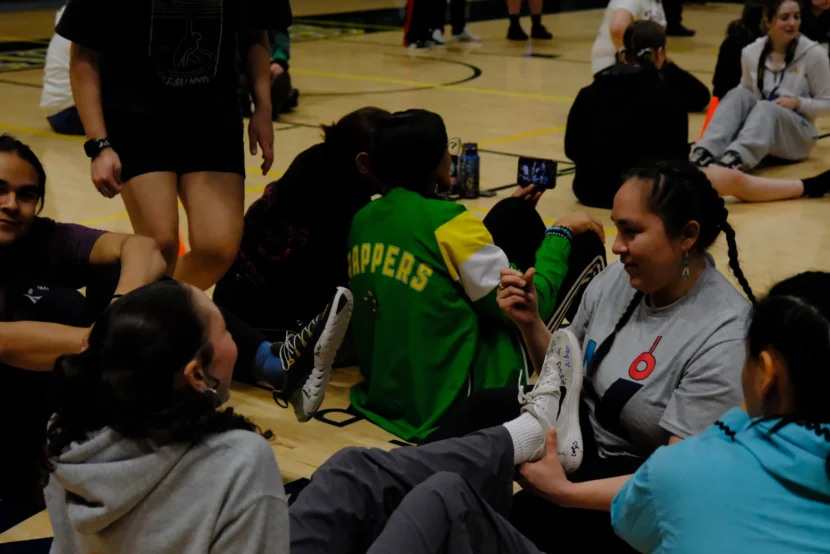
North Slope Borough School District coach Joanna Hopson signs a sneaker for one of her athletes during the Native Youth Olympics on April 25, 2025. (Alena Naiden/KNBA)

Joanna Hopson said that the games have been helping students gain confidence and come out of their shell.

“Our athletes that are coming in, they come in to us at practice so reserved, timid,” she said.As they’re starting to learn more of their cultural games, they’re starting to learn that courage. They’re starting to learn what it means to be who you are, to accept who you are, where you’re at, and then to grow from that.”

Participating in the Native Youth Olympics is often a family tradition. Kya Ahlers, a coach for Salamatof on the Kenai Peninsula, said she trains some of her siblings and is always proud to see them and her other athletes succeed. This year, Ahlers saw her younger sister Abigail Semaken place first in the toe kick competition.

“It’s really a good confidence booster, and really good to see all these young women competing. And I mean, sometimes I do see some girls getting themselves down. But then once I see that, there’s already other girls from other teams coming to comfort her and empowering her again,” Ahlers said. “That really warms my heart.”
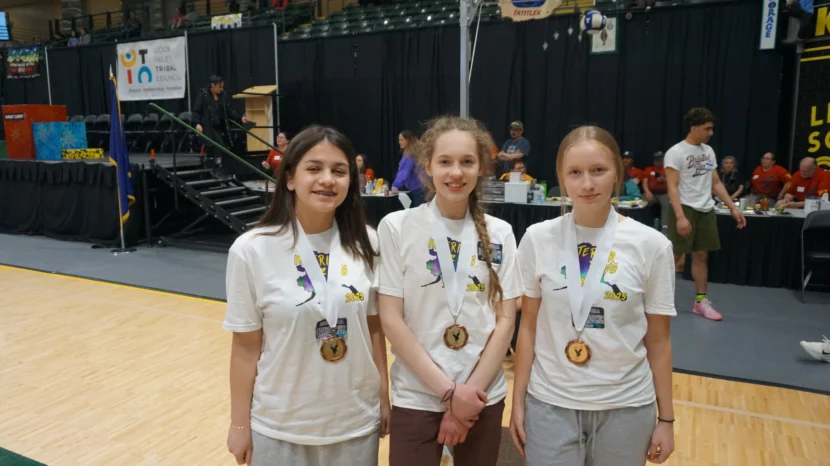
(From left) Camylle Hull, Isabel Dosch and Calli Bundschuh from Fairbanks took third in the wrist carry competition during the first day of the Native Youth Olympic games on April 24 in Anchorage. (Alena Naiden/KNBA)

Girls lifting each other up was something on the mind of Camylle Hull from Fairbanks. Hull was on the team with Isabel Dosch and Calli Bundschuh, and together they took third place in the wrist carry competition. Dosch wrapped her wrist around a stick, and Hull and Bundschuh grabbed the opposite sides of it, carrying Dosch for 202 feet and 3 inches.

“Our team was an all-girls team, the only all-girls team that got on the podium, and we got further than most of the guys down there,” Hull said. “I think it’s really cool for us, showing that we can do what they can do, like the guys.”

But the community of the games as a whole was the main highlight athletes kept bringing up. Anastasha Wilde of Anchorage, who took second place in a two-foot high kick competition, said the games helped her improve her social life.

Anastasha Wilde of Anchorage won took second place in a two-foot high kick competition during the 2025 Native Youth Olympics. She said she loves the community aspect of the games. (Alena Naiden/KNBA)

“My favorite part about it is that we all come together, and we’re participating together, not apart, and you get to connect with other people and make new friends,” Wilde said. “It’s not about winning. It’s about beating your personal records and improving, not for yourself, but improving for the others around you, so you could help them out.”
Lingít Word of the Week: X̱alak’ách’ — Porcupine

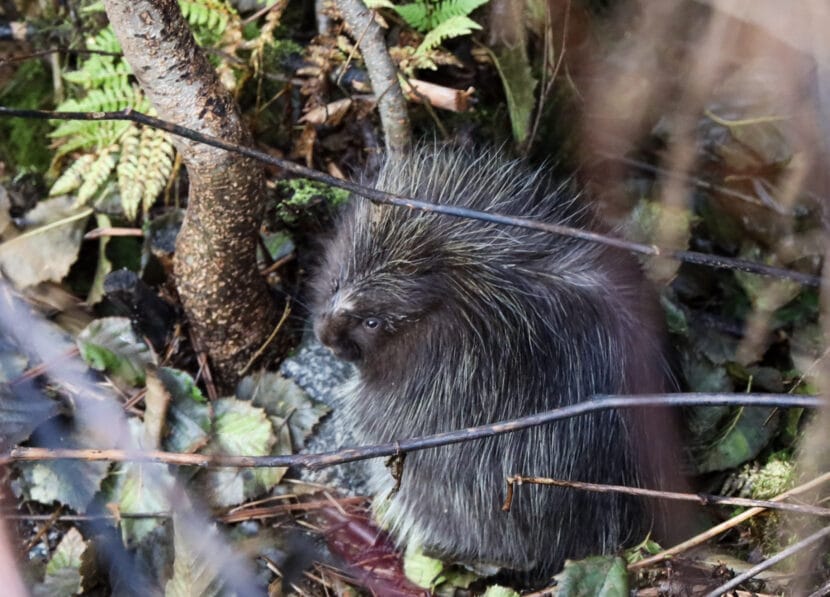
A porcupine hides in some foliage near the Mendenhall Glacier Visitor Center on Saturday, Oct. 15, 2022. (Photo by Clarise Larson/KTOO)

This is Lingít Word of the Week. Each week, we feature a Lingít word voiced by master speakers. Lingít has been spoken throughout present-day Southeast Alaska and parts of Canada for over 10,000 years.

Gunalchéesh to X̱’unei Lance Twitchell, Goldbelt Heritage Foundation and the University of Alaska Southeast for sharing the recorded audio for this series.

This week’s word is x̱alak’ách’, or porcupine. Listen to the audio below to learn how to say x̱alak’ách’.

The following transcript is meant to help illustrate the words and sentences. 

Keiyishí Bessie Cooley: X̱alak’ách’. 

That means porcupine.

Here are some sentences:

Keiyishí Bessie Cooley: X̱alakʼáchʼ kagéináx̱ yaa gagútch.

Porcupines walk down slowly.

Keihéenák’w John Martin: A x̱oo.aa haa atx̱aayíx̱ sitee wé x̱alakʼáchʼ.

Itʼs food for some of us, the porcupine. 

Kooshdáakʼu Bill Fawcett: Alʼóon kḵwagóot x̱alakʼáchʼg̱áa.

I am going to go hunting for porcupine. 

Ḵaakal.áat Florence Marks Sheakley: Chʼáakw dus.éeyin yá x̱alakʼáchʼch haa atx̱aayíx̱ sitéeyin.

A long time ago people would cook it; porcupine used to be our food.

Kaxwaan Éesh George Davis: X̱alak’ách’ ashaawax̱ích.

They clubbed the porcupine.

You can hear each installment of Lingít Word of the Week on the radio throughout the week. 

Additional language resources:

Find biographies for the master speakers included in this lesson here.

Learn more about why we use Lingít instead of Tlingit here.

Watch a video introducing Lingít sounds here.

Tongass Voices: Author Tessa Hulls on feeding her family’s ghosts

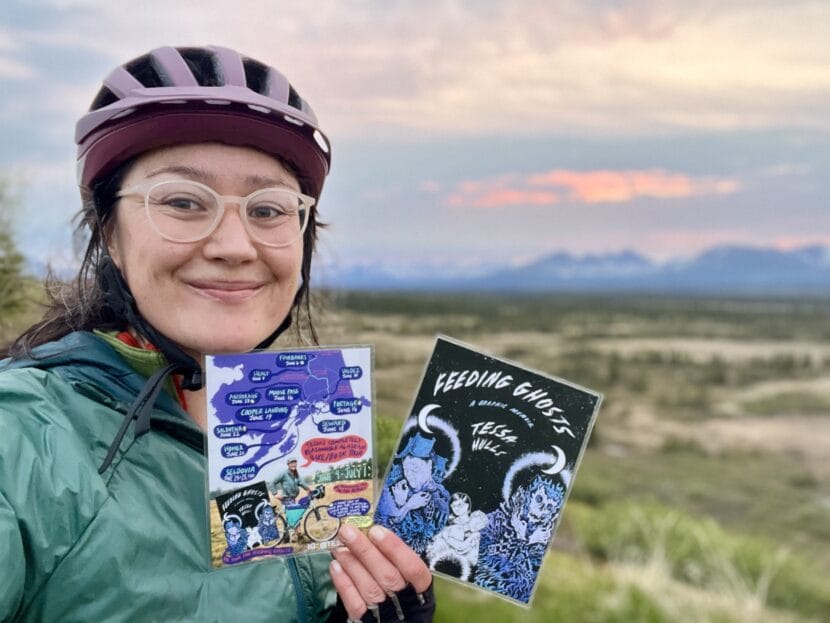
Artist and author Tessa Hulls published the graphic memoir Feeding Ghosts last year. It chronicles her family’s history with political oppression and mental illness. (Photo courtesy of Tessa Hulls)

This is Tongass Voices, a series from KTOO sharing weekly perspectives from the homelands of the Áak’w Kwáan and beyond.

Tessa Hulls has worked a lot of jobs, biked a lot of miles, and lived a few different lives in and outside of Alaska. A part of her was running from something.

But she spent the last decade turning to face it by writing a graphic memoir about her family’s history. The memoir is called Feeding Ghosts, and it’s won three national awards.

The following transcript has been lightly edited for clarity.

Tessa Hulls: I have always been somebody who wrote. You know, I was one of those kids where, from the age I could shove a crayon up my nose, it was clear I was going to be a writer and an artist. And there’s not any route I could have taken that would have allowed me to escape that. 

My name is Tessa Hulls. I am an artist, writer and adventurer who drew and wrote the graphic memoir Feeding Ghosts. 

And yeah, my grandmother, Sun Yi, she was a journalist in Shanghai during the communist takeover, and she ended up on the wrong side of political history, so she was labeled a dissident and was arrested and put through Maoist era thought reform. And for her, writing was the way in which she tried to assert her own reality, even as she watched the government take over and deny everything that was happening.

And it was something that was both her liberation, but also ultimately what broke her mind, because after she and my mom fled China as political refugees, they went to Hong Kong, and my grandma wrote a memoir about eight years of living under the communist regime, and then, unfortunately, had a mental breakdown, and she never really regained her sanity, and she spent the rest of her life trying to rewrite the story that had been taken from her.

Yeah, well, I think when I first started the book, I was really determined to not talk about any feelings. It was just going to be about history. I was not going to be a character in it. And once I was able to commission a translation of my grandmother’s memoir, because it was written in Chinese and never translated into English. So when I opened it and finally read her book, it was kind of the first time that I ever heard her voice, because even though I grew up with her and my nuclear family, we had a language barrier, and she was also heavily medicated on antipsychotics. 

So when I started reading this book that she had written as a political refugee in her 20s, I just immediately went “Oh no,” because I knew suddenly the scope of what I was trying to do had become infinitely more complicated, and the book was going to have to contend with the question of, ‘what is truth?’ when you’re working with both an unreliable mind and a government that is dismantling reality all around you. 

I didn’t feel like I had a choice. My family ghosts literally told me I had to do this. 

So I would spend full summers working in Alaska, and then would freelance as an artist and writer in Seattle in fall and winter, and then spend two months alone on a solo bikepacking trip.

And I was doing it in a way that felt really authentic to what I needed, but I also was well aware that I was running from something. 

And so I was on one of these bike trips kind of realizing that this chapter of my life where I was just hoarding my own wonder had come to an end and that I needed to step into a different kind of responsibility. 

 And so I was biking alone up a mountain and so I said, “Okay, if this chapter is done, what comes next?” And the landscape opened up and spoke to me and said, “Someone has to feed the ghosts.” And my book is called Feeding Ghosts, because that was the beginning of this nine year process of really stepping into something that was my family duty. 

And as I got towards the end of the story, you kind of get contemplative about,” Well, what did I learn, really, along the way?” And I think the process of drawing and writing this book was really me learning how to render both my mother and my grandmother in two complex, three dimensional characters. And in order to do that, I had to draw them from every angle.

And I wrote about my grandmother saying that it’s much easier to call someone crazy than it is to contend with how deeply they’ve been injured by the past. 

And I think a lot of the things that we put the umbrella category of trauma on are really just instead coming from a refusal to look at the depth of rupture, and therefore the amount of work it would require for there to be genuine repair.

So the places where there weren’t clear answers, I forced that uncertainty on my reader and said, look, it’s kind of a choose your own adventure here, because there’s no way to actually discern what actually happened, and here are the competing narratives. And I leave it up to you to decide what path to take through it.

You can find Feeding Ghosts at Alaska Robotics, where Hulls will launch the paperback version with a party on May 6 at 5:30 p.m. 

Lingít Word of the Week: Laax̱ — Red Cedar

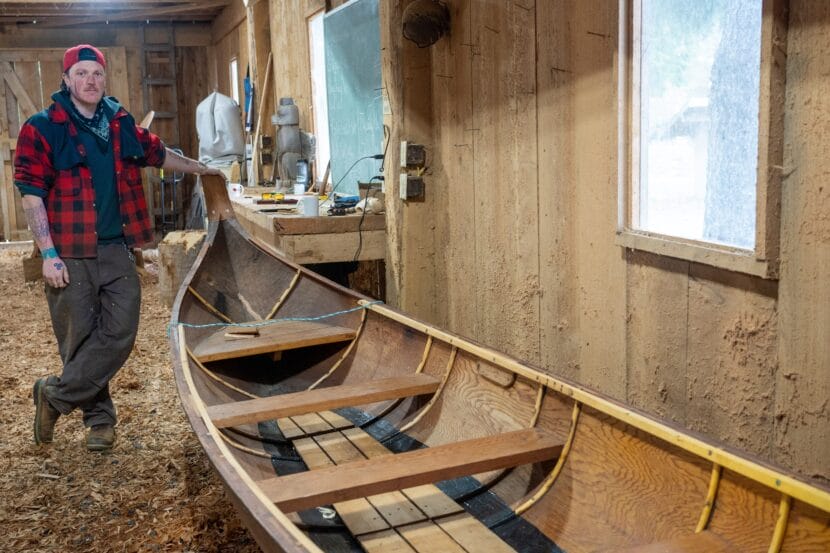
Haida artist and carver Nang K’adangáas Eric Hamar poses with a red cedar canoe hand-carved in the Native Village of Kasaan’s carving shed on Prince of Wales Island on May 9, 2024. (Jack Darrell/KRBD)

This is Lingít Word of the Week. Each week, we feature a Lingít word voiced by master speakers. Lingít has been spoken throughout present-day Southeast Alaska and parts of Canada for over 10,000 years.

Gunalchéesh to X̱’unei Lance Twitchell, Goldbelt Heritage Foundation and the University of Alaska Southeast for sharing the recorded audio for this series.

This week’s word is laax̱, or red cedar. Listen to the audio below to learn how to say laax̱.

The following transcript is meant to help illustrate the words and sentences. 

Keihéenák’w John Martin: Laax̱. 

That means red cedar.

Here are some sentences:

Keihéenák’w John Martin: Kootéeyaa aan dulyeix̱ yaa laax̱.

They make totem poles with red cedar.

Keiyishí Bessie Cooley: Laax̱ haawú litsʼáa.

Red cedar branches smell good.

Kooshdáakʼu Bill Fawcett: Deikeenaa aasí laax̱, ḵúnáx áwé xʼalitseen hé naakéexʼ.

It is a Haida tree, red cedar, it is really valuable here in the north

Ḵaakal.áat Florence Marks Sheakley: Ldakát át aan yéi daadunéi yá laax̱.

People work on red cedar for everything.

Kaxwaan Éesh George Davis: Laax̱ dax̱ dulyéix̱.

People use red cedar.

You can hear each installment of Lingít Word of the Week on the radio throughout the week. 

Additional language resources:

Find biographies for the master speakers included in this lesson here.

Learn more about why we use Lingít instead of Tlingit here.

Watch a video introducing Lingít sounds here.

Student-written plays engage Juneau community on addiction, climate change

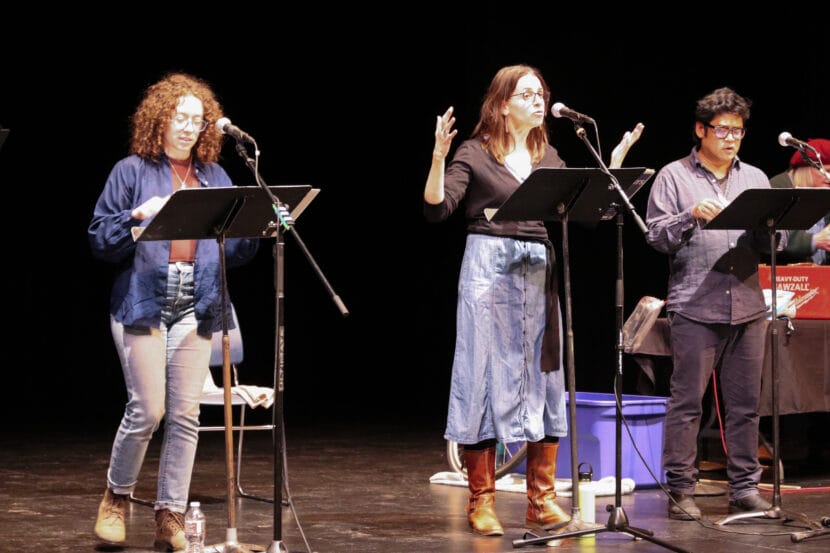
Alexandra Wagner, Christina Apathy and Flordelino Lagundino performing radio plays written by local high school students at Thunder Mountain Middle School on April 17, 2025. (Photo by Jamie Diep/KTOO)

Students at Yaaḵoosgé Daakahídi High School and Juneau Douglas High School: Yadaa.at Kalé wrote four plays earlier this year centered on deeply personal topics. They were performed live on the radio in February, and again this week. 

Theater Alaska hosted the performance Thursday at Thunder Mountain Middle School. It was followed by a forum with teachers, mental health professionals and policy makers that gave community members the opportunity to discuss the topics brought up by the plays, including addiction, climate change and consolidating the city’s two high schools.

National Alliance on Mental Illness Juneau is a local non-profit that provides mental health education. Executive Director Aaron Surma said the lack of resources locally means they work with students to help them support one another.

“Feeling comfortable supporting your friend always makes sense. But saying that we – people who make the worlds – are just not going to have good enough systems for you to make it be helpful is a pretty tragic thing,” Surma said.

Yaaḵoosgé Daakahídi teacher Electra Gardinier said the opportunity to write radio plays helped students engage with writing in a new way.

“I, as a teacher, saw students who had never interacted with one another in a positive way suddenly be able to take on a character and interact as these characters in a really healthy and communicative way, and then also to make writing collaborative,” Gardinier said.

The performances come as schools and arts organizations face funding uncertainties in Juneau and across the state and country.

Thursday’s program wrapped up hours after Gov. Mike Dunleavy vetoed a bill that would increase the state’s per-student allocation by $1000. The Trump administration is also slashing grant funding for humanities organizations.

Still, Theater Alaska’s Artistic Director Flordelino Lagundino said they hope to continue working in local schools and expand the program next year.

Disclaimer: KTOO was a partner in the radio play performances, but the KTOO newsroom took no part in organizing the event.

Joann closure a hit to Alaska’s crafting community

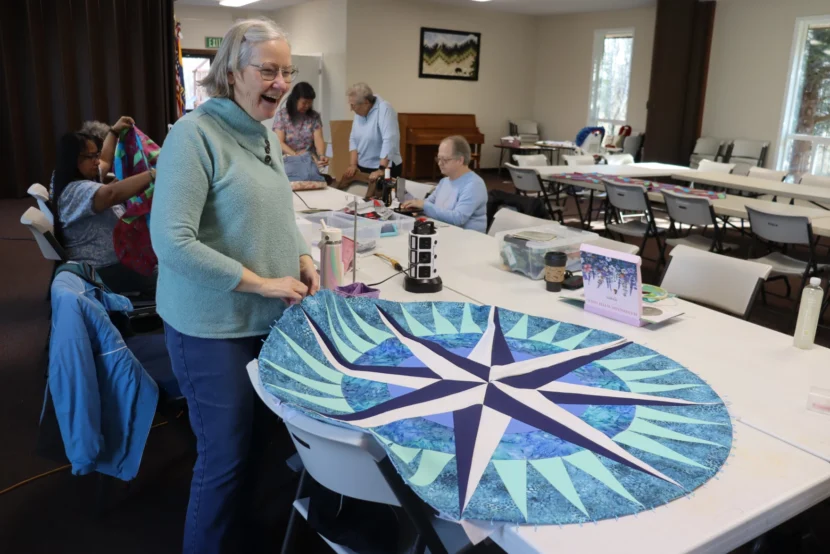
Deborah Standefer, a member of Soldotna’s Thursday quilting group, shows off a mariner star she’s working on. (Hunter Morrison/KDLL)

It’s a Thursday morning in the multipurpose room of Soldotna’s Christ Lutheran Church, where a handful of quilters gather weekly to work on projects. Deborah Standefer fires up her sewing machine and stitches a blue, circular quilt.

But despite Standefer’s enthusiasm, there’s a palpable feeling of loss among the group. Just two traffic lights north on the Kenai Spur Highway, the Joann Fabric and Crafts store is hosting a going-out-of-business sale. The Soldotna location is set to close April 29.

Standefer says she mostly shops at Joann for its selection of quilt batting – or insulated material between the quilt top and backing fabric.

“You never truly miss them until they’re really gone,” Standefer said. “We all shop at Joann’s at some time or another, so I think it’s going to have a big impact.”

The Ohio-based nationwide retailer filed for bankruptcy last year amid financial troubles. It originally planned to close about two-thirds of its stores – like those in Anchorage and Juneau. But the company wasn’t able to find a buyer willing to keep any stores open.

For quilters on the Kenai Peninsula, there aren’t many other local options to turn to. One of them is North Beach Quilting in Kenai, which sells higher-end fabrics. It’s a lot smaller than Joann, but shop owner Shonda Powell says many established quilters in the area already shop there.

“I get my fabrics from like, they’re made in Bali or Indonesia,” Powell said. “So the stuff that I have is not something that you’re going to find at Joann Fabrics.”

Since the Soldotna Joann store announced its closure, Powell says she sees new customers every day. Some are looking for items her store doesn’t carry. Powell is hoping to expand the small shop’s inventory as much as possible.

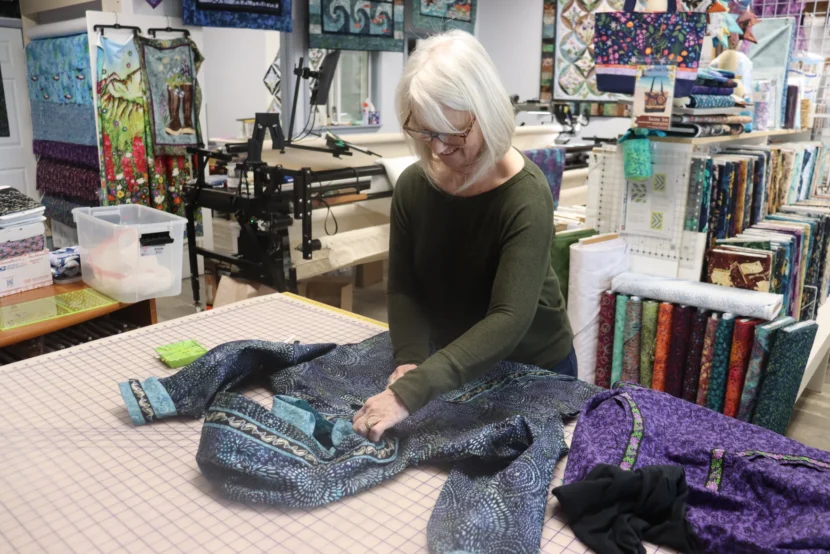
Shonda Powell, owner of North Beach Quilting in Kenai, works on a blue hooded kuskpuk. Her store is one on the Peninsula hoping to fill the gap. (Hunter Morrison/KDLL)

But Powell says she’s sad that crafters will soon have fewer options on the Kenai Peninsula to choose from. She’s concerned that Joann’s closure will impact quilters on a budget and those new to the craft.

“I think that if somebody’s learning how to sew, this is not the place that they’d pick first,” Powell said.

Crafters say they shop at Joann’s because of the store’s breadth of inventory. Barbara Steckel is a long time member of Soldotna’s Thursday quilting group. She says she’s used to being able to find a wide range of items at Joann, like every shape and size of velcro.

“Well, it’s definitely going to have an impact, because when I’m working on something, I’m used to running in there and being able to find most of the supplies,” Steckel said.

Steckel is also involved with Stitches of Love, a local group that makes and donates quilts to those in need. Even though much of the group’s quilting material is donated, they buy a lot. And Steckel fears the store’s closing could make it hard to stay within their budget.

”We’ve been looking at other sources and looking at the prices,” Steckel said. “We’re not quite sure what the impact is going to be.”

For quilters on the Kenai Peninsula, Joann’s closure will affect more than just their quilting projects. Many also knit, paint or scrapbook, and are not sure where to go for their crafting supplies. Some say they’ll resort to Walmart or online retailers.

Standefer, with the Thursday Soldotna quilting group, says Joann is a landmark for Kenai Peninsula crafters. She says the store’s closure is a blow to the community.

“You go into Joann Fabric, and everybody in town’s there,” Standefer said. “It’s kind of a melting pot, you always see somebody that you know, and it’s just been there for a long time, so it’s kind of a highlight to the community.”

Standefer says crafters from across the Kenai Peninsula would visit the Soldotna store, and often make purchases at other local businesses. She’s concerned about how the chain’s closure will affect local employees and those who craft to make money.

Site notifications
Update notification options
Subscribe to notifications