Now in its twelfth year, Poetry Out Loud is a national program that encourages high school students to learn about poetry through memorization, performance, and competition. Throughout the school year students have been practicing and competing and now it’s down to 10 finalists.
This video is of Juneau’s Briannah Letter reciting David Kirby’s “Broken Promises” at last year’s Poetry Out Loud statewide finals. This year’s competition is at 5 p.m. Tuesday.
Among this year’s state finalists is Elissa Koyuk, a senior at Juneau Douglas High School. She’ll compete against the other finalists Tuesday @360 in the KTOO building. The competition begins at 5 p.m., is open to the public and will also be streamed live at 360North.org. If Koyuk wins, she’ll have the opportunity to travel to Washington D.C. in April for the National finals.
Marian Call and Laura Zahasky dropped into the arts room recently to record a Red Carpet Concert. Here are the tunes “Pie Maker,” “Iceland” and “Rainboots.”
“Pie Maker” is part of Call’s new album called “Standing Stones.” Call will be giving a “first listen” of the recording on Friday, Feb. 24 on KXLL beginning at noon AKST.
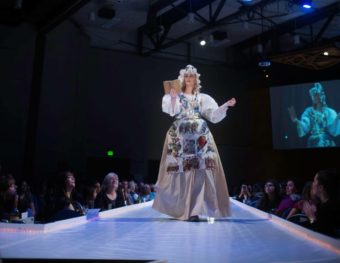
The Wearable Art 2017 theme was "Renaissance." Both Saturday and Sunday's performances were sold out. (Photo courtesy John Hutchins)
Samantha Adams models her piece "DaVinci's Airborne Muse" at Wearable Art 2017 on Feb. 12, 2017, in Juneau. (Photo courtesy John Hutchins)
Amy Lloyd models Jessie Kovach's "Votes for Women" at Wearable Art 2017 on Feb. 12, 2017, in Juneau. (Photo courtesy John Hutchins)
Wearable Art entrants are known for innovation, creativity, repurposing materials and for social commentary.
Sarah Sjostedt models “Food Security” by Deena McDougal and Jake Musslewhite at Wearable Art 2017. (Photo courtesy John Hutchins)
This year was no exception.
The 2017 show “Renaissance” took place Saturday and Sunday at Centennial Hall.
Models walked 29 entries down the runway as part of the annual fundraiser for the Juneau Arts and Humanities Council.
Materials included tin can lids, glass beads, duct tape, guitar and violin strings, bottle tops, flowers, chicken wire, lace, recycled copper fuel line, corn husks, fur, and vinyl records to name a few.
Emcees were actor Allison Holtkamp and actor-playwright Frank Henry Kaash Katasse.
Listen to a few audio highlights from the event here:
Amy Romme models one side of “Royal Divergence” at Wearable Art 2017. It was a two-person piece she and artist Jessica Hood collaborated on. (Photo courtesy John Hutchins)
Winners were chosen by a group of jurors who scored four categories: construction, innovation, overall presentation, and what they call the “wow” factor.
The juror’s first place award, or Best of Show, went to “Church of the Wild,” by artist Lauralye Miko and modeled by Amy George.
“A Lid-dle Un-can-ny,” by artist and model Michelle Morris, won juror’s second place and the people’s choice award.
“Battling Potted Land,” by artist and model Angela Ecklund won, the juror’s third-place award.
You can watch the broadcast of the event on 360 North at 8 p.m. Thursday.
“They Don’t Talk Back” opens at Perseverance Theatre tonight (Friday, Jan. 27). Among other themes, it’s a play about family, identity, colonization and cultural preservation. It features three generations of Tlingit men in Southeast Alaska facing change. And it’s also a love story.
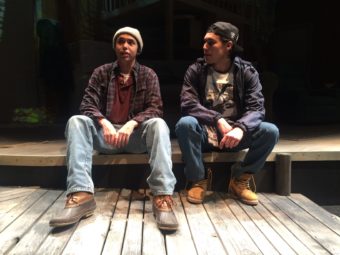
Jake Waid, left, and Skyler Ray-Benson Davis talk briefly during a technical rehearsal Tuesday, Jan. 24, for “They Don’t Talk Back,” at the Perseverance Theatre, Douglas, Alaska. Behind them is Brian Westcott, Diane E. Benson and Kholan Studi. (Photo by Tripp J Crouse/KTOO)
The diversity of themes is supported by a diverse cast and director composed of Tlingit, Cherokee, Athabascan, Yup’ik and Choctaw people.
Tonight’s opening at 7:30 is part of what is being described as a rolling world premiere that began in California, and is in collaboration with Native Voices at the Autry and La Jolla Playhouse.
The play opens with Paul Senior on a second floor balcony of a modest home with mismatched and worn furniture.
Paul Senior, played by Juneau actor and Tlingit Jake Waid, is a gruff fisherman who wears Carhart overalls and is the patriarch of the story. He’s reciting a poem in Tlingit that playwright Frank Henry Kaash Katasse would call one of the play’s interludes — poems, songs and monologues woven throughout the play’s story line.
Ironically, Katasse wrote the interludes during interludes.
“I worked at KTOO for quite some time and I’d finish work at 4:30 and my wife finished work at 5. So, sometimes I’d have a half an hour before I had to go pick her up,” Katasse said. “So what do you do for a half an hour? You can dink around on your phone, or you can work.”
Listen to the story and clips from the play here:
Katasse hadn’t written a full-length play before, and he wasn’t trying to at the time.
Diane E. Benson and Kholan Studi laugh during a musical performance at a technical rehearsal for "They Don't Talk Back" at Perseverance Theatre in downtown Douglas, Alaska. (Photo by Tripp J Crouse/KTOO)
Skyler Ray-Benson Davis performs Tuesday, January 24, 2017, during a technical rehearsal of "They Don't Talk Back" at Perseverance Theatre in downtown Douglas, Alaska. The Alaskan-born Tlingit actor was born in Juneau, but currently calls Anchorage home. (Photo by Tripp J Crouse/KTOO)
Kholan Sturdi plays Edward, the dutiful cousin who was raised in the village. (Photo by Scott Burton/KTOO)
“My intention was to write things that were inspiring me,” Katasse said. “One of the monologues I wrote was because I wanted an audition piece as an actor … As a matter of fact all the parts are parts I would love to act.”
Katasse also is an accomplished actor — readers may have seen him in Perseverance’s “Chicago,” or “Our Voices Will Be Heard” among others.
He’s also the board president of the Juneau Douglas Little Theatre.
And what inspired the 30-minute writing sessions?
“It was rainy one day so I write this monologue about rain and how it refreshes you,” Katasse said.
The rain interlude is now performed by actor Brian Wescott who is Athabascan and Yup’ik, and plays both a minister and Paul Senior’s son, who is a Desert Storm veteran. He’s also the estranged father of Nick, played by Skyler Ray-Benson Davis, who is Tlingit.
“After a while I had this short story about a young man (who eventually became Nick) going to live with his grandparents,” Katasse said.
He thinks the short story was called “City Boy.”
“Then I realized I could take this story and weave it through the rest of these interludes,” he said. “I could tie this story to all these different characters.”
Nick’s counterpart is his raised-in-the-village cousin Edward, played by Kholan Studi.
Katasse said both Tlingit characters represent parts of himself.
“Back in the day it was very affordable to take your family and go tour Southeast Alaska on the ferry,” Katasse said. “We would do that when I was little. And my dad was a commercial fisherman so sometimes he’d be fishing out of Petersburg, or Wrangell, or Sitka. And we’d go meet him there on the ferry.”
“So I have these vivid memories of us being little in some of these communities, and some of the experiences I had from being the city boy from the big town of Juneau,” he said.
Nick is sent to live with his grandparents, Paul Senior and Linda (played by Diane E. Benson, who is Tlingit), and Edward in the village while his mother awaits trial for drug-related charges in Juneau.
The following scene exemplifies Nick’s angst.
“Hey cousin, want to grab the skiff and go check on the crab pots?” Edward asks.
“No, I don’t want to check the f—ing crab pots, cousin! I’m sick of this place. Maybe dad had the right idea — get as far away from you as possible — get away before I end up as f—ed up as you!” answers Nick.
Drama like this is often balanced with comedy, and a diverse selection of music including a church song.
Katasse brought jazz musician and friend Ed Littlefield onto the team as a composer and Tlingit Language Consultant.
Playwright Frank Henry Kaash Katasse posses in Paul Senior’s easy chair after the show. (Photo by Scott Burton/KTOO)
“One of the reasons you break into a song during a musical is that the character reaches an emotional boiling point, and the best way to express that is through song,” Katasse said. At one point Nick raps — another one of Katasse’s interludes. (Clink on the audio player above to hear it).
Beyond coming of age the cousins experience, and change everyone faces, it’s also a love story between the grandparents. Paul Senior and Linda play the kind of long-time in-love lovers to which many aspire.
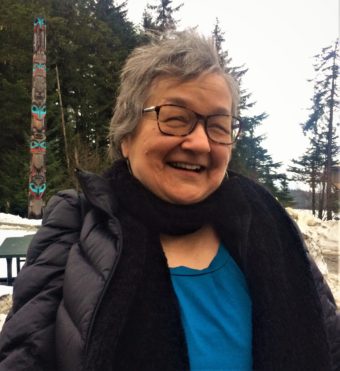
In addition to the evening’s awards presentation and live arts performances, Juneau-based Ernestine Saankalaxt’ Hayes will be officially honored as the Alaska State Writer Laureate.
Hayes belongs to the Kaagwaantaan, or wolf clan, on the Eagle side of the Tlingit nation.
She may be best known because of her award-winning book “Blond Indian,” a memoir that chronicles the author’s early life between Alaska and California.
Listen to the story here:
The Alaska State Council on the Arts facilitates the selection of the Writer Laureate. The Governor’s Awards for the Arts and Humanities can be seen on 360 North beginning at 8 p.m.

Beyond publications and awards however, the state’s writer laureate must be nominated to the Alaska State Council on the Arts — in this case it was by Homer-based writer, poet and teacher Erin Hollowell.
“I would like to flatter myself that she recognized lyricism in my prose,” Hayes said.
Most know that prose refers to standard writing — or writing that is not poetry or drama for theater. But what is lyricism?
“It is prose that has elements of poetry,” Hayes said. “So that when we say, What is creative nonfiction? One common understanding is that it is nonfiction writing that has some of the characteristics and techniques of fiction. And, for me, lyrical prose is like that except that it has some of the characteristics and techniques that are commonly associated with poetry.”
Here is an excerpt of Hayes reading from “Blonde Indian.” Note how the writing, especially toward the end of the selection, could indeed be read from a poem.
“…and he’d never take another drink and he’d be a good husband to Mabel and a good father to Patricia and even a good son to Old Tom and a good friend to everybody and he would never let another swallow of saltwater fill his mouth–migod he should never have bought that last pint of vodka or even the beer–he couldn’t feel the tears on his skin or hear his last bubbling gasps as his face sank into the cold wet hidden inlet where the smell of the ocean, the feel of the spray, the sound of the gulls, the taste of the salt, the sight of mountain behind mountain behind island behind island, falling back and back in shadows and gray and dark green would never change.”
When Alaska’s laureate program started in the early 1960s it was only for poets.
In the mid-1990s the program broadened to include all genres of writing, and is now a two-year appointment.
Being the laureate means more than talented writing — it includes working with Alaskans to promote literature in the arts.
Another reason Hayes thinks she was selected was because of her recent participation in the Alaska Reads program. In February she visited 15 communities personally, and later, an additional 18 communities via teleconference.
“I did workshops and readings. I visited book stores, Highland Mountain (Correctional Facility), different sorts of schools, incarcerated people, senior centers, and Bean’s Café in Anchorage,” Hayes said. “I was thrilled and honored to meet so many Alaskans and hear their stories.”
That program, Alaska Reads, was an initiative created by the outgoing Writer Laureate Frank Soos. Hayes said she also has a concept for what she’d like to accomplish.
“Asking people of different generations to write and share parts of their stories and perform one another’s words,” Hayes said.
In the meantime, Hayes can often be found at the University of Alaska Southeast, where she teaches writing.