Alaska Folk Festival 2017 Guest Artist The Murphy Beds perform at 8 p.m. Thursday at Centennial Hall. (Photo by Anna Colliton/Courtesy of the Artist)
Irish folk music duo The Murphy Beds of New York, are this year’s Guest Artist for the 43rd annual Alaska Folk Festival. Jefferson Hamer and Eamon O’Leary are known for their close harmonies and dynamic arrangements featuring guitar, bouzouki and Mandolin. Together they reinvent traditional folk songs with a repertoire from Scotland, England, America, and write original tunes.
The Murphy Beds’ first set is Thursday at 8 p.m. They’ll also be leading workshops throughout the weekend, host a dance at the JACC, and will close the festival at 9 p.m. Sunday.
Nicole Church performs a Red Carpet Concert during Celebration 2016. (Photo by Annie Bartholomew/KTOO)
Jacob Pickard plays the KXLL Showcase Friday at 10:00 at the Hangar Ballroom. (Photo by Annie Bartholomew/KTOO)
Taylor Vidic and Cameron Brockett of the Quaintrelles perform at Louie’s Douglass Inn at 9:00 Thursday. (Photo by Annie Bartholomew/KTOO)
Dan DeSloover and Dan Kirkwood perform on the F/V Arete during their Tiny Desk Contest submission. (Photo by Annie Bartholomew/KTOO)
(Photo by Annie Bartholomew/KTOO)
It’s not hard to find something to do during the Alaska Folk Festival, but this year we tried to make it easy and list your favorite venue schedules all in one place. As these things go, we’ll be updating the schedule daily with changes, new events, and start times as we learn more.
Nicole Church performs at Kindred Post Wednesday at 7:00. (Photo by Annie Bartholomew/KTOO)
Bluegrass Holiday at 9:30 p.m. at the Red Dog Saloon
Louie’s Residency featuring Annie B. Good and The Quaintrellesin Douglas
Open Mic at the Alaskan Hotel & Bar
Dan DeSloover and Dan Kirkwood perform on the F/V Arete during their Tiny Desk Contest submission. Goldwing headlines the KXLL Showcase Friday at the Hangar Ballroom. (Photo by Annie Bartholomew/KTOO)(Photo by Annie Bartholomew/KTOO)
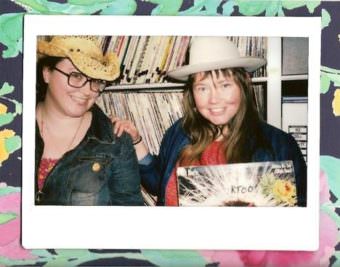
To KXLL listeners, Your Favorite Sisters are known as the DJs “spinning the platters that matter” on Tuesday evenings.
Individually, Kirsa Hughes-Skandijs, a.k.a. “big sis,” is a musician, multimedia artist and a writer. Alicia Hughes-Skandijs, “lil sis,” is a comedian (you may recognize her from Club Baby Seal), a musician, and a writer.
Collectively, the two have been to some 20 Alaska Folks Festivals, and they wrote us this guide:
Kirsa Hughes-Skandijs, left, and Alicia Hughes-Skandijs are Your Favorite Sisters on KXLL on Tuesday evenings. (Photo by Scott Burton/KTOO)
Prepare to be in two or more places at one time. Scheduling:
Listen to the guide here:
The good thing about Folk Fest is that it lasts all week so you can ease yourself into the musical mayhem slowly. Monday through Wednesday, downtown is fairly quiet, there aren’t all-night jam sessions raging into the morning light, and that means it’s a good time to focus on the festival itself at Centennial Hall. Amateurs and professionals, kids and elders, string bands and alphorns, the Centennial stage is the reason for the season.
Being as the festival starts on a Monday, some of us have to worry about pesky things like getting up for work in the morning. The good news is that not only does KTOO stream the Fest live, but they even have video. Welcome to the future. You can see the show from your own couch.
1) Keys to getting that sweet merch:
In addition to being DJs, Your Favorite Sisters are also musicians. Their Alaska Folk Fest set is at 10:15 p.m. Friday at Centennial Hall. (Photo courtesy of Your Favorite Sisters)
Besides giving the performers moral support in the form of live applause and the novelty of being able to use the restroom without waiting in line in the hallway, there is one other reason to make the trek to the hall in person – the merch table! We’re going to regret telling you this, but if you want to make sure you get your pick of the apparel styles and sizes (a little birdy told us that there are going to be girly tanks this year, for example), you want to get there early in the week.
A lot of phenomenal talent comes to our town for this festival and they typically start arriving around Thursday. That’s when the festivities start picking up steam – gigs and jamming abound downtown.
The festival itself kicks into high gear as the dances begin at the Juneau Arts and Culture Center on Thursday evening, and Friday morning the JACC hosts Coffee and Jam: a crazy contra potluck. The good thing about the JACC’s dance sets is they’re longer than the usual Folk Fest set, so you can pop across the lot to catch a set in Centennial that you’ve had your eye on and be back in time for the next number. The guest band plays Thursday and Sunday on the main stage in Centennial and they also play a full set at the JACC on Saturday so people can get their dance on.
The downtown scene has its staples like the Alaskan, the Rendezvous and the Red Dog Saloon.
You can count on a broad variety of excellent live music through the weekend, and if one bar is too crowded, then it’s a mere stroll across the street or down the block (also a good time to catch your breath with some fresh air and cool off).
The Rockwell is fully jam-friendly during Folk Fest and has a lineup featuring KXLL’s own Annie B in addition to some other mega-talented babes on Saturday night. The new kid on the block is the Hanger’s newly renovated ballroom, which is hosting showcases and open mics all week. KXLL’s having a pretty killer showcase late Friday, by the way (cough cough).
After hours, jams will be huddled in any number of hotel rooms and halls, and Monday morning, if you’re a very early riser, you can probably see the folks who went the distance walking over to the Sandpiper for some well-deserved breakfast before bedtime.
2) Folk Fest? More like Broke Fest! Budgeting:
Cost of attending Folk Fest? Zero dollars and zero cents! Covers to see amazing bands in town for the festival and super groups jamming on stage at the local bars? Also (usually) zero! So where does the money go?
Well, the aforementioned merch table is one good place to lose some cash – and of course, we strongly encourage you to purchase a membership to help keep this amazing 43-year-old party going. Budget a measly $25 and make sure that this institution of Juneau keeps its lights on (and its guest artists stellar)!
If you indulge in adult beverages, then you probably already know that closing out that bar tab can be more bracing than a hot cup of coffee. We can’t tell you how to budget out your bar costs, but we can remind you to plan ahead. If you’re going to be playing or listening to the after-hours jams, it also behooves you to think about where the next warm can of flat Rainier is going to come from after the liquor store closes. Stock up!
Most importantly, after you’ve been dancing, hollering, picking, and celebrating, you’re probably hungry enough to eat a horse or two. On site, Pucker Wilson will of course be flipping Juneau’s top rated burgers and Happy Camper’s got healthy noms covered.
Some venues, like Rockwell or the Red Dog, can serve food right to your grubby little paws, but for most of us as the hours pass the choices narrow to street meat and frozen burritos. It wouldn’t hurt to have a snack or two up your sleeve, and hey, maybe stick some coconut water in there while you’re at it.
3) Live your life like a can of Sterno in the wind. Pacing:
You want to make it to the finish line. Wine gets better with age and the jams get sweeter as the weekend flies by — and that’s not just the sleep deprivation talking.
It’s important to carve out a little time for naps and showers.
Showers are great. Please shower.
Your body is a fine-tuned machine and you need to make sure it’s got gas in the tank. Just like everyone needs to change their guitar strings regularly, you need to change your Achilles tendons – make sure you get those hip replacements before you go out dancing for the third or fourth night in a row. Better to sleep in and make it through the night than try to get up, stagger to brunch, and end up asleep before the first act of the night goes onstage at 7 p.m.
All too soon, Monday rolls back around, and after so much music the real world can feel a little empty, a little lonely and a whole lotta Sunday Morning Coming Down (thanks, Kris Kristofferson).
Giving it your all helps when you have a new year’s worth of magical memories to cherish in your little heart, and savor the ghost jams that haunt your empty ears, and start practicing for next year!
Those whimsical ’80s hits aren’t going to cover themselves.
Juneau songwriter George Kuhar performs at 8:00 Tuesday night at the Alaska Folk Festival. (Photo by Jack Sanders/KTOO)
Juneau songwriter George Kuhar plays in the band Playboy Spaceman, but Tuesday he’s playing alone on the Alaska Folk Festival stage. Among the originals and cuts from his band, Kuhar also is performing a song written by friend and late Alaskan filmmaker Lisle Hebert.
Hear an excerpt below, recorded in Peabody’s Monster rehearsal space:
Stream the Alaska Folk Festival online or listen live at KRNN Juneau 102.7 FM.
Ideally, when someone gets out of prison, they don’t go back.
In reality, nearly two out of every three offenders in Alaska go back inside within three years.
Some call this the revolving door. The technical term is recidivism.
Elasonga Milligrock and Dani Cashen visit outside KTOO. Cashen says felons can be stigmatized by the community. (Photo by Scott Burton/KTOO)
I’ve been through Alaska’s revolving door myself, and hope to bridge the gap between convicts, ex-cons and the communities they’re trying to re-enter.
The Alaska Judicial Council defines a case of recidivism as when an offender is re-arrested, has a new court case filed or is remanded to custody for new charges or for probation/parole violations.
Listen to the story here:
For 25 years, I found just about all of the ways in and out of prison — more times than I care to count. Ironically, I’d never heard the word recidivism. I found I was not alone, so I hit the streets and asked about it.
After asking three random people, not one knew what the word recidivism meant.
The coalition is a group of people and organizations dedicated to reducing recidivism, among other justice reforms.
I met Logan Henkins, a carpenter and ex-convict, who got it.
Logan Henkins and his girlfriend, LauraLee Peters. (Photo by Elasonga Milligrock/KTOO)
“Recidivism to me is the percentage of people that go into prison and continue to go back after they’re released because of not changing,” Henkins said.
The part about not changing was right on the money for me.
Eventually, I decided to change my ways, got treatment for my alcohol and drug abuse, and now I am staying out of jail.
But, that personal change, was only part of the equation.
When a person gets out of jail, the process is called re-entry — they’re re-entering society.
And I’ll tell you what, it isn’t easy.
It can be like starting a life in a foreign land where the people don’t want you there.
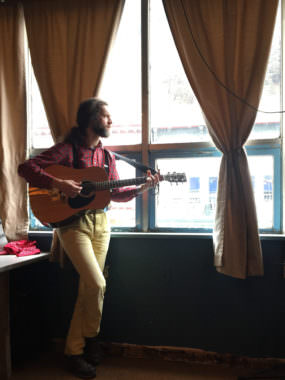
“I am a felon, yes, and I am a recovering addict after five years,” said Dani Cashen, who’s starting a house cleaning business. “I’m still a felon and it still tracks me and haunts me and follows me wherever I go.”
That stigma is something all felons and ex-convicts experience.
Unlike me, with my tattoos, you might not know Cashen had been to prison – unless you’re an employer.
By law, she has to check the felon box on things like job applications.
And then there’s the rest of life’s challenges, like getting housing and keeping up with the conditions of your release.
I’ve been on parole for three years. I check in with my parole officer downtown once a month, can’t leave town unless approved, can’t go into bars, and, I take random drug tests at my PO meetings. I have to obey all state and federal laws.
If I miss or fail any stipulations, it’s back to prison.
If that isn’t hard enough, imagine adding on mental health issues, which might go undiagnosed and untreated in prison.
Bruce Van Dusen is the executive director at Polaris House, an organization dedicated to supporting people with mental illness. (Photo by Elasonga Milligrock/KTOO)
“In general, the story is around the whole country is that the prisons have become the mental health providers,” said Bruce Van Dusen, who is an ex-convict and executive director of Polaris House, an organization dedicated to supporting people with mental illness.
It’s also part of the re-entry coalition trying to stop the revolving door.
“Because they have so many people who are incarcerated who have schizophrenia, or depression, or bipolar,” Van Dusen said.
Thankfully, people like Van Dusen are helping.
And then there’s Ramona Wigg who is a volunteer advocate for people going through reentry. Despite the many challenges, Wigg says she has seen attitudes around reentry shift for the better.
Despite the many challenges, Wigg said she has seen attitudes around re-entry shift for the better.
“It’s just now coming out in the public, so now it’s popular I guess. But it’s important and it should have been popular years ago,” Wigg said. “Think of all the lives we could have saved.”
Confronting and sharing these experiences, including my own, are just a few steps toward understanding and reducing recidivism as a community.
In my next story, I’ll profile a few people staying out of trouble and try to identify why.
This story is part of an ongoing project on re-entry and recidivism. 360 North is also producing a television documentary on the topic slated for June.
Correction: In a previous version of this story Ramona Wigg was misidentified as a mother of a person going through the revolving door. She is a volunteer advocate for people going through reentry.
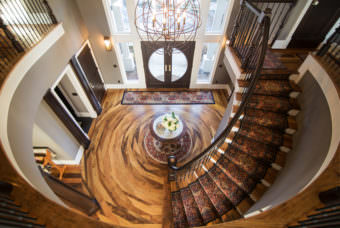
This remodeled entryway won Bauer/Clifton Interiors a first place prize for most innovative design at the 17th Annual Northwest Design Awards in Seattle. (Photo courtesy Bauer/Clifton Interiors)
A Juneau McMansion’s redesigned entryway was recently celebrated at the 17th Annual Northwest Design Awards in Seattle. Juneau’s Bauer/Clifton Interiors took first place for most innovative design for their work. The entire home’s remodel was inspired by something you might not expect.
If you’ve been to Salt, the Hangar Ballroom, downtown McGivney’s or driven by the downtown Blockbuster remodel, you’ve seen work by Bauer/Clifton Interiors. Their office is downtown, and just inside the door is a wall-mounted image of the design that won the award.
“We’re looking down in the center of an entryway in a home here in Juneau,” said Jeremy Bauer, one of the firm’s principal designers, standing in front of the picture.
The new entryway was part of a remodel of what they call an ’80s McMansion in the valley.
Jason Clifton, left, and Jeremy Bauer hold their award at the 17 Annual Northwest Design Awards Gala in Seattle. (Photo courtesy Bauer/Clifton Interiors)
“And you can see that the round shape is a very prominent form in this entry here with the circular staircase coming up on one side. Definitely, you can see the challenge of laying a wood floor in straight patterns there — that we’d lose the essence, the importance of the circle,” said Bauer.
Thinking in circles was just one of the design’s considerations. Jason Clifton, the firm’s other principal designer, said the clients’ needs were a priority.
“We found that they have some really strong ties to family homesteads in the countryside — as do each of us. And so we were able to share those experiences, bond over those experiences, and come up with a plan to establish more of a farmhouse chic design,” said Clifton.
And what is farmhouse chic?
Jason Clifton holds a sample of the wood used for the entryway floor. The 150-year-old American chestnut was salvaged from a farmhouse in West Virginia. (Photo by Scott Burton/KTOO)
“It’s a nice blend of some more historical pieces, heirlooms, antique furnishings, intermixed with the modern amenities of a brand new home.”
But the biggest influence for the entryway might surprise you.
“Looking at the bottom of a woven basket,” said Bauer. “It was something that the owner collected and was very fond of and we had one of them that we took as an inspirational piece that we had laying here on our island in our studio. That was the piece that we turned over and looked at, and it was when the light went off and went, ‘OK, let’s try doing this — let’s try creating a woven wood floor,’” said Bauer.
With farmhouse chic in mind, the designers found reclaimed 150-year-old American chestnut wood flooring from an old farm in West Virginia. The reuse factor is something the designers like, too.
A close up of the American chestnut and its imperfections. (Photo by Scott Burton/KTOO)
“We see that pile of trash getting bigger and bigger out there,” said Bauer, “and I think that is something in the forefront of our minds — instead of something being thrown away can we reuse it and give it new life?”
And it looks cool too.
“And so the product itself isn’t perfect, by any means, so it has quite a bit of character,” said Clifton.
Clifton holds up a sample of the tan wood that’s full of tarnished black holes made by nails and insects.
The planks’ colors vary from light to dark brown, and their widths vary too. This added an additional challenge.
“Each and every one of those planks was laid out individually within CAD (computer aided design) with the dimensions, the angle cuts, the direction, everything pre-planned here within our office before installation was even considered.”
If you didn’t know a basket was its reference, one might also guess kaleidoscope or mandala or beehive. Even though weaving and basketry are several millennia old, they’re still inspiring innovation.
As a professional courtesy, the duo won’t disclose who the homeowner is.
Know what “greige” means?
Listen here:
Close
Update notification options
Subscribe to notifications
Subscribe
Get notifications about news related to the topics you care about. You can unsubscribe anytime.