KRNN

Club Baby Seal provides new artistic outlet in Juneau

It’s awful out in Juneau on a Saturday night. After a bunch of snow, it’s raining, and moat-like ponds of water fill the streets, the sidewalks, everywhere.

Bad conditions however, have not affected attendance at a Club Baby Seal show, a new comedy troupe in Juneau.

The group of four comedians, two managers, a volunteer bartender and security guard are set up at the Gold Town Nickelodeon. It’s their second show of the night and it’s well attended — the first show sold out.

After a welcome from manager Grace Lee, emcee Corin Hughes-Skandijs warms up the crowd.

Part of his open includes a self-deprecating realization that he has the look of a movie extra.

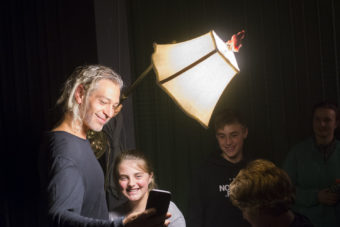
Corin Hughes-Skandijs is CBS's emcee. (Photo by Rashah McChesney/KTOO)
Corin Hughes-Skandijs emcees Club Baby Seal. (Photo by Rashah McChesney/KTOO)

“I’m the kind of guy that you would see stuck at the top of roller coaster, the hero has to come up and save me. I’m sitting there with like, a Mickey ears hat,” he said. The audience gives the bit a healthy laugh.

Next up is one of the group’s founders, Brady Ingledue. After taking a stand-up workshop, he started gathering long-time friends to write jokes and perform at home.

One of his jokes takes place in the bedroom.

“I do like to experiment in the sack, though. What I like to do is get, like, a girl. I’m coming in, I’ll get you all set up in the bedroom right there, doing your thing,” he says. “And then I’ll be over here kind of making a baking soda volcano. You know, getting the elements going, there’s test tubes.”

Audience members laugh during the stand up comedy show, Club Baby Seal, on Saturday, Dec. 18, 2016 in Juneau, Alaska. (Photo by Rashah McChesney/KTOO)
Audience members laugh during the stand-up comedy show, Club Baby Seal, on Saturday, Dec. 18, in Juneau. (Photo by Rashah McChesney/KTOO)

Alicia Hughes-Skandijs is the other group founder who wrote and practiced with Ingledue in the beginning. Her bit is about role-playing — but in a decidedly unsexy setting, the produce section of Fred Meyer.

“So I start in the organic section, and I just, like, grab it, like I know what I’m doing,” she says in a suggestive voice. “Ohh, this recipe calls for two kinds of kale. I know what’s going to happen with it.”

She snaps back to her regular voice.

“I do know what’s going to happen to the kale. The kale is going to get really, really slimy, like in my produce drawer.”

After the show she said, “It is the best feeling in the world when people are laughing because it feels like through their laughter they’re like, ‘Oh yeah I get it. Like, I’m with you on that point.’”

Alicia and Brady eventually met Nate Williams at a party. They started doing house shows in his living room in front of a brick-patterned curtain they ordered from Amazon.

Williams also is the one who suggested the name — Club Baby Seal — an irreverent play on words he conceived as a fifth-grader for the name of a snow fort he made.

“I don’t listen to self-help directly, but I listen to people who listen to self-help,” Williams said. “It’s too powerful straight from the source, like, uncut Tony Robbins is more than anyone can really handle. And I really don’t want to improve too rapidly.”

For those first house shows they brought on Alicia’s brother, actor Corin Hughes-Skandijs as emcee, and eventually actor and long-time friend Allison Holtkamp started performing too.

Holtkamp’s performance includes a bit about artificial insemination that brings hard laughs. She also works as an actor.

Allison Holtkamp (Photo by Rashah McChesney/KTOO)
Allison Holtkamp. (Photo by Rashah McChesney/KTOO)

“It is much more terrifying than acting because in acting you get to go on stage and you get to be someone else. With stand-up comedy you have to get up there and be yourself, and talk about things in your life that may be uncomfortable or … you know, sperm,” Holtkamp said with a laugh.

Unfortunately, Holtkamp’s sperm bit is not public-media safe, but whether it’s that, being an extra, role-playing, self-help or self-image, Alicia said material works “because there is something universal in there that everyone can relate to.”

And what does it feel like when it’s working and everyone is laughing?

“It’s like getting done with a 10-mile run and you get all of those endorphins in that one big laugh,” Holtkamp said.

Corin said, “It’d be like if your whole family was gathered in the living room when you came home from work and they all give you a standing ovation. And you were like, ‘What’s it for?’ ‘For you, and by the way, here is your favorite dinner that you’ve always wanted.’”

Williams said, “It’s like a hug from father or something. It’s a huge acceptance that what you say, what you think — yeah, it’s actually a really neat connection.”

The comedians are quick to thank their managers Hali Duran and Grace Lee, and they’re proud of providing a new artistic outlet in Juneau.

Club Baby Seal has shows scheduled in Petersburg in January, and they hope to make it to Anchorage and beyond in the spring.

From left to right Club Baby Seal is: Allison Holtkamp, Grance Jang, Alicia Hughes-Skandijs, Brady Ingledue, Nate Williams, Hali Duran, and Corin Hughes-Skandijs. (Photo by Scott Burton)
From left to right, Club Baby Seal is: Allison Holtkamp, Grace Lee, Alicia Hughes-Skandijs, Brady Ingledue, Nate Williams, Hali Duran and Corin Hughes-Skandijs. (Photo by Scott Burton)

Correction: An earlier version of this story misidentified one of the club’s managers. Grace Lee is a manager of Club Baby Seal, not Grace Jang.  

Interviews about Alaska Native education recorded

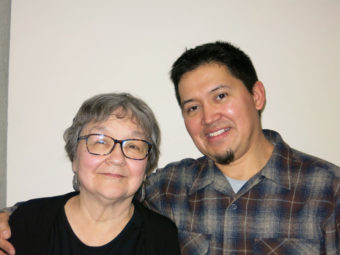
The Quinto family is among the participants in the StoryCorps project at the Juneau Public Library. (Photo courtesy of the Juneau Public Library)
The Quinto family is among the participants in the StoryCorps project at the Juneau Public Library. (Photo courtesy Juneau Public Library)

The Juneau Public Library recently celebrated the addition of 30 audio interviews to their collection. The recordings were done in Juneau, Haines and Klukwan. Many focus on Alaska Native education.

The initial inspiration for the project stems from StoryCorps, a national oral history organization that’s received support from many local entities.

Among the recordings is this conversation between scholar Lance Twitchell and writer and educator Ernestine Hayes. Here are a few some excerpts from their 45-minute conversation.

Ernestine Hayes and Lance Twitchell.
Ernestine Hayes and Lance Twitchell. (Photo courtesy Juneau Public Library)

Twitchell: My name is Lance Twitchell, or Xh’unei, and my relationship to Ernestine Hayes is we are colleagues, we are partners in a fight against coloniality, and she would be my clan auntie and my clan daughter, is how I consider it, and I am very happy to be here.

Hayes: I’m Ernestine Hayes. I’m 71 years old. Today is Dec. 6, 2016. Here we are at the UAS Egan Library in Auk Kwan territory. And I’m here with my colleague Lance Twitchell, and we are, as he says, battling together.

Twitchell: Everybody who walks on this very soil is walking on a place where the Tlingit language was born, and if they’re walking in other places, where those other languages were born. A big part of trying to be — moving in a different direction that colonialism is saying, “Hey, that you’re not the only thing that’s around,” and, “Hey, you’re not the only important thing,” and also, “Things didn’t start with you.” And so, a big part is trying to educate this general populace so that they know, so that the indigenous is not a nameless, faceless thing that’s frozen in time, that has no capability of doing modern things.

Hayes: If we built a racist society, what would it look like? Who would be incarcerated? Who would be the dropouts? Who would have the highest suicide rates? Who would have the highest rate of parental termination? Who’s language would be disappearing? Who would be sick from addiction, and tuberculosis and diabetes? If we build a racist culture, that’s what it would look like, and that’s what this looks like.

Twitchell: I think about the arrogance of the colonial world and then how that translates now to this total reluctance to see the blatant racism that carries through so many, just system after system after system, and drives you nuts cause you’re like, trying to talk to somebody and you just realize how they don’t get it.

Hayes: I think some of us have to be warriors and I just have defined a line where I stand. And I’ll stand there as long as I can, and when I can no longer stand there, I will lay there. But I will not, you know, move back from that line.

Twitchell: Ernestine, you are one of the most important voices in my life, so I like having this conversation with you.

Hayes: Thank you.


This conversation, and more with people like the Quinto family, Hellen Feller and Carol Brady, and Cherri and Wayne Price will be available soon at the Juneau Public Library.

Respected Chilkat and Ravenstail weaver Clarissa Rizal dies at 60

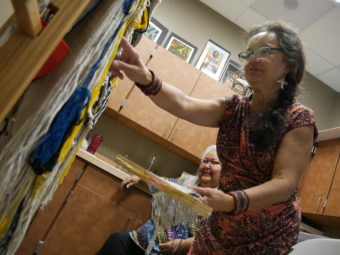
Della Cheney, left, and Clarissa Rizal work on braiding the side borders for the Weavers Across Waters Chilkat/Ravenstail community robe on Monday, August 22, 2016, at the Sealaska Heritage Institute, Juneau. One of three of Rizal's daughters, Lily Hope watches the weavers work on the robe, which will be part of the Huna Tribal House opening celebration. Hope is also an accomplished weaver, actress and storyteller. (Photo by Tripp J Crouse/KTOO)
Della Cheney, left, and Clarissa Rizal work on braiding the side borders for the Weavers Across Waters Chilkat/Ravenstail community robe on Aug. 22, 2016, at the Sealaska Heritage Institute in Juneau. Lily Hope, one of Rizal’s three daughters, watches the weavers work on the robe, which was part of the Huna Tribal House opening celebration. (Photo by Tripp J Crouse/KTOO)

“The world has lost another luminary.”

That’s how the Sealaska Heritage Institute began a message announcing the death of Clarissa Rizal at age 60, a renowned Chilkat and Ravenstail weaver. She was a Raven of the T’akdeintaan Clan, also known as the black-legged Kittywake Clan.

The institute’s announcement says Native people owe her a debt for teaching and reviving the sacred art.


Rizal was diagnosed with terminal liver and colon cancer in October and passed in the early hours this morning. Her sudden death comes as a shock to many.

In addition to weaving, Rizal was a multimedia artist who worked with paint, music, spoken word, printmaking and sculpture. Among her works in recent years was a collaboration with the Seattle-based band Khu.éex’. You can hear Rizal perform in “To Her Grandmother” by clicking below.

Among other awards, Rizal was a 2016 National Endowment for the Arts fellow. You can watch her presentation at the Fellowships Concert below.

She leaves behind children Kahlil and his wife Mikiko along with their daughter Violet; Lily Hope and husband Ishmael, and their children Elizabeth, Louis, Mary and Ella; Ursala Hudson and husband Chris Haas and their daughters Amelie and Simone. She is also survived by her siblings Richard, Tim, Irene and Deanna.

A celebration of life in Juneau will take place in the summer of 2017.

10-year-old inspires with Friday concerts in Ms. Harmon’s 5th grade class

Kayla Harmon’s fifth grade class is just in from lunch-recess on a sunny Friday.

With little prompting, the students move to the front of the classroom. Some sit in kid-size chairs and tables, others sit cross-legged on the ground or on pillows.

Filori's mini concerts have become a Friday routine after lunch recess. One student said it's a nice way to transition back into the classroom. (Photo by Scott Burton/KTOO)
Waid’s mini concerts have become a Friday routine after lunch recess. One student said it’s a nice way to transition back into the classroom. (Photo by Scott Burton/KTOO)

At the beginning of the school year, 10-year-old Mia Waid asked her teacher if she could play her guitar and sing in front of the class. Harmon agreed.

Waid stands with her guitar on a throw rug. The fluorescent lights are off, and natural light filters in through large windows facing Mount Juneau. Her 26 classmates are silent, focused on her.

Harmon had seen Waid play around town before the fifth grader asked to play for the class.

“She really connects to the songs,” said Harmon. “Some of the topics are more about love or something and she’s a 10-year-old girl, but I always feel like she just really embodies the lyrics that she’s singing, and it’s so believable when she sings it.”

Today, Waid plays four songs including a class favorite called “Rip Tide” by indie-folk artist Vance Joy. Beyond Joy, this 10-year-old’s inspirations may surprise.

“I like the old stuff like Carol King, Bill Withers, Ray Charles and Michael Jackson, of course,” said Waid.

Harmon says her students are supportive--some even think Filori should be on NBC's 'The Voice.' (Photo by Scott Burton/KTOO)
Harmon says her students are supportive. Some even think Waid should be on NBC’s “The Voice.” (Photo by Scott Burton/KTOO)

“I think it’s really fun not to necessarily look at her,” said Harmon, “but look at her peers just like, staring at her basically, with a big grin on their face. They’re so focused on listening to her, and I think they know that it’s taken a lot of time and dedication to be as good as she is.”

Kayla Harmon and Mia Filori
Kayla Harmon and Mia Waid. (Photo by Scott Burton/KTOO)

Among those peers is Cayman Jardell.

“It’s really inspiring. Like, I used to think that I would never be a football player, but after this, I know I think I can,” said Jardell.

And Audrey Noon.

“Mia wrote a song and that inspired me to, like, come up with my own songs ‘cause one of my career choices is a singer,” said Noon.

“When Mia got up there and was really brave it really inspired me to go do stuff and be really brave,” said Andrew Waldron.

Georgia Lawton is inspired too. “When she did her own song, I love playing guitar so it kind of inspired me to do that as well,” said Lawton.

Waid has advice for getting over the jitters, and maybe, life in general.

Mia Filori says everyone gets nervous, that's part of being human. (Photo by Scott Burton/KTOO).
Mia Waid says everyone gets nervous, that’s part of being human. (Photo by Scott Burton/KTOO)

“Breathe slowly, and I would say, just like, instead of walking backwards, run toward it. Just like, bolt towards it, pretty much. Like a little figurative language,” said Waid with a laugh.

As for her future?

“I actually want to be an archaeologist, but I want the music to pay for my archaeology,” said Waid.

To hear Waid’s music live, keep an eye out. She’s been known to busk around town.


Correction: An earlier version of this story contained an incorrect last name for Mia Waid. 

Dan DeRoux’s ‘Raindrops’ competes in national public art contest

Work by Juneau artist Dan DeRoux is in the midst of a competition that could earn him $10,000. The advocacy group Americans for the Arts nominated DeRoux’s “Raindrops” for the contest, which is driven by online votes.

"I got about three of them hung and there were all of the sudden a million reflections." -Dan DeRoux (Photo by Scott Burton/KTOO)
“Raindrops” at Gastineau Elementary School. “I got about three of them hung and there were all of the sudden, like, a million reflections,” said artist Dan DeRoux. (Photo by Scott Burton/KTOO)

The piece was installed at Gastineau Elementary School on Douglas in 2015.

It’s made up of mirrors and handmade tears of glass several feet long suspended from a hallway ceiling. A skylight illuminates the installation.

Dan DeRoux (Photo courtesy of Dan DeRoux)
Dan DeRoux (Photo courtesy Dan DeRoux)

“So when I actually got up there on the scaffolding, and had the mirror put in, and got up there and started hanging these pieces — I got about three of them hung and there were all of the sudden, like, a million reflections, “ said DeRoux. “It just was infinite, you know. And you’re standing up there inside a box of mirrors inside this light well — I just got real giddy.”

Deroux has about a dozen pieces of public art in Juneau. He says the most challenging part of this installation was creating the glass raindrops at a foundry in Ashland, Oregon.

“You have a big ball of molten glass on the end of a big rod and you have to drop it off, you have to make sure the neck is the right thickness that you want and still has a big lobe on the end,” said DeRoux. “But you have to stop it in midair. So, hot glass is dropping off of a pipe and you have to make it stop before it hits the ground. So it was really frustrating, as you might imagine, and I lost way more pieces than I made, by far.”

DeRoux said the most challenging part of the installation was creating the raindrops from molten glass. (Photo courtesy of Dan DeRoux)
DeRoux said the most challenging part of the installation was creating the raindrops from molten glass. (Photo courtesy Dan DeRoux)

“Raindrops” is among 101 works of public art in the contest that runs until Oct. 31. First, second and third prizes win $10,000, $5,000 and $1,000 respectively. KRIS Wines in Montagna, Italy, is sponsoring the competition.

Q&A with Matisyahu: Improvising is risky, but leads to unique experiences

Matisyahu poses for a selfie
Matisyahu poses for a selfie with a fan at the Goldtown Nickelodeon, Sept. 22, 2016. (Photo by Annie Bartholomew/KTOO)

Grammy nominated artist Matisyahu is performing to a sold out Centennial Hall on Friday night after almost a year of planning. His music blends reggae, beatboxing and alternative styles and hit the top 40 chart in 2005 with a tune called “King Without a Crown.” Thursday night, Matisyahu answered questions at a private event for KTOO members.

Listen to the entire question and answer session here.

One highlight came in response to a question about his creative process while performing live. Matisyahu said it’s about improvisation.

“I am always more interested in sort of not doing the thing that I know will get a reaction, or that will be like good. But actually holding back from doing that, and seeing what new can happen. And that’s sort of a risk because sometimes the songs might just go into nowhere. And nothing happens. But I feel if I keep trying that throughout the course of a show, at some point there’s some kind of like — something, like, breaks open, and then I’m actually able, like, to have a really unique experience with the people that are there.”

Matisyahu spoke to the crowd of 40 people for about 40 minutes. His concert Friday starts at 7:30. If you missed getting tickets, the Juneau Arts and Humanities Council will start putting names on a waitlist at 6:30 p.m.

The show is a joint collaboration between the Juneau Arts and Humanities Council and KTOO, KRNN and KXLL.

Site notifications
Update notification options
Subscribe to notifications