KRNN

Stolen art piece was intended to raise awareness of homelessness in Juneau

(Photo by Scott Burton/KTOO)

It’s a nice afternoon in Juneau as Michael Spoon stands in front of Juneau’s City Hall looking at the abstract figure.

Michael Spoon says he's thankful for the resources available at the Glory Hole. (Photo by Scott Burton/KTOO)
Michael Spoon says he’s thankful for the resources available at the Glory Hole. (Photo by Scott Burton/KTOO)

“You can tell it’s a humanoid form. What is this? A bench?” Spoon asks.

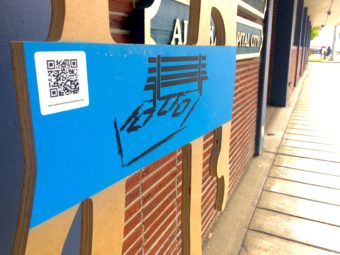
The figure is a little taller than Spoon, who’s been homeless in Juneau since December. It’s a plywood cut-out of a person that is part of a national effort to bring awareness to homelessness. The social art project began in Charleston, South Carolina, where the city collaborated with a design firm to create 430 plywood figures — the estimated number of homeless people in the city at the time.

The figures were placed in a park in front of their City Hall. Now, the project has gone national and every state capital has been asked to put a figure in front of their city hall in solidarity.

The figure is hollow to symbolize the invisibility of homeless people, and there’s an image of a bench with a house as a shadow near the figure’s belt line. Spoon didn’t sleep on a bench last night, but close.

“I was sleeping up behind a restaurant this morning. It was blowing like 35, 45 mph and rainin’ — layin’ on cardboard — I had cardboard covering me. I still froze,” Spoon says.

Spoon says he’s been homeless in Juneau 6 or 7 times before, and in several other cities.

“Sitka, back in my hometown, Seward, Alaska, Anchorage, Alaska, Seattle, Portland, Oregon, on the outskirts of Portland, Oregon, Grimshaw, Milwaukee, Gladstone …”

The figure is next to the large City Hall sign board tourists like to take pictures with. A couple walks by, cameras in hand. Spoon asks the man for a smoke. The man, with a cigarette in his mouth, shakes his head no.

“That’s another issue around here, too, is the drugs,” says Spoon. “I’m an alcoholic but I try and take a break from it once in a while and keep on trying to find work.”

He also says that violence is an issue, but that it’s the same everywhere. Overall, Spoon says that Juneau seems better than some other places.

“You get to wash your clothes and take a shower at the Glory Hole, and they get fed three times a day,” says Spoon. “These other cities I was in, you only got to eat once a day, and you could never use the shower ‘cause someone was always in there — beat you to it or something.”

I ask him what advice he has for Juneau.

“Just keep trying I guess. Find enough resources of what’s around you and try to use ‘em. They’re starting to do the housing thing and stuff. I missed (out by) 5 minutes. Some guy beat me by 5 minutes — he was the last guy to sign up for the housing,” answered Spoon.

The housing Spoon is referring to is Juneau’s housing first facility now under construction in Lemon Creek. The 32-unit building, which should be done in May 2017, is meant for people like Spoon. The idea is that with a stable living environment, people can then address their addictions, get medical attention, find work.

City and Borough of Juneau Chief Housing Officer Scott Ciambor stands with the figurine that was sent from Charleston, South Carolina. (Photo by Scott Burton/KTOO)
City and Borough of Juneau Chief Housing Officer Scott Ciambor stands with the figure that was sent from Charleston, South Carolina. (Photo by Scott Burton/KTOO)

“We’ve had a great community effort in the last five years,” says Scott Ciambor, Juneau’s chief housing officer. He’s among a group of organizers and planners that have made the housing first project a reality.

“This is kind of showing that, unlike the figurine which is supposed to represent invisibility and not seeing homeless people as part of communities, we’ve gotten past that hurdle and are making active choices for solutions,” he says.

If Juneau were to fully emulate Charleston’s project, we’d put out 216 figures — maybe in Marine Park. That’s the number of homeless people counted in Juneau in January. Ciambor is proud of the 32-unit housing first project, but he says we still have more work to do.

“Realistically, that is a small sample targeted to those who are most vulnerable,” Ciambor says. “So there’s still opportunities slightly up the spectrum, more low-income, affordable housing, more supported housing that is not as intensive as that project. And some more private market rentals that social service providers can connect with to put some of their clients in.”

A couple walks by and I ask them what they think of the figure. Beyond the shape of a person, they’re not sure what it is and they don’t know how to use the QR code that links to the project website. I explain it to them. It turns out I am preaching to the choir. Eddie Snell is off a cruise ship from Florida and is active in his community’s efforts to fight homelessness.

Sherry and Eddie Snell are visiting Juneau from Florida. Eddie is active in his community's efforts to address homelessness. (Photo by Scott Burton/KTOO)
Sherry and Eddie Snell are visiting Juneau from Florida. Eddie is active in his community’s efforts to address homelessness. (Photo by Scott Burton/KTOO)

“We should not have large numbers of people roaming the streets without receiving some type of help in this country with all the resources we have,” Snell says.

Spoon agrees, but unlike Snell he doesn’t have a stateroom.

“I don’t know where I am going to sleep tonight,” Spoon says.

Ciambor took a picture of the figure and sent it to the project organizers in Charleston. So far, Juneau, Little Rock and Santa Fe have participated. To see the figure, the pictures in this story will have to do — it was stolen the night after I did these interviews. Ciambor has mixed emotions about the theft. He’s glad it has a new home, but he’d like it back.

Yakutat man is one of ‘The Magnificent Seven’

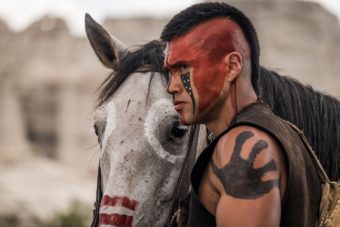
Martin Sensmeier, a 32-year-old actor from Yakutat, is co-starring in the major motion picture “The Magnificent Seven.”

In the film, Sensmeier shares the screen with Denzel Washington and Ethan Hawke.

The movie is a remake of the 1960 western version starring Yul Brynner, and also the 1954 Japanese film “Seven Samurai.”

On the phone from Los Angeles, Sensmeier said that riding horses was the most challenging part of the role.

Listen to the story here:

“Being Tlingit and Athabascan, you know, I didn’t grow up on them, right?” Sensmeier said. “We traveled like a hundred miles every day. So they sent us to Louisiana a month before filming and we started training five days a week on horseback riding — about an hour and a half to two hours a day. And I was riding bareback in the movie — I’m the only one that didn’t have a saddle.”

Sensmeier grew up in Yakutat and enjoyed playing basketball and subsistence fishing and hunting.

As an adult, he worked on an oil rig at one point, and has lived between Los Angeles and Yakutat working as an actor and model.

Beyond doing cultural research, and having a Comanche cultural adviser on the set, Sensmeier said he could relate to his character.

“There’re similarities between all of us. Certain innate qualities we all share. We all have similar experiences in terms of what we went through — colonization, but also there’re a lot of similarities between the cultural values,” Sensmeier said. “Of course our rituals and ceremonies and stuff like that are different, but culturally, we connect. Hanging out with native people wherever I go, you feel that connection.”

From left to right, the Magnificent Seven are Vincent D'Onofrio, Martin Sensmeier, Manuel Garcia-Rulfo, Ethan Hawke, Denzel Washington, Chris Pratt and Byung-hun Lee. (Photo courtesy of Sony Pictures)
From left to right, the Magnificent Seven are Vincent D’Onofrio, Martin Sensmeier, Manuel Garcia-Rulfo, Ethan Hawke, Denzel Washington, Chris Pratt and Byung-hun Lee. (Photo courtesy of Sony Pictures)

That being said, Sensmeier does not pretend to speak for the Comanche.

“As few roles as there are for Native characters, it’s representative of our place in Hollywood in a way,” he said. “But as far as representing the Comanche people, I did the best I could with what I was given. And I hope they like it. But I am not going to sit here and tell you that this is the Comanche way because I am not a representative of that, right? I am not a part of their culture. I am not a part of their tribe. I’m an actor. You know? So, I act.”

When Sensmeier is not acting, he visits home often.

“If I could do what I do and live at home, I would definitely do that,” he said. “Unfortunately, I have to be down here. Not unfortunately, I am very blessed to be in this position, but I would much rather live at home in Yakutat than in Los Angeles.”

“I am not really a city boy. I like being in the village.”

The movie opens Sept 23 in theaters everywhere.

Red Carpet Concert: Nicole Church

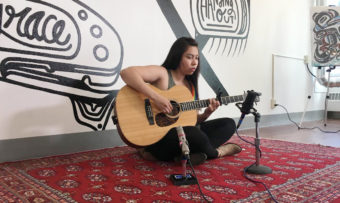
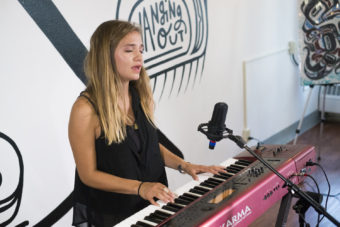
The latest Celebration Sessions Red Carpet Concert video features Juneau songwriter Nicole Church. She performs her song “My Demise” in a studio shared by Rico Worl and Christy NaMee Eriksen, who curated the eight-part series.

The Celebration Sessions Red Carpet Concerts are a collaboration between KTOO, Kindred Post and Trickster Company. Watch other Red Carpet Concerts with David Sumiq Russell-JensenChantil Dukart and  Lily Hope.

Red Carpet Concert: David Sumiq Russell-Jensen

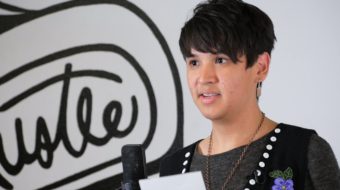
The latest Celebration Sessions Red Carpet Concert video features Juneau writer David Sumiq Russell-Jensen perfoming his poem “Kei nalnúkdzi Kax’át’,” which means ripening berries. He recites it in Tlingit, then in English. The video was  in a studio shared by Rico Worl and Christy NaMee Eriksen who curated the eight-part series.

The Celebration Sessions Red Carpet Concerts are a collaboration between KTOO, Kindred Post and Trickster Company. Watch other Red Carpet Concerts with Lily HopeChantil Dukart and Stephen Qacung Blanchett.

Walking tour explores Juneau’s art scene

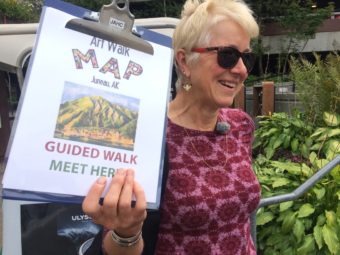
In June, the Juneau Arts and Humanities Council began selling guided art walk tours that weave through the capital city.

Attendance has been low on the tour, which stops at about 32 galleries, public art displays and studios.

Listen to the story here:

Seckel looks for familiar faces in Jane Terzis and Dan DeRoux's "Children's Storybook Characters." (Photo by Scott Burton/KTOO).
Art walk participant Cornelia Seckel looks for familiar faces in Jane Terzis and Dan DeRoux’s “Children’s Storybook Characters.” (Photo by Scott Burton/KTOO).

“Now this is about two hours, and we do some hills, you don’t mind that? It’s not a bad hill, we’re just going to walk to the steeper part of town,” warned Deb Rudis, our volunteer tour guide on a beautiful Tuesday afternoon in late August.

(Rudis guides Tuesdays, and classical guitarist Dan Hopson covers Sundays and Mondays).

The walk begins at the Visitor’s Information Booth near the downtown library.

On the tour with me is Cornelia Seckel, who is the publisher of Art Times, an online arts journal based near Woodstock, New York.

“I’m thrilled to see the activity that goes on here in Juneau and that’s what I’ll be writing about in Art Times online and blogging about it as well,” Seckel said.

Our first stop is Dan DeRoux’s mural, “Ancon,” on the water side of the downtown parking garage.

Then we head into the library to see Bruce Elliot’s “Transfiguration” — the stained glass that shows salmon changing into Tlingit figures.

My first new discovery is in the library’s children’s section: there’s a floor-to-ceiling painting by Jane Terzis and Dan DeRoux of a mountain meadow filled with storybook and fairy tale characters.

Art walk participant Cornelia Seckel and MK MacNaughton talk in MacNaughton's studio Sketch. (Photo by Scott Burton/KTOO).
Art walk participant Cornelia Seckel and MK MacNaughton talk in MacNaughton’s studio Sketch. (Photo by Scott Burton/KTOO).

“Every time I look at it I see another figure,” Rudis said. “I’m like ‘oh, that’s who that is!’ You know I didn’t recognize the Cheshire Cat the first time when I was looking at it. There’s the cat that jumps over the moon,” Rudis said.

At the library’s front desk, we admire Steve Brown’s wood Bear Panel carving.

Outside, as the tour continues, I realize downtown Juneau is really dense with art: there’s Ray Peck’s metal wall sculpture depicting traditional and modern ways of fishing; the Patsy Ann sculpture on the waterfront; a mural at the Taqueria; the near life-size bronze sculpture “Hard Rock Miner” in Marine Park; and lots more.

Seckel and Rudis talk about the Old Witch Totem in the State Office Building. (Photo by Scott Burton/KTOO).

“This is one of my favorite pieces of public art in Juneau,” said Rudis, as she directs our attention to Bill Ray Jr.’s mural on City Hall.
“It’s the Raven — the Trickster — opening the clam shell which released man, and then it’s the Tlingit representation of all the different wildlife species that are the dominant clan symbols: the bear, the frog, the eagle, the orca, and the wolf,” Rudis said.

The tour winds through town stopping at studios and galleries where we can speak with artists at work.

Seckel chats with artists like Rico Worl, MK MacNaughton and Lily Hope.

Seckel takes notes diligently and I ask her what her headline might be.

“It’s not just about fishing,” Seckel said. “It’s very much that story of being drawn to an area because it’s so rich in the arts, because it’s so rich in culture, and beauty, and outdoor life. So what if you have to get here by plane?”

Seckel’s been publishing the arts journal for over 30 years and has written widely about the arts.

I asked her if she noticed anything unique about the Juneau scene:

“I like seeing the indigenous culture so vibrant and apparent,” she said. “You wouldn’t see that where I am. I mean I am not too far from Woodstock, New York. People are dressed in all sorts of ways, and shops and, there’s no real indigenous anything. Or in New York City I don’t see that there’s—there’s a presentation of hundreds of different peoples.”

“Here it’s narrowed down and so it becomes much more obvious and exciting and makes me want to know more,” Seckel said.

We climb up through town, check in at the Canvas, visit the Empty Chair Memorial in Capitol Park, and admire the Old Witch Totem in the State Office Building.

Lily Hope talks about Chilkat Weaving with art walk participant Cornelia Seckel.
Lily Hope talks about Chilkat Weaving with art walk participant Cornelia Seckel. (Photo by Scott Burton/KTOO)

This day, our art tour with Rudis ends looking at Nimbus.

“It’s kind of like an iceberg in some ways, and kind of like a glacier in some ways,” Rudis said. “You know I think it pretty much captures the feel of Alaska—it’s raw and it’s different.”

The tour isn’t a deep dive into Juneau’s art history.

Rudis says it’s a cursory introduction, a good fit for cruise ship visitors.

It’s available through September, costs $20 per person, and runs at 1 p.m. Sundays, Mondays and Tuesdays.

The JAHC also offers online and printed Art Walk maps for self-guided tours.

Red Carpet Concert: Chantil Dukart

The latest Celebration Sessions Red Carpet Concert video features Miami-based jazz musician Chantil Dukart. She performs her song “The Future Is Our Friend” in a studio shared by Rico Worl and Christy NaMee Eriksen who curated the eight-part series.

The Celebration Sessions Red Carpet Concerts are a collaboration between KTOO, Kindred Post and Trickster Company. Watch other Red Carpet Concerts with Lily Hope, Silver Jackson, and Stephen Qacung Blanchett.

Site notifications
Update notification options
Subscribe to notifications