Juneau

Marriage equality and mourning: Mildred Boesser fought till the end

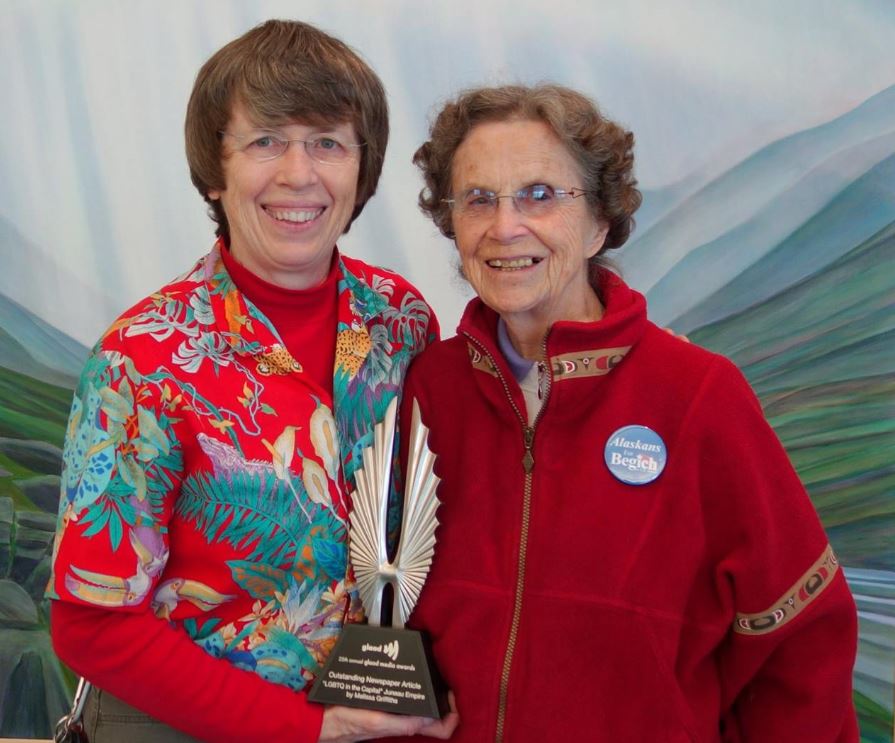
Sara Boesser and Mildred Boesser in September, 2014. (Photo by Melissa Griffiths)

When the Supreme Court legalized same sex marriage nationwide last week, President Obama called the ruling “a consequence of the countless small acts of courage of millions of people across decades who stood up.”

Mildred Boesser stood 5 feet tall, and she was one of those people. On the day of the ruling, Boesser was on her deathbed at home in Juneau, surrounded by family.

“Friday she was still up and in the chair and talking and holding court and doing well,” says Sara Boesser, Mildred’s daughter. “But she was ready to go and she said, ‘Why am I still here? Why am I still here? I am ready.’ And then the Supreme Court ruling came through and she said, ‘That’s why I’m still here,’ and she was so happy.”

The wife of an Episcopalian minister, Mildred spent decades fighting for gay rights and marriage equality. Just last year, she testified to the legislature in support of a bill that would prohibit discrimination based on sexual orientation or gender identity.

“For the record, I’m 88 years old. I’ve lived in Alaska since 1959. I’ve been married for 65 years to the same man and together we’ve raised four children. I’m also a Christian and my faith informs what I do,” Mildred said. “I can’t begin to tell you how saddened I am by the fact that in this great state I love so dearly, a person can be fired legally from a job, evicted from housing, denied credit or financing simply because of whom they happen to love.”

Mildred’s advocacy work stemmed from her daughter Sara.

Sara recounts her mother visiting her while she was a senior at the University of Washington in Seattle. It was the early 1970s.

“I was working at a bookstore called Madwomen Bookstore downtown and it had a lot of feminist and progressive and some lesbian books,” Sara says.

As they were leaving the store, Sara decided at that moment to tell her mother:

“At the crosswalk, light hit green and we started across the crosswalk. I said, ‘Mom, did you know that I’m a lesbian?’ She kind of kept going and she looked at me and said, ‘No, but I’m glad you told me, but that doesn’t change anything about what I feel for you.’ And we got across the crosswalk.”

Throughout the years, Mildred spoke up in the State Capitol Building, in city halls across Alaska and knocked on doors in support of gay rights. Sara says her mother never missed an opportunity to testify in the Capitol, even when Sara herself was discouraged.

“At some point it became too difficult for me to go back to those same legislators and tell them again that we are no threat. I couldn’t do it anymore,” Sara says. “And my mother still would. She wouldn’t even sometimes tell me she’d done it and then I read about it in the paper and think, ‘Wow, way to go Mildred.’”

Liz Dodd is a close family friend. She worked alongside Mildred in 1998 against the state constitutional amendment that defined marriage as between a man and a woman. Dodd says the hearings were antagonistic and she recalls times when lawmakers were rude.

“You would have this bank of legislators sitting around their little dais there and little Mildred at the table in front of them, soft spoken, just preaching love basically,” Dodd says.

Sara Boesser was honored to be Mildred’s daughter.

“People would stop me on the street always and say, ‘I love your mother. She’s my surrogate mother. She’s my grandmother. She’s a mother to us all.’ I was always very proud of her,” Sara says.

The respect was mutual, says Dodd. Dodd recounts her last conversation with Mildred.

“She started to talk about Sara and how Sara was her hero and how Sara inspired her and made her stronger,” Dodd says. “And she said, ‘I had brought this person into the world and then all through the years, I’ve watched her in absolute amazement at who she is.'”
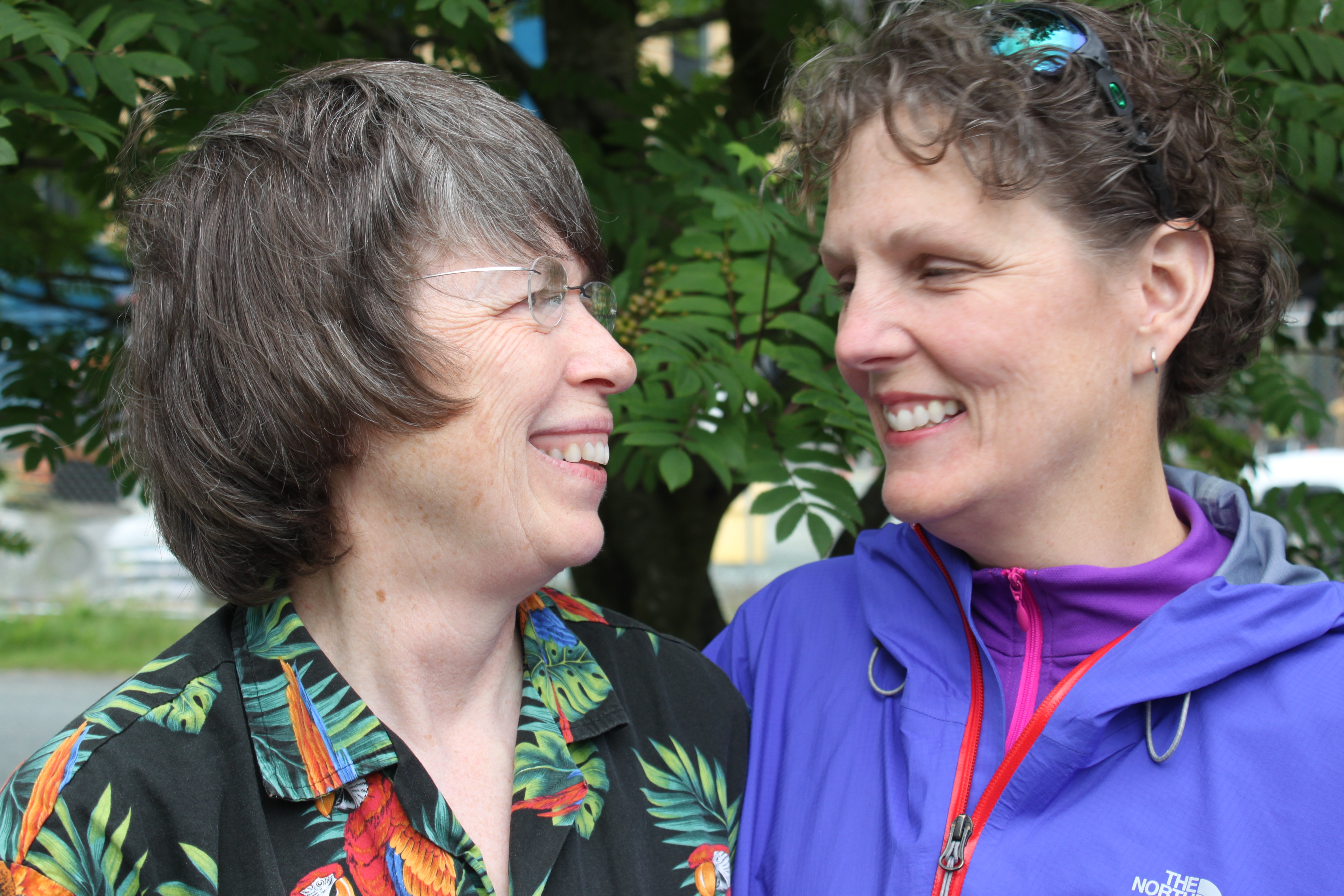
Sara Boesser and her partner Juanita Reese recently got engaged. (Photo by Lisa Phu/KTOO)

After the Supreme Court ruling, Sara announced to her mother and father that she and her partner of four years are getting married.

“The last day that she was alive, she said, ‘I’m sorry I’m going to miss your wedding.’ I said, ‘Oh, don’t worry mom. You’re my first invitee and you’re going to be there with us, don’t you worry,'” Sara says.

Mildred Boesser passed away at age 90 on June 29, 2015. She is survived by her husband Mark, her four daughters and countless others who considered Mildred their mother.


UAS Juneau goes smoke-free Wednesday

A ban on all tobacco products goes into effect July 1 on UAS's Juneau campus. (Photo by Lisa Phu/KTOO)
A ban on all tobacco products goes into effect July 1 on UAS’s Juneau campus. (Photo by Lisa Phu/KTOO)

The University of Alaska Southeast campus in Juneau goes completely smoke-free on Wednesday.

UAS will join thousands of colleges nationwide with similar policies banning tobacco use by students, staff and visitors.

No more cigarette, e-cigarette or hookah breaks between classes; the ban applies to all tobacco products. Anyone looking for a nicotine fix will have to leave campus to get it.

The ban is part of a university-wide policy approved in December by the Board of Regents.

The University of Alaska is not alone in adopting a tobacco-free policy. Institutions of higher learning have been banning tobacco on their campuses for years.

UAS Vice Chancellor of Administration Michael Ciri has been following the issue. He says the university is entering the discussion somewhat late.

“But I don’t necessarily think that is a bad thing,” Ciri says. “We were able to learn a lot from other universities that drafted smoke-free policies and, I think, have a better policy for that.”

The regents’ decision to make all University of Alaska campuses tobacco free was primarily to reduce employee healthcare costs.

“When there’s smoking-related illnesses, that is a real, actual cost borne by the University of Alaska. If we pay for fewer employee-related health issues, that provides an immediate savings to the institution,” Ciri says.

The smoking ban will apply to all university property and buildings. Ciri says UAS Facilities Services has been surveying campus to create a simple graphical map.

“We need to be very clear about, OK, actually the property line is right there because if I were a smoker and I am willing to comply with the letter of the law, what I would want to know is, specifically, where’s your property line? Because I’ll stand right on the other side of it,” Ciri says.

Some students have already voiced concern about the university’s enforcement plan, or lack thereof. Like graduating senior Trevor Luedke:

“I think it’s going to be impossible to enforce.”

Administrators admit that enforcement will depend on “the consideration and cooperation of both users and non-users of tobacco.”

In other words, Ciri says, no one will be tasked with enforcing the new policy.

“There’s not going to be a smoking czar or the smoking police going around with little seltzer bottles, hitting people,” Ciri says laughing.

However, Ciri points out that the smoking ban is just one of many conduct policies students are asked to observe. The expectation is that people are going to be courteous.

Juneau Assembly votes to raise penalty for unpermitted signs

downtown Juneau
Downtown Juneau. (Creative Commons photo by Kyle Rush)

The Juneau Assembly voted Monday night to amend the signs code, adding a penalty that’s at least five times higher for unpermitted signs outside businesses.

Violators could pay $500 a day per offense; however, they may be eligible for a “fix it” period said Assemblyman Jesse Kiehl.

“If you get a citation for one of these sign violations, within 15 days, you can fix it,” he said. “You can get a permit, you can take it down–whatever it is. And your citation gets dismissed.”

Violators can only get one “fix it” period. After that, they can incur the penalty. The ordinance is based on one used in Skagway’s historic district.

Assemblyman Jerry Nankervis disagreed with the high fine, suggesting it should be lowered to $300. But Assemblywoman Karen Crane said there’s already been an enormous amount of discussion on the topic.

“There’s been agreement by a number of people. A lot of input on the $500 fine,” she said. “It’s worked well in other communities and I say, let’s go forward.”

Previously, business owners with unpermitted signs could be fined a staggered penalty of $25 to $100. It cost $50 to apply for a signs permit, only $25 for the violation. An advisory committee said that model discouraged compliance.

The new ordinance goes into effect at the end of July.

Tall Timbers takes Haven House appeal to court

The Tall Timbers Neighborhood Association filed its appeal in Superior Court June 19. (Photo by Lisa Phu/KTOO)

A Juneau neighborhood association has taken its fight against a transitional home for just-released female inmates to court.

The Tall Timbers Neighborhood Association filed an appeal against the Juneau Planning Commission and Haven House in Superior Court June 19.

In the appeal notice, the neighborhood association contends the planning commission made a mistake in granting Haven House a permit to be located on Malissa Drive in the Mendenhall Valley. Before taking the matter to the court, Tall Timbers had appealed to the Juneau Assembly in May and lost.

June Degnan is board chair of Haven House, a faith-based nonprofit.

“They’re exercising their legal right so if that’s the game they’re willing to play, then I’m willing to continue to defend women and do the right thing as is my board,” Degnan says.

Haven House provides a structured living situation for women transitioning out of prison. It opened in April and has two residents.

Court appeal aside, city officials are in the process of changing city code to clarify what transitional housing is and where it can go.

City Attorney Amy Mead says the ordinance amendment could make the Tall Timbers’ argument moot, even if it won the appeal.

“It would not require Haven House to leave because if this ordinance passes then Haven House is properly in a D5 with a conditional use permit, per this ordinance,” Mead says.

Tall Timbers’ lawyer could not be reached for comment by deadline.

The ordinance change was introduced during Monday night’s Juneau Assembly meeting and is scheduled for a public hearing July 20.

Mini-jökulhlaup peaks on Mendenhall Lake

Mendenhall Lake levels at 11:00 a.m. Monday, June 29, 2015. (Courtesy National Weather Service)
Mendenhall Lake levels at 11 a.m. Monday. (Courtesy National Weather Service)

There was another jökulhlaup or glacial release at Mendenhall Glacier over the weekend. But this one pretty much came and went without any big floods.

Forecaster Bob Shontz at the National Weather Service’s Juneau office says Mendenhall Lake water levels peaked Sunday morning at just under 7.5 feet. That’s about a foot and a half below flooding.

This glacial release may not have come from Suicide Basin above the Mendenhall Glacier, such as another jökulhlaup earlier this month. Instead, this weekend’s release was likely from another lake that is not monitored with measuring equipment.

With the glacier receding and getting thinner, Shontz says, “Water that had been trapped behind it for awhile can suddenly get out. It can lift under the glacier and run out.“

No damage or injuries were reported from Sunday’s event.

Shontz says they’re also monitoring the Taku River and the Salmon River near Hyder for potential glacial releases this summer.

Juneau soccer camp grooms players for the international field

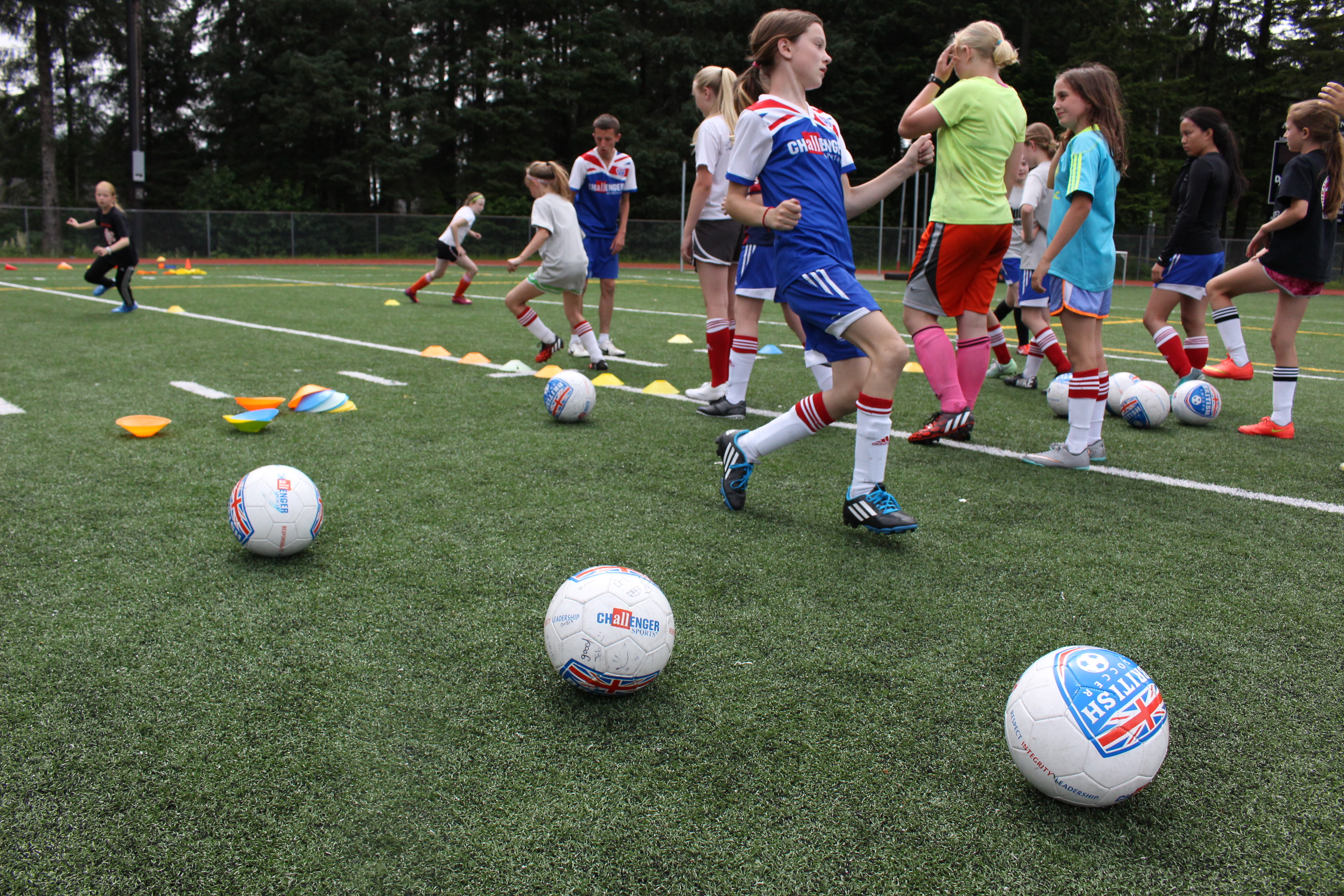
Juneau Soccer Club hosts the coed camp which teaches kids about the global sport. (photo by Elizabeth Jenkins/KTOO)
Juneau Soccer Club hosts the coed camp which teaches kids about the global sport. (Photo by Elizabeth Jenkins/KTOO)

As the U.S. team heads to the Women’s World Cup quarterfinals this weekend, a Juneau soccer camp is teaching kids all about the global sport.

On the turf at Adair-Kennedy Memorial Park, a group of Scots and Brits are teaching 145 kids how soccer–or what they call “football”–is played across the pond. Miley Quigley is part of the 11- to 13-year-old group. She says her favorite thing about the camp is learning new skills.

“I barely knew any tricks before and now I know a lot of tricks because Spider Man taught us,” she says.

“Spider Man” is the nickname for Stephen Paris, a sports coach major from Glasgow, Scotland. He doesn’t play competitively due to an old foot injury, but that doesn’t stop him from teaching the sport. His signature move is called a “rainbow.”

With the kick of his heel, the ball arches over the back of his body.

“Right over the head. I went right over the reporter’s head,” he says.

Coach Paris runs the girls through drills. (Photo by Elizabeth Jenkins/KTOO)

Challenger Sports sends foreign players, like Paris, to different parts of the country to teach regional techniques. Last year, a Brazilian group taught Samba dribbling.

“It’s like the fancy freestyle side of soccer. So like all these flicks you see. You run pass the player. It’s flair,” says Hamza Butt, otherwise known as “coach Hamburger.”

He can be pretty strict on the field, which he says comes from his background playing semi-professional soccer in England. Unlike Samba dribbling, the British style is more buttoned-up, strategic.

“You got to be much more technical,” he says. “Teams want an individual who has everything to his game: passing, dribbling, crossing, shooting.”

Typically, soccer teams are an international patchwork, but in the World Cup, athletes play for their home country. Coach Butt says the kids here at camp are watching.

“For example, Rapinoe, the U.S. winger. Women here in the camp, want to be like Rapinoe,” he says. “Whilst they’re dribbling the ball, they say, ‘It’s Rapinoe! Rapinoe!’  They’re are trying to imitate these players.”

But the young women say it can be tough to find equality on the field, especially when you’re teammates with pre-teen boys. They hurl what they think is the ultimate insult: “You play like a girl.”

“It’s kind of honestly really sexist when they say ‘like a girl,’ cause we’re like, ‘why?'” says camp participant Merry Neuman.

Because these soccer players know what it really means.

“Then you must be doing something really good if it’s like a girl  because we’re way better.”

The last time the U.S. men’s team reached the World Cup quarterfinals was in 2002.

Site notifications
Update notification options
Subscribe to notifications