Kaiser Health News

California Approves Physician-Assisted Suicide; Bill Heads To Governor’s Desk

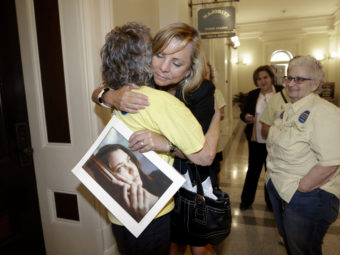
Debbie Ziegler holds a photo of her daughter, Brittany Maynard, as hugs supporter Ellen Pontac after a right-to-die measure was approved by the state Assembly on Wednesday in Sacramento, Calif.

A controversial bill to legalize physician-assisted suicide in California is headed to the governor for consideration, after almost nine months of intense — often personal — debate in the legislature.

If Gov. Jerry Brown signs the bill, California would become the fifth state to allow doctors to prescribe lethal medication to terminally ill patients who request it, after Oregon, Washington, Vermont and Montana.

“Our hope, our fervent hope, is that Gov. Jerry Brown will sign this bill and bring relief to hundreds of dying Californians,” said Toni Broaddus, state campaign director for advocacy group Compassion & Choices.

The California bill was modeled after the Oregon law. It requires two different doctors to determine that a patient has six months or less to live before prescribing the drugs. Patients must be physically able to swallow the medication themselves, and must have the mental capacity to make medical decisions.

Numerous additional safeguards were added to the bill in recent months to sway opponents, including a sunset clause that ends the law in 10 years. Patients must request the drugs three times to receive them — once in writing before two witnesses — and they must sign a form two days before ingesting the medication.

“I can assure you that the joint and co-authors on this bill … have endeavored to build in protections in this law that are stronger than the protections in any of the states where this has been practiced,” said Sen. Bill Monning, D-Carmel.

The bill continued to face fierce opposition, however, from religious groups and disability rights advocates. They are concerned that elderly and disabled people, especially those who are low-income, could be pressured into taking the drugs in order to end or avoid expensive, life-sustaining care. They fear the protections are not enough, and that family members or other heirs could slip the drugs to the patient without their knowledge or consent.

“The legislation effectively paints a target on the back of each and every elderly and disabled person in our state,” said Sen. Joel Anderson, R-San Diego, paraphrasing an elder abuse advocate. “The promises and assurances of the safeguards and protections from the representatives of those in favor are based in innocent ignorance.”

Opponents also criticized the procedure for getting the bill through the Legislature. During the normal legislative session, the bill stalled in the Assembly Health Committee when authors couldn’t get enough votes. Several Democrats from Southern California would not support it.

But proponents managed to navigate through that roadblock by re-introducing the bill during a special session on health care financing, where committee memberships were different. The bill passed the Assembly on Wednesday 44 to 35, and it passed the Senate on Friday 23 to 14.

Gov. Jerry Brown’s office also criticized the political pathway, saying the special session was not the appropriate venue for the physician-assisted suicide bill. But Brown has not indicated where he stands on the issue itself, nor whether he will sign or veto the bill. If he does nothing, after 30 days the bill will become law.

This story is part of a reporting partnership with NPR, KQED and Kaiser Health News.

Copyright 2015 KQED Public Media. To see more, visit http://www.kqed.org.
Read Original Article – Published SEPTEMBER 12, 2015 3:20 AM ET

Can Health Care Be Cured Of Racial Bias?

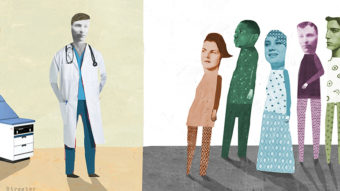
Illustration by Katherine Streeter for KHN/NPR

Jane Lazarre was pacing the hospital waiting room. Her son Khary, 18, had just had knee surgery, but the nurses weren’t letting her in to see him.

“They told us he would be out of anesthesia in a few minutes,” she remembered. “The minutes became an hour, the hour became two hours.”

She and her husband called the surgeon in a panic. He said that Khary had come out of anesthesia violently — thrashing and flailing about. He told Lazarre that with most young people Khary’s age, there wouldn’t have been a problem. The doctors and nurses would have gently held him down.

“But with our son, since he was so ‘large and powerful,’ they were worried he might injure the medical staff,” Lazarre said. “So they had to keep sending him back under the anesthesia.”

Khary was 6 feet tall. But he was slim.

“He wasn’t the giant they were describing him as,” Lazarre said.

Lazarre is white. Her husband is black. Lazarre says there’s no doubt in her mind that the medical team’s fear of Khary was because of race.

“I understood, certainly not for the first time, that my son — and my sons both — were viewed as being dangerous, being potentially frightening to people who were white,” she said.

She’s also sure the surgeon didn’t see it that way.

“Like most white people, I don’t think he was conscious of it at all,” Lazarre said.

She and her husband insisted on seeing Khary. They saw right away that he wasn’t angry or violent.

“He was scared,” Lazarre said. She and her husband leaned over and whispered in Khary’s ear: “‘It’s going to be OK, you can calm down.’ And he began coming out of the anesthesia more normally.”

Lazarre first wrote about this experience in her book “Beyond the Whiteness of Whiteness: Memoir of a White Mother of Black Sons.” Though it’s been years since Khary’s surgery, Lazarre says there’s still so much that hasn’t changed.

Racial Disparity In Medical Treatment Persists

Even as the health of Americans has improved, the disparities in treatment and outcomes between white patients and black and Latino patients are almost as big as they were 50 years ago.

A growing body of research suggests that doctors’ unconscious behavior plays a role in these statistics, and the Institute of Medicine of the National Academy of Sciences has called for more studies looking at discrimination and prejudice in health care.

For example, several studies show that African-American patients are often prescribed less pain medication than white patients with the same complaints. Black patients with chest pain are referred for advanced cardiac care less often than white patients with identical symptoms.

Doctors, nurses and other health workers don’t mean to treat people differently, says Howard Ross, founder of management consulting firm Cook Ross, who has worked with many groups on diversity issues. But all these professionals harbor stereotypes that they’re not aware they have, he says. Everybody does.

“This is normal human behavior,” Ross said. “We can no more stop having bias than we can stop breathing.”

Unconscious bias often surfaces when we’re multitasking or when we’re stressed, research shows. It comes up in tense situations where we don’t have time to think — which can happen frequently in a hospital.

“You’re dealing with people who are frightened, they’re reactive,” Ross said. “If you’re doing triage in the emergency room, for example, you don’t have time to sit back and contemplate, ‘Why am I thinking about this?’ You have to instantaneously react.”

Doctors are trained to think fast, and to be confident in their decisions. “There’s almost a trained arrogance,” Ross said.

But some medical schools are now training budding physicians and other health professionals to be a bit more reflective — more alert to their own prejudice.

Places like the University of Texas Medical School at Houston, the University of Massachusetts, and the University of California, San Francisco now include formal lessons on unconscious bias as part of the curriculum.

New Approach Teaches Students To Recognize Bias — And Slow Down

At UCSF, all first year medical school students take a workshop led by Dr. Rene Salazar, who coaches other members of the medical team, too.

“A lot of folks come to San Francisco thinking, ‘Oh it’s such an open-minded place, there are no biases here,’” he tells a class of newly arrived pharmacy residents. “That’s not true. You’re going to see this in every hospital. It’s going to be an issue.”

What Salazar wants these students to talk about isn’t other people’s biases, but their own. And not just the biases they know they have. But the ones they don’t know — or don’t believe — they have.

“Like it or not, all of us hold unconscious beliefs about various social and identity groups,” he says to the class. “Many times we think about bias and unconscious bias — they are incompatible with our conscious values, right?”

Before the class, students were asked to take an implicit association test, a series of timed computer tests that measure unconscious attitudes around race, gender, age, weight and other categories. Salazar asks who wants to share their results.

The students study their fingernails.

Salazar clears his throat.

“Well, I can share with you my story,” he says.

When he took the test for the first time, it showed that he had a preference for whites — or a bias against African-Americans. Research shows that 75 percent of people who take the race test show an automatic preference for whites.

“I was struck,” he tells the students. “Particularly being in the health professions and wanting to serve diverse communities, to learn that I had these biases — it was a bit disheartening.”

So he began to explore where these biases came from.

“I grew up in south Texas — 99 percent Mexican-American. Mostly Latino. In my high school, we had one black student,” he tells the pharmacy residents. “And so, up until age 18, you can imagine, a lot of my ideas — a lot of my attitudes, a lot of my beliefs — about folks who were black came from what? The media.”

A student named Amanda raises her hand. She asked that we not use her last name because she’s afraid that what she learned about herself could harm her career.

Amanda explains to the class that her parents made their way to the U.S. from Iran, and settled in Marin County, north of San Francisco. She took the version of the test that measures bias against Muslims, and another on light and dark skin tone.

“I kind of went in thinking that these are two areas that I would probably not have a bias, and that’s kind of why I chose them,” she said.

But the results were not what she expected.

“It was like, actually, ‘You’re biased and you don’t like brown people and you don’t like Muslims,’” she said. “Which is interesting for me — because that’s, kind of, the two things that I am.”

Traditional Diversity Training Didn’t Work — And Sometimes Backfired

The UCSF curriculum is based on a training program designed by Howard Ross, the diversity consultant. He says he developed the new “unconscious bias” approach to sensitizing people to their own predjudices after realizing that the traditional diversity training he was doing in the ’80s and ’90s wasn’t working.

“People who seemed to have transformative responses to those [earlier] trainings, to have that kind of ‘aha’ moment — particularly people in the dominant group, [of] whites, men, heterosexuals — often, if you talk to them a month or two later, they actually felt quite wounded by the experience,” Ross said. In some cases, he adds, participants seemed to become more defensive and hardened in their biases after those early trainings, not less prejudiced.

A 2007 study described in the Harvard Business Review examined diversity training programs at more than 800 companies over 30 years, and the results underscore Ross’s point. Overall, such programs seemed to do nothing to change people’s prejudices or improve diversity. Instead, in some cases, they reinforced bias.

“What happens is, ultimately, we feel bad about ourselves, or bad about the person that made us feel that way,” Ross said.

So rather than making people feel bad or awkward, Ross and Salazar say that, more than anything, they want people to accept that having biases is part of being human.

“You know we all have them,” Salazar tells his class in San Francisco. “It’s important to pause for a second and normalize this. And be OK with this.”

Salazar emphasizes that unconscious bias can’t be eliminated, but it can be managed.

“So how do we address our bias? What do we do?”

One student says, “Slow down.”

“Yeah,” Salazar responds. “A trick that I use is that I pause before I walk in, take 10 seconds even, 15 seconds, just to try to clear your mind and go in with that clean slate.”

It’s too early to know if these new types of trainings that explore unconscious bias are actually having any effect on what goes on in the exam room. Participants fill out evaluation forms after the class, and these anecdotal self-reports are often positive. But, so far, there have been no formal studies to measure if anything in patient care has actually changed.

“What happens when that door closes? What happens in the interaction when I can’t see the patient and the doctor talking?” Salazar said. “That’s a little hard to capture.”

Still, UCSF is betting the technique will help. Salazar and other leaders believe the younger generation of health care providers could help shift medicine — by learning early how to keep their own biases in check.

This story is part of a partnership that includes KQED, NPR and Kaiser Health News.
Kaiser Health News (KHN) is a nonprofit national health policy news service.

Read Original Article – Published August 20, 2015
Can Health Care Be Cured Of Racial Bias?

Site notifications
Update notification options
Subscribe to notifications