Kaiser Health News

Research Gives Context To Addressing Nation’s Drug Abuse Crisis, Review Finds

Heroin is prepared to shoot by a man in Vermont in 2014. A New England Journal of Medicine review says those who abuse prescription painkillers are less likely than previously thought to use heroin as well. (Spencer Platt/Getty Images)

Prescription painkiller abuse is drawing national attention as states battle increasing abuse cases, presidential candidates offer possible solutions and even President Barack Obama includes the issue in his State of the Union address Tuesday night.

A new review article published Wednesday in the New England Journal of Medicine provides insights for policymakers on how to curb this deadly trend.

Almost 19,000 people died from overdoses of prescription painkillers — drugs like morphine and OxyContin — in 2014, the most recent year for which statistics are available, according to the Centers for Disease Control and Prevention. That same year, about 10,600 died from heroin overdoses — more than five times the number of fatalities from them in 2000.

Concern about the issue has grown in a number of states where heroin and painkiller addiction is particularly common. Vermont Gov. Peter Shumlin focused his entire 2014 state-of-the-state address on heroin addiction. Meanwhile, an increased focus in New England states on curbing painkiller abuse has resulted in the issue emerging as an area of national interest, with a number of presidential candidates discussing the problem as they campaign in New Hampshire. Last week, Republican presidential candidate Jeb Bushrolled out a set of proposals to fight drug addiction. That puts him in the company of GOP rivals like New Jersey Gov. Chris Christie, Kentucky Sen. Rand Paul, Carly Fiorina and Democrats Hillary Clinton and Vermont Sen. Bernie Sanders, all of whom have made addiction major campaign issues.

The review of recent studies examines the often cited link between abuse of prescription painkillers and heroin use. That consequence, the researchers say, fuels the need for better treatment and prevention of prescription drug abuse. They noted, however, that “although the majority of current heroin users report having used prescription opioids nonmedically before they initiated heroin use, heroin use among people who use prescription opioids for nonmedical reasons is rare, and the transition to heroin use appears to occur at a low rate.”

The correlation between painkillers and heroin, the authors suggest, could be in part because the drugs are chemically very similar. Heroin, meanwhile, has become much cheaper than it was 20 years ago, the review notes.

“Once someone has a significant habit or addiction to [prescription painkillers], heroin turned out to be cheaper and readily accessible,” said Wilson Compton, the first author on the review article and deputy director of the National Institutes of Health’s National Institute on Drug Abuse.

Policymakers have proposed a number of solutions: for instance promoting treatment for addicts, and preventing addiction by limiting the supply for painkillers to begin with. That could involve coming up with better prescription guidelines for doctors and cracking down on so-called “pill mills,” the purportedly corrupt physicians who may majorly overprescribe.

The CDC is currently finalizing new guidelines for doctors to help them better prescribe medication for pain, Compton said.

Meanwhile, cracking down on “pill mills” could address some of the problem but would hardly suffice, said Jonathan Chen, an instructor at the Stanford University School of Medicine who has researched painkiller abuse but is not associated with the review article. The top 10 percent of doctors prescribe about 57 percent of all painkillers, according to a study he co-authored that came out last December. That’s fairly concentrated but still consistent with other kinds of medications that aren’t abused — about 63 percent of all medications are prescribed by only 10 percent of physicians.

The NEJM article addresses another issue that’s been raised: whether efforts to curb inappropriate painkiller use will just drive more people to use heroin instead. On the whole, the article said that studies in a variety of states, including North Carolina, Wisconsin, Florida and New York, did not find a clear link between those efforts and increases in heroin deaths.

And even when there were more deaths from heroin, Chen noted, those were more than offset by the number of lives saved when people didn’t abuse prescription drugs.

“For an individual patient, when a doctor cuts them off [from painkillers], that may have been a strong motivation” to get heroin, Compton said. But on a larger basis, that isn’t generally the case, the review indicated.

To fully address painkiller abuse — and to curb heroin addiction — policymakers need to keep  people from getting started with drug abuse, but also to get treatment for those who need help, Compton said.

“When you turn a faucet down on a bathtub, you still have an awful lot of water before you drain it out,” he said. “We need to be thinking about intervention.”

Read original article – January 13, 2016
Research Gives Context To Addressing Nation’s Drug Abuse Crisis, Review Finds

Making The Most Of Military Medics’ Field Experience

Veteran Dave Manning served two combat deployments in Iraq and was the sole medical provider for more than 100 people on a Navy ship. But as he contemplated his post-military job prospects, he struggled.

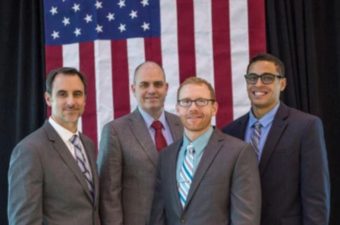
Dave Manning (left) and three other military veterans who will be in the new program’s first class. (Photo by Brian Strickland/UNC Health Care)

“Nothing I’ve done really translates over [to civilian jobs] beyond basic EMT,” said Manning, who served 15 years in the Navy and five more in the Army. “Trying to find something in the medical field without any credentials, without any licensure is tough. There’s nothing out there.”

Manning is in the inaugural class of a physician assistant training program launched this month by the University of North Carolina at Chapel Hill and geared at recruiting non-traditional students — specifically, veterans, as the country seeks to improve health care by expanding the number of primary care providers. UNC staff worked with Army officials at Fort Bragg to figure out how to translate troops’ medical experience into jobs.

Manning’s story is becoming more common as the U.S. winds down wars in Iraq and Afghanistan, and it’s especially important for North Carolina which is home to eight military bases, including some of the country’s largest installations. Manning has experience that can’t be found in a classroom, and some in the UNC medical community wanted to capitalize on that.

“The medics and the corpsmen are often very skilled in acute medical care of younger people,” said Dr. Paul Chelminski, the director of UNC’s new Physician Assistant Program. “They’re extremely skilled in trauma care if they’ve been deployed.”

But Chelminski said there are some gaps in the veterans’ ability to diagnose and manage chronic illness, which is a large part of civilian health care. UNC’s program will fill in those gaps. The program will also accept some field experience in lieu of other, more standard, training.

Insurance company Blue Cross and Blue Shield of North Carolina is donating $1.2 million to help launch the training program and provide scholarships. North Carolina Blue Cross CEO Brad Wilson said the program will also help with a growing need for primary care providers in the state as more people get insurance through the Affordable Care Act.

“The customers who are accessing the health care system through the ACA are using more services than any other groups,” he said. “Many are in need of primary care, and the physician assistant plays a key role in delivering high quality, high value health care.”

Physician assistants work under the supervision of doctors but still diagnose and treat patients.

The first class is underway with 20 students, including nine veterans. The program is open to students of all backgrounds and takes two years to complete. Chelminski said this first class has an extraordinary amount of clinical experience compared to the national average. Its members are also a few years older than what is typical, with an average age of 33.

UNC research shows many troops with medical training are more interested in becoming a physician assistant than a doctor, and Manning, who is 43, said he is definitely in that camp.

“As I was coming out of the military in my early 40s, I didn’t want to spend a decade training and being in school,” he said. “I just wanted to get in and get out, and physician assistant is perfect for that.”

This story is part of a reporting partnership with NPR, WFAE and Kaiser Health News.
Read original article – January 13, 2016
Making The Most Of Military Medics’ Field Experience

Gaps Remain Among States’ Medicaid Efforts To Help People Kick Smoking Habit

The 2010 federal health law has a provision that was supposed to make it easier for people on Medicaid to quit smoking. But in a number of states, it’s not, so far, having widespread success.

That’s the main takeaway from a study published Tuesday in the journal Health Affairs. The law says all state Medicaid programs have to cover tobacco cessation drugs — meaning they have to pay for things like nicotine patches, Chantix, nicotine gum or Wellbutrin, when patients are using them to try to quit smoking. But it leaves states relative freedom in how they go about doing so and what conditions they place on how the benefit is applied.

That flexibility has consequences, according to the study’s authors. They examined Medicaid data and found that very few enrollees — about 10 percent nationwide in 2013 — got medicine that might help them stop smoking, even though Medicaid recipients are around twice as likely as average Americans to be smokers.

Both from a public health standpoint and an economic one, that’s a problem, said Leighton Ku, director of the Center for Health Policy Research at George Washington University and the study’s lead author. Figures from the U.S. surgeon general indicate about 15 percent of Medicaid’s expenses — $40 billion in 2010 — are caused by smoking. The authors estimated that number will reach $75 billion this year. By contrast, Medicaid spent $103 million in 2013 on smoking cessation drugs.

“This is something where you can improve health, you can save you money,” he said. “And we’re just not very effective at it.”

In 2013, the study found, about 1.7 million prescriptions were filled or refilled for drugs to help Medicaid patients quit smoking. That’s estimated to be enough to treat about 830,000 people — out of about 8.3 million Medicaid patients whom the researchers estimated were smokers in 2013.

Some states have done a markedly better job than others. In Minnesota, for example, almost 27 percent of smokers on Medicaid were using medications to help them quit smoking, the researchers found. In Texas, only 1 percent did.

Ideally, Ku said, 100 percent of smokers on Medicaid would get help quitting. But even the Minnesota experience — which has the highest proportion of Medicaid smokers getting those prescriptions — indicates the extent to which other states currently fall short, he said.

It’s not entirely clear why, according to the researchers. But there are a number of factors that could be at play. In some states, patients have to make co-payments toward the medication, or get prior authorization from the Medicaid program before getting the drug. Those are more or less “functional barriers” that keep Medicaid beneficiaries from getting the medicine that could help them quit, said Michael Fiore, a professor of medicine and director of the University of Wisconsin Medical School’s Center for Tobacco Research and Intervention. Fiore wasn’t involved in the study.

And often, the study notes, people don’t realize Medicaid covers smoking cessation drugs.

“This is still a new thing,” Ku said. “It’s underappreciated, under-recognized.” The federal government hasn’t placed much emphasis on the regulation, he added, though he thinks more state Medicaid agencies are starting to prioritize it.

The study also notes another wrinkle. When it comes to states where smokers on Medicaid have less frequently gotten cessation drugs, most declined to expand Medicaid to cover a larger number of childless adults, a component of the health law the Supreme Court made optional in 2012.

That connection, Fiore said, is probably because the same states that declined the expansion are often ones that haven’t emphasized preventive care — though that isn’t always the case. He also pointed out that Wisconsin has actively publicized the smoking cessation benefit, despite choosing not to expand the low-income health insurance program.

When states don’t help people quit smoking, Ku said, they will ultimately face greater health care costs, since smoking helps cause diseases such as lung cancer and chronic obstructive pulmonary disease.

“If [those states] would expand Medicaid, more people would have access to Medicaid that would cover tobacco cessations,” he said.

For Medicaid programs that do emphasize the benefit there’s a major opportunity to recoup that spending, Fiore said, citing evidence that for each Medicaid dollar states put toward quitting smoking, they recover three times that, in as little as two years.

And that doesn’t even account for the savings in terms of how helping people quit smoking can bolster the economy, or improve a family’s health, Fiore said. When parents stop smoking, children aren’t exposed to second-hand smoke – which affects poor children more than those from higher income families — and are less likely to develop asthma. Smoking can damage someone’s health enough that he or she can’t hold a steady job, he added, a drag on the economy for which these figures don’t account.

“There are very few things we do in health care that have a positive return on investment, and smoking cessation is one of those,” he added. “It doesn’t take a decade.”

Read original article – January 5, 2016
Gaps Remain Among States’ Medicaid Efforts To Help People Kick Smoking Habit

Health Systems Dipping Into The Business Of Selling Insurance

In addition to treating what ails you, a number of health care systems aim to sell you a health insurance plan to pay for it. With some of the most competitively priced policies on the marketplaces, “provider-led” plans can be popular with consumers. But analysts say it remains to be seen how many will succeed long term as insurers.
It’s not surprising that health systems might get into the insurance business. Doing so funnels more patients to a health system’s hospitals and doctors. And it makes sense that combining clinical and claims data under one roof could lead to better coordinated, more cost-efficient patient care.

A number of well-regarded health systems have long sponsored insurance plans, including Kaiser Permanente, headquartered in Oakland, Calif., Geisinger Health System in central Pennsylvania and Intermountain Healthcare in Utah.

Yet even though health care systems can gain insurance know-how by partnering with or acquiring an insurer or third party administrator to handle claims, compliance and customer service, putting it all together can be challenging.

“They’re inexperienced,” says Gunjan Khanna, a partner in the health care practice at McKinsey & Company who co-authored a paper on this type of plan, when talking about newer entrants in this market. “The viability of that business and the ability to manage that is a question.” [] For example, it may take years to develop the necessary skills in managing financial risk and coordinating patient care beyond the hospital or clinic, among other things.

Health plans sponsored by providers are still rare. In 2014, 13 percent of health care systems in the United States offered plans that covered 18 million members, or about 8 percent of all people with insurance, according to McKinsey. Most of the people covered by provider-led plans are in Medicaid managed care or Medicare Advantage plans.

A growing number of provider-led plans are available on the health insurance marketplaces. When the marketplaces opened in 2014, there were 64 provider-led plans; next year there will be 72, according to McKinsey. In 2016, 19 percent of the new carriers on the exchanges will be provider-led plans.

The provider-led marketplace plans are priced very competitively, says John Holahan, a fellow at the Urban Institute’s Health Policy Center. In a number of rating areas, the plans will be the lowest priced at the silver level in 2016, according to a forthcoming analysis of 63 rating regions in 21 states, Holahan says. The lowest priced silver plans include those sponsored by New York’s North Shore-LIJ Health System, Oregon’s Providence Health and Services and Inova Health System in Virginia.

Inova, which is headquartered in Northern Virginia, partners with insurance giant Aetna to offer Innovation Health plans in several areas of the state. “Because of our strong relationship with Inova we’re able to buy our healthcare cheaper than most of our competitors,” which helps keep premiums down, says David Notari, CEO at Innovation Health.

An Innovation Health member who lives in Arlington, Va., and buys a marketplace plan, for example, has in-network access through Aetna’s marketplace network to all Inova hospitals, clinics and physicians and as well as other area providers.

Network coverage in provider-led plans varies. Some cover only services within the health system, while others offer broader access.

Consumers have generally been willing to accept narrower provider networks in exchange for lower premiums.

“The exchanges have pushed the concept of narrow networks front and center,” says Khanna. Consumers confronting that might want to “consider a provider health plan, because it’s based around a network of providers and at heart a network is built around a health care system.”

Read Original Article – Published November 10, 2015
Health Systems Dipping Into The Business Of Selling Insurance

Health Law Increases Coverage Rates For Women Not Yet Pregnant

The Affordable Care Act brought health insurance to 5.5 million women over the past two years, but many  women still tell of unmet health care needs that could pose risks for them or future pregnancies, a new report finds.

Researchers from the Urban Institute and the March of Dimes Foundation underscored the ACA’s long-term potential to improve health care for women in their child-bearing years, 18 to 44. The report was released Tuesday.

The health law, in addition to making insurance available to more women, also established maternal and newborn care as essential benefits for all health plans. They must also provide free preventive services, such as gynecological exams, and free supplies such as breast pumps.

Past studies have shown that costs prevent women from getting necessary medical care when they lack insurance, and that women who get services before and between pregnancies can improve their health and that of their future children.

“They’re getting the coverage they need and that’s the first step,” said Cynthia Pellegrini, senior vice president of public policy at the March of Dimes Foundation. The foundation funded the report as a first effort to monitor the health law’s impact on maternal care and birth outcomes.

Researchers drew on data from the Health Reform Monitoring Survey, a quarterly online survey that is monitoring the ACA’s impact before federal survey data is available. It is funded by the Robert Wood Johnson Foundation and the Urban Institute.

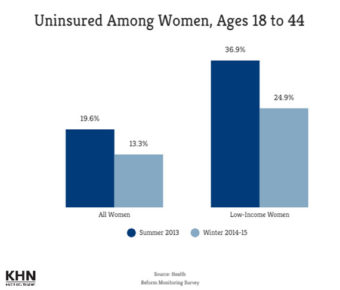
The rate of uninsured women in their childbearing years dropped to 13.3 percent in winter 2014-2015 from 19.6 percent in summer 2013, representing an increase in coverage for 5.5 million women, the report said.

Uninsured among women, ages 18 to 44Other changes: Smaller shares of women overall reported problems paying family medical bills and having unmet needs for care because of cost than in the previous year. Both trends also held true for low-income women.

Despite signs of progress, the report said more remains to be done. Low-income women in states that did not expand Medicaid under the ACA did not achieve the same gains as low-income women in expansion states.

Almost a quarter of low-income women in their childbearing years remained uninsured last winter. Nearly half of low-income women – and almost four in 10 overall — reported an unmet need for care due to cost last winter, despite improvement on that issue since 2013, the report said.

Health care postponed for financial reasons could suggest that women who can buy insurance – instead of going on Medicaid – are choosing high-deductible plans under the health law. Those charge lower premiums but require users to first meet an annual deductible – and pay thousands of dollars for health care services themselves – before insurance kicks in for subsequent services.

“You’d have a high psychological concern about cost, no question about it. You’d also have a reluctance to see a doctor,” said David Newman, executive director of the Health Care Cost Institute, a nonpartisan nonprofit.

Another possible explanation for a woman missing needed care is the expenses associated with taking time off work if she is an hourly employee and possibly paying for transportation and childcare.

“For low-income women without great benefits, there are all sorts of issues that stop them from getting to the doctor. Access to insurance isn’t going to alleviate those other problems,” said Atul Grover, chief public policy offer at the Association of American Medical Colleges.

The challenge for future health care enrollment periods will be reaching more minority and low-income women, said Claire Brindis, a professor of health policy at the University of California, San Francisco.

“We’re still at the beginning of a major upheaval,” she said.

Read Original Article – Published October 27, 2015
Health Law Increases Coverage Rates For Women Not Yet Pregnant

Marketplace Customers Could See Higher Premiums, No Coverage For Out-Of-Network Care

When the health insurance marketplaces open on Sunday, consumers shopping for 2016 coverage may encounter steeper premium increases than last year and more plans that offer no out-of-network coverage.

open-enrollment-570According to an analysis released Monday evening by the Health and Human Services Department, the cost of the second-lowest silver plan in states using the federal marketplace will rise an average of 7.5 percent for 2016 coverage. Silver plans are the most popular type of marketplace plan. They pay 70 percent of medical costs, on average, leaving consumers to cover 30 percent. And premium tax credits that are available to people with incomes up to 400 percent of the federal poverty level — about $47,000 for one person — are benchmarked to the second-cheapest silver plan.

But the overall increase doesn’t tell the whole story for those shopping for insurance in the individual market — generally people who don’t get coverage through their work. Depending on the market, consumers may see larger or smaller increases or even declines in premiums. Premium changes for the second-lowest cost silver plan ranged from a 13 percent average decrease in Indiana to a 36 percent average increase in Oklahoma.

The consulting firm McKinsey & Company earlier had analyzed premiums reported in 26 states and found that in more than half of the rating areas in those states there will be a new insurer offering the lowest-cost silver plan next year.

“It’s indicative of the price jockeying that’s still going on in the market,” says Erica Coe, co-leader of McKinsey’s Center for U.S. Health System Reform. “If consumers want to have the lowest cost silver plan, they’ll have to shop.”

The open enrollment season for marketplace coverage runs from Nov. 1 through Jan. 31. People who want coverage to begin on Jan. 1 must buy a plan by Dec. 15.

Although most consumers zero in on premiums when comparing plans, next year it could be especially important to pay attention to the network of doctors and hospitals that are part of the plans that they’re considering. There will likely be fewer plans that cover broad networks of providers, says Kathy Hempstead, who directs health insurance coverage issues for the Robert Wood Johnson Foundation. In addition, a growing number of marketplace plans will cover only doctors or hospitals in their provider networks.

“The PPO and POS categories are definitely shrinking,” Hempstead says, referring to preferred provider organization and point of service plans, both of which typically offer coverage of out-of-network providers, although consumers generally have to pay a larger share of the cost. Instead, consumers may see more health maintenance organizations that don’t provide any out-of-network coverage.

Despite the well-publicized demise of nine health insurance co-operatives and other insurer exits, carriers moving into new markets next year will likely offset the declines. The number of carriers selling plans should be essentially unchanged at roughly 327 next year, according to McKinsey data based on 42 states.

This year, consumers in most states will have access to online tools to use while shopping for plans. Healthcare.gov unveiled its 2016 plans Sunday on the website, allowing customers in the two-thirds of states that use that federal marketplace to browse through plans in their area to see premium prices ahead of the actual start of enrollment. The revamped site also offered consumers a cost estimator to help determine their likely out-of-pocket costs in the plans. Two other new tools touted by federal officials to allow consumers to type in their doctors’ names or medication details and see whether they’re included in various plans are not yet ready to roll out. Federal officials said they hope to have them online soon, although they could not say if the tools would be ready by Nov. 1.

Some state-based marketplaces have similar tools available.

Although the online tools may streamline the process of comparing plans, consumers should always confirm details about doctors, hospitals and medications they receive online with the health plan directly.

Consumers who want telephone or in-person help choosing a plan can locate assistance on the state or federal marketplace websites. In addition, Enroll America, a consumer group that focuses on health insurance enrollment, connects people with local help through its website.

Even though shopping for plans should be easier this fall and it’s in consumers’ best interest to check out their options, chances are many won’t.

People who don’t renew their federal marketplace coverage will generally be automatically re-enrolled for Jan. 1 in their current plan, or a similar one if their plan has been discontinued. The government will incorporate the most up-to-date income, benchmark premium and poverty data when calculating the subsidy for auto-renewal.

That’s different from the past. When people didn’t update their income or other information for 2015 plans, they were automatically assigned the same premium tax credit amount they received in 2014.

Consumers who are automatically re-enrolled can change their plan until the end of January. But that may not be the best move, says Judith Solomon, vice president for health policy at the Center on Budget and Policy Priorities. “You’ll start your deductible all over again,” she says.

Read Original Article – Published October 27, 2015
Marketplace Customers Could See Higher Premiums, No Coverage For Out-Of-Network Care

Site notifications
Update notification options
Subscribe to notifications