Kaiser Health News

Political Gridlock Blocks Missouri Database For Fighting Drug Abuse

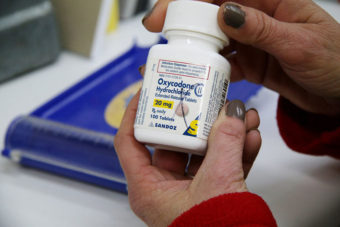
Michelle Pattengill, a technician at L&S Pharmacy in Charleston, Missouri, holds a bottle of oxycodone. (Bram Sable-Smith/Side Effects Public Media/KBIA)

At Richard Logan’s pharmacy in Charleston, Missouri, prescription opioid painkillers are locked away in a cabinet.

Missouri law requires pharmacies to keep schedule II controlled substances — drugs like oxycodone and fentanyl with a high addiction potential — locked up at all times.

Logan goes further than the law requires.

He’s been a pharmacist for 40 years. For the last 20, he has also been a reserve deputy with two local sheriff’s departments, investigating prescription drug abuse. That puts him on edge in his day job.

After his technicians count out a prescription for controlled narcotics by hand, Logan has them place the pills on a machine that resembles an overhead projector lit from the top instead of the bottom.

“There’s a camera up there,” Logan said. “It actually photographs each pill that we dispense.”

When he has probable cause to suspect that a customer is trying to get opioids with a forged or fraudulent prescription, Logan will arrest them on the spot. When he only has a strong hunch and they’re from out-of-state, he’ll escort them out of the pharmacy and direct them to the nearest bridge out of Missouri, about 9 miles away.

These run-ins with drug-seekers make Logan anxious to see the state enact a prescription drug monitoring program. A PDMP would be a statewide database tracking narcotics prescriptions, which doctors and pharmacists can check to catch signs of abuse or addiction and to intervene if necessary.

In the battle against America’s surging opioid drug addiction, 49 states, the District of Columbia and even Guam have all implemented some kind of PMDP. Missouri is the only state that hasn’t. A protracted political battle has kept the state from passing a law to establish one. That leaves pharmacists like Logan with few options.

He can only check the prescription history of patients on Medicaid, which tracks such data. But when a patient pays cash — a red flag for Logan — there is no record to check leaving pharmacists to guess whether the patient is in genuine pain, feeding an addiction or maybe looking for pills to sell.

“We want to take the best care of everybody that we can, and without a PDMP we are absolutely flying blind,” he said.

Restrictions Versus Privacy

State Rep. Holly Rehder, whose district includes Charleston, has championed establishing a database ever since joining the legislature in 2013.

“I’ve been working on this since my feet hit the floor,” she said.

It’s an issue close to her heart. Her cousin died of a drug overdose. Her mother was addicted to prescription medications. Her sister used heroin. And for 13 years, her own daughter has struggled with drug abuse — an addiction that began with a legal prescription for Lorcet.

“I’m very candid about it,” Rehder said. “I don’t believe God gave me a microphone to keep my mouth shut.”

She cites these databases’ success in limiting drug abuse in other states. They make it harder for pill-seekers to “doctor shop,” meaning go from doctor to doctor getting multiple, simultaneous prescriptions for the same drug.

One year after New York required its prescribers to check the state’s PDMP before writing a prescription, for example, doctor shopping dropped by an estimated 75 percent.

Doctors surveyed in many states, including Connecticut and Rhode Island, say prescription drug monitoring programs have helped them identify opioid drug abuse and intervene with patients who need help. Those are reasons the federal government strongly recommends the databases.

For the third straight year, Rehder’s bill has passed the Missouri House and moved on to the Senate. There, each year, it’s been blocked by her main opponent on this issue, Sen. Rob Schaaf, a fellow Republican.

“It’s just the heavy hand of government taking away your liberty,” he said. In 2012, before Rehder joined the legislature, Schaaf led an eight-hour filibuster of PDMP legislation, an act that has loomed over subsequent attempts to pass a similar bill. This year Schaaf has called the bill “dead on arrival.”

The bill is currently in committee where a hearing on it has yet to be scheduled — and it likely won’t be taken up by the full senate before the legislative session ends May 13.

Schaaf is a physician by training. To some, that background makes him a surprising opponent to prescription drug monitoring, which is supported by the Missouri Academy of Family Physicians, the Missouri American College of Physicians and the Missouri State Medical Association, among others.

He argues that drug monitoring may inhibit doctors from prescribing medications that patients really need. His main objection, though, is about privacy.

“The monitoring program would put every citizen’s private drug information on a government database accessible to 30,000 people with usernames and passwords,” he said. “That’s just an outrage.”

Rehder doesn’t buy that argument. The database is electronic medical information, she said, so it would be protected by the same privacy laws protecting all electronic medical records. “It’s not like anyone can go on a phishing expedition in this data.”

“There is no data that is secure,” Schaaf countered, citing hacks against the IRS and the Department of Veteran Affairs, and even Hillary Clinton’s email imbroglio.

Rehder argues that 49 other states have faced these same questions about security and Missouri would be able to follow the best practices they’ve developed.

Schaaf said he isn’t entirely opposed to prescription drug monitoring. He said he would allow Rehder’s bill to pass the Senate if it included a provision that final approval for the database would be put before the voters — a test he doubts the bill could pass.

For the past three years, he has proposed his own monitoring legislation that would limit access to the database to Missouri’s Bureau of Narcotics and Dangerous Drugs, which would then communicate concerns to providers.

Rehder said she can’t support his bill because it would be cumbersome and impractical to implement, and that it’s doctors who should be making decisions with the data.

“Missouri is the only state that doesn’t have this. It’s very shameful,” Rehder said. “It’s hurting our population so much.”

In March, St. Louis County, which has one of the state’s highest drug overdose death rates, passed its own PDMP. Other counties have signaled they would consider doing the same.

Rehder said this is better than nothing, though she prefers a statewide database over a patchwork of county systems.

“We have got to start realizing that this isn’t something we can close our eyes and turn our heads to because it’s not going to affect us. It’s affecting us,” she said. “Our families are being torn apart, lives are being destroyed.”

Twenty miles down the road from Logan’s pharmacy and also in Rehder’s district, 33-year-old Jason Lynch is close to completing a 120-day stay at Mission Missouri, an addiction treatment facility.

Lynch was given his first prescription painkiller by an older student on the school bus when he was just 11 years old.

“I think right from the get-go I was hooked because the next day I was trying to get some extra lunch money to buy some more,” Lynch said.

He’s battled opioid use for 22 years, feeding his addiction with pills prescribed to him by doctors. “I would research [symptoms] on the Internet and say, ‘This is what’s going on with my back.’ ”

Usually, Lynch said, the doctor would write him a prescription.

“It’s nobody’s fault but my own,” Lynch said of his addiction, but, he added, getting the pills “should have been a lot harder.”

“You just think about what if those drugs weren’t so available to him,” Rehder said. “How could his life have been different?”

This story is part of a reporting partnership with Kaiser Health News, Side Effects Public MediaKBIA and NPR.

For Native Americans, Health Care Is A Long, Hard Road Away

In January, Cody Pedersen, 29, was stabbed in the neck. It took the ambulance over two hours to arrive in Cherry Creek, where he lives. It's in the Cheyenne River Indian Reservation in South Dakota. Misha Friedman for KHN and NPR
In January, Cody Pedersen, 29, was stabbed in the neck. It took the ambulance over two hours to arrive in Cherry Creek, where he lives. It’s in the Cheyenne River Indian Reservation in South Dakota.
Misha Friedman for KHN and NPR

Cody Pedersen and his wife, Inyan, know that in an emergency they will have to wait for help to arrive.

Cody, 29, and his family live in Cherry Creek, a Native American settlement within the Cheyenne River Indian Reservation in north central South Dakota.

The reservation is bigger than Delaware and Rhode Island combined. But Cherry Creek has no general store, no gas station and few jobs.

When Inyan, 34, was preparing to give birth to her two youngest children, doctors scheduled her to have cesarean sections in a hospital rather than having her wait until she was in labor to come in.

In January, Cody was stabbed in the neck. It took an ambulance two hours to arrive.

The road to Cherry Creek is 17 miles of gravel and is often inaccessible in harsh South Dakota weather. Misha Friedman for KHN and NPR
The road to Cherry Creek is 17 miles of gravel and is often inaccessible in harsh South Dakota weather.
Misha Friedman for KHN and NPR

A 17-mile gravel road in Cherry Creek connects to a better road that eventually leads to Eagle Butte, the largest town on the reservation and home to just over 1,300 people. That’s where the closest doctors are.

When Cody runs out of gas money, he has to pay $40 to a neighbor to take him to the health center in Eagle Butte. But he can’t do that before lucking out and securing an appointment, calling at 7 a.m. on the day he wants to see a doctor.

Clinics like the one Cody goes to don’t allow patients to schedule appointments in advance.

There’s a clinic in Cherry Creek, but it has been closed for weeks. Their 11-year-old daughter Makrista missed school for two weeks because they couldn’t get a doctor’s note to vouch that her head lice had gone away.

Before the 1950s, most Native Americans lived in reservations or near them. Then, with support from the federal government, many started moving to large cities, looking for employment opportunities and better education. Today, more than half of Native Americans live in urban areas.

The federal government is obligated by law to provide medical care to American Indians and Alaska Natives, and it does so through the Indian Health Service, an agency of the Department of Health and Human Services. There are also tribal-run health centers set up on reservations. And 20 states have Urban Indian Health Programs, which receive IHS funding to provide medical services and support to American Indians who don’t live on reservations.

Every Tuesday, Edie Hoff, an Urban Indian Health clinic nurse, drives over 100 miles from Sioux Falls, S.D., to Wagner, site of the nearest Indian Health Service clinic. She picks up free medicine for Native Americans who are still registered as residents of the reservation but live in Sioux Falls. Misha Friedman for KHN and NPR
Every Tuesday, Edie Hoff, an Urban Indian Health clinic nurse, drives over 100 miles from Sioux Falls, S.D., to Wagner, site of the nearest Indian Health Service clinic. She picks up free medicine for Native Americans who are still registered as residents of the reservation but live in Sioux Falls.
Misha Friedman for KHN and NPR

But there are still significant gaps in care, both on the reservation and in town. The IHS is chronically underfunded. It receives a set amount of money each year to take care of 2.2 million native people — no matter how much care they may need. On the reservation, IHS facilities often don’t have services that people elsewhere expect, such as emergency departments or MRI machines. And those limited facilities can be hours away by car. In town, reaching care is easier, but clinics also don’t have enough funding to meet all of the health needs of the community. And people can’t get the free medication they are entitled to through the IHS anywhere but an IHS facility.

Donna Keeler is executive director at South Dakota Urban Indian Health, which has been providing health services to the American Indian population since 1977. Keeler says her clinics in Sioux Falls and Pierre receive federal grants, but that a federal prisoner has more health care funding allocated for his care than an urban American Indian does.

Hoff picks up prescriptions at the Indian Health Service clinic in Wagner. The pharmacy staff member is part of the U.S. Public Health Service Commissioned Corps. Misha Friedman for KHN and NPR
Hoff picks up prescriptions at the Indian Health Service clinic in Wagner. The pharmacy staff member is part of the U.S. Public Health Service Commissioned Corps.
Misha Friedman for KHN and NPR

In 2013, Indian Health Service spending for patient health services was $2,849 a person, compared with $7,717 for health care spending nationally, according to a report from the National Congress of American Indians. That despite the fact that Native Americans typically have more serious health problems than the general public, including higher rates of diabetes, liver disease and unintentional injuries.

Keeler says most of her clients are the poorest of the poor. In other states, American Indians with low incomes can sign up for expanded Medicaid. But South Dakota lawmakers haven’t expanded Medicaid coverage to low-income adults, leaving thousands of people, most of them urban, poor American Indians, without health coverage.

Gov. Dennis Daugaard, a Republican, has left the door open to a special legislative session this year in which lawmakers could consider a Medicaid expansion proposal, but consideration of such a proposal isn’t guaranteed. If South Dakota did expand Medicaid, it would give clinics like the one Keeler runs additional funding, since the Medicaid reimbursement rates are higher than what IHS provides.

Still, even without Medicaid expansion, the Urban Indian Health clinic is an improvement for patients like Joe Marrowbone, Cody Pedersen’s brother. Marrowbone moved out of Cherry Creek and off the reservation partially to get out of the cycle of poverty prevalent there, he says. It was an added bonus that access to health care for his family dramatically improved.

Joe Marrowbone left the reservation and moved to Sioux Falls for a job. He and his wife, Connie, play with daughters Grace and Alicia. Misha Friedman for NPR
Joe Marrowbone left the reservation and moved to Sioux Falls for a job. He and his wife, Connie, play with daughters Grace and Alicia.
Misha Friedman for NPR
Living in Sioux Falls means that Marrowbone can get checkups and other health care at the Urban Indian Health clinic (right). Misha Friedman for KHN and NPR
Living in Sioux Falls means that Marrowbone can get checkups and other health care at the Urban Indian Health clinic (right).
Misha Friedman for KHN and NPR

Marrowbone works as a janitor at a religious school in Sioux Falls. The Sioux Falls Urban Indian Health clinic is much closer to his home than it would be if he lived in Cherry Creek, and there’s also the option of getting care at a local hospital. As a result, the family rarely has to wait long. Instead of worrying about where his health care is coming from, Marrowbone can focus on a new goal: trying to adopt his niece, Savannah, after her mother died.

Access and lack of funding are just two problems with Native Americans in South Dakota. Difficulties coordinating patient records also hamper their care.

Jami Larson, 32, grew up in Pierre and is a member of the Lower Brule Sioux tribe. She is a registered nurse who specializes in diabetes care among Native Americans. Misha Friedman for KHN and NPR
Jami Larson, 32, grew up in Pierre and is a member of the Lower Brule Sioux tribe. She is a registered nurse who specializes in diabetes care among Native Americans.
Misha Friedman for KHN and NPR

Jami Larson, a resident nurse at Urban Indian Health Programs in Pierre, is frustrated that none of the systems with the Indian Health Service, tribal-run clinics or the Urban Indian Health Programs share patient data with each other. Each clinic has its own records, and patients who don’t keep up with their own records often have to repeat immunizations or lab work.

For Larson, herself an American Indian, the year and a half that she’s spent as a nurse at the clinic in Pierre has allowed her to develop deep relationships with her patients.

Larson goes shopping with Alan and Ruthie Marshall and explains how to choose food based on nutrition labels. Larson also uses food props to illustrate healthy choices. Misha Friedman for KHN and NPR
Larson goes shopping with Alan and Ruthie Marshall and explains how to choose food based on nutrition labels. Larson also uses food props to illustrate healthy choices.
Misha Friedman for KHN and NPR

She says that care for them would improve if the clinics, hospitals and doctors serving American Indians worked together. For now, Larson is leaving her own mark the best she can: On many days, you can find her visiting patients to make sure they’re on track, or going food shopping with some to help them get food that will keep them as healthy as possible.

This story and the related photo essay were produced through a collaboration between Kaiser Health News and NPR.

Photographer Misha Friedman says he tries “looking beyond the facts, searching for causes, and asking complex and difficult questions.” His work has been featured by many media organizations, including NPR, The New Yorker, Sports Illustrated, Der Spiegel and GQ.

Kaiser’s Andrew Villegas contributed to this report.

Copyright 2016 NPR. To see more, visit http://www.npr.org/.

Study: Primary Care Doctors Often Don’t Help Patients Manage Depression

Although primary care doctors frequently see patients with depression, they typically do less to help those patients manage it than they do for patients with other chronic conditions such as diabetes, asthma or congestive heart failure, a recent study found.

That is important because research has found that it can be good for patients’ health when physician practices have procedures in place to identify and provide targeted services to patients with chronic conditions and to encourage patients to get involved in actively managing their own care.

But physicians were less likely to use those “care-management processes” with patients who have depression than with those who had other chronic conditions, according to the study in the March edition of the journal Health Affairs.

The study analyzed data from the three largest national surveys of physician practices to determine the extent to which they employed five care-management processes between 2006 and 2013. The five processes studied were patient education; patient reminders about preventive care; nurse care managers to coordinate care; feedback on care quality to providers; and disease registries that identify patients with chronic conditions, enabling practices to be proactive about their care.

The results were particularly dismal for depression. In the 2012 to 2013 time frame, physician groups on average used fewer than one (0.8) of the care-management processes for their patients with depression, and that level of use hadn’t changed since the 2006 to 2007 period, according to the study. In contrast, practices used 1.7 diabetes care-management processes on average overall with their patients between 2012 and 2013. Among only large practices, the use of diabetes care-management processes grew significantly over time, to 3.2 in 2012-2013.

The use of care-management processes for patients with congestive heart failure and asthma was 1.1, a statistically significant difference compared with their use in patients with depression. Still, Dr. Tara F. Bishop, the lead author of the study and an associate professor in the department of health care policy and research at Weill Cornell Medical College in New York City, said those measures were also considered low.

The depression results were not surprising, said Bishop. 

“There’s a growing understanding that depression and mental illness generally are being undermanaged [in primary care settings] and we’re not using the tools that are available,” she said.

It may be that physicians are less comfortable managing psychological illnesses than they are physical ones, but size may also matter, she said. Primary care practices that are part of academic medical centers or integrated health care systems may be better equipped to adopt care-management processes, while smaller, independent practices have trouble marshaling the staff and other resources necessary to put comprehensive care-management techniques to use.

Read original article – March 25, 2016
Study: Primary Care Doctors Often Don’t Help Patients Manage Depression

Demand Surges for Addiction Treatment During Pregnancy

Makenzee Kennedy is groomed by nurse Megan Kelly in a special unit for weaning newborns off heroin and other opioids at North Baltimore’s Mount Washington Pediatric Hospital. The number of newborns suffering from opioid withdrawal symptoms has skyrocketed in the last five years. Getty Images

BOSTON — As soon as the home pregnancy test strip turned blue, Susan Bellone packed a few things and headed straight for Boston Medical Center’s emergency room. She’d been using heroin and knew she needed medical help to protect her baby.

“I felt so guilty. I still do,” said Bellone, a petite, energetic woman. At 32, and six years into her heroin addiction, having a baby was the last thing on her mind. “I was not in the right place to start a family,” she said. “But once it was happening, it was happening, so I couldn’t turn back.”

Nationwide, the number of pregnant women using heroin, prescription opioids or medications used to treat opioid addiction has increased more than five-fold and it’s expected to keep rising. With increased opioid and heroin use, the number of babies born with severe opioid withdrawal symptoms has also spiraled, leaving hospitals scrambling to find better ways to care for the burgeoning population of mothers and newborns.
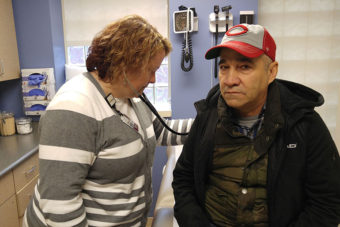
Among the most important principles is that expectant mothers who are addicts should not try to quit cold turkey because doing so could cause a miscarriage. Trying to quit opioids without the help of medications also presents a high risk of relapse and fatal overdose.

Until the opioid epidemic took hold about eight years ago, most hospitals saw only one or two cases a year of what is known as neonatal abstinence syndrome. Now, a baby is born suffering from opioid withdrawal every 25 minutes in the U.S., according to the National Institute on Drug Abuse.

When a pregnant woman uses drugs or alcohol during pregnancy, some of the substances travel through the placenta to the baby. In many, but not all, cases, exposure to opioids during pregnancy can cause the fetus to develop physical drug dependence. When the umbilical cord is cut at birth, the newborn is abruptly disconnected from its supply of opioids and can suffer withdrawal symptoms.

When Bellone rushed to the emergency room six years ago, she didn’t know she’d gone to one of the best places in the country to receive addiction treatment during pregnancy.

At Boston Medical Center in the city’s South End, heroin addiction during pregnancy is not new. A specialized team of obstetricians, addiction medicine providers and counselors known as Project RESPECT has been treating pregnant drug users here for more than 30 years.

Now, dozens of hospitals and health clinics are gearing up to provide the same kind of specialized treatment for a rapidly rising number of pregnant drug users and their newborns

Demand Surges for Addiction Treatment During PregnancyAlthough painful, newborn withdrawal symptoms, which include muscle cramps, tremors, diarrhea, vomiting, sleep problems and sometimes seizures, are not life threatening and have not been shown to cause health problems or developmental deficiencies later in life. The condition can be treated with small doses of morphine and subsides within a one to three weeks.

Methadone and Buprenorphine

As an epidemic of opioid and heroin addiction continues to ravage the nation, affecting at least 2.5 million people, hospitals and obstetrical practices nationwide have begun collaborating with addiction specialists to find the best way to treat women for their addiction while providing the safest care for their babies.

“Addiction specialists are terrified of treating anyone with a baby inside, and obstetricians are terrified of getting into addiction medicine,” said Dr. Ronald Iverson, of the Massachusetts Perinatal Quality Collaborative. But as demand for prenatal care for opioid-dependent women skyrockets, hospitals and private practices are increasingly offering combined addiction treatment and obstetrical services, so that pregnant women can see both specialists in one appointment.

Last year, a federal law was enacted — the Protecting Our Infants Act — authorizing the U.S. Centers for Disease Control and Prevention (CDC) to work with states to collect data on the prevalence of babies born with opioids in their bloodstream. It also calls on the U.S. Department of Health and Human Services to develop recommendations for the best way to prevent and treat drug use during pregnancy.

For now, here’s what major medical organizations — including the American College of Obstetricians and Gynecologists, the American Society of Addiction Medicine and theAmerican Academy of Pediatrics — agree on:

The standard of care for pregnant women using prescription painkillers or heroin is maintenance treatment with opioid addiction medications methadone or buprenorphine. Abstaining from drugs without medication is not recommended because of the high risk to the mother of relapse and overdose.

Although methadone and buprenorphine expose the fetus to low doses of opioids, the risk to the newborn of withdrawal symptoms is far outweighed by the risk of a fatal overdose when pregnant women receive no treatment or attempt to abstain from drugs without medication.

Abruptly quitting opioids in the first and third trimesters of pregnancy can cause harm to the fetus, including miscarriage and stillbirth, and is not recommended. Even in the second trimester, specialists agree that the risk of relapse outweighs any potential benefit to the fetus of lowering the dose of addiction maintenance medications or discontinuing their use.

Advocates for newborns, including the March of Dimes, agree with major medical organizations on the use of opioid treatment medication. But they argue more data and better research are needed to determine the best approach to treating opioid addiction during pregnancy.

“With pregnant moms, we’re weighing the high risk of death from overdose against the risk to the newborn of treating pregnant women with low dose opioid maintenance,” said Dr. Siobhan Dolan, medical adviser to the March of Dimes. With more research, she said, “we would be in a better position to consider abstinence and behavioral health counseling for some women.” And that could result in healthier babies.

According to the most recent data from the CDC, the number of opioid and heroin overdose deaths shot up by 14 percent between 2013 and 2014, killing more than 28,000 people, more than 10,000 of whom were women.

Demand Surges for Addiction Treatment During Pregnancy

Fear and Misinformation

Most women who come into Boston Medical Center for drug treatment and prenatal care do so early in their pregnancy, said Dr. Kelley Saia, who heads Project RESPECT’s team that now treats about 250 patients at any given time, triple the number it did 10 years ago.

“They are so smart and so tuned into what they’re going through,” Saia said. “But they feel incredible guilt about taking medication during pregnancy and they worry about what their babies will go through.”

When Bellone arrived at Boston Medical she was ready to quit heroin. She’d done it before. “I wanted to stop everything. I didn’t even want to be on Subutex [a form of buprenorphine], but they said I might miscarry.”

On top of the normal worries about going through a pregnancy and becoming a parent, women with a drug habit worry about getting reported to child protective services. Massachusetts requires hospitals to report all babies born with opioids in their bloodstream to the state’s child welfare agency.

In many other states, doctors are required to report their patients to child welfare agencies before their babies are born, said Farah Diaz-Tello, an attorney with National Advocates for Pregnant Women, which advocates for the civil rights of drug-using women. In three states — Alabama, South Carolina and Tennessee — women can be prosecuted for child endangerment if they are reported using drugs during pregnancy. (The Tennessee law will not be in effect after July 1.)

Diaz-Tello and others say this threatens the health of women and their babies. Women need to feel safe so they don’t have to hide their drug use when seeking prenatal care or not seek care at all, she said.

Bellone said she wasn’t concerned about getting reported to child protective services because she knew she was doing the right thing. “If I wasn’t ready to quit I would have been worried,” she said. “But I knew five years before I got pregnant that I didn’t want to lead that life. I needed help and didn’t know where to go.

“It was almost like it took me getting pregnant to find help. It was hard to get into any place. There were no beds. But once you got pregnant it was instant, people were willing to help.”

Bellone’s pregnancy and her addiction treatment went smoothly. She delivered twin girls, Gemma and Mischa, on Aug. 3, 2010. They had to stay in the hospital for three weeks, but they’ve been healthy since they came home.

Perched on her chair sipping a huge to-go cup of iced tea in one of the hospital’s private consultation rooms, Bellone passed around photos of the twins jumping on their bed. Gemma, the oldest by seven minutes, just lost a tooth. “She pulled it out herself. She was very brave,” Bellone said.

Nearly six years after their birth, Bellone is still in recovery. She’s taking buprenorphine, making monthly visits to her addiction doctor and attending group meetings two times a week. She’s also working full time as a cook at a nursing home. “I’m tired a lot, like anyone with twins would be,” Bellone said. “People think I’m lying, but I never think about using.”

Read original article – March 25, 2016
Demand Surges for Addiction Treatment During Pregnancy

In Conservative Indiana, Medicaid Expansion Makes Poorest Pay

Reginald Rogers of Gary, Indiana, pays $1 a month for dental coverage through Healthy Indiana. (Phil Galewitz/KHN)

GARY, Ind. — Reginald Rogers owes his dentist a debt of gratitude for his new dentures, but no money.

Indiana’s Medicaid program has them covered, a godsend for the almost toothless former steelworker who hasn’t held a steady job for years and lives in his daughter’s basement. “I just need to get my smile back,” Rogers, 59, told his dentist at a clinic here recently. “I can’t get a job unless I can smile.”

Rogers is among the more than 240,000 low-income people who gained health coverage in the past year when Indiana expanded Medicaid as part of the Affordable Care Act. Rogers pays $1 a month — a fee that is a hallmark of the state’s controversial plan.

Healthy Indiana pushes Medicaid’s traditional boundaries, which is why it has the attention of other conservative states. The plan demands something from all enrollees, even those below the poverty line. The poorest Hoosiers can get coverage with vision and even dental benefits, but only if they make small monthly contributions — ranging from $1 to $28 — to individual accounts similar to health savings accounts. Individuals who fail to keep up lose the enhanced coverage and face copayments. Others who are above poverty can temporarily lose all coverage if they fall behind on contributions.
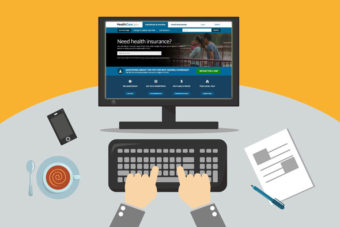
If that sounds more like commercial insurance, it’s by design. So is the plan’s tough-minded approach to paying for low-income Americans’ health care.

Proponents say the strategy makes Medicaid recipients share financial responsibility for their care, which they say will save Indiana money by reducing unnecessary services and inappropriate emergency room use.

Several states, including neighboring Kentucky and Ohio, are looking at Indiana Medicaid as a possible model.

Detractors worry that its complexity could make health care harder for the poor to access — the opposite of a core goal of expansion. There is no proof that the state is yet saving money or that its approach is making beneficiaries healthier.

“Other states have looked at it, but the Obama administration has made it pretty clear that Indiana is going to be a test case and much evaluation will need to be done before they approve any more like it,” said Matt Salo, executive director of the National Association of Medicaid Directors. No other program has been allowed to require health spending accounts, much less threaten a loss of coverage for not paying in, he noted.

Since Indiana’s expansion began in February 2015, more than 235,000 previously uninsured able-bodied adults have signed up. As of late February, the plan covered more than 370,000 people total, many with extremely low incomes. Another 190,000 adults are eligible but not enrolled, according to state estimates, though some who are above the poverty line may be in subsidized private plans.

Michelle Stoughton, senior director of government relations for Anthem, says the response to date represents success. Anthem is one of three private insurers providing coverage under Healthy Indiana. “What we heard for years … is that these people won’t pay and don’t have the ability to pay,” Stoughton said. “But this has turned those arguments around and been able to show that people do want to be engaged.”

Ramon Ramos, of Indianapolis, is a Healthy Indiana member getting treated at the Jane Pauley Community Health Center. (Phil Galewitz/KHN)

The ACA created both the financial means and the opportunity for Healthy Indiana. The 2010 law paid for states to expand Medicaid by enrolling all adults under 65 who earned up to 138 percent of the federal poverty level — about $16,394 annually for an individual. The federal government will have absorbed the full cost of newly eligible beneficiaries from 2014 through this year. After that, its share falls gradually to 90 percent in 2020 and beyond.

As did most GOP-controlled states, Indiana initially balked at the offer, with officials citing concerns about Medicaid’s costs and effectiveness. Now they believe they’ve found the solution. Republican Gov. Mike Pence sees the plan as a model for others.

Healthy Indiana “has established a new health care paradigm in Indiana; rooted in consumerism and personal responsibility, Pence said in late January as he marked the plan’s first anniversary. It has federal approval until January 2018.

With Healthy Indiana, enrollees can choose basic coverage that requires no monthly fee but excludes dental and vision. Or they can pay the monthly fee for enhanced coverage with those benefits. Their contributions go into what’s called a POWER account — the acronym stands for Personal Wellness and Responsibility — that is used for the first $2,500 of medical expenses each year. Indiana pays the bulk of that, and if expenses exceed $2,500, the state also pays for additional services at no cost to the individual.

The optional dental and vision coverage, which many states don’t offer to adults on Medicaid, is proving a powerful lure. Nearly 75 percent of Anthem’s Healthy Indiana members visited a dentist, and 65 percent sought vision care in the first three months of coverage, Stoughton said.

Members who don’t maintain their monthly contributions are penalized, but the punishment is tied to their income level. A person above the poverty level — $11,880 in annual income — can be unenrolled for six months from all coverage. Someone below that level who stops paying will lose the dental and vision coverage and face copay charges of up to $8 to see a doctor or fill a prescription. Just over half of program enrollees have annual incomes below $600, according to state figures.

Recipients who make their contributions face no other health care costs. They can also lower future contributions by getting recommended preventive care, such as cancer screenings and checkups.

The hook may be working. State figures show a 42 percent drop in emergency room use in 2015 among people who were on traditional Medicaid and shifted to the new program. Cesar Martinez, CEO of health plan MDwise, said about 80 percent of its 105,000 Healthy Indiana members have used primary care at least once. That’s a third higher than the typical figure in other states’ Medicaid programs.

So far, 70 percent of enrollees are making the required contributions to get Healthy Indiana Plus with dental and vision coverage. “That’s 70 percent more than folks in Washington told me would make those contributions,” Pence said in January.

And overall, 94 percent of people with POWER accounts have continued to pay into them, state officials said. Most do so through debit cards, money orders or a free payment service at Wal-Mart stores in the state.

Yet since the state began enforcing the program’s stick provision in May, about 2,200 people with incomes above poverty have lost coverage because they didn’t pay their monthly fees.

Officials say their surveys show nearly nine in 10 Healthy Indiana members are satisfied or very satisfied with their coverage. Most residents interviewed at health clinics in Indianapolis and the state’s northwest corner, its poorest region, shared that opinion.

Byron Yeager Jr.’s decision to enroll last spring proved prescient. Not only did he get his first pair of new eyeglasses in many years, as well as dentures to replace his rotted teeth, but after he suffered a stroke in June, Medicaid also paid for his hospitalization and rehabilitation care. All of that for his $1 a month.

“It was a stroke of luck,” said Yeager, a 60-year-old former construction worker who lives in Indianapolis.

Hospitals and doctors supported the Healthy Indiana plan because both got substantial raises from Medicaid. Indiana agreed to increase hospitals’ rates by an average of 20 percent and doctors’ pay by an average of 25 percent. As a result, Medicaid has gained more than 5,300 providers in the past year, and patients report few problems getting care.

What’s not clear yet is whether Healthy Indiana is paying off for the state and worth modeling in others. Some conservative groups say the program may be more expensive than traditional Medicaid because it provides dental and vision care and better compensates providers.

“I’m not against expanding coverage, but people should know it comes at a cost,” said Josh Archambault, senior fellow for the conservative Foundation for Government Accountability.

Other critics worry that the monthly payments and the more complicated structure of people’s coverage will keep the poor from getting care.

Joan Alker, executive director of the Georgetown University Center for Children and Families, said the red tape in Healthy Indiana exceeds that of any state’s Medicaid expansion. Few third parties, such as employers and nonprofit groups, have offered to help individuals cover their monthly contributions, as the state had hoped, Alker noted.

She questions why so few eligible people above the poverty level have not enrolled. Many may have signed up for subsidized Obamacare marketplace plans in 2014 and could now be paying more than necessary, she said.

“It’s premature for Indiana to take a victory lap,” Alker said.

Read original article – March 24, 2016
In Conservative Indiana, Medicaid Expansion Makes Poorest Pay

Three Changes Consumers Can Expect In Next Year’s Obamacare Coverage

Health insurance isn’t simple. Neither are government regulations. Put the two together and things can get confusing fast.

So it’s not surprising that federal regulators took a stab at making things a bit more straightforward for consumers in new rules unveiled in late February and published Tuesday in the Federal Register. Because those rules are part of a 530-page, dizzying array of changes set for next year and beyond, here are three specific changes finalized by the Department of Health and Human Services that affect consumers who buy their own health insurance in one of the 38 states using the online federal insurance exchange.

1) Consumers could have access to more information about the size of the insurers’ network of doctors and hospitals.

Most consumers care about two things: the cost of the plan and whether their doctor or hospital is in the plan’s network. The new rules would require insurers to give consumers 30-days’ notice when a provider is being removed from the network. They must also continue to provide coverage for that provider for up to 90 days for patients in active treatment, such as those getting chemotherapy or for women in the later stages of pregnancy — unless the provider is being dropped for cause. Consumers will also see another change: The relative breadth of each plan’s network will be noted with three size designations, which are roughly equal to basic, standard and broad.

2) Consumers could be given slightly more warning about “surprise” medical bills from out-of-network providers.

One of the most common complaints from consumers — even before the federal health law passed — concerns bills they get from out-of-network providers. Such bills can hit consumers even when they go to facilities that are in an insurer’s network because not all of the doctors and other medical staff in those facilities are part of the network. The new rules make a small change, requiring that amounts paid by consumers for ancillary care — such as anesthesiology or radiology — count toward their annual out-of-pocket maximum. That’s important because once a patient hits that out-of-pocket maximum, the insurer is responsible for all in-network medical costs for the rest of the year. But the new rule only applies in cases where the insurer hasn’t warned patients — generally at least 48 hours before the hospitalization or procedure — that they might receive care and bills from such out-of-network providers. Consumer advocates say insurers will simply issue form letters to as many patients as they can to avoid the rule, while insurers complain the rule doesn’t get at the heart of the matter: the high charges they say are set by out-of-network providers.

3) Consumers’ out-of-pocket costs could be more standardized.

This provision could be the rule’s most substantive change. Regulators are requesting that next year insurers voluntarily offer plans with a standard set of coverage costs — from deductibles to copayments for drugs or doctor visits.

The new rules aim to make comparison shopping easier. The change also gives a nod to a cost hurdle that may keep some consumers from enrolling: having to pay hundreds if not thousands of dollars in deductibles before some common services are covered. To entice those consumers, federal regulators created six standard plans that include specific flat-dollar copayments for urgent care visits, most prescription drugs, primary care, mental health and substance abuse treatment — without the consumer first having to spend money to meet an annual deductible. “Insurers will have to compete head-to-head providing the same benefit package, one that most consumers will find fairly attractive,” said Tim Jost, a consumer representative to the National Association of Insurance Commissioners and former law professor who writes widely on the health law.

Still, the standard copayments in plans will likely seem high for some consumers. For example, the bronze plan standard design sets a $45 copayment for a primary care visit and $35 for a generic drug prescription. Copayments are smaller in the standardized silver plans, which set a $30 flat rate for a primary care visit, $65 for a specialist, $15 for generic drugs, $50 for brand name products and 40 percent of the total cost for the most expensive type of drugs, deemed “specialty drugs.” Those amounts are slightly higher than the average costs in silver-level plans sold this year, according to an analysis by consulting firm Avalere.

Insurers opposed the idea of standardized plans, saying they could stifle innovation, lead to higher premiums and make it less likely they will be able to create plans that appeal to a broad variety of consumers. Still, a handful of states, including California, Connecticut, Massachusetts, New York, Oregon, Vermont and the District of Columbia, have designed standardized plans that all insurers in the state marketplace are required to sell. But, because this part of the regulation is voluntary — meaning the federal government is requesting rather than compelling insurers to make these changes — it is unclear how much impact it will have on consumers and the marketplace.

So, in the next open enrollment period, consumers could see such standardized plans available in addition to the varied policies currently sold, which can have widely different payment packages. For example, one plan may have a lower deductible but higher out-of-pocket costs for doctor visits, while another might exclude certain office visits from the annual deductible, while a different option does not. Such variations have provided choice for consumers but also made comparing and contrasting plans difficult.

Meanwhile, HHS also finalized its annual increase in the cap on how much consumers can be charged out of pocket annually for such things as deductibles and copayments. The rule applies to those who buy their own coverage and many employers plans. Next year the cap will be $7,150 for an individual or $14,300 for family coverage.

Read original article – March 15, 2016
Three Changes Consumers Can Expect In Next Year’s Obamacare Coverage

Site notifications
Update notification options
Subscribe to notifications