Rep. Sarah Vance, R-Homer, sits in the House chamber at the Alaska State Capitol in Juneau on Feb. 14, 2024. (Eric Stone/Alaska Public Media)
The Alaska state House’s ethics committee has launched an investigation into whether Homer Republican Rep. Sarah Vance illegally used state resources when she successfully pushed the local newspaper to remove and revise a story.
Vance objected to a Homer News article about a vigil she helped organize after the assassination of conservative activist Charlie Kirk. The article described Kirk’s views as “racist and controversial” and said Kirk promoted conspiracy theories.
Vance accused the paper of “hate-baiting” and raised concerns about the impact of what she called the newspaper’s “partisan spin” on the paper’s financial viability. She listed her objections in a letter on state letterhead that she posted to her official Facebook page.
The newspaper’s owner, Alabama-based Carpenter Media Group, then removed, revised and reposted the story without the reporter’s byline. Carpenter, now the U.S.’s fourth-largest newspaper operator, told the Columbia Journalism Review that the article did not meet its standards.
State law prohibits legislators from using public resources for “nonlegislative” or partisan political purposes.
The House Subcommittee of the Select Committee on Legislative Ethics said it had received “numerous complaints” about Vance’s conduct and that the allegations, if true, would violate state ethics laws. It opened an investigation in November and determined the scope of its review on Jan. 15.
“There is credible information to indicate that further investigation and proceeding is warranted,” reads a portion of a document outlining the investigation obtained by Alaska Public Media.
Two lawmakers serving on the committee — Republican Rep. Kevin McCabe and independent Rep. Alyse Galvin — declined to comment on the investigation.
In an interview, Vance defended the move and said she was asking to have the complaint dismissed.
“I believe that I was acting within my legislative duties,” Vance said.
Vance said she was aware of advisory opinions from the ethics committee covering “many examples of similar instances,” including one that allowed the use of state letterhead for political endorsements.
In a 1984 opinion, the ethics committee said it was not a violation of ethics laws to use official letterhead to endorse a candidate for office. However, lawmakers have significantly tightened state ethics laws since then, including in 1998, when the Legislature explicitly prohibited lawmakers from using state resources for partisan political purposes.
Ethics committee investigations are typically confidential, but Vance waived that protection in the interest of transparency, she said.
“I consider this a form of lawfare, using the ethics committee against me for something that they disagreed with,” she said.
The committee is asking Vance to provide copies of her communications with Carpenter Media, an explanation of the “legislative purpose” of the letter and why it was posted to her official social media account on state letterhead, how the letter was drafted, and what funds were used to draft and distribute it.
Vance’s letter and Carpenter’s response led to an exodus of editorial staff at the company’s three Alaska newspapers, including its top editor in the state, and indirectly to the creation of a new nonprofit online news outlet, the Homer Independent Press.
Vance applauded the new outlet.
“We need local journalism,” Vance said. “People in the community have come together and said, ‘We want a local paper to talk about local issues,’ and I fully support that, because we need that local voice in our small community.”
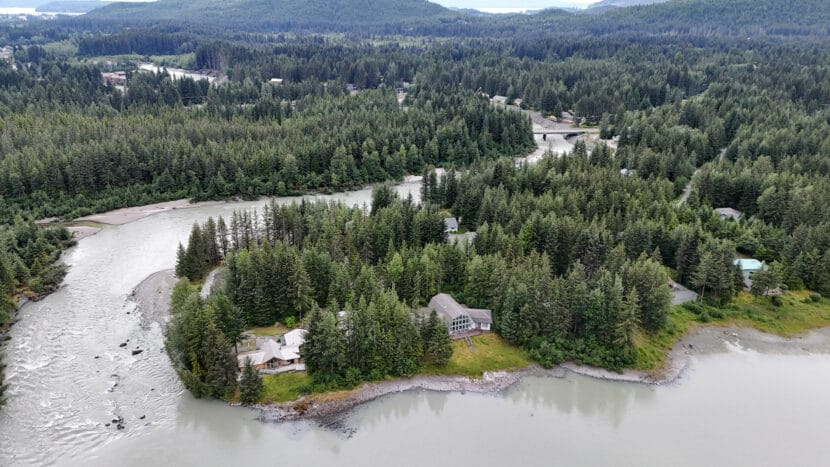
The Mendenhall River surrounds homes on View Drive in the Mendenhall Valley on Tuesday, July 22, 2026. (Photo by Clarise Larson/KTOO)
The City & Borough of Juneau tip-toed toward a federal buyout program for homeowners on View Drive this week, a street that’s been hit the hardest by annual glacial outburst flooding. The city’s asking those residents if they’ll help pay for it.
Eighteen homes line the forested cul-de-sac on View Drive, which extends into the Mendenhall River like a peninsula. They’re located beyond the temporary levee the city built last year, which protected hundreds of homes during the record flood in August.
The buyout program, through the Natural Resources Conservation Service, or NRCS, would cost roughly $25 million if every household participates. The federal government has offered to cover three-quarters of the cost. The local portion could be around $6 million.
City Manager Katie Koester spoke about it at a Juneau Assembly finance committee meeting on Jan. 7.
“The project would be a buyout of up to 18 homes on View Drive, and those homes would need to be demoed and turned into parkland in perpetuity,” she said.
The city sent an informal ballot and letter to View Drive residents on Wednesday, asking if they’d be willing to give up hundreds of thousands of dollars from their home payout to shoulder that local portion. But it’s still unclear how this would work. In exchanges with KTOO, staff from the federal agency and the city explained it differently.
Tracy Robillard, a spokesperson for NRCS Alaska, said in an email that state governments typically sponsor the 25% cost-share — including in New Jersey and Connecticut, and upcoming projects in New Mexico and South Carolina — where state environmental protection agencies have programs to purchase floodplains. In other cases, city governments have paid the local portion, Robillard said.
Brett Nelson, Alaska’s watershed program manager at NRCS, said at the committee meeting there is another option.
“The more likely route would be some sort of third party coming up with the 25% local cost share,” he said.
That third party could be a nonprofit. City staff spoke with the Southeast Alaska Land Trust back in July, but leaders there said they can’t commit millions of dollars in such a short time frame.
NRCS hopes to offer the buyout before the next flood, expected this summer, Nelson said.
The U.S. Army Corps of Engineers is working on an engineered solution that would protect the whole Valley, but it’s still years away. In the meantime, homes on View Drive are expected to flood again and again. Some residents have said that leaving feels like their only option.
“That’s an individual decision for those property owners, whether or not to, you know, take their chances and wait for an enduring solution,” Koester said at the meeting.
If the buyout program moves forward, homes would be appraised at their 2024 value, prior to the flood that year.
The city is asking residents to submit their informal ballots by Feb. 16, and plans to discuss the results at a Juneau Assembly committee meeting on Feb. 23.
Ariel Hasse-Zamudio urges protestors to call their representatives. (Photo by Alix Soliman/KTOO)
More than 200 people gathered in the capital city Thursday to speak out against U.S. Immigration and Customs Enforcement, or ICE, following recent killings of two citizens in Minneapolis.
Juneau resident Denali Marin organized the noon rally outside the courthouse, where protestors brought salt and chanted, “Melt ICE.”
Marin listed some of the people who have lost their lives at the hands of ICE officers, including U.S. citizens Alex Pretti and Renee Good. Dozens of others have died while in custody in recent months.
“I want to be very clear about what we’re asking for today, not vague statements, not calls to lower the temperature and not investigations that lead to nowhere,” she said into a microphone on the plaza steps. “Today, I’m calling on our national leaders to act.”
She and other speakers at the event called for leaders to defund ICE and impeach Homeland Security Secretary Kristi Noem.
On Thursday, seven U.S. Senate Republicans joined Senate Democrats to block a funding bill that would have included $10 billion for ICE. Senators Dan Sullivan and Lisa Murkowski were not among those Republicans; instead they voted in favor of the funding bill. But Murkowski said this week that Noem should resign.
Protestors hold a large banner urging senators to stop funding ICE. (Photo by Alix Soliman/KTOO)
Local advocate Ariel Hasse-Zamudio encouraged attendees to call Alaska’s congressional delegation.
“Dan Sullivan, Lisa Murkowski, Nick Begich, we need to call them and hold them accountable,” she said.
Emma Sulczynski, a student at the University of Alaska Fairbanks, took the microphone to urge people to get involved in other ways.
“There is a nationwide strike — strike on going to school, going to work, and on spending,” she said, referring to the national anti-ICE strike planned for Friday. “You don’t have to do all of these things, but whatever is accessible for you, please stand in solidarity with the brave people in Minneapolis and in the rest of our country who are resisting day and night.”
She also urged people to boycott corporations that support ICE.
Representative Sara Hannan and others sing along to a song written by an organizer. (Photo by Alix Soliman/KTOO)
Juneau’s recycling center is closed again in order to repair damaged critical equipment. And it could be quite a while before the center opens back up again.
New public art is coming to downtown Juneau this spring. Murals will soon adorn the Marine View building parking garage near the cruise ship docks. It’s part of a project years in the making that teaches artists about the legal and creative sides of murals.
The City & Borough of Juneau tip-toed toward a federal buyout program for homeowners on View Drive this week, a street that’s been hit the hardest by annual glacial outburst flooding. And the city’s asking those residents if they’ll help pay for their own buyout.
More than 200 people gathered in the capital city on Thursday to speak out against U.S. Immigration and Customs Enforcement, or ICE, following recent killings of two citizens in Minneapolis.
Maddox Rasmussen paints a mural of an orca at the Juneau Arts and Culture Center on Jan. 25, 2026. (Photo by Jamie Diep/KTOO)
Listen here:
Murals will soon adorn the Marine View building parking garage near Juneau’s cruise ship docks.
It’s part of a project years in the making that teaches local artists about the legal and creative sides of murals.
Maddox Rasmussen washed paintbrushes in between sections of a mural he was working on at the Juneau Arts and Culture Center on a recent Sunday afternoon. The Juneau-Douglas High School: Yadaa.at Kalé junior was painting a realistic orca swimming through the tendrils of an ethereal kelp forest. Rasmussen finished the orca’s fin and moved to a section of its body that’s white.
“I like blending on the palette or on the piece itself,” he said. “So sometimes, if I have leftover blue in a section that I want to be more white, it’ll mess it up.”
Rasmussen is one of 13 artists participating in a workshop to create murals in downtown Juneau. It’s the first time he’s worked on a large project like this. But art is not his only interest: he also swims competitively and works as a lifeguard.
He said it’s been a bit difficult to make time for the project on the weekends while balancing his other interests. He had a swim meet earlier in the day.
“It’s definitely a little hard, because the swim meet lasts all day, so I have to sacrifice the finals to come here,” he said. “But it’s okay.”
Rasmussen’s project is sandwiched between two artists along the wall of the JACC. Every mural has a different style – one artist is experimenting with spray paint and another carved a massive block print. The designs vary from folk art to landscapes and wildlife.
Each mural is 8 feet wide and 4 feet tall. Altogether that’s more than 100 feet-worth of new art for downtown Juneau.
Rio Schmidt fills in a large block print mural with black paint at the Juneau Arts and Culture Center on Jan. 25, 2026. (Photo by Jamie Diep/KTOO)
Dezarae Arrowsun is at the helm of the project, which is a collaboration between her business, the Downtown Business Association, the Juneau Arts and Humanities Council and Princess Cruises.
Arrowsun owns Picture This, a custom frame shop in downtown Juneau with a view of the concrete walls of the Marine View parking garage that will be the future home for the murals. She said the idea came from wanting to beautify space downtown outside of her store, and she turned it into an opportunity to teach local artists more about mural making.
“A lot of the things that are very intimidating to artists is the permit process, the legal side of it, contractual side of it, and then site preparation. What do you have to look for as warning signs, those kind of things,” Arrowsun said. “So that’s how we came about this.”
The artists don’t get paid. Instead, they get education and materials, including large sheets of plywood that are treated to withstand the elements. After a year the murals will come down and the artists can either keep or sell their work.
Arrowsun said she put a lot of thought into making sure the murals will last an entire year in the Southeast Alaska elements. She said she wants it to be art for the community as a whole, not just something for tourists.
“I want us in Juneau to appreciate it all winter long, especially when it’s dark and, you know, we need some brightness and some beauty,” she said.
Arrowsun has a three-year contract with the Marine View owners and plans to run the workshop again next year. She said they plan to take applications this September.
Lillian Egan is another artist in the workshop. They work at the Pottery Jungle as a ceramic studio assistant, and have had their art featured around Juneau in the past. They’re painting a landscape with a little bit of fantasy added to it.
“I was thinking of, you know, what it’d be like to be up at Gold Creek, and kind of being the salmon in the river and coming up,” Egan said. “But also being able to be aware of the city in the backdrop and seeing the channel in the distance and stuff, but kind of seeing it from a perspective of, ‘This is what Juneau is.’”
Lillian Egan sits and paints a mural at the Juneau Arts and Culture Center on Jan. 25, 2026. (Photo by Jamie Diep/KTOO)
They said it’s been fun to do more community art and they feel the city needs more of it.
“It’s been really cool to find out that it is kind of attainable for people, even in Juneau, to do community art and … have it like, actually support you financially,” they said.
In the future, they want to use their newfound skills to create more art in the community.
“How can I apply that into ways that can help our community more? I don’t know. I think about our recycling center right now, and how could I maybe make a mural like this, but with recycled materials in the future, would be pretty cool,” Egan said.
The murals are going to be installed in late April, with a celebration taking place May 1.
A road sign marks the road towards the Lower Kuskokwim School District offices and the Bethel High School. October 9, 2023. (Claire Stremple/Alaska Beacon)
While Alaska school districts are seeing improvements in kindergarten to third grade students’ reading proficiency, which officials credit to the Alaska Reads Act, some districts are struggling to access state managed funds for a federal grant program aimed at supporting literacy programs, teacher development, and student learning.
Lawmakers with the House Education Committee heard from two district superintendents about the successes and challenges of the Comprehensive Literacy State Development grant program — which in 2024 awarded $50 million to Alaska schools over five years.
In 2025, roughly half of Alaska’s districts, or 27 school districts, qualified for these grant funds administered through the Alaska Department of Education and Early Development, according to the department.
The program is aimed at advancing literacy for children from birth through 12th grade students, including pre-literacy skills, reading and writing. The program focuses on districts with disadvantaged children, including those living in poverty, English language learners and students with disabilities.
While all Alaska districts are required by state law to implement the Alaska Read’s Act, the policy did not come with additional state funding, said Rep. Rebecca Himschoot, I-Sitka, co-chair of the education committee, in an interview on Monday. She said some districts are struggling to fund the kindergarten through third grade reading initiatives. “I would like to see us supporting schools so that everybody gets the support they need to implement the law the way it was written,” she said.
The program isn’t new, but it has more money and it’s funding more districts now. In 2019, nearly one third of Alaska districts were awarded $25 million over five years, according to DEED.
“The literacy grant is a really powerful tool that is going to help the districts that it’s in, a lot,” Himschoot said. “I’ve heard a lot of gratitude from superintendents about having this opportunity for those who have it, but we did hear about some bumps in the rollout of it.”
District officials’ testimony prompted Himschoot to send a list of questions to DEED about how the grant is managed.
Michael Robbins, superintendent of the Bristol Bay Borough School District, which serves approximately 135 students, said the grant has been crucial for implementing the Alaska Reads Act, particularly supporting teachers’ training professional development, which helps retention. “The grant supports training, coaching and leadership development grounded in research-based instruction, including the science of reading,” he said.
“It creates consistency across classrooms in schools, helps prevent problems before they grow, and ensure that limited resources are utilized where that matters most,” Robbins said.
But Robbins said in implementing the grant, districts need more “clear, timely and reasonable guidance around allowable use of grant funds” from DEED.
He said the district would like to use the money for professional services vendors to provide training to teachers, and funding to attend conferences. “The approval process has been particularly cumbersome as some districts have had to resubmit their application multiple times, which takes valuable time from our grant leaders and administrators, as well as delaying the implementation of important activities,” he said.
Officials with DEED did not attend the legislative hearing, but department spokesperson Bryan Zadalis said by email on Monday that the department recognizes the importance of clear guidance, which is communicated through multiple channels including webinars and office hours. “DEED also aligns state-level guidance with federal updates as they are released to ensure accuracy and compliance, which can at times require sequencing information rather than issuing it prematurely,” he said.
In addition, Robbins, who formerly served as the superintendent of the Ketchikan Gateway Borough School District, said that that district did not qualify for grant funding. “The need was there, but the resources are not,” he said. “We need to find ways for all districts and all students to have access to the same level of support and opportunity.”
Robyn Taylor is superintendent of the Petersburg School District which serves approximately 420 students, and was awarded $350,000 per year through the grant program. She testified to lawmakers and echoed the need for equity in supporting reading programs across Alaska’s school districts. She said Petersburg still continues to have challenges with implementing the Alaska Reads Act, which she called “a real tension.”
“In Petersburg alone, between FY 25 and FY 26 we eliminated one of our three elementary reading interventionist positions, positions that were directly supporting Reads Act implementation and student outcomes,” she said. She said the district was told that CLSD funds were for supplementing programs not replacing funding.
“(The) restriction makes it difficult to use this grant to maintain positions or systems that are already working but are no longer financially sustainable under current funding structures,” she said.
Taylor and Himschoot both emphasized that districts who did not qualify for funding need support with the administrative work to apply. They said some schools should have easily qualified for the funding, but didn’t in part because they lack proper documentation of their students’ need for free or reduced school meals, which is one of the federal poverty guidelines. “It’s not that they don’t have kids in need,” Himschoot said. “It’s that they haven’t been identified through the paperwork, because they don’t have the capacity in their district to go chase that down.”
Zadalis said the grant process is a competitive one. He said the primary source of education funding is through the state’s funding formula, but districts may also access state or federal funding through other grants focused on literacy efforts.
Taylor said Petersburg students are making gains in reading proficiency, and the district is committed to continuing improvements beyond the grant cycle. “What we are asking for is greater flexibility, clearer and earlier guidance,” she said. “And increased trust in districts to make decisions that reflect local context and student needs.”
School districts awarded CLSD grants in 2025
Alaska Gateway School District
Aleutians East Borough School District
Anchorage School District
Bering Strait School District
Bristol Bay Borough School District / Chugach School District
Copper River School District
Cordova City School District
Dillingham City School District
Galena City School District
Iditarod Area School District
Kake City School District
Kashunamiut School District
Kenai Peninsula Borough School District
Kodiak Island Borough School District
Kuspuk School District
Lake and Peninsula Borough School District
Lower Yukon School District
Mount Edgecumbe High School
North Slope Borough School District
Northwest Arctic Borough School District
Petersburg Borough School District
Pribilof School District
Southeast Island School District
Yakutat School District
Yukon Flats School District
Yukon–Koyukuk School District
Close
Update notification options
Subscribe to notifications
Subscribe
Get notifications about news related to the topics you care about. You can unsubscribe anytime.