1 Sections

Republican Sens. Murkowski and Tillis call for Noem to resign

woman surrounded by people extending their iphones to her, aimed at her face
Sen. Lisa Murkowski was surrounded by reporters outside the U.S. Senate chamber last year. (Liz Ruskin/Alaska Public Media)

WASHINGTON — Sen. Lisa Murkowski said Secretary of Homeland Security Kristi Noem should be held accountable over a fierce immigration crackdown that has killed two citizens in Minneapolis and that she should resign.

“She has — through her words, and I think in her actions — she’s taken a direction that has not been helpful to the situation, and I don’t think that it helps the country,” Murkowski told reporters.

She said Noem has an obligation to maintain control of what the agencies in her jurisdiction are doing. Instead, Murkowski said, Noem has inflamed tensions. She noted that almost immediately after Border Patrol agents shot and killed nurse Alex Pretti, Noem claimed, without evidence, that Pretti was a “domestic terrorist.”

Murkowski spoke to reporters on her way to a Senate vote as lawmakers returned to the Capitol from a week away. She called it a good sign that the administration has removed top Border Patrol official Gregory Bovino from Minneapolis. But, she said, accountability rests with Noem.

Reporters pressed her on whether Noem should resign.

“I voted for her,” Murkowski said, referring to Noem’s Senate confirmation. “I think the President needs to look at who he has in place as a secretary of Homeland Security. I would not support her again, and I think it probably is time for her to step down.”

Murkowski was among the first Republicans in Congress to openly criticize the tactics of the immigration enforcement operation after agents killed Pretti. The group of GOP critics remains small.

But minutes before Murkowski spoke, Sen. Thom Tillis, R-N.C., also castigated Noem. He said the enforcement operations need to focus on the serious criminals President Trump promised to target and not pursue nonviolent people.

“I think that what she’s done in Minnesota should be disqualifying. She should be out of a job,” Tillis said of Noem. “And I mean, really, it’s just amateurish. It’s terrible. It’s making the president look bad on policies that he won on.”

Tillis is retiring from the Senate after his term ends in a year. He’s become one of the more outspoken Republicans in Congress when it comes to criticizing and voting against the Trump administration.

Unlike Murkowski and Tillis, Sen. Dan Sullivan, R-Alaska, didn’t issue a social statement or a press release this weekend to condemn Pretti’s death or call for reform.

His office provided a statement to reporters on request. Sen. Sullivan “strongly supports our law enforcement and their ability to do their jobs,” it says, while calling any loss of life tragic. It also says he hopes that “the temperature in Minnesota on both sides can be lowered.”

On his way to the Senate chamber to vote Tuesday, Sullivan held his phone to his ear as he walked through a crowd of reporters, fending off approaches.

Union contract negotiations spark student outrage in support of Juneau teachers

Zoe Lessard, dressed in a yellow t-shirt, sits at a wooden table in front of teachers crying during a school board meeting.
Zoe Lessard testifies in support of teachers during a Juneau School District Board of Education meeting on Oct. 28, 2025. (Photo by Jamie Diep/KTOO)

Listen here:

Juneau high school students are speaking out about how unresolved contract negotiations are affecting them in the classroom. 

It’s been nearly a year since contract negotiations officially began between the Juneau School District and its teachers’ union. During negotiations, they reached an impasse and the district declared it would enter arbitration with Juneau Education Association. But they haven’t yet reached a new agreement. The district also hasn’t reached an agreement with its support staff union.

Seventeen-year-old Zoe Lessard is a senior at Juneau-Douglas High School: Yadaa.at Kalé. She sits on the Juneau School District Board of Education as a student representative. At meetings, she typically gives updates on school dances and sports.

But during a meeting in October, she got up from where she normally sits for board meetings and sat at the testifier seat to speak as a student and not a representative.

“These people were and are my advocates, my friends, my support, and some of them, my family,” she said. “My teachers have pushed me to be better and go into my future with confidence. Please allow them to continue to do this.”

Lessard spoke after more than an hour of comments from teachers and community members sharing their experience about working without a new contract. Some spoke about taking multiple jobs to make ends meet. Others said they were overwhelmed with the workload. 

Outside of the board setting, Lessard is continuing to speak out. She wants to send an even stronger message. So she turned to the high school’s student government last week with a drafted message.

“I cannot say what I really want to say at school board meetings, and I thought it would be a powerful statement if it was approved by the whole student council,” she said.

The high school’s governing body of 42 students unanimously approved the statement. Lessard is part of the student government because of her school board role. 

The written statement speaks to the need to have contracts that adequately pay teachers. 

“We, as the Juneau-Douglas High School: Yadaa.at Kalé Student Government, are completely appalled at the Superintendent and School Boards (sic) lack of action about this matter,” part of the statement reads. “We do not support your decision to leave teachers and support staff with insufficient contracts.”

Lessard has some personal insight into teachers’ lives; her dad is a teacher. But, she said, students in general notice and see the impact not having a new contract has on teachers.

“If they are stressed, if their needs aren’t getting met, if they need to work one or two other jobs, we notice, and we notice because they aren’t able to focus on teaching as much as they would like to, which is by no means their fault,“ she said.

The statement also brings up teacher vacancies. Based on reports from early January, the Juneau School District has more than 40 open teaching and staff positions. Vacancies and employees not opting into the district’s health insurance plan amounts to $8.5 million dollars in unused funding, according to board documents.

Bella Reyes-Boyer is the student body president at the high school. Her mom is a veteran teacher and now the school’s librarian. Last year, Reyes-Boyer volunteered at an elementary school and said she saw the effect teacher vacancies have on students.

“I really got to see firsthand how important having those paraeducators and, like, teachers who are actually able to accommodate each student individually, and how important that really is.” She said. “It was really apparent that there is a lack of, like, specialized teachers for certain students.”

Two students smiled while sitting next to each other. One wears a blue and gray sweatshirt while the other is in a green winter jacket.
Juneau-Douglas High School: Yakaa.at Kalé seniors Bella Reyes-Boyer and Zoe Lessard pose for a portrait at the high school library on Jan. 24, 2026. (Photo by Jamie Diep/KTOO)

Lessard said many students don’t know much about the contract negotiations, so she’s trying to educate her peers. She wants them to speak to the board in support of teachers.

“I would hope people come and testify for their teachers and support staff at the next school board meeting, that they tell the school board how much the teachers and the staff in the schools matter to them and how that’s what they need to be investing in for everybody’s future,” she said.

Juneau Education Support Staff, the union representing employees like paraeducators and custodians, had its latest negotiation meeting on Jan. 26. JEA met with the district last month, according to JEA negotiation support team co-chair Kelley Harvey. JEA and the district have an arbitration hearing scheduled April 27 and 28. As of Tuesday, JESS does not have any additional meetings scheduled with the district.

The school board is holding several budget-specific meetings in the coming weeks, including a budget work session on Tuesday evening and a budget public forum on Feb. 5.

Clarification: This story has been updated to reflect new information from the district. 

Newscast – Tuesday, Jan. 27, 2026

In this newscast:

  • The Juneau Assembly has stalled on deciding whether to disempower the Eaglecrest Ski Area’s board of directors until March.
  • Students are speaking out about how unresolved union negotiations are affecting them in the classroom.
  • Students in Skagway are calling on their school district to adopt a policy that would let them take part in subsistence activities without it potentially counting against them.
  • With almost 700 participants, Juneau’s annual board game convention sold out for a second year.

Skagway students are asking for time off school to participate in subsistence activities

A subsistence fisherman checking his net in the Chilkat River.
A subsistence fisherman checking his net in the Chilkat River. (Alaska Department of Fish and Game)

The federal government says 98% of rural Alaskans catch, hunt or gather at least some of their food. And much of that happens during the school year.

Now, students in Skagway are calling on their school district to adopt a policy that would let them take part in those activities — without it potentially counting against them.

The push originated with Ryder Calver, who is the treasurer of the Skagway student council. Calver said he’s gone moose hunting almost every year since he was six years old. But in his experience, taking part in an annual moose hunt eats up most of his allotted absences in one go – leaving little room for other absences later on.

“I’m gone for around 10 days each time, and the school only allows you to miss 15 days total per semester, whether that is a trip, you’re sick, excused or unexcused,” Calver said. “I got the idea to add a buffer.”

So this fall, Calver teamed up with Student Council Senior Parliamentarian Sam Munson to write a resolution they hope will push the school board in that direction.

Right now, students can be penalized after their fifteenth excused absence – unless they get a waiver from the superintendent or school board. The resolution makes a case for allowing students to take up to 7 “subsistence days” per semester, which wouldn’t count toward the 15 day limit.

The board’s policy committee took up the issue during a recent meeting. Munson, Calver and Student Council President Lina Hischer spoke, saying the policy should specifically provide flexibility around subsistence activities.

The fact that the current policy doesn’t do that “negatively affects kids who do subsistence hunt or gather,” Hischer said. “We want to make it more even, or equal.”

During the meeting, Skagway School District Superintendent Josh Coughran said the policy could be updated to mention subsistence activities – and to allow students to proactively request days off for a moose hunt or other trip that wouldn’t count against their attendance record.

In that case, he said subsistence days could be treated like travel days for sports or debates – which don’t count as absences.

“We know they’re not in school, but it’s on a school-sanctioned event. And so this would be the school sanctioning subsistence activities and not counting it against families,” Coughran said.

The board is set to discuss the issue at a meeting this week.

Coughran said in an email on Monday afternoon that it’s still “early days” for the idea. If the board decides to move forward with the proposal, it would go back to the policy subcommittee and then return to the full board for consideration.

Disclosure: Sam Munson, the student council parliamentarian, is the son of KHNS News Director Melinda Munson.

Juneau Assembly stalls on whether to disempower Eaglecrest Ski Area’s board

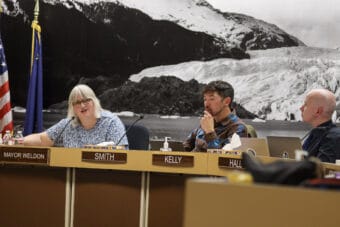
Juneau Assembly member and Eaglecrest Ski Area board liaison Neil Steininger speaks during a meeting at City Hall on Monday, Jan. 26, 2025. (Photo by Clarise Larson/KTOO)

The Juneau Assembly has stalled on deciding whether to disempower the Eaglecrest Ski Area’s board of directors until a joint meeting in March. 

Earlier this month, Mayor Beth Weldon proposed an ordinance to reduce the status of the city-owned ski area’s board from an empowered board to an advisory board. She cited the recent leadership turnover at the mountain and ongoing financial challenges.

At a committee of the whole meeting Monday night, Weldon further explained her reasoning for the proposed ordinance to the Juneau Assembly and the roughly 20 members of the public in the audience. 

“I’m literally trying to save Eaglecrest, and I think with the empowered board making the decisions, I don’t see the status quo changing,” she said.

Right now, as an empowered board, Eaglecrest has its own set of laws, rules and responsibilities. But, if it became an advisory board, members could only make recommendations to the Assembly. It would lose the authority to establish policies or make decisions without Assembly approval. 

At the meeting, Weldon argued the ski area needs more oversight, given the high amount of funding the city has funneled toward it in recent years, specifically on a new gondola project.

“If we are investing large amounts of money on things such as the chair lifts or maybe even the gondola, we want to have more of a say in how that money is spent, and currently, we don’t,” she said. 

In the coming years, the ski area is slated to run into a multimillion-dollar deficit. The deficit is a part of a plan to repair some broken and aging infrastructure while boosting pay to employees and preparing to operate year-round. 

Its expansion into summer operations relies heavily on the success of the gondola, which the ski area hopes to get up and running by the summer of 2028. However, many city leaders are worried the timeline — and cost — of the project will run far over what the board projected. 

The Assembly agreed to hold off on any decision-making until it holds a joint meeting with the Eaglecrest board on March 4. Assembly member and Eaglecrest Ski Area board liaison Neil Steininger said he thinks that’s the best option. 

“I think we owe it to everybody in the community to have a joint meeting with the Eaglecrest board to actually hash this out,” he said. 

The Assembly will then vote on whether to move the ordinance forward during a committee meeting on March 16.

A University of Alaska Fairbanks student is out on bail after tearing up and eating another student’s AI-generated art

Some pictures remained on the wall after Granger ate around 57 of the 160 images on display on Jan. 13.
Some pictures remained on the wall after Granger ate around 57 of the 160 images on display on Jan. 13. (Lizzy Hahn)

A University of Alaska Fairbanks student is out on bail after ripping almost 60 images off the walls of a university art gallery and eating some of them earlier this month.

The incident has since gone viral — prompting countless social media posts and even reaching national outlets. Lizzy Hahn, an undergraduate journalism student at UAF, broke the story in The Sun Star, the school’s student-run newspaper.

She said the incident is shaping culture and policy around AI on campus.

This interview has been lightly edited for length and clarity.

Lizzy Hahn: A student was tearing Polaroids off of an exhibit in the UAF Art Gallery and putting them in his mouth, chewing them, swallowing some bits, but spitting some bits out. This was a protest against the use of AI art, since this exhibit was made in collaboration between the artist, Nick Dwyer, and AI — like, he used ChatGPT to help him make it.

Shelby Herbert: Whoa. Tell me what happened to the protester.

LH: His name is Graham Granger. He was arrested by the UAF police and charged with criminal mischief in the fifth degree, and he was taken to the Fairbanks Correctional Center, where he was for about six or seven hours, I believe. So, he’s out on bail.

SH: That was quite a splashy headline, and that story has really sprouted wings. I’ve had folks texting me from the East Coast about it. How does it feel to see your work get so much exposure?

LH: It’s really insane to me. I am a young journalist here at UAF. I’m a senior graduating soon, so like this is my first story to go — some people have said that it’s going viral. It has definitely been picked up by multiple, multiple, multiple news sources. Art News for one, Brut America for another.

SH: I think I just saw it in the New York Post?

LH: Yeah. Just so many media sources that have taken the information and my images and spread them to their corners of the world.

SH: Tell me about where you were when you found out this was going down.

LH: That’s actually kind of a funny story. I’m in a pottery class, and it’s in the fine arts building. And as I was walking in, I noticed that there was a police car outside of the building. So, I walk into class, and then my editor, Colin, starts texting our whole staff’s Slack. And he’s like, “Hey, is anyone in the arts building? There’s a student protesting in the gallery.”

So I asked my pottery teacher, like, “Hey, do you know anything about this?” And she’s like, “Yeah, I do.” So we walk into the gallery together, and all we see is just these torn up, chewed up bits of Polaroids. The artist was there, Nick Dwyer, and he was like, “Yeah, someone came and he started chewing up my work.”

SH: And how does the artist feel about all of this?

LH: He was upset, and rightfully so. This was his MFA exhibit. It’s hard to see your art destroyed like this. He had put a lot of time and effort into this. He wanted to press charges, and he had begun to press charges. But then the next day, things had kind of cooled down, he had talked to some of the art professors, and had realized that pressing charges maybe wouldn’t be the best idea.

Pieces of chewed up artwork lie on the floor in the University of Alaska Fairbanks art exhibit on Jan. 13. (Lizzy Hahn)

SH: Lizzy, you’re a journalism student and a student-reporter, but you also have a foot in the art world — you’re an art minor. Can you tell me about how AI content and tools are being received on campus, especially in the humanities?

LH: Yeah, so every teacher has an AI policy. This has been a fairly new development to the syllabi that we are getting. It’s gone from teachers saying, “You’re not allowed to use AI, don’t use AI.” But in the past year, there’s been kind of a shift towards like, yes, you can use AI, but cite it.

Then also, in the art community, we’re starting to see a little more use of AI, and that has really been because of Nick. Like, Nick is really spearheading the use of AI. Art and AI is kind of an interesting mashup because you don’t really think of them going together, but Nick has really used AI in his pottery and now in this AI art exhibit.

I don’t know that many students personally, besides Nick, who are using AI art, but I think that in the future, it totally could change and the use of AI could become more common.

SH: You’re working on part two of the story. Can you give us a little tease about what comes next?

LH: Yeah, I’m kind of looking into what is happening here at UAF, because since this protest has occurred, there has been a lot of uprise. Our student government here on campus has actually proposed a resolution to ban AI art in the department. But at the same time, the art department is creating a statement about their AI policies. So, unsure where that will go, but bright futures ahead!

Site notifications
Update notification options
Subscribe to notifications