The Harborview Elementary School playground on July 9, 2025. (Photo by Jamie Diep/KTOO)
The Juneau School Board held off on returning $1.05 million in funding earmarked for child care to the City and Borough of Juneau this week amid questions about the current privately-run program and the possibility of an additional operator in the future.
Board Vice President Elizabeth Siddon said at a meeting Tuesday she still has questions around how things are going with Auke Lake Preschool, like the status of its state licensing. Auke Lake Preschool started running an after-school program at the beginning of this school year after the district stopped operating its own.
“I just think we’re not ready, especially in a final reading, to make this decision,” Siddon said. “We don’t have all the information about the programs and what options we have for kids at all of our sites.”
Siddon said there is also a possibility for YMCA Alaska to expand its child care program to Juneau, and that the city funding might be able to be used for that.
Nate Root is the CEO of YMCA Alaska. The organization currently runs after-school child care in Anchorage, the Mat-Su Borough and Kodiak.
In an interview with KTOO, Root said YMCA is looking into how feasible it would be to expand its after-school program to Juneau. He toured three schools last year and said the organization is working on surveys to see how many families are interested in the program.
He said running a program depends on how financially sustainable it will be. And it will still take a while to get licensed by the state if they move forward with starting a program in Juneau.
“To be completely transparent, it would look like the soonest we would open a program would be the beginning of the 26-27 school year,” he said.
Derik Swanson is the co-owner of Auke Lake Preschool, which runs the current after-school child care program out of Harborview Elementary, Auke Bay Elementary and Sít’ Eetí Shaanáx̱ – Glacier Valley Elementary.
He said in an interview Friday that the program is still currently unlicensed. Swanson said staffing issues have delayed the process, but with those now resolved, he plans to keep working on getting licensed.
“It’s been pretty successful overall,” Swanson said. “It was kind of a rush to get the program started and up and running, but now it seems to be running fairly smoothly.”
Swanson was unaware of the potential for YMCA to expand to Juneau, but said child care providers in the city generally work together to meet the high demand.
The school board unanimously agreed to discuss the state of the after-school child care program and the remaining city funding at its facilities committee meeting on Feb. 3.
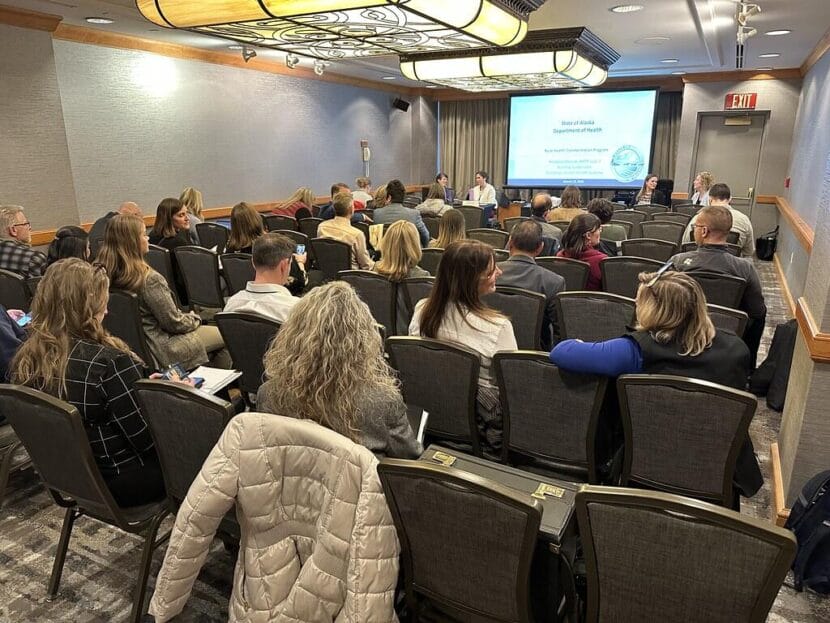
Attendees watch during a breakout session at the kickoff of Alaska’s Rural Health Transformation Program in Anchorage on Jan. 15, 2025. (Alaska Department of Health)
Hundreds of health care workers and government officials descended on Anchorage this week for the kickoff of a five-year, $1.3 billion program aimed at reimagining medical care across Alaska.
The problem the funding seeks to solve is no secret, the state’s former chief medical officer, Dr. Anne Zink, said on a call with reporters and state officials. Zink is working with the state Department of Health on the program, she said.
“We consistently see that people who live in rural areas — Alaska and beyond — have worse health outcomes with increased cost,” she said. “This is an opportunity to rethink the way that care is delivered to make sure, no matter where you live, you have access to quality, timely, effective care.”
States across the country are racing to develop plans to spend the influx of cash. They have until October to obligate the first tranche of cash and another year to spend it.
Alaska is building its version of the program around six goals, from improving maternal health, preventive care and access to healthcare to strengthening the workforce and rethinking how doctors and hospitals charge for care.
That last point — what the state is calling “pay for value” — is a big one. Most medical care is what’s known as “fee for service,” for example, when a patient goes to a doctor and pays the doctor for their time, whether they get healthy or not.
But given the fragmented nature of health care in Alaska, where many patients have to travel hundreds of miles from home for care, “the realities of making that transition take time,” said Deputy Health Commissioner Emily Ricci.
“It’s very challenging, and it will look different for every community and every provider and the provider types,” Ricci said.
Another example: Say you have a rash. You go to the doctor. The doctor sends you to the dermatologist, who sends you to the pharmacy for a medicated lotion.
Does your primary care provider know what your dermatologist prescribed? Does your dermatologist know your regular doctor tried that same medication with the hard-to-pronounce name six months ago?
And does anyone know if you eventually get better?
Maybe not. And that’s an issue standing in the way of a transition to value-based care that the state would like to address, Ricci said.
“How can we use this funding to begin now, over the next five years, building out the infrastructure, the concepts, the protocols, the data that providers need in order to kind of make that transition?” Ricci said.
So technology is one focus for the first of what the Department of Health said will be a series of workshops in Anchorage.
The meetings — known as “convenings” — are an effort to get as many stakeholders involved as possible, from cities and tribes to hospitals, medical providers and vendors, Health Commissioner Heidi Hedberg said.
“This funding is really to support what the community and region need,” Hedberg said. “Every community, and every region, needs something different.”
Alaska will receive roughly $273 million per year for five years as part of the $50 billion nationwide program. Hedberg calls it “generational.”
But the elephant in the room, of course, is that the same tax cut legislation that created the program could also push many Alaskans away from the health care system, said Alaska Hospital and Healthcare Association head Jared Kosin.
“I see the bright side and the good things looking ahead,” Kosin said. “I talk about coverage disruptions with these enhanced premium tax credits expiring. We talk about coverage disruptions with the tightening of Medicaid eligibility right around the corner.”
State officials have downplayed the spending law’s impact on Alaskans on Medicaid. But Kosin is worried the changes will push health care costs up, he said, because when people can’t pay, hospitals have no choice but to shift those costs onto those who can.
Kosin said he’s also concerned that the transition to a new administration after Gov. Mike Dunleavy’s term ends in December could throw a wrench in the state’s plans.
State officials, though, say they’re building sustainability into their plans. Ricci, the deputy health commissioner, said that the state Health Department was “acutely aware” of the challenges involved in standing up a program that will span at least two governors’ administrations over half a decade.
“The key to that, I think, is bringing in the communities and the partners and the healthcare entities into the discussion from the beginning and into that structure,” Ricci said.
Put more simply, “this is a project for Alaskans by Alaskans,” said Zink, the state’s former chief medical officer.
“The sustainability will be dependent on Alaskans,” she said.
Alaska Public Media’s Rachel Cassandra contributed reporting.
Dr. Martin Luther King Jr. on the steps of the Lincoln Memorial on the day he delivered his famous “I Have a Dream” speech during the Aug. 28, 1963, March on Washington. (Photo Courtesy of National Park Service, CC BY 2.0 https://creativecommons.org/licenses/by/2.0, via Wikimedia Commons)
Martin Luther King Jr. Day is coming up on Monday.
It’s a day to remember the legacy of the famous civil rights leader and a national day of service, and local organizations and volunteers will host events to mark the occasion.
The Black Awareness Association of Juneau will also host a virtual MLK Day event on Monday from 1 to 2 p.m. It’s advertised as a family-friendly service featuring soulful music and accounts from people whose lives were impacted by Dr. King.
More information is available at baajuneau.org, where participants can also register for the event.
The Alaska Bar Association, in partnership with the Alaska Court System, Alaska Legal Services Corporation, ACLU of Alaska, will host a free legal clinic at Ḵunéix̱ Hídi Northern Light United Church in the Flats neighborhood from 10 a.m. to 1 p.m. and at St. Paul’s Catholic Church in the Mendenhall Valley from 9 a.m. to 2 p.m.
Local lawyers, judges and legal professionals volunteer their time to help advise people on legal matters. Kevin Higgins from the Alaska Bar Association shared information about the clinic on Juneau Afternoon Wednesday.
“Really anything can bring you in the door,” he said. “And a lot of times what we’re able to do at the clinic, you know, it’s a very limited representation. I’s not like we’re going to be coming into court with you over the life of a potential case, but we can really kind of help you figure out how to orient yourself with the court system and what steps you can take next.”
Higgins said they can help with any stage of a legal situation, including how to potentially avoid one. No appointments are required. You can find more information at alaskabar.org/MLK. Similar clinics are also happening Monday in Anchorage, Bethel and Fairbanks.
Musicians perform Sunday, Feb. 18, 2024, at Devil’s Club Brewing in Juneau. The event was among the first three allowed under a newly amended state law. (James Brooks/Alaska Beacon)
An Alaska Superior Court judge has ruled that a state law limiting live shows at breweries, distilleries and wineries in Alaska is an unconstitutional violation of the First Amendment and the Alaska Constitution’s protections for free speech.
“The speech restrictions fail the tests of strict and intermediate scrutiny, and such suppression of speech by the state cannot stand,” Zeman wrote at the conclusion of his 25-page order.
Until 2022, alcohol manufacturers were prohibited from having entertainment — including TVs, dancing, games and live music — on site. That year, as part of a sweeping modernization of the state’s alcohol laws, breweries, distilleries and wineries were allowed up to four live events per year if approved by the Alaska Alcohol and Marijuana Control Office, the state regulator.
Bars continued to be allowed an unlimited number of live events without permit; the difference in limits was billed as a political compromise necessary for the reform to pass the Legislature and become law.
Three companies — Zip Kombucha, Sweetgale Meadworks and Cider House, and Grace Ridge Brewing Company — filed suit to overturn the four-event limit, raising free-speech and equal-protection claims.
They were represented in court by a national group, the Pacific Legal Foundation. While the plaintiffs eventually dropped the equal-protection argument, the free-speech debate continued through written arguments.
Zeman ultimately concluded that the state failed to show how restricting live entertainment at breweries and distilleries, but not bars, would protect public health or safety.
“This court recognized that the challenged speech restrictions were once a critical piece of a grand compromise … however, political compromise is not recognized as a substantial government interest for the purposes of restricting speech under the First Amendment. Neither is the codification of preference for one industry actor over another,” he wrote.
While Zeman overturned a law limiting live entertainment, he upheld a law forbidding breweries, distilleries and wineries from having pool tables, dartboards and similar games, “because they are not speech.”
He also gave nodding approval to a law that restricts brewery, distillery and winery operating hours and serving sizes to less than what’s allowed for bars.
“The Legislature has, and can further address public health and safety risks associated with alcohol consumption in breweries and wineries by limiting the amount of product that can be served, the hours during which they can operate, or by reducing the cap for the number of brewery or winery licenses allowed in a given community,” he wrote.
Alaska Cabaret, Hotel, Restaurant & Retailers Association, or CHARR, a trade group representing all kinds of alcohol retailers — including bars and package stores — did not return a request for comment before the reporting deadline for this article.
An appeal to the Alaska Supreme Court is possible by either side. Representatives of the Alaska Alcohol and Marijuana Control Office and the Alaska Department of Law said those agencies were still analyzing the decision.
“AMCO does not have an opinion on the ruling and is discussing the matter with agency legal counsel,” said Jenae Erickson, acting public information officer for the Alaska Department of Commerce, Community and Economic Development, the parent agency of AMCO. “At this time, we can’t definitively state how the order will be implemented, or what Alaskans can expect. When AMCO has appropriate guidance, an advisory notice will be released.”
Donna Matias, an attorney with Pacific Legal Foundation who represented the plaintiffs, said she is “really pleased” with the decision and said Alaska limits on live events are “actually very unusual” on a national level.
“It was a political compromise, but the legislature really never had the breweries’ First Amendment rights to use as political bargaining chips,” she said, “and I think the court in this opinion recognizes that very explicitly.”
Lee Ellis, head of the government affairs committee for the Brewers Guild of Alaska, said by phone that the guild had been pushing for a legislative solution to the issue, “but we’re happy to see those entertainment live-music restrictions are finally lifted. I think it’s a win regardless, and we look forward to offering a lot of opportunities for small-time musicians to further present their craft.”
One of those musicians is Juneau singer-songwriter Marian Call, who also works as executive director of MusicAlaska, a group devoted to boosting Alaskan musicians.
Call hosted a Christmas concert in a Juneau distillery before the end of the year, one of four events allowed at that space last year.
She said her group applauds Zeman’s ruling.
“Musicians have a superpower — we can enter an empty room and fill it with people. We create economic activity out of nothing but sound waves. Many businesses benefit from our labor, but none more than restaurants, bars, and the alcohol industry at large,” she said. “Limiting music professionals’ opportunities to work as a part of the SB9 compromise was inappropriate and, as the Superior Court has now ruled, unconstitutional, since musical performance is a form of speech.”
Call said MusicAlaska would love to see Thursday’s ruling bring more music to all kinds of venues — bars, breweries and those that don’t serve alcohol at all.
“Alaskan musicians’ desire and ability to host music events is not a limited resource,” she said, “and the more we get to work, the more Alaskans get to play.”
The seal of the state of Alaska hangs behind the dais at the Boney Courthouse, where a three-judge panel of the Alaska Court of Appeals heard oral arguments Thursday, Jan. 15 in the voter misconduct case of Tupe Smith. (file photo/Alaska Public Media)
The Alaska Court of Appeals took up the case of a Whittier woman Thursday who was indicted in 2023 on felony charges of voter misconduct.
Like others born in American Samoa, Tupe Smith is a U.S. national but not a U.S. citizen. Smith says she thought that meant she could vote in local elections but not presidential elections.
When filling out voter registration forms in the past, Smith and her lawyers say a Whittier city official told her to check a box that said she was a U.S. citizen, even though Smith knew she wasn’t, because the forms did not have a box for U.S. national.
That led to an investigation by Alaska State Troopers, who arrested Smith in late November 2023.
Voting rights advocates have linked Smith’s case – and a similar, separate case that includes some of her family members in Whittier – to national efforts by conservatives to end birthright citizenship in the United States. The advocates say the plight of people born in American Samoa highlights a group that is already being denied the right to vote.
After a grand jury indicted Smith in early 2024, her lawyers asked a Superior Court judge to toss the indictment, saying a trooper who testified to the grand jury had misled them on the issue of whether Smith intentionally checked the box saying she was a U.S. citizen.
The judge denied the request. But in a rare move, the Alaska Court of Appeals accepted Smith’s appeal before the Superior Court judge’s final decision and on Thursday heard oral arguments from one of her lawyers, as well as an attorney for the state.
Now, one of the main sticking points is whether the words “knowingly” and “intentionally” mean the same thing in regards to a person making a false statement on a voter registration form.
While some people might use the terms interchangeably, doing something “intentionally” requires a higher mental state – in legal terms, mens rea, or “guilty mind” in Latin – than doing something “knowingly.”
Smith’s attorney, Whitney Brown, told the three-judge Appeals Court panel Thursday that the words do not mean the same thing. In writing the law on voter misconduct, Brown said, the Legislature used both terms differently and therefore they should be understood differently.
“The record also reflects that if she had known she was not supposed to vote, she would not have done so,” Brown said. “So the state has just shown no evidence of an intent to mislead or deceive. So we believe that the court, in this instance, can take the extra step of just dismissing the indictment.”
The state wants the Appeals Court to send the case back to the Superior Court for a final decision. The state’s attorneys argue that the words “intentionally” and “knowingly” can mean the same thing.
“It’s not that she didn’t know what she was writing was false. It’s that she thought she was supposed to write something that she knew was false for these specific purposes, and that’s a little bit different,” Assistant Attorney General Kayla Doyle told the Appeals Court judges.
Doyle agreed with Brown that it was a difficult, but important, case. And there were multiple puns made in Thursday’s oral arguments – intended or not – about how intentional the Legislature had been in including the word “intentional” in the law on voter misconduct.
The Appeals Court will make a decision in the case at a later date, though it’s unclear when that will be.
The Juneau School District Board of Education agreed to approve the $180,000 in funding to help pay for a new playground at the Dzantik’i Heeni campus in Lemon Creek,
Southeast Alaska’s largest tribe has earned nearly $40 million from U.S. Navy contracts in Guantanamo Bay,
KTOO is checking in with members of Juneau’s legislative delegation to talk priorities, predictions, and plans for the session. Up first, Sen. Jesse Kiehl
Close
Update notification options
Subscribe to notifications
Subscribe
Get notifications about news related to the topics you care about. You can unsubscribe anytime.